
 Dustin Ogle
A specialty practice can rank well for symptom questions and still fail the reader at the exact moment that matters: when they need to understand whether a specialist evaluation is relevant and what to do next. The problem is rarely a lack of content or a weak call to action. It is a missing handoff. The symptom page answers its own question accurately, then leaves the reader with no clear path to the next legitimate piece of information.
That gap between educational visibility and specialist relevance is where most journey-continuity problems hide. It is not automatically a traffic problem, and it is not always a conversion problem. The more useful question is whether your content gives the reader enough verified context to understand the next legitimate question.
This article gives you a practical audit for finding those gaps without turning marketing copy into medical advice.
A Search Journey Breaks When Each Page Answers Only Its Own Question
Search journeys are not single-page events. They are sequences of information needs, and each need hands off to the next. A reader searching a symptom topic may learn what the symptom involves, but that answer alone does not help them understand what kind of evaluation might matter, which type of specialist is relevant to their situation, or how to take a next step.
A page that ranks for a symptom term proves discoverability. It does not prove that the reader can move from that page to the next legitimate question. When marketing metrics stop at traffic, journey dead ends stay invisible.
A "gap" in that journey can take several forms: missing context between a symptom explanation and any evaluation-related content, an internal link that skips two steps in the reader's understanding, unclear or outdated access information, or a page that links to a specialist profile without establishing why that specialty is relevant. The goal is not to push every reader toward an appointment. The goal is to make sure each page gives the reader enough verified information to understand the next legitimate question.
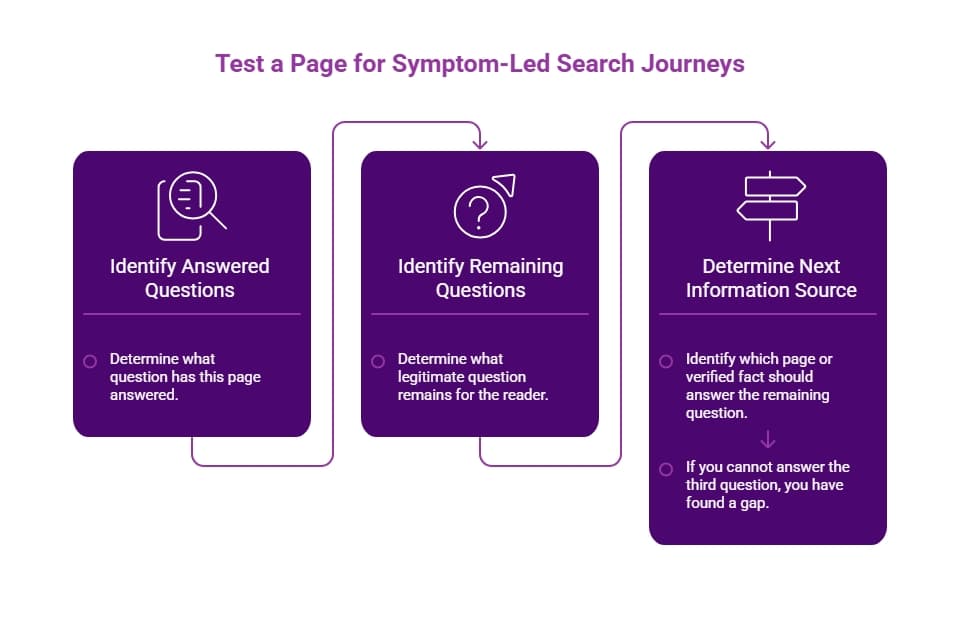
Before auditing a full journey, test any page with three questions:
- What question has this page answered?
- What legitimate question remains for the reader?
- Which page or verified fact should answer it?
If you cannot answer the third question, you have found a gap.
A stronger call to action does not repair missing context. If a symptom page explains the topic thoroughly but ends with only a generic "Contact Us" button, the reader still may not understand why contacting the practice is relevant or what evaluation question comes first. The problem is not that the page lacks a prompt. The problem is that the page has not given the reader enough information for any prompt to make sense.
Audit the Six Handoffs Between Symptom Discovery and Specialist Evaluation
Most symptom-to-specialist journeys move through six checkpoints. Not every journey will include all six (and a single page should not try to cover them all), but each one represents a potential break point worth auditing.
Conceptual journey: Symptom → Evaluation Context → Condition Information → Specialist Relevance → Treatment Consideration → Access/Next Step
1. Symptom to evaluation context
Does the symptom content acknowledge the limits of general symptom information? Does it point toward any evaluation-related context, or does it end with a generic contact button that skips the reader's next real question? The goal is not to assign a diagnosis. It is to prevent the page from ending before the reader can understand the next information need.
2. Evaluation context to condition information
Where appropriate, does the site offer clinically reviewed context about possible categories of concern without diagnosing the reader? This is the step most often missing entirely. Marketing should not create that relationship from keyword similarity alone. Patient-facing relationships between a symptom and a condition should reflect reviewed clinical information, not topical proximity in a keyword list.
3. Condition or context to specialist relevance
Does the site explain verified relationships between a problem area and the practice's actual expertise? A specialist page that lists credentials but never connects them to the conditions a reader may have arrived with creates a dead end from the other direction. When physician scope or roster changes, these connections can become outdated without anyone noticing, so the verified relationship must reflect current clinical reality.
For a deeper look at structuring content when a single symptom may involve more than one clinical pathway, see when one symptom can point to several specialties.
4. Specialist relevance to treatment or procedure consideration
Treatment content should enter only after the reader has enough context to understand why evaluation comes first. A symptom page that links directly to a procedure page implies treatment relevance before relevance has been established. Treatment availability may also differ by physician or location, so generic "we treat this" claims can mislead when they do not match actual scope.
5. Evaluation to access and referral requirements
Can the reader find accurate next-step information about referrals, records, locations, or appointment processes where applicable? Access requirements vary by practice, payer, specialty, and sometimes jurisdiction, so this content must reflect the practice's actual current information rather than generalized assumptions.
6. Access to an explicit next step
Is there a clear, non-coercive action the reader can take, such as learning more about the specialist's approach, understanding consultation steps, or contacting the practice? Consider a hypothetical specialist page where the clinical focus is well explained but no administrative path is visible. The reader understands why the specialist may be relevant yet cannot determine how to take the next step. That is a gap between clinical relevance and operational access, and it requires accurate, practice-specific information to close.
Symptom-to-Specialist Handoff Audit
Use this table to audit one high-priority route on your site. Each row should document the reader's current question, the page that owns it, the next legitimate question, the verified relationship that must hold before linking forward, the recommended next content node, and the reviewer responsible.
| Searcher's current question | Current page owner | Next legitimate question | Verified relationship needed | Recommended next content node | Reviewer or owner |
|---|---|---|---|---|---|
| What does this symptom topic mean? | Symptom page | What evaluation context should I understand next? | Clinically supportable context | Condition, context, or specialty overview where supported | Clinical reviewer and marketing |
| Could this practice be relevant to this problem area? | Condition or context page | How does the practice evaluate problems in this area? | Current clinical focus and service availability | Specialist or service page | Physician SME and operations |
| What happens if I want an evaluation? | Specialist or service page | What access step applies? | Current referral, direct-access, records, location, or scheduling information | Access or appointment page | Access team or operations |
The "verified relationship needed" column is the one most teams skip. It forces you to ask whether the clinical or service connection between two pages is something the practice can actually support, not just something that sounds logical from a keyword perspective. Use the table on one priority route before creating another page. The purpose is to identify the first unsupported or unanswered transition.
A Useful Handoff Is Not the Same as a Clinical Recommendation
This is the distinction that separates a defensible content architecture from a liability.
Marketing can structure questions and verified relationships. Marketing cannot determine diagnosis or candidacy. A handoff can say "learn how this specialty evaluates concerns related to this area" without saying "you need this specialist." The difference matters for accuracy, for trust, and for the practice's clinical and legal standing.
| Useful handoff | Unsafe leap |
|---|---|
| "Learn how this specialty evaluates problems in this area." | "You need this specialist." |
| Present several reviewed content routes when relevance is uncertain. | Force one specialty because it is commercially convenient. |
| Explain what information a consultation or evaluation may cover. | Imply that a treatment is appropriate before evaluation. |
When a symptom could plausibly involve more than one clinical pathway, the content should preserve that ambiguity rather than resolve it. Reviewed, neutral language can present the relevant possibilities and let appropriate clinical or access pathways handle the next step. The marketer's job is to make sure the options are understandable, not to triage the reader.
Consider a hypothetical example. A symptom education page has three adjacent content routes available on the site: condition education, specialist expertise, and appointment or access information. The correct route for any individual reader depends on clinically verified relevance. The content team's responsibility is ensuring all three routes are findable, accurate, and clearly scoped. Choosing which route applies to a specific patient is not a marketing decision.
Overlapping physician expertise creates another governance problem. If several physicians treat related conditions, page ownership should reflect verified differences in focus, service responsibility, and availability rather than routing every condition page toward a single profile. When the marketing team cannot distinguish one physician's scope from another's, the correct response is to flag the question for clinical review, not to default to the provider with the most prominent web presence.
Clinical reviewers often have limited bandwidth, so separating low-risk structural edits (link placement, page-role assignments, navigation updates) from claims that require qualified review makes the process sustainable. For a structured approach to governing that boundary, see clinical review workflow for specialty SEO content.
Give Each Page One Decision Job
Journey continuity improves when every page has a clear, singular role. Overlap and ambiguity between pages create confusion for readers and for the teams maintaining the content.
| Page Type | Primary Decision Job |
|---|---|
| Symptom page | Explain the symptom topic and the limits of the information |
| Condition page | Explain a verified condition or problem context |
| Treatment page | Explain a verified treatment or evaluation option and its limitations |
| Physician or specialist page | Establish credentials, clinical focus, and fit evidence |
| Location or access page | Clarify practical access details |
| Appointment path | Explain the next administrative step |
Better continuity often comes from explicit page roles plus sensible internal links, not from making one page answer every stage. A symptom page that also tries to establish specialist credentials, explain a treatment, and present appointment logistics is doing four jobs poorly instead of one job well.
Ownership must also remain current. Physician expertise can change, service lines can move, and treatment availability can differ by physician or location. A once-valid link can become misleading if the site continues routing readers to a provider or service that no longer owns that pathway. The same problem appears when a page ranks successfully but hands the reader to stale or generic content. Ranking shows that the page can be found. It does not show that the next question is answered accurately.
This page-role principle applies regardless of how the content is surfaced, whether through traditional search results, AI-generated answers, or direct site navigation. Clear roles and verified relationships make the content architecture more understandable for any system that needs to interpret it.
For a related framework on preventing search overlap when these page types cover adjacent topics, see how to map symptom, condition, treatment, and specialist pages.
Fix One Broken Route Before Publishing More Content
The most common instinct when journey gaps appear is to create more pages. That instinct usually makes the problem worse if the existing pages lack clear roles and connections. Similarly, the issue is usually not a technical SEO problem (crawlability, indexing, site speed) but a content-architecture problem: the pages exist, the pages rank, and the handoff between them is still missing. Start with one route instead of more volume.
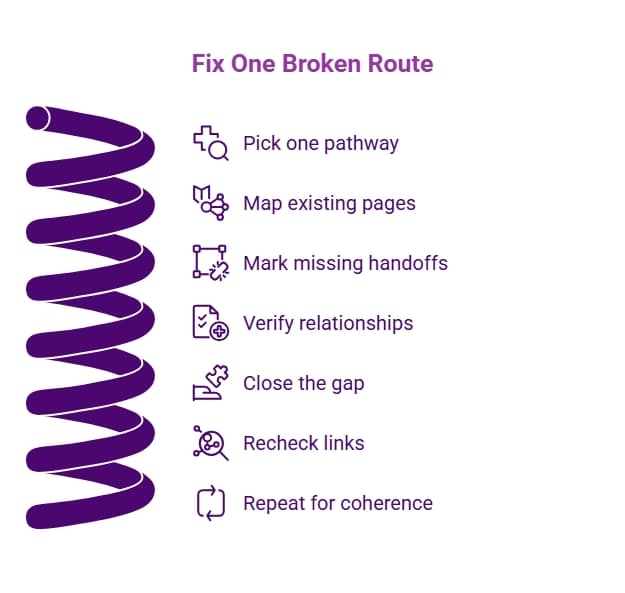
- Pick one commercially important, clinically reviewable symptom or condition pathway.
- Map the existing pages that touch that pathway.
- Mark where the reader's next question becomes unanswered or where the handoff skips a step.
- Verify the clinical, service, and access relationships that each link depends on.
- Add or revise the smallest content element needed to close the gap.
- Recheck internal links and access information for accuracy.
- Repeat only after the first route is coherent.
This process also helps separate a content gap from a technical SEO problem. If the right information exists but the route between questions is unclear, you are dealing with content architecture and journey continuity. If the page itself cannot reliably be reached or processed by search systems, that belongs in a separate technical review.
Do not use traffic alone to decide whether the repair worked. Look for increases in click-through rates from symptom education pages to specific specialist profiles, or a higher volume of qualified appointment requests originating from these repaired routes. A qualitative path audit can reveal whether each page answers its assigned question and hands the reader to a supportable next node, independent of whether the traffic numbers have shifted yet.
Prioritize continuity before volume. One complete, defensible journey through your site is more valuable than a dozen pages that each perform well in isolation but leave the reader stranded between questions.
If you want to see how specialty-practice service pages fail to connect symptoms to the right specialist, that related analysis covers the service-page side of this same problem.
The Unit of Analysis Is the Journey, Not the Page
Symptom traffic becomes strategically useful only when the site supports a defensible sequence of questions, verified relationships, and clear next steps. The audit question is not whether individual pages rank. It is whether the path between those pages gives a reader enough context to move from general awareness toward a legitimate evaluation step. Top-of-funnel content may appropriately lead to another educational or evaluation step before any conversion action becomes relevant, and that is a feature, not a failure.
Start with one route, find the first broken handoff, verify what the next step can accurately say, and repair that transition before increasing content volume. Audit the transition before creating another page.
For a broader specialty-search framework, see medical specialty SEO. If you want an external perspective on where your specialty-search journeys break, get a specialty search audit.
Frequently Asked Questions
Disclaimer: This article is for educational and marketing-strategy purposes only. It does not provide medical advice or determine whether any symptom, condition, treatment, or specialist is appropriate for an individual patient. Clinical statements and patient-facing pathways should be reviewed by qualified medical professionals before publication.
Our Editorial Process: Our expert team uses AI tools to help organize and structure our initial drafts. Every piece is then extensively rewritten, fact-checked, and enriched with first-hand insights and experiences by expert humans on our Insights Team to ensure accuracy and clarity.
By: About the BVM Insights Team
The BVM Insights Team is our dedicated engine for synthesizing complex topics into clear, helpful guides. While our content is thoroughly reviewed for clarity and accuracy, it is for informational purposes and should not replace professional advice.