
 Dustin Ogle
Clinical review becomes slow when every request arrives as an undifferentiated document and every reviewer is asked to approve everything. Physicians receive long drafts without defined questions, marketing teams wait for broad feedback, and approved wording may change during final editing.
The real challenge is not choosing between accuracy and production speed. It is designing a workflow that identifies the decision being made, the evidence supporting it, and the person authorized to approve it.
A scalable clinical review workflow separates clinical meaning from editorial work, credential verification from operational approval, and approval from publication. It assigns review depth according to risk, records the approved version, and reopens published content when a material fact changes.
The seven-step model below is a practical operating framework. Each practice should adapt it to its clinical structure, internal policies, and applicable professional requirements.
What a Clinical Review Workflow Actually Reviews
A condition page does more than explain a health topic. It represents several relationships:
- Condition to physician
- Physician to credential
- Condition to treatment
- Physician to location
- Page to appointment path
- Claim to supporting source
Each relationship requires the right type of review. A content editor may improve clarity but should not independently decide that a physician treats a condition. A clinical reviewer may confirm medical meaning without knowing whether the physician currently sees patients at the location shown. Credentialing staff may verify qualifications but may not approve treatment language.
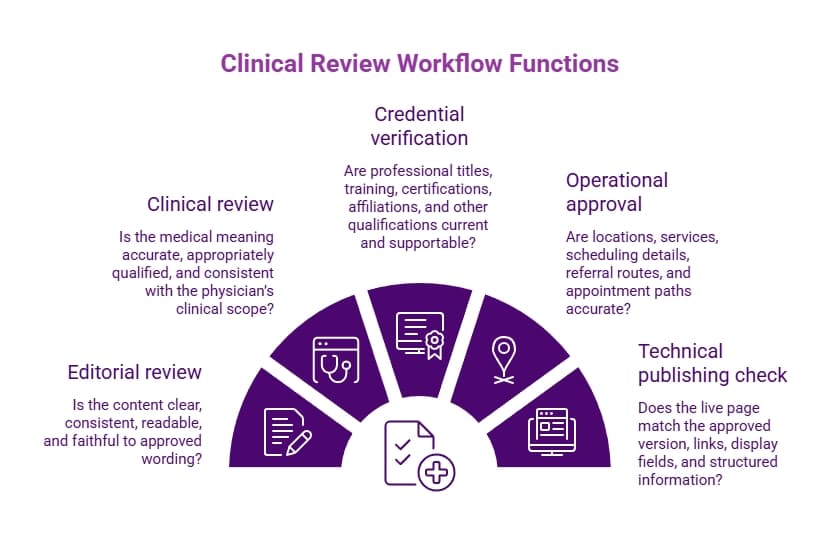
Practices should therefore separate five functions.
| Review function | Primary decision |
|---|---|
| Editorial review | Is the content clear, consistent, readable, and faithful to approved wording? |
| Clinical review | Is the medical meaning accurate, appropriately qualified, and consistent with the physician’s clinical scope? |
| Credential verification | Are professional titles, training, certifications, affiliations, and other qualifications current and supportable? |
| Operational approval | Are locations, services, scheduling details, referral routes, and appointment paths accurate? |
| Technical publishing check | Does the live page match the approved version, links, display fields, and structured information? |
One person may perform more than one function in a smaller practice, but the decisions should remain separately documented.
Before review begins, the practice may also need to define how conditions connect to physicians across the website. This condition-to-physician mapping framework explains how those relationships can be organized before they are submitted for approval.
The Seven-Step Condition-to-Physician Review Workflow
1\. Establish an Approved Source of Truth
Create a defined source hierarchy for every claim type. Depending on the information being verified, sources may include current internal credentialing records, physician-approved scope statements, service-line records, location and scheduling systems, official professional records, and approved clinical references.
An old physician bio should not automatically control the decision. Website copy may be outdated, abbreviated, or written before a physician changed location or clinical focus.
When two sources conflict, the affected claim should be marked as unresolved. The content owner can continue preparing unaffected parts of the page, but the disputed statement should not advance to publication until the designated owner resolves the conflict.
External tools such as ABMS Certification Matters and the FSMB Physician Data Center may be relevant to credential verification. The appropriate source can vary by credential and jurisdiction, so internal credentialing records or state-level sources may also be necessary.
2\. Assign Ownership and Decision Authority
Every page needs a content owner responsible for moving it through the workflow. That person coordinates the process but does not automatically approve clinical, credential, or operational claims.
Assign the following roles before drafting:
| Role | Responsibility |
|---|---|
| Content owner | Maintains the control sheet, coordinates review, and tracks status |
| Clinical reviewer | Decides whether clinical meaning and condition-to-physician relationships are appropriate |
| Credential verifier | Confirms qualifications, titles, certifications, and affiliations |
| Operational approver | Confirms locations, appointment access, services, and referral routing |
| Compliance or legal reviewer | Reviews claims requiring specialized regulatory or legal analysis |
| Final publisher | Confirms that the approved version is the version placed online |
A broad specialty title should not be treated as automatic authority to review every subspecialty, procedure, or physician-specific claim. Reviewer selection may vary according to the subject, the reviewer’s qualifications, and the practice’s governance policy.
3\. Triage the Change by Risk
Not every edit requires physician review. A risk-tier model helps route changes without weakening clinical oversight.
| Risk tier | Typical change | Usual review path |
|---|---|---|
| Tier 1: Editorial | Grammar, formatting, or exact reuse of approved wording without changing meaning | Editorial review |
| Tier 2: Contextual | New explanations, revised physician relationships, or presentation changes that could alter interpretation | Editorial review plus the appropriate clinical or operational decision |
| Tier 3: Clinical or credential-critical | Treatment, candidacy, risk, outcome, contraindication, scope, qualification, certification, or provider-fit statements | Qualified clinical, credential, compliance, or legal review as applicable |
Each practice should approve its own tier definitions.
A minor-looking word change can raise the risk level. Changing “physician with a clinical focus in” to “leading expert in” introduces an unsupported comparative claim. Changing “may be considered” to “is recommended” changes clinical meaning. Neither should be treated as routine copyediting.
4\. Draft With Claims and Evidence Visible
Do not ask a physician to “review the page” without identifying the decision. Link each material statement to its source, highlight the sentences requiring clinical input, and separate clinical questions from credential or scheduling questions.
A bounded request might ask:
Please confirm whether the highlighted condition-to-physician relationship is accurate, whether the scope wording needs qualification, and whether any treatment statement could be misleading.
Marketing work can continue while a clinical decision is pending. Editors may organize the page, collect approved sources, prepare technical elements, and work on unaffected sections. The unresolved claim should remain clearly marked as blocked rather than being softened through guesswork.
Research supports drafting, but it does not authorize statements about an individual physician’s current qualifications, services, or patient fit.
5\. Conduct Clinical, Credential, and Operational Reviews
The clinical reviewer should assess medical meaning, condition-to-physician fit, treatment and scope wording, material omissions, and potentially misleading simplifications.
The credential verifier should examine professional titles, certification wording, training, fellowships, affiliations, and other qualification claims.
The operational approver should separately confirm locations, appointment types, current availability, service access, and referral routing.
Consider an illustrative example: a condition page names two physicians, but one has moved to another office and no longer accepts the appointment type promoted on the page. The physician may remain clinically relevant, yet the access path is inaccurate. The page therefore requires both clinical confirmation and operational correction.
Generic wording such as “our specialists treat this condition” also requires support. The practice should define which physician group that phrase represents and whether every included physician fits the stated relationship.
6\. Resolve Revisions and Lock the Approved Version
A useful workflow replaces the ambiguous label “reviewed” with defined outcomes.
| Status | Publishing consequence |
|---|---|
| Draft | Not ready for final review or publication |
| Changes requested | Cannot publish until required revisions are completed and reviewed |
| Blocked | Cannot proceed until a named conflict, source gap, or approval issue is resolved |
| Approved with conditions | May publish only after documented conditions are satisfied |
| Approved | The identified version may proceed to publishing |
| Published | The live page has been checked against the approved version |
Approval received through email, chat, a meeting, or a verbal conversation should be transferred into the central control sheet. Informal feedback should not become the final publishing record.
Record the exact approved version, not merely the page title. The approval record should connect to the reviewed draft, the relevant CMS revision, and the live URL. Material edits made after approval must return to the appropriate reviewer. Purely editorial corrections may follow the practice’s approved Tier 1 policy when they do not alter meaning.
7\. Publish With Defined Re-Review Triggers
Published content should be reopened when a material fact changes. Relevant triggers may include:
- A physician joining, leaving, relocating, or changing clinical focus
- A professional title or credential changing
- A treatment, procedure, or service being added or removed
- A clinical source, guideline, or internal policy changing materially
- A substantial rewrite of the page
- A change to appointment or referral routing
- A complaint or internal concern identifying possible inaccuracy
A physician who remains employed but changes location and clinical focus may trigger two review paths: operational review for access details and clinical review for the condition relationship.
No single review interval is universally correct. Practices can combine an internally approved maintenance cadence with event-based triggers based on page risk.
Condition-to-Physician Clinical Review Control Sheet
The following fields create a repeatable record that can be used across physicians, conditions, and service lines.
| Field | What to record |
|---|---|
| Page title and URL | The page being reviewed |
| Condition or topic | The clinical subject |
| Assigned physician or physician group | The proposed relationship |
| Approved scope wording | The exact language permitted for reuse |
| Clinical claims requiring review | Statements involving medical meaning, treatments, risks, candidacy, or physician fit |
| Credential claims | Titles, certifications, training, affiliations, and qualifications |
| Supporting source | The source supporting each material claim |
| Risk tier | Tier 1, Tier 2, or Tier 3 |
| Content owner | Person responsible for moving the page through review |
| Clinical reviewer | Qualified person deciding clinical meaning and fit |
| Credential verifier | Person confirming qualifications and professional records |
| Operational approver | Person confirming location, availability, services, and routing |
| Review status | Draft, changes requested, blocked, approved with conditions, approved, or published |
| Approved version | File, revision number, or dated copy that received approval |
| Review date | Date the decision was recorded |
| Re-review trigger | Event that should reopen the page |
| Notes and limitations | Conditions, exclusions, disagreements, or wording restrictions |
The same control sheet can be used throughout the practice, but review depth should still vary according to the claim, specialty, and reviewer scope.
How to Prevent the Workflow From Becoming a Bottleneck
Clinical review becomes faster when uncertainty is removed before the request reaches the reviewer.
Maintain one control sheet rather than distributing final decisions across email, chat, documents, and verbal conversations. Name backup reviewers for predictable absences. Consolidate nonurgent requests into scheduled review windows, while allowing high-risk corrections to follow an escalation path.
Use preapproved wording blocks for recurring statements, but prohibit uncontrolled paraphrasing. A phrase approved for one physician, service, or location should not automatically be reused elsewhere.
When reviewers disagree, the page should remain blocked only for the disputed relationship or claim. The escalation record should identify the decision owner, the competing interpretations, the evidence considered, and the final wording. This prevents a disagreement from disappearing into a comment thread or being resolved by whoever publishes last.
Better request design respects limited physician capacity. It does not bypass clinical review.
What “Medically Reviewed” Should Communicate
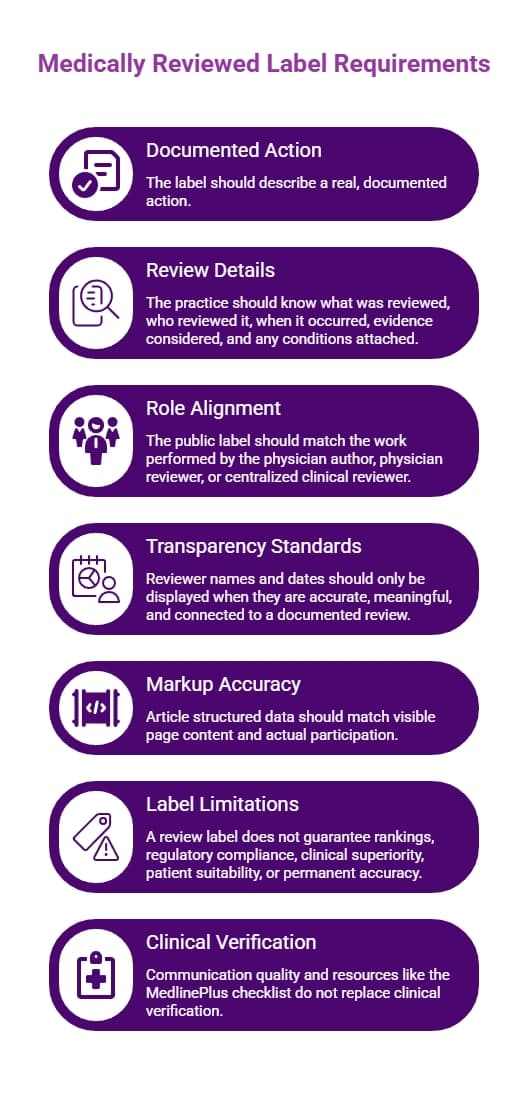
A “medically reviewed” label should describe a real, documented action. The practice should know what was reviewed, who reviewed it, when the review occurred, which evidence was considered, and whether the reviewer attached any conditions.
A physician author, physician reviewer, and centralized clinical reviewer perform different roles. The public label should match the work that actually occurred.
Reviewer names and dates may improve transparency when they are accurate and meaningful. They should not be added decoratively or displayed when the practice cannot connect them to a documented review.
Google’s published people-first content guidance discusses transparency about who created content and why. Its search-quality materials use E-E-A-T as a content-evaluation concept; it should not be presented as a direct ranking control. Similarly, Article structured data can represent accurate author information, but markup should match visible page content and actual participation.
A review label does not guarantee rankings, regulatory compliance, clinical superiority, patient suitability, or permanent accuracy. Communication resources such as the MedlinePlus health-information evaluation checklist may help teams assess source transparency and freshness, but communication quality does not replace clinical verification.
Start With One Condition Page
Select one priority condition page and identify every clinical, credential, location, and appointment claim it contains. Define the proposed physician relationship, assign the reviewers, complete the control sheet, and record the approved version.
Document which events will reopen the page. After publication, review where the process slowed down. The cause may be a missing source, unclear ownership, an unbounded request, reviewer disagreement, or a material edit introduced after approval.
Correct that friction before expanding the system.
A scalable workflow does not require a physician to edit every sentence. It matches review depth to claim risk, assigns each decision to the right authority, and preserves the meaning that was approved.
For practices evaluating broader physician, condition-page, and content-governance gaps, explore Medical Specialty SEO or get a Specialty Search Audit.
Disclaimer: This article provides general educational and operational information and is not medical or legal advice. Clinical content, physician credentials, professional-scope statements, and applicable requirements should be reviewed by appropriately qualified professionals using current authoritative sources.
Our Editorial Process: Our expert team uses AI tools to help organize and structure our initial drafts. Every piece is then extensively rewritten, fact-checked, and enriched with first-hand insights and experiences by expert humans on our Insights Team to ensure accuracy and clarity.
By: About the BVM Insights Team
The BVM Insights Team is our dedicated engine for synthesizing complex topics into clear, helpful guides. While our content is thoroughly reviewed for clarity and accuracy, it is for informational purposes and should not replace professional advice.