
 BVM Insights Team
A treatment page sits in a physician's inbox with a single instruction: "Please review and approve." No one has defined what the physician is being asked to check, and no one has claimed ownership of the page for when a service changes or that physician leaves.
The obstacle is not unwilling clinicians. It is that six distinct decisions (ownership, evidence, clinical meaning, editorial quality, approval, and maintenance) have been compressed into one undefined request. This article provides the operating model that separates them: defined roles, a six-step workflow, a review record template, and re-review triggers your team can adapt this week.
The Workable Model Separates Six Decisions
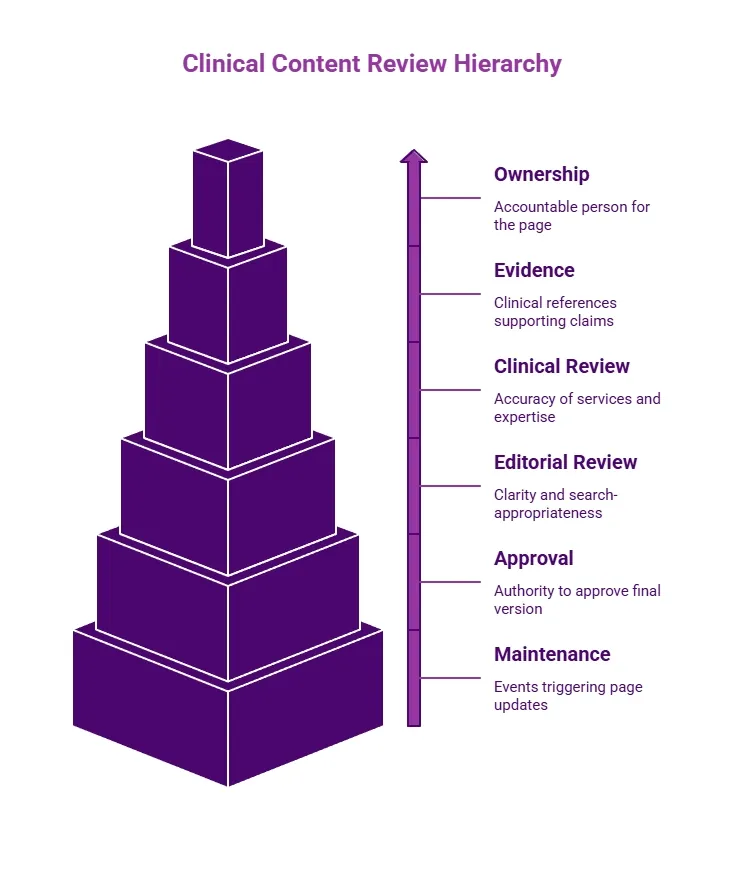
A workable model recognizes six separate decisions inside every publishable page, even when one person handles more than one of them:
- Ownership: Who is accountable for this page after it goes live?
- Evidence: What clinical references, practice protocols, or verifiable sources support each claim?
- Clinical review: Does the content accurately represent the practice's services, expertise, and scope?
- Editorial review: Is the content clear, readable, and search-appropriate?
- Approval: Who has the authority to approve the final version?
- Maintenance: What events should reopen this page?
A solo practitioner may fill every role. The number of people matters less than ensuring each decision is visible, assignable, and documented.
Each decision also needs a recognizable output. Ownership produces a named responsible person. Evidence work produces traceable support for each claim. Clinical and editorial reviews produce scoped changes or approvals. The approval step produces an authorized version. Maintenance produces a cadence, triggers, and an escalation path. Without those outputs, the team cannot tell whether a step was completed or merely discussed.
Who Owns What In A Small Specialty Practice?
"We are too small for governance" is a common objection, but it confuses governance with bureaucracy. A two-physician practice still makes all six decisions informally. The risk is that informal decisions become invisible ones. Roles can overlap in personnel as long as the decisions remain distinguishable.
| Role | Primary decision | Required input | Output |
|---|---|---|---|
| Content owner | Ongoing accuracy and relevance | Practice knowledge, service-line updates | Triggers re-review when conditions change |
| Subject-matter contributor | Which practice facts belong in the draft | Service availability, physician roles, locations, appointment pathways | Verified operational inputs |
| Clinical reviewer | Whether clinical claims are accurate and appropriately scoped | Subject-matter expertise relevant to the specific claims | Clinical approval or requested corrections |
| Editorial/SEO reviewer | Whether content is clear, readable, and search-appropriate | Writing, formatting, and search practices | Editorial approval or revision notes |
| Approver | Whether the page is ready for publication | Clinical and editorial review outputs | Documented sign-off |
| Publisher | Technical publication and page setup | Approved content and metadata | Live page with correct formatting |
The subject-matter contributor supplies practice-specific facts that ground the draft before clinical review begins. In a small practice this person is often the practice administrator or a senior staff member who knows current service availability, physician scheduling, and referral pathways. Separating this input from clinical review prevents the clinical reviewer from spending time verifying operational details that someone else can confirm more efficiently.
When two physicians describe their approach to the same service differently, the practice needs a designated clinical owner for that content area. That person holds the final content decision and documents the approved wording so future edits start from a recorded baseline, not a remembered conversation. Unresolved clinical disagreements escalate according to the practice's own policies.
Role assignment should occur at the content-item level. A person who owns a physician biography may not own a service page, and a reviewer assigned to one topic may not hold the relevant expertise for another. Recording scope at the page level prevents a familiar name from becoming the default reviewer for unrelated decisions.
A Six-Step Clinical Content Review Workflow
Step 1: Define the page purpose and assign an owner
Before drafting begins, identify what the page covers, which service or condition it addresses, and who will own its accuracy after publication. The content owner is the person responsible for flagging when the page needs attention, not necessarily the person who writes or reviews it.
Step 2: Identify claims and match them to approved evidence
List the clinical, procedural, eligibility, and expertise claims the page will make. For each claim, record the supporting evidence: a clinical guideline, practice protocol, credential, referral relationship, or another verifiable source.
This step is especially important when an outside agency drafts the content. Without access to practice-specific protocols and approved clinical language, outside drafts risk becoming generic or overstated. The evidence record gives both internal reviewers and external writers a traceable foundation. For a deeper look, see how to support specialist claims with verifiable practice evidence.
Claim-level identification also narrows the reviewer's task. Instead of asking a physician to reread every sentence with equal attention, the team directs clinical focus to the statements that carry clinical, credential, service, or access implications. The editor still reviews the full page for clarity and coherence, but physician time goes where judgment is actually required.
Step 3: Assign the reviewer based on claim type
Not every claim requires a physician's time. A statement about office hours or appointment logistics may need only an administrative check. A claim about a treatment approach or diagnostic capability requires review by someone with relevant clinical expertise and authority under the practice's own policies.
The assumption that every page needs the medical director creates a bottleneck that delays content without improving accuracy. Route content to the reviewer whose expertise matches the claim. If a page crosses service lines, designate which reviewer holds final authority for each claim.
Step 4: Run clinical and editorial review as separate passes
The clinical reviewer checks whether the content accurately describes what the practice does, whether certainty language matches actual evidence, and whether scope, eligibility, and risk statements are appropriately bounded. The editorial reviewer checks clarity, readability, formatting, and search alignment. Editorial improvements are expected, but they must not alter clinical meaning.
Consider a hypothetical: a clinical reviewer approves a sentence stating that a procedure "may be considered for patients meeting specific criteria." An editor later rewrites it to say the procedure "is recommended." That single word change shifts the certainty, scope, and eligibility of the original claim. Any revision that changes meaning, certainty, scope, eligibility, or risk framing in the approved version requires renewed clinical review before publication.
This separation creates a material-change test the practice can apply to every post-approval edit. Correcting punctuation or repairing a broken link may not require clinical re-review under the practice's rules. Changing language in ways that strengthen certainty or broaden eligibility does. The practice should define its own routing rules for this distinction, subject to qualified review where appropriate. For example, changing "can treat" to "cures" is a material change requiring clinical re-review; correcting a comma or updating a broken link is not.
For condition-to-physician pages specifically, a related article covers how to build a clinical review workflow for condition-to-physician content.
Step 5: Resolve changes and record the approval
When clinical and editorial feedback conflict, the clinical reviewer's approved meaning governs. Record the approval so it is retrievable: who approved the content, what version, what wording boundaries, and when.
If approved wording must change after initial sign-off, record both the requested revision and the decision that follows. This creates a clear boundary between language an editor may refine and language that must return to the appropriate clinical reviewer, and it gives the approver a reliable basis for resolving later disagreements.
The belief that "our physician reviewed it, so the workflow is complete" is one of the most common gaps. Physician review addresses one of the six decisions. Ownership, evidence documentation, editorial quality, approval recording, and maintenance triggers still need definitions.
Step 6: Publish with ownership and maintenance triggers
Before the page goes live, compare the approved version with the page prepared for publication. Confirm that headings, disclosures, internal links, physician relationships, and appointment paths have not changed during implementation. Then confirm that the content owner, clinical reviewer, approval date, and re-review triggers are documented.
One important caveat: privacy-sensitive content (such as language describing patient information handling or data collection) requires separate qualified review by legal, privacy, or compliance professionals. An editorial content workflow does not replace those assessments.
Use A Clinical Content Review Record, Not An Approval Email
An approval email disappears into an inbox. A structured record preserves the decisions that make future updates faster and more consistent.
| Field | Purpose |
|---|---|
| Page or content item | Identifies what is being governed |
| Content owner | Names the person responsible after publication |
| Claim or section under review | Prevents vague whole-page approval |
| Approved evidence/source | Records the basis for the claim |
| Clinical reviewer | Identifies the qualified reviewer |
| Editorial reviewer | Separates clarity/SEO review from clinical approval |
| Approved wording or boundaries | Preserves important nuance and limitations |
| Approval date | Records the decision point |
| Re-review trigger | Defines what should reopen the content |
| Affected pages | Helps propagate corrections consistently |
Example row (hypothetical):
| Field | Entry |
|---|---|
| Page | /services/[procedure-name] |
| Content owner | Practice administrator |
| Claim under review | Service availability statement |
| Approved evidence | Internal credentialing records |
| Clinical reviewer | Designated clinical owner for this service line |
| Editorial reviewer | Content manager |
| Approved wording | "Available at [practice name] for patients meeting [criteria]" (do not broaden eligibility without clinical re-review) |
| Approval date | [Date of approval] |
| Re-review trigger | Physician departure, credentialing change, or service discontinuation |
| Affected pages | Related physician bio page, related condition page |
This record is an adaptable editorial template, not a compliance form. It can live in a shared document, a project management system, or another practice-approved location. This template maps easily into standard project management tools like Jira, Asana, or a secure Google Sheet, ensuring it remains visible to the whole team. The tool matters less than consistent use, controlled access, and a clear relationship between the record and the published page. The content owner should be able to find the current entry without reconstructing decisions from email threads. Practices should have qualified reviewers evaluate the structure before relying on it.
Review Dates Matter Only When Something Triggers Action
A displayed review date that advances on a calendar schedule, without a corresponding re-review, creates a false signal. For instance, if a practice updates the "Last reviewed" date each quarter, but the physician who performed that service left two months ago, the date looks current. The content is not.
The assumption that "we will review everything annually" treats maintenance as a calendar task rather than an ownership responsibility. A fixed cadence cannot catch every physician departure, service change, or evidence update between scheduled reviews. Combine a practice-defined cadence with event-based triggers:
- A physician joins, leaves, or changes roles within the practice
- A credential, board certification, or fellowship status changes
- A service or procedure becomes available or is discontinued
- A referral or appointment pathway changes
- Clinical evidence, guidelines, or professional standards are updated
- A location opens, closes, or changes its service scope
- An editorial rewrite changes the meaning, certainty, scope, or eligibility of approved clinical content
This list is not exhaustive. The practice should define which events matter most.
When a single change (such as a physician departure) affects several pages, the "affected pages" field in the review record helps the team identify every URL that needs attention rather than correcting only the most visible one. A related article explains how to keep multi-physician content accurate when service lines change.
Make Accountability Visible Without Turning Credentials Into Decoration
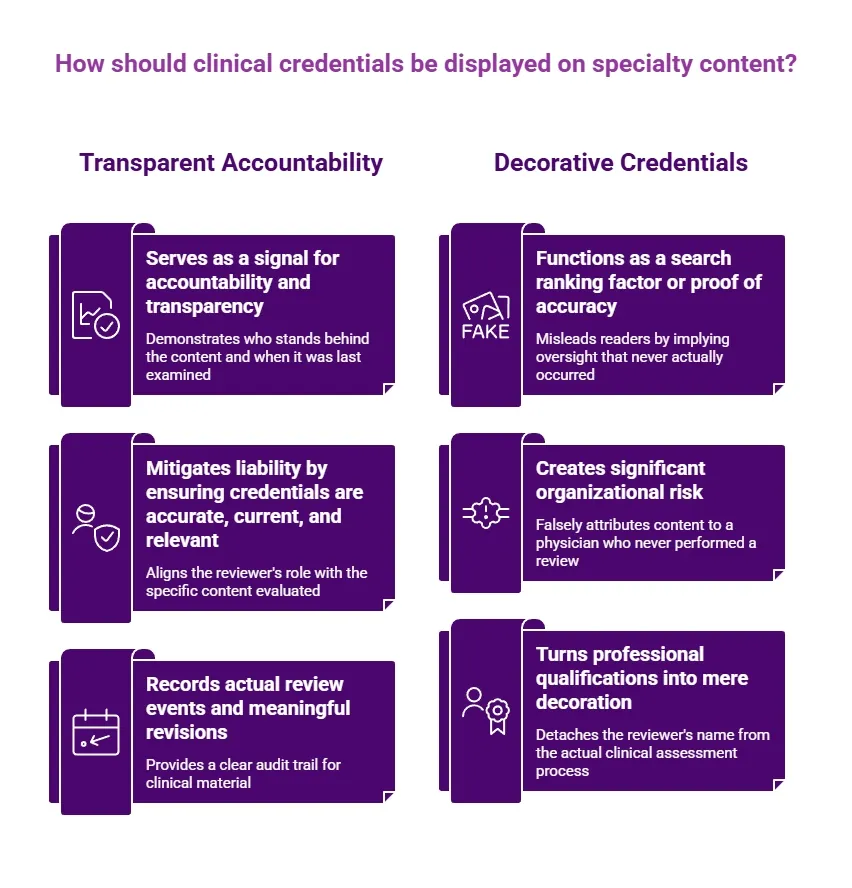
Author names, clinical reviewer names, credentials, and review dates can make the review process visible to readers. An author identifies who prepared the content. A clinical reviewer identifies who assessed the assigned clinical material. Credentials help readers understand the reviewer's relevant role. A review date records when that decision occurred, and an update note can explain a meaningful revision. These signals serve accountability and transparency: they show who stands behind the content and when it was last examined.
They should not be treated as search ranking factors or as proof of accuracy. Listing a physician's name and board certification on a page that was never reviewed by that physician does not create accountability. It creates risk.
Display only credentials that are accurate, current, and relevant to the content on that page. Show a review date only when it corresponds to an actual review event. Where appropriate, explain the clinical reviewer's role so readers understand why that person is qualified to evaluate the content.
FAQs
Does every specialty-practice page need physician review?
Not necessarily. The practice should define which claims require clinical review based on subject matter, clinical risk, and internal policy. Editorial or operational changes may follow a different route when they do not alter approved clinical meaning.
Can the same physician review content for every service line?
Only when that reviewer has relevant expertise and appropriate authority under the practice's own policies for each service described. If the content covers a subspecialty outside that physician's scope, route it to a reviewer with the relevant background, with disagreements escalated to the accountable clinical owner or approver.
How often should medical website content be reviewed?
Use a practice-defined review cadence combined with event-based triggers rather than a single fixed interval. Physician changes, service changes, evidence updates, and material editorial rewrites should independently trigger re-review regardless of the calendar.
Is this a compliance workflow?
No. This article describes an editorial governance model. Privacy, protected health information, advertising, legal, and jurisdiction-specific compliance obligations require separate review by qualified professionals. Do not treat an editorial workflow as a substitute for those assessments.
Start With One High-Risk Page
Select one condition, treatment, or physician page that lacks a clear owner or has not been reviewed recently. Name its content owner. Identify its claims and assign the appropriate clinical reviewer. Create the review record. Document the triggers that should reopen it.
If your specialty practice is ready to evaluate how its clinical content performs in search, Brazos Valley Marketing offers medical specialty SEO built around structured clinical participation. Get My Specialty Search Audit.
Disclaimer: This article is for general educational purposes and does not constitute medical, legal, privacy, or compliance advice. Clinical content workflows should be reviewed and adapted by qualified clinical, legal, privacy, and compliance professionals for the practice and jurisdiction involved.
Our Editorial Process: Our expert team uses AI tools to help organize and structure our initial drafts. Every piece is then extensively rewritten, fact-checked, and enriched with first-hand insights and experiences by expert humans on our Insights Team to ensure accuracy and clarity.
By: About the BVM Insights Team
The BVM Insights Team is our dedicated engine for synthesizing complex topics into clear, helpful guides. While our content is thoroughly reviewed for clarity and accuracy, it is for informational purposes and should not replace professional advice.