
 Dustin Ogle
A physician remains with a specialty practice but stops seeing one condition at one location. The biography is corrected, yet the condition page, provider card, location page, and appointment pathway still show the old relationship.
Changing the biography alone is not enough. Physician-service content accuracy depends on a governed process that treats each physician-service mapping as shared operational data rather than isolated website copy. A practical system combines defined change triggers, a single source of truth, appropriate reviewers, an inventory of affected content surfaces, and post-publication verification.
The framework below addresses content governance, not clinical decision-making. It includes a change-control matrix, clear ownership rules, a five-step publishing workflow, an affected-surface checklist, and a method for detecting gradual content drift.
Why Service-Line Changes Create More Than a Bio-Page Update
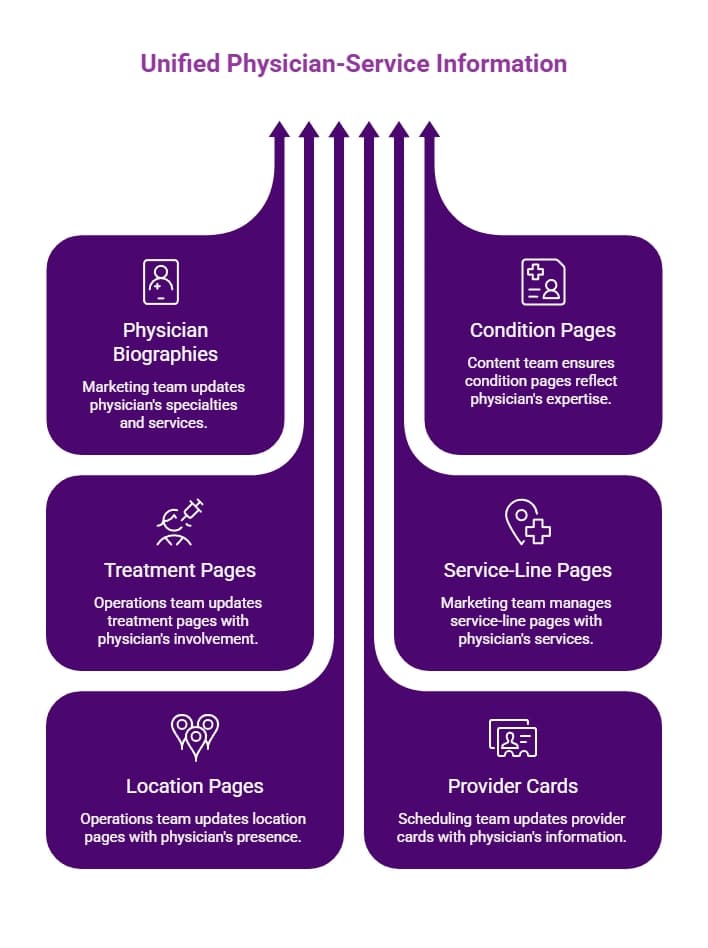
A physician-service relationship may appear across physician biographies, condition pages, treatment or procedure pages, service-line pages, location pages, provider cards, appointment modules, filters, structured data, directories, and referral resources. Not every practice uses every surface, but most multi-physician sites distribute the same underlying facts across several places.
A content surface is any public-facing page, component, record, or pathway that communicates a physician’s relationship to a condition, treatment, service, location, or next step. These surfaces often have different owners and update cycles. Marketing may maintain biographies, operations may control location information, scheduling may manage appointment routing, and a web team may own reusable components.
Consider a hypothetical physician who continues treating related conditions but stops treating one condition. If the biography changes while the condition page and provider card remain untouched, the practice is publishing two versions of the relationship. Scheduling staff may correct the issue later, but the public information and appointment pathway should be aligned before that handoff reaches them.
Practices with separate condition, treatment, and physician content paths therefore need a way to trace one approved change through every dependent surface.
Define Change Triggers and a Source of Truth for Physician-Service Content Accuracy
A change trigger is an event that starts a formal content review. General examples include a physician joining or leaving, changing clinical focus, relocating, adding or pausing a service, changing appointment eligibility, updating a public credential or affiliation, or altering a scheduling destination. A discovered inconsistency should also open a review.
The change should enter a controlled source of truth before anyone edits public copy. This is the current, approved record of the relationship. It should not be reconstructed from old emails, meeting notes, website text, or an automated suggestion.
A physician-service mapping records how a physician connects to a condition, service, treatment, location, and appointment pathway. Practices can adapt the record to a spreadsheet, database, ticketing system, or existing governance platform. The process matters more than the software.
Physician-Service Change Control Matrix
| Field | Example of what to record | Approval owner |
|---|---|---|
| Physician | Verified public-facing name | Administrative or credentialing owner |
| Change type | Join, departure, location, focus, availability, or procedure | Administrative owner |
| Effective date | Date the revised information becomes accurate | Operational owner |
| Condition or service relationship | Add, remove, revise, or review | Clinical reviewer |
| Location relationship | Office or facility affected | Operations |
| Appointment pathway | Scheduling destination or restriction | Scheduling or operations |
| Affected surfaces | Pages, modules, structured data, directories, or PDFs | Content owner |
| Review status | Pending, approved, published, and verified | Workflow owner |
The matrix is not a legal or credentialing record. It is an adaptable content-change record that separates approved facts from page wording.
For example, a physician may continue offering the same service but move to another office. The clinical relationship remains unchanged, while the physician-location mapping and appointment pathway need revision. The biography may already be correct even though the location page and booking destination are not.
The same structure can help practices map patient conditions to the right physician pages without treating existing copy as proof.
Use a Five-Step Review and Publishing Workflow
1\. Record and Classify the Change
Capture the physician, change type, effective date, condition or service, affected location, appointment pathway, urgency, and person reporting the change. The reporter identifies the issue; that person does not necessarily verify the fact or approve publication.
Classify the work by risk. A departed physician, unavailable service, incorrect clinical relationship, or broken appointment route usually warrants higher priority than a biography refinement or formatting change. This is a general prioritization model, not a regulatory standard, and exact handling may vary by practice.
Risk-priority guide: Correct information that could send a reader toward an unavailable physician, service, location, or appointment path before routine editorial improvements.
2\. Validate the Underlying Fact
The appropriate reviewer depends on the information involved.
A clinical reviewer is an authorized physician, service-line lead, or other qualified person who confirms condition, treatment, expertise, or scope-of-care relationships. Credentialing or administration should confirm public credentials, affiliations, and status. Operations should validate locations and service availability. Scheduling should confirm the appointment destination and any routing restrictions.
The publishing owner implements the approved change across pages and systems. That role is different from factual approval. Marketing should not infer a clinical relationship from a physician CV, old biography, directory profile, or neighboring page.
Clinical review should remain proportional. A physician-specific statement about clinical focus may need approval; a punctuation correction or visual adjustment generally does not require the same review path.
Credentials also do not speak for themselves. They must be current, represented accurately, and connected only to approved areas of practice.
3\. Build the Affected-Content List
Search for the complete relationship rather than the physician’s name alone. Look for combinations of physician, condition, procedure, service line, location, and appointment action.
Review the CMS, navigation, provider modules, internal links, filters, structured data, directories, scheduling paths, and documents still in circulation. Reused components require particular care because one edit may change many pages. Preview those dependencies before publishing, then confirm that unaffected relationships remain intact.
An AI-assisted scan or script may help identify every page mentioning a physician and service. A human content owner should decide which references are actually outdated, after which clinical and administrative owners approve the factual corrections.
AI can help: Find candidate references, compare records, and surface inconsistencies.
AI cannot approve: Clinical fit, physician scope, credential status, service availability, location assignments, or appointment eligibility.
4\. Publish in Dependency Order
Begin with the approved source-of-truth record. Next, correct high-risk routing information, including unavailable services, incorrect offices, and invalid appointment destinations.
Update core physician, condition, treatment, service, and location pages before revising related-provider cards, internal links, filters, calls to action, navigation, and structured data. Update core physician, condition, treatment, service, and location pages before revising related-provider cards, internal links, filters, calls to action, navigation, and structured data. Update JSON-LD structured data (such as Physician, MedicalClinic, and MedicalSpecialty schemas) simultaneously with front-end page updates to ensure search engines and AI systems instantly reflect the revised service relationship without indexing gaps. Address external profiles only where the practice controls the information.
A physician departure requires a coordinated decision. The team may need to remove the physician from active service relationships, revise appointment paths, update related pages, and determine whether the physician URL should be updated, archived, redirected, replaced, or removed. The correct action depends on the page’s purpose, continuing services, approved practice policy, and page-specific technical review.
5\. Complete Post-Publication Verification
Post-publication verification is the documented check that approved information appears correctly in the live experience. Publication alone does not complete the change.
Review visible copy, physician and service links, appointment destinations, mobile behavior, location associations, site-search results, reusable components, structured data where used, and controlled external profiles. Test the pathway as a patient or referring office would encounter it, not only from inside the CMS.
Record who verified the change, when the check occurred, and whether any exceptions remain open.
Audit Every Surface Where the Old Relationship Can Persist
Use the following checklist as a filter for the practice’s actual systems.
Core pages: physician biography; condition page; treatment or procedure page; specialty or service-line page; location page.
Reusable website components: provider cards; related-content blocks; filters; navigation; calls to action; appointment modules; structured data.
Operational and external surfaces: scheduling scripts or routing rules; provider directories; location profiles; referral resources; downloadable PDFs still in circulation.
A page can contain accurate prose and still route the reader incorrectly. Audit the full chain: physician, condition, treatment, location, and appointment pathway. Track physician-location-service relationships separately when one physician works across multiple offices.
For a deeper page-level review, examine what physician bio pages need to support condition and treatment discovery. When links are changing, determine when a condition page should link to a physician or procedure page. The decision should reflect the verified page role and care pathway, not an assumption that every related page needs every physician.
Prevent Gradual Drift With Ownership, Review Dates, and Exception Reporting
Event-driven reviews address known changes. Scheduled audits catch information that becomes inconsistent gradually. A fixed annual review may be too infrequent for changing service lines, while a universal quarterly requirement may be unnecessary for stable information. The cadence should reflect practice size, staffing, technology, change frequency, and risk.
Assign one workflow owner to monitor open records, route each question to the correct reviewer, and confirm completion. Store the latest approval date, effective date, review status, publishing date, and verification date.
Exception reporting should surface records that need attention, including:
- A service with no current physician
- A physician linked to an unavailable location
- A condition page with no clear next step
- Conflicting physician descriptions
- A record with no assigned owner
- An unresolved factual conflict
- A page not reviewed after a known change
Automation may compare records and detect candidate mismatches. Authorized reviewers must resolve the correct clinical and operational facts.
This work is not solely a marketing task. Operations, scheduling, credentialing, clinical leadership, and publishing teams each control part of the public experience. Inconsistency often develops because ownership is fragmented while care teams and service lines continue to change—not because any one team ignored the website.
Accuracy Is an Ongoing Operating Process
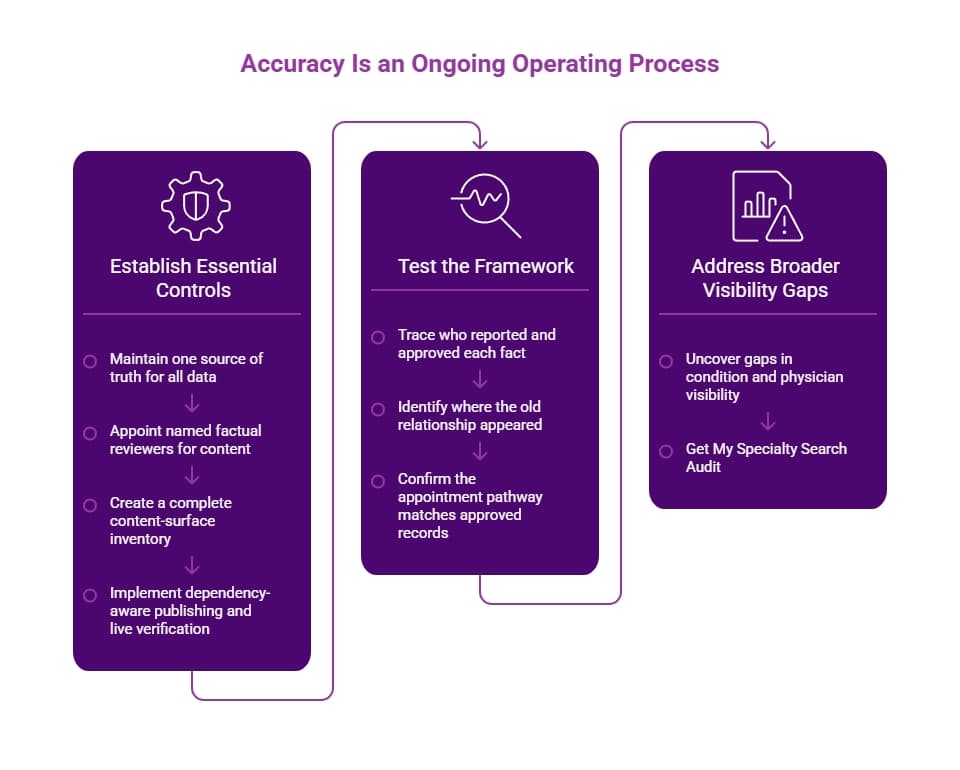
Physician-service content accuracy requires more than occasional page cleanup. One source of truth, named factual reviewers, a complete content-surface inventory, dependency-aware publishing, and live verification provide the essential controls.
A practical first step is to test the framework against the practice’s most recent physician or service-line change. Trace who reported it, who approved each fact, where the old relationship appeared, and whether the appointment pathway now matches the approved record. The process can support clearer, more consistent information, but it does not guarantee rankings, appointments, compliance, or clinical outcomes.
Practices that uncover broader gaps in condition, physician, location, and access-path visibility can Get My Specialty Search Audit.
Frequently Asked Questions
Disclaimer: This article is for general informational purposes only and does not constitute medical advice, diagnosis, or treatment. Readers should consult a licensed healthcare professional for guidance specific to their health, symptoms, medications, or treatment options.
Our Editorial Process: Our expert team uses AI tools to help organize and structure our initial drafts. Every piece is then extensively rewritten, fact-checked, and enriched with first-hand insights and experiences by expert humans on our Insights Team to ensure accuracy and clarity.
By: About the BVM Insights Team
The BVM Insights Team is our dedicated engine for synthesizing complex topics into clear, helpful guides. While our content is thoroughly reviewed for clarity and accuracy, it is for informational purposes and should not replace professional advice.