 Dustin Ogle
This article addresses website architecture and patient-search routing for specialty practices — not clinical advice. Any condition-procedure-physician relationship published on a practice website should be reviewed by a qualified clinician before going live.
A condition page should link to a physician page when the patient's primary uncertainty is "who should I see?" It should link to a procedure page when the patient is evaluating treatment options. It should link to both when the condition is complex enough that patients need to understand the care team and the care path before they're ready to book. The safest routing structure depends on patient intent, clinical relevance, and what the linked page can actually help them decide.
Most specialty-practice websites have the right components — condition pages, physician bios, treatment pages, service-line hubs. What's missing is the logic that connects them in a way that helps patients decide what to do next.
A condition page occupies a specific moment in the patient journey. The visitor has identified a concern but hasn't yet determined who to see, whether a specific treatment is relevant, or whether this practice is the right fit. Done well, the condition page resolves that uncertainty. Done poorly, it answers an informational question and stops — leaving the patient to piece together the rest on their own.
Six terms carry specific meaning throughout this framework:
- Condition page: A page focused on a diagnosis, symptom cluster, or clinical problem the patient is researching.
- Physician page: A profile that helps patients evaluate a doctor's credentials, clinical focus, conditions treated, procedures performed, locations, and appointment path.
- Procedure page: A page focused on a treatment, test, surgery, therapy, or intervention — distinct from the condition itself.
- Service-line page: A broader specialty-context page that helps patients understand a full care area before narrowing to a specific condition, physician, or procedure.
- Location page: A page that helps patients understand where care may be available — relevant when a practice operates multiple offices or service delivery points.
- Routing decision: The structural and page-hierarchy choice that determines where a patient goes next after landing on a condition page.
Start with the Page's Job, Not the Keyword
Many specialty practices build page architecture around keyword labels: a condition keyword earns a condition page, a procedure keyword earns a procedure page, a doctor name earns a bio. That logic produces pages that may rank adequately in isolation but fail to move patients toward a decision.
The more useful starting question is: what does the patient need to decide after reading this?
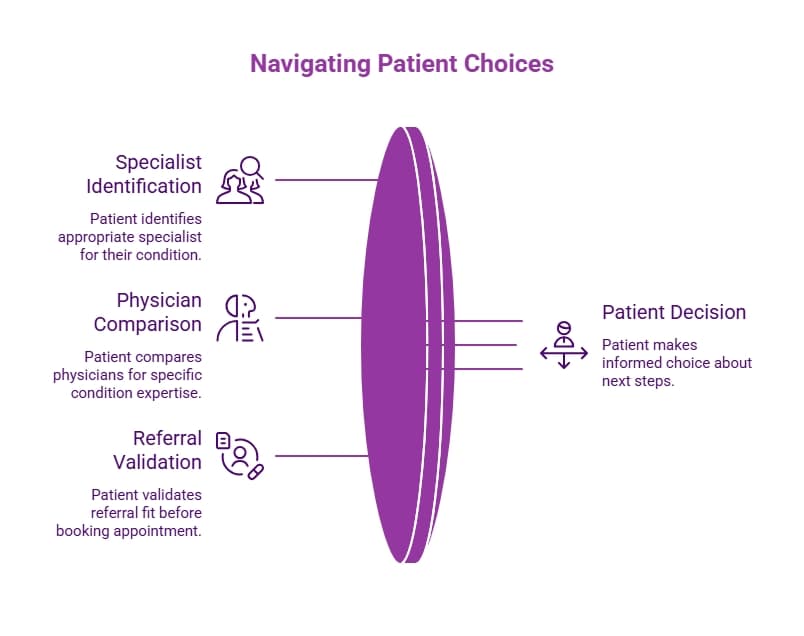
Some visitors need to identify which type of specialist handles their problem. Others are comparing physicians at the same practice to understand who treats which subset of the condition. Still others have been referred and want to validate fit before booking. Each of those needs points to a different primary link target. Specialty patients typically compare physician credentials, condition fit, referral confidence, and practice fit before booking — and the condition page is where that evaluation often begins. If it offers no clear path forward, it does informational work without doing routing work.
Medical specialty SEO connects those page types without blending their jobs together. The condition page explains the concern and routes the visitor toward the next useful decision asset. Google's guidance on creating [helpful, people-first content](https://developers.google.com/search/docs/fundamentals/creating-helpful-content) is clear that pages should serve genuine informational needs, not just target a keyword. For specialty condition pages, that means the content has to go beyond explaining the condition — it has to clarify what the patient should do next.
Link to a Physician Page When Provider Fit Is the Next Decision
A condition page should prioritize physician-profile links when the patient's most immediate uncertainty is "who treats this?" or "which doctor is right for my case?"
Several situations call for this approach. The condition may map naturally to a specific subspecialist — an orthopedic condition associated with a sports medicine physician, for instance — so patients searching for the condition are effectively searching for the specialist type. In other cases, different physicians at the same practice treat different subsets of a condition, and the patient needs to understand that distinction before choosing who to contact. Physician fellowship focus, board certification, and clinical subspecialty can also materially affect patient confidence. Referral validation is another common scenario: the patient has a name from their referring provider but wants to confirm the specialist is a genuine fit for their specific case before booking.
The language should stay careful. The page should not direct all patients to a top physician by implication. It should help visitors understand which physicians may evaluate their concern.
Useful physician-page links often use anchors such as "physicians who evaluate this condition," "specialists with relevant clinical focus," or "providers who see patients for this concern." The destination page must then support that promise. Physician pages that support condition-page routing typically include:
- Conditions the physician evaluates
- Relevant procedures or treatments performed, where applicable
- Training, fellowship, and board certification details
- Practice locations and appointment path
- Referral instructions, if applicable
- The clinician responsible for reviewing and maintaining the page's accuracy
Tracking clinical-review ownership internally — and updating physician pages when conditions treated or procedures offered change — protects the practice and keeps routing meaningful over time.
Schema.org's Physician entity includes properties such as availableService, medicalSpecialty, and hospitalAffiliation, while a physician's NPI can be explicitly defined using the broader identifier property. Structured data at this level gives search systems an explicit way to understand which physicians are associated with which conditions and procedures, rather than inferring those relationships from page text. As Google's introduction to structured data explains, structured data provides explicit clues about page meaning but should describe visible page content — it reinforces sound architecture and does not substitute for it. For a practical implementation reference, see BVM's guide to medical schema for service pages.
Link to a Procedure Page When Treatment Intent Is the Next Decision

A condition page should link to a procedure page when the visitor is evaluating what a potential treatment involves, not simply choosing a physician.
Search language such as "surgery," "injection," "ablation," "repair," "screening," or "therapy" signals that intent has shifted from understanding the condition to evaluating a care option. A procedure page is also appropriate when the treatment requires explanation that a condition page can't reasonably cover — candidacy criteria, preparation steps, recovery expectations, potential risks, and care setting all belong on the procedure page, not squeezed into the condition overview.
For a gastroenterology condition page, connecting to a procedure page that explains how a specific screening test is typically used, what patients can generally expect, and how the practice evaluates candidacy keeps each page focused on its own job — the condition page explains the diagnosis; the procedure page explains the intervention.
A useful framing: the condition page may link to a procedure page that explains how the procedure is generally discussed, what questions patients may want to ask, and how the practice evaluates fit. That keeps the procedure page educational and protects the condition page from becoming a catch-all that repeats procedure details without context.
The key is qualification. A procedure page should not imply that every patient with the condition is a candidate for the procedure. It should not make claims about safety, recovery, outcomes, risks, or eligibility unless those claims are approved, sourced, and clinically reviewed. AHRQ's health literacy resources consistently emphasize plain language that helps patients understand options and ask better questions — the same principle that should govern how procedure pages linked from condition pages are written.
Link to Both When the Condition Requires a Full Care Pathway
Many condition pages — particularly those covering complex, high-stakes, or high-consideration diagnoses — should connect to both physician profiles and procedure pages. The patient needs to understand who treats the condition and what treatment options may be discussed before they're ready to take a next step.
This structure fits when the condition has multiple treatment options, when more than one physician treats it and subspecialty fit matters, or when the practice needs to serve both direct patient discovery and referral validation from the same page. A cardiology condition page, for example, might link to electrophysiology physician profiles for patients narrowing by specialist type and to an educational procedure page for patients evaluating a specific intervention. Neither link does the other's job.
A clear sectional structure helps patients orient quickly:
1. Physicians who evaluate this condition — names, clinical focus, subspecialty, appointment paths
2. Related treatments or procedures — links to relevant procedure pages, labeled as educational
3. Where care is available — location context without implying universal availability
4. What to do next — a single, unambiguous next step
The location piece requires particular care. If care availability varies by office, provider, referral status, or service line, those details should be verified before publication. For practices managing multiple offices, see BVM's guide to location pages for multi-specialty clinics for the depth of distinct content that makes location routing useful at the local level.
Linking to both a physician page and a procedure page does not mean the website is recommending a treatment path. BVM's approach to high-value healthcare SEO treats this layered architecture as essential for higher-consideration care journeys — situations where patients or caregivers are comparing care paths, program credibility, and access before they make contact.
A Practical Routing Decision Table
The routing decision depends on what the practice actually offers, which physicians are confirmed for the condition, and whether any condition-procedure-physician relationship has received clinical review.
| Condition page situation | Primary link target | Secondary link target | Why |
|---|---|---|---|
| One subspecialist clearly associated with the condition | Physician page | Procedure page, if relevant | Patient needs provider-fit confidence |
| Condition has a commonly searched treatment | Procedure page | Physician page | Patient is evaluating treatment options |
| Multiple physicians treat the condition differently | Physician section or filtered list | Procedure pages | Patient needs to choose the right fit |
| Condition belongs to a larger service line | Service-line hub | Physician/procedure pages | Patient may need broader context first |
| Condition is high-stakes or complex | Both physician and procedure pages | Location or referral page | Patient needs trust, care-path clarity, and access |
| Procedure is not always clinically appropriate | Physician or consultation page | Educational treatment page | Avoid implying clinical eligibility |
How to Avoid Thin, Duplicative, or Clinically Risky Content
Getting the routing right matters, but the quality of each linked page determines whether the routing actually works. Several common patterns undermine specialty-practice content architecture.
Near-identical condition and procedure pages dilute both at the same time. The condition page explains the diagnosis; the procedure page explains the intervention — candidacy, preparation, recovery, risks, and care setting. When the two overlap substantially, neither page earns full trust.
Blanket cross-linking signals that no relationship is particularly meaningful. A dermatology condition page should link to a treatment page only when that treatment is offered by the practice and the relationship has been clinically reviewed — not because the pairing makes general medical sense. Connecting every condition to every physician or every procedure, without that specificity, reduces the value of every link on the site. Google's guidance on crawlable links and helpful, people-first content supports this principle: links and content should help people understand what they are reading and where to go next. For condition pages, that means anchor text should tell the patient why the destination is relevant — not just confirm that a related page exists.
Physician pages that function as thin directory listings can't support condition-page routing. If the bio doesn't clarify which conditions the physician evaluates and what makes them a relevant fit, the link loses its value before the click happens. Procedure pages that imply universal eligibility create a separate risk. Any procedure page linked from a condition page should make clear that suitability is determined through clinical evaluation, not self-selection. MedlinePlus advises patients to discuss health information with a provider before relying on it — a principle that applies equally to how practices present treatment information online.
Hiding physician expertise or treatment details in PDFs removes content from the searchable, linkable page structure. Content locked in a downloadable document can't support a patient's search journey or the site's internal routing.
City or service-area pages without unique clinical or access value fragment the site without adding the patient-relevant depth — specific physicians, conditions treated at that location, appointment paths, referral instructions — that would make routing useful at the local level.
The Simplest Audit: Can the Patient Understand the Path?
Before adjusting anchor text or implementing schema markup, a straightforward page-level audit reveals whether the routing is actually working. For each condition page, the questions are:
- What patient question does this page answer?
- What decision should the patient make after reading?
- Which physician, if any, is clinically relevant to this condition?
- Which procedure page, if any, is educationally relevant?
- What claims on this page require clinical review before going live?
- Is the next step clear without the page veering into medical advice?
If the first two questions don't have clean answers, the page isn't ready to route patients effectively — regardless of how it performs in search. Appointment-first healthcare SEO starts with this kind of structural clarity: organic search traffic only converts to appointments when patients can follow a coherent path from the condition they're researching to the physician who can evaluate them.
Getting those entity relationships clear — condition to physician, condition to procedure, physician to location — also matters for how search systems and AI platforms understand what a practice treats, which is central to medical specialty SEO. BVM's guide to medical schema for service pages offers one structured way to make those relationships explicit. As Google's introduction to structured data explains, however, structured data must describe what the page actually says — it reinforces sound architecture but doesn't substitute for it.
This article discusses website architecture and patient-search routing, not clinical advice. Any condition, procedure, physician, location, referral, insurance, availability, or appointment-related relationship should be reviewed by the appropriate clinical and administrative stakeholders before publication.
Want to see whether your specialty pages connect patient searches to the right physicians, procedures, and appointment paths? Get a visibility analysis.
Our Editorial Process: Our expert team uses AI tools to help organize and structure our initial drafts. Every piece is then extensively rewritten, fact-checked, and enriched with first-hand insights and experiences by expert humans on our Insights Team to ensure accuracy and clarity.
By: About the BVM Insights Team
The BVM Insights Team is our dedicated engine for synthesizing complex topics into clear, helpful guides. While our content is thoroughly reviewed for clarity and accuracy, it is for informational purposes and should not replace professional advice.