
 Dustin Ogle
A specialty SEO taxonomy defines which content entities a practice manages—conditions, symptoms, treatments, physicians, service lines, and locations—how those entities relate to each other on the website, who is responsible for each relationship, and when content should be created, consolidated, or reviewed. This is a decision architecture, not a keyword spreadsheet. Without it, a specialty practice's website becomes a collection of pages rather than a system, and patients researching specialists encounter a maze instead of a path.
The operational reality makes this harder than it looks. One cardiologist may see patients for arrhythmia, heart failure, and preventive care. Three orthopedic surgeons may all treat knee conditions, but each with a different subspecialty focus. Some conditions route toward diagnostic workups, others toward surgical consultations, others toward conservative management. Locations may not offer every service. Insurance and referral requirements often vary by site, by physician, and by payer. Any taxonomy that ignores this complexity will collapse under it.
What a Specialty SEO Taxonomy Actually Does
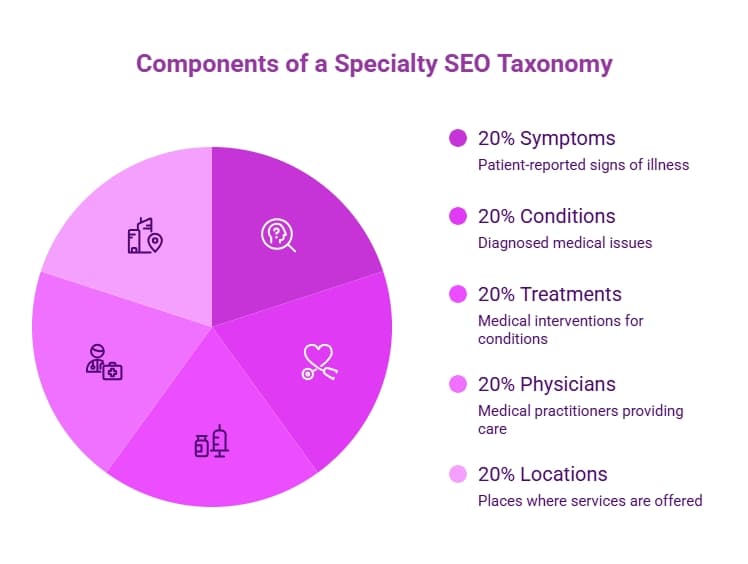
A specialty SEO taxonomy is a practical site architecture model. It defines how symptoms, conditions, treatments, physicians, service lines, locations, and access information relate to one another—and who is responsible for maintaining those relationships over time.
This is broader than keyword grouping. Keyword grouping may show that people search for "knee arthritis," "knee replacement," "orthopedic surgeon," and "orthopedic clinic near me." A taxonomy decides what each of those searches should map to on the website—and which topics deserve standalone pages, which should be consolidated, which physicians connect to which conditions, and which content needs clinical, compliance, or operational review.
Without a taxonomy, marketing, clinical, and administrative teams make independent page-creation decisions based on their own priorities. With one, the practice has a shared model that connects patient search behavior to the right specialty, care path, physician, and appointment option—consistently, and in a form that can be reviewed and maintained over time.
Google's people-first content guidance emphasizes helpful, reliable content made for people rather than content created primarily to attract search traffic. For specialty healthcare websites, that principle carries particular weight because patient-facing content can affect trust, clarity, and review responsibility.
The Five Entity Types and How They Connect
Every specialty practice translates these core clinical concepts into distinct page archetypes. Understanding how they connect matters more than understanding each one in isolation.
| Entity Type | What It Represents | Taxonomy Role |
|---|---|---|
| Conditions and diagnoses | Named concerns patients may search for | Explains the issue at a general level and routes readers to relevant care paths |
| Symptoms and concerns | Earlier-stage patient language | Connects broad questions to reviewed condition, service-line, or appointment information |
| Treatments and procedures | Services the practice offers or evaluates | Explains the service in reviewed, general terms and connects it to physicians and locations |
| Physicians and subspecialists | Providers patients or referring parties evaluate | Shows fit, credentials, focus areas, locations, and next-step options |
| Locations and access points | Offices, appointment paths, and practical access details | Helps patients understand where and how to take the next step |
The relationship between these entities follows a consistent logic:
Symptom or concern → Condition or diagnosis → Treatment or procedure path → Physician or subspecialty fit → Location and appointment access
This model should not be treated as a rigid funnel. Specialty practices are operationally complex. One physician may treat several conditions. Several physicians may treat the same condition. Some conditions map to procedures; others map to diagnostics, conservative care, monitoring, or referrals. Locations may not offer every service. The taxonomy gives the practice a way to represent that complexity without turning the website into a pile of disconnected pages.
Every page the practice creates should occupy a defined position in this hierarchy and link to the adjacent entities it belongs with. A condition page that has no physician connection, no care-path guidance, and no appointment path is not a taxonomy entry—it is an orphaned page.
When a Page Earns Its Place
A condition page earns its place when it has meaningful search or referral demand, a clearly associated physician or subspecialty, sufficient depth to explain evaluation options and care-path direction without making clinical promises, and a review pathway. The right question before creating any new page is not "Is there search volume for this?" It is "Does this represent a distinct patient decision need that the practice can support with enough accurate content, physician fit, and next-step clarity?"
Consider how this plays out in an orthopedic setting. A knee pain page, a knee arthritis page, a knee replacement page, and a surgeon bio may each serve a genuinely different patient decision—but only when each has a distinct role and the practice can support it with appropriate depth and review. Publishing all four with thin, overlapping content produces no useful signal for patients or search systems. The practice would be better served by one authoritative page for each distinct decision stage.
A dermatology practice illustrates a different dimension of the problem: routing complexity. A condition page for a skin concern may need to direct patients differently depending on whether the evaluation path leads to medical dermatology, a cosmetic treatment consultation, or a surgical assessment. That routing decision requires clinical judgment, and the content behind it requires clinical review before publication. Generalizing across care paths without review is where specialty pages most often create compliance risk.
When a Condition Should Not Become Its Own Page
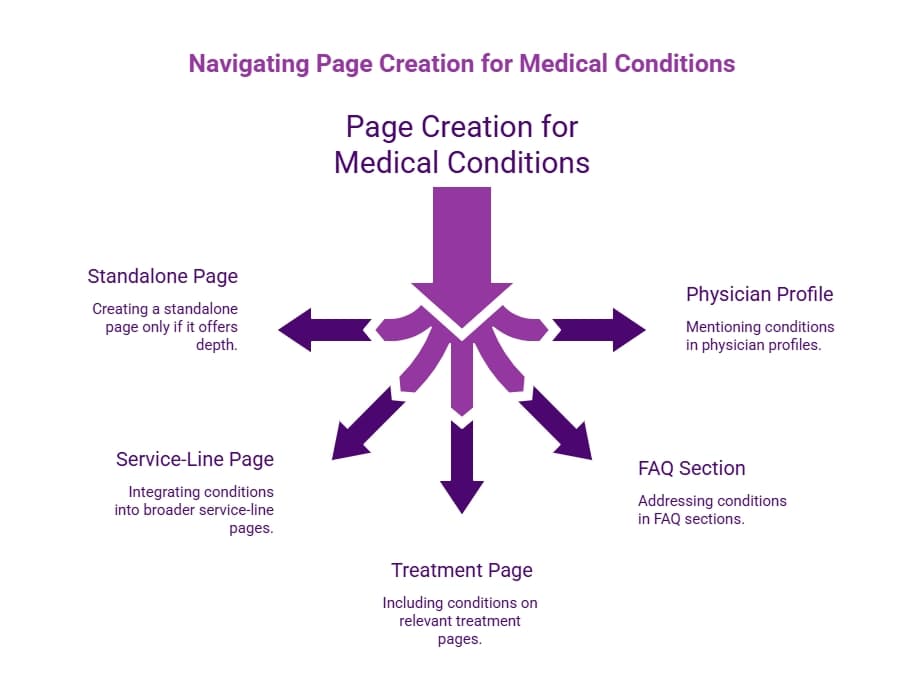
Not every condition, symptom, or keyword variation needs its own URL.
A condition may be better handled inside a broader service-line page, treatment page, FAQ section, or physician profile when the practice lacks the depth to support a standalone page. This is especially true when the condition overlaps with an existing page or when covering it accurately requires medical nuance the marketing team cannot responsibly publish without review.
Avoid creating a standalone page when it would only provide a basic definition, substantially duplicate another page, lack clear physician or care-path ownership, or imply medical suitability, safety, recovery, risk, or outcome information without clinical approval.
Consolidation is not a failure. In many cases, a smaller number of stronger pages is more useful than a large library of thin pages. Google's guidance on helpful, people-first content aligns with this principle: content created primarily to target a ranking rather than to genuinely help a specific reader tends to underperform and can weaken the credibility of the broader site.
Distinguishing Condition, Treatment, and Service-Line Pages
A specialty taxonomy works only when page types have distinct jobs. Treating these three page types interchangeably is one of the most common specialty SEO errors, and it produces exactly the overlap the taxonomy is designed to prevent.
A condition page helps the patient understand a concern, confirm that the practice evaluates or treats it, identify which specialty or physician is most relevant, and find the next step. It should stay general and avoid individualized diagnosis or treatment recommendations.
A treatment or procedure page explains what the service involves at a general level, which physicians perform or oversee it, and what evaluating candidacy typically involves. Any candidacy, preparation, recovery, risk, safety, or outcome language should be clinically reviewed.
A service-line page functions as a hub, organizing the broader specialty area and routing visitors to conditions, treatments, physicians, and locations without duplicating their content. A dermatology service-line page should not try to answer every question about every skin condition and procedure—its job is to help readers navigate the dermatology section with confidence.
Each type answers a different question at a different stage of the patient's research. Keeping them distinct—and linking them to each other with clear internal architecture—produces a navigable system. Blending them produces a site where no page does its job well.
Physician Pages as the Taxonomy's Backbone
Physician pages should be decision pages, not profile pages. A page that lists board certifications and a headshot does not help a patient determine whether this is the right specialist for their situation. It also does not help search systems understand the physician's clinical scope, associated conditions, or practice locations.
An effective physician page clarifies subspecialty focus, the conditions the physician evaluates or treats, procedures performed or overseen, practice locations, referral context, and the appointment path—all reviewed for accuracy by a qualified clinical stakeholder. It links to relevant condition and procedure pages, and those pages link back. This bidirectional relationship is what transforms a directory of bios into a navigable specialist taxonomy.
The page should not be stuffed with every possible condition keyword. It is better to connect a physician to the conditions and procedures that genuinely match their role than to make every provider appear interchangeable. That restraint is what makes a physician page useful—for patients, for referring parties, and for search systems evaluating the authority behind medical content. BVM's [Medical Specialty SEO](/services/medical-specialty-seo) service page provides related context on mapping specialty, condition, procedure, physician, and access signals.
Location Pages: Access First, Content Second
Location pages fail when they try to do too much. Copying condition and treatment content across every office page produces near-duplicate pages, dilutes the authority of the canonical specialty pages, and creates the kind of thin, city-name-swapped content that erodes rather than builds trust.
An effective location page focuses on access: address and appointment options, which physicians practice there, which services and specialties are currently available, and clear links back to the authoritative condition, treatment, and physician pages that serve patients at that site. The location page is not the destination for clinical decision-making—it is the bridge from a specific access point to the right care path.
For multi-location practices, this structure keeps local search signals clean without requiring a doorway grid of near-identical variants. A location page should not imply that every physician, procedure, appointment type, or service is available at every office unless that is accurate and reviewed. For broader healthcare content architecture, High-Value Healthcare SEO and Healthcare & Biotech SEO provide related context.
| Entity Type | Page Role | Create When | Avoid When | Reviewer Needed | Internal Links to Include |
|---|---|---|---|---|---|
| Condition page | Patient decision and evaluation support | Distinct patient need + clear physician fit + reviewable depth | Generic definition only, or significant overlap with an existing page | Clinical + compliance | Related treatments, relevant physicians, service-line hub |
| Treatment / procedure page | Explain the service and care path | Distinct procedure with care-path questions and a physician association | Only a brief mention under a broader treatment category | Clinical + compliance | Associated conditions, performing physicians, relevant locations |
| Physician page | Specialist fit and decision support | Distinct subspecialty, credentials, and location presence | Never remove — improve depth instead | Clinical (for credential and condition claims) | Associated conditions, procedures, practice locations |
| Location page | Access and appointment routing | Real access point with specific providers and available services | Page exists primarily to capture city-based keywords | Compliance (access and insurance claims) | Condition and treatment pages, physician bios for that location |
| Service-line page | Hub and routing for a specialty area | Needed to organize conditions, treatments, and physicians | Too broad to answer any specific patient decision need | Clinical oversight | All relevant conditions, treatments, physicians, and locations |
| Support page | Explain insurance, referral, appointment, or access information | The question affects routing across many pages | The information changes often and lacks an assigned owner | Operations, billing, or access owner | Relevant condition, treatment, physician, and location pages |
Governance: The Maintenance System Behind the Taxonomy
A taxonomy without governance degrades. Physicians change subspecialty focus, retire, or join the practice. Services are added or discontinued. Locations open, consolidate, or close. Insurance terms shift. Content that was accurate at publication can quietly become inaccurate—and in a healthcare context, that creates both compliance exposure and patient trust risk.
Practical governance assigns each page a primary entity type and a named clinical or administrative owner. It maintains a living condition-to-physician matrix—kept behind the scenes—that helps the marketing team know which physicians should appear on which condition and treatment pages, and helps avoid overlinking every condition to every provider. A practical checklist provides a working starting point:
- Each condition, treatment, and service-line page has a named clinical reviewer assigned by specialty
- Each physician page has been reviewed for accuracy of credentials, conditions treated, procedures listed, and current locations
- A condition-to-physician matrix is documented and updated when staff or clinical scope changes
- Content review is triggered by: new or departing physician, discontinued procedure, new service line, location change, updated insurance or referral terms, or new clinical guidance in the specialty
- Internal links across the taxonomy are audited whenever a trigger event occurs
- Each location page accurately reflects which physicians and services are currently available at that site
This checklist is not a launch-day exercise. It is the operating procedure that keeps the taxonomy from drifting out of alignment with what the practice actually offers.
Entity Clarity and Structured Data
Structured data helps search systems understand what a page is about and how its entities relate to adjacent ones—but it should not be treated as a ranking guarantee or an AI visibility guarantee. Google's introduction to structured data explains how it provides explicit clues about page meaning, and Google's general structured data guidelines cover implementation expectations. Schema.org includes healthcare-specific vocabulary for marking up medical entities, including MedicalBusiness and Physician.
The practical value of schema in a specialty taxonomy is entity clarity—helping search systems confirm the relationships between a physician, their clinical focus, the procedures they perform, and the locations where they practice. What it cannot do is fix thin content, unclear page roles, or unsupported medical claims.
If a page makes health-related advertising or outcome claims, compliance review should be involved before publication. The FTC's health products compliance guidance is a relevant high-authority reference for claim substantiation principles. For implementation context specific to healthcare content, see BVM's resource on medical schema for service pages.
Mistakes That Undermine the Taxonomy
The most common taxonomy mistakes are structural, not technical.
- Creating separate pages for keyword variations of the same condition instead of one authoritative page with clear internal links
- Publishing condition pages with no physician or subspecialty association, making the practice read like a health information site rather than a specialist destination
- Replicating the same clinical copy across location pages with only the city name changed
- Building physician bios as career summaries rather than clinical decision pages
- Linking every condition page to every physician in the practice regardless of clinical relevance
- Publishing condition or treatment descriptions without clinical review, creating both compliance risk and credibility problems
- Asserting that schema, taxonomy work, or AI optimization will guarantee rankings or AI citations
Most of these problems can be corrected through consolidation, stronger internal linking, clearer page ownership, and a defined review workflow.
Build the Architecture Before Scaling the Content
The most effective specialty practices do not begin with a content calendar. They begin with a page inventory, a defined role for each entity type, and a review workflow that can scale alongside the site.
Before publishing another condition, treatment, physician, or location page, audit the existing site. Mark each page as a condition page, treatment page, physician page, location page, service-line page, or support page. Then ask whether each page has a distinct decision role, enough useful content, accurate physician and location connections, and an assigned reviewer. That audit often reveals which pages should be strengthened, which should be consolidated, and which should not have been created in the first place.
Getting those foundational decisions in place first prevents the three outcomes that derail most specialty content programs: pages that cannibalize each other's search relevance, physician profiles that make specialists look interchangeable, and clinical content that creates review risk rather than patient confidence. The taxonomy does not need to be complete before content creation starts—but the decision rules need to exist before new pages do.
Audit your current site against the decision matrix above before building anything new. To understand how your existing architecture maps to patient search intent and specialty demand, explore Medical Specialty SEO or review the guide to appointment-first healthcare SEO for context on connecting page structure to the conversion path that matters most. To discuss your practice's specific taxonomy needs, get a visibility analysis.
Disclaimer: This article is for general healthcare marketing and SEO education only. It is not medical, legal, compliance, or clinical advice. Specialty practices should have qualified clinical, legal, and compliance reviewers evaluate any condition, treatment, procedure, physician credential, insurance, access, or patient-facing medical content before publication.
Our Editorial Process: Our expert team uses AI tools to help organize and structure our initial drafts. Every piece is then extensively rewritten, fact-checked, and enriched with first-hand insights and experiences by expert humans on our Insights Team to ensure accuracy and clarity.
By: About the BVM Insights Team
The BVM Insights Team is our dedicated engine for synthesizing complex topics into clear, helpful guides. While our content is thoroughly reviewed for clarity and accuracy, it is for informational purposes and should not replace professional advice.