 Dustin Ogle
When a patient searches "knee arthritis orthopedic surgeon," they are not looking for a homepage. They want a clear answer to a specific question: does this practice treat what concerns them, and is there a physician who might be the right fit? If the answer is buried inside a generic specialty overview — or scattered across three disconnected physician bios — the patient either works harder to find it or simply leaves.
This is the structural problem most specialty practice websites share. Physicians, services, conditions, and appointment paths exist on the site, but they do not connect in a way that helps patients move forward. The real issue is rarely missing keywords. It is missing architecture.
A strong specialty-practice SEO structure consistently answers three questions for every important condition: What is the patient trying to understand? Which page is responsible for answering that question? Which physician, service line, location, or appointment path should the page connect to next? When those three questions are difficult to answer from looking at the site, the website is not doing enough work.
What Does Condition-to-Physician Mapping Actually Mean?
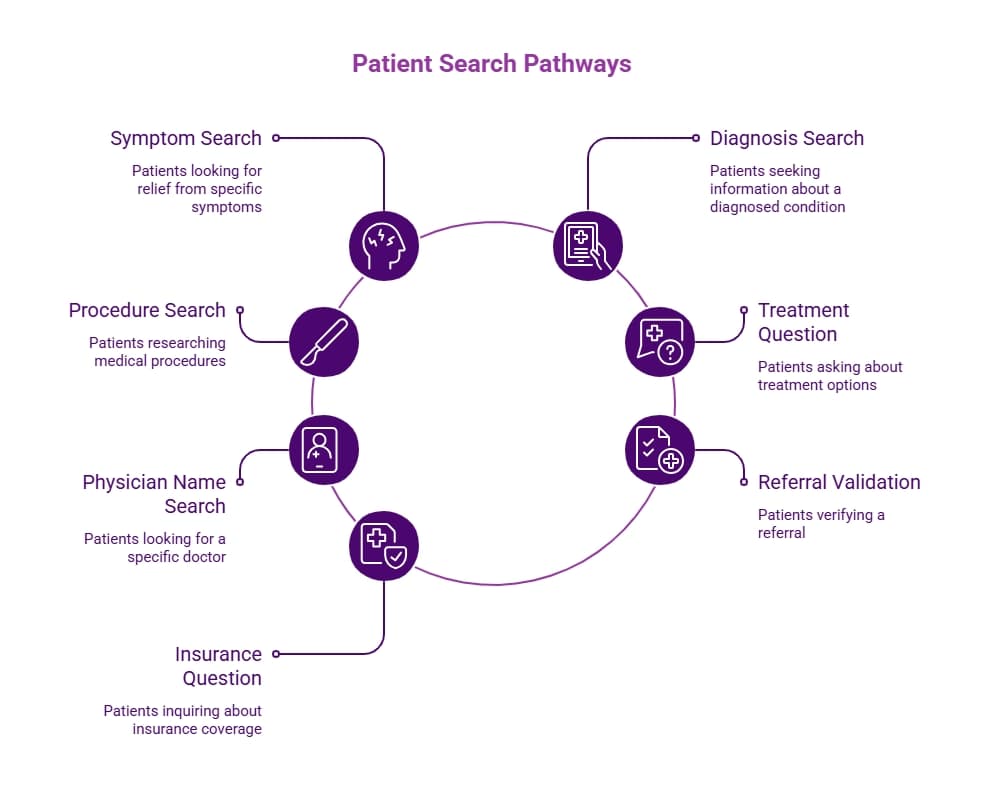
Condition-to-physician mapping is the process of organizing a specialty practice website so patient searches for symptoms, diagnoses, procedures, and treatment questions connect to the right condition pages, specialty pages, physician profiles, locations, and appointment paths.
This is a content-architecture and SEO concept, not a clinical triage tool. Its purpose is to make relationships legible — to patients, search engines, and AI systems alike — across the full chain: condition → specialty or service line → physician expertise → procedure or treatment information → location and access → next step.
Patients searching for specialty care arrive through many different entry points: a symptom, a diagnosis, a procedure name, a physician's name, a referral validation query, or an insurance and access question. Each path represents a different question, and strong specialty-practice SEO assigns each question to the right page type, then links those pages so the patient can move forward without confusion. The goal is not more pages. It is clearer relationships.
Which Page Type Should Own Each Patient Search?
Before creating content, a practice should classify what the patient is actually trying to understand. Not every query justifies a new page, and building without intent mapping leads to competing or redundant content across the site.
| Patient Search Intent | Example Query Pattern | Primary Page Type | Supporting Pages |
|---|---|---|---|
| Understand a condition | specific condition specialist" | Condition page | Physician bio, specialty page |
| Compare treatment options | "[condition] treatment options" | Condition or treatment overview | Procedure pages |
| Research a procedure | "[procedure] for [condition]" | Procedure page | Condition page, physician bio |
| Find a physician | "[specialty] doctor near me" | Physician bio or specialty page | Location page |
| Validate a referral | "[doctor name] [condition]" | Physician bio | Reviews, condition page, location page |
| Confirm access | "[specialty] clinic [city] insurance" | Location or access page | Specialty page, physician page |
Once intent is classified, each page type has a distinct job in the site's page hierarchy. Recognizing these five types as separate roles — rather than interchangeable containers for similar content — is the foundation of a coherent specialty SEO structure.
| Page Type | Primary Patient Question | Role in Site Architecture |
|---|---|---|
| Common Mistake to Avoid | Condition page | What is this condition and who evaluates it? |
| Hub for condition-specific intent; links to physicians and procedures | Creating thin pages for every keyword variation | Procedure page |
| What is this procedure and which physicians perform it? | Supports treatment-intent searches; links back to condition pages | Presenting treatment advice without clinical review |
| Physician bio | Is this doctor relevant to my situation? | Physician-fit and referral validation; links to relevant conditions |
| Repeating full condition-page content on every bio | Specialty or service-line page | Does this practice treat what concerns me? |
| Broad entry point; routes patients to condition and physician pages | Making the page too generic to support patient decisions | Location page |
| Can I access this practice conveniently? | Captures access and logistics intent; supports appointment conversion | Trying to make the location page carry every condition and physician topic |
When Does a Condition Deserve Its Own Page?
One of the most common structural mistakes in specialty websites is treating all conditions equally — giving every condition a standalone page regardless of depth, or burying all of them inside a single specialty overview. Google's helpful content guidance is relevant here: pages should provide genuine value to users, not exist primarily to capture keyword variations.
A condition generally warrants its own page when it is a common reason patients seek care in that specialty, when multiple physicians or locations treat it, when it connects to more than one procedure or treatment path, or when patients need education before they are ready to book.
Conversely, a condition may belong as a section within a broader specialty or service-line page rather than a standalone page when it is too narrow to support useful content, when it substantially overlaps with an existing page, or when it would exist solely to capture an exact-match keyword. All clinical content — any language touching on symptoms, diagnostic context, or care considerations — should be reviewed by qualified clinical stakeholders before publication.
What Should a Physician Bio Actually Do for SEO?
Physician bios are among the most underused pages in specialty practice SEO, and also among the most misused. A bio that lists thirty conditions without context tells a patient very little about whether this physician fits their specific situation. A bio that repeats every condition page wholesale creates duplicate content and blurs the distinctions between physicians. Effective physician bios help patients understand fit, not just credentials.
A well-structured bio should identify specialty and subspecialty focus, reference conditions commonly evaluated and procedures performed (if verified and approved), include relevant credentials and training, explain how to request an appointment, and link to the condition and procedure pages that reflect the physician's clinical focus. The bio's job is to signal relevance — to answer "is this doctor relevant to my situation?" — and then guide the patient to the appropriate next step.
Avoid inflated language. Claims such as "top specialist" or references to outcome volumes require substantiation and appropriate clinical review before appearing in any public-facing content.
How Should Page Ownership Work Across a Full Specialty Site?
Before writing new content, a practice should assign every major condition a single primary owner page. This prevents duplication, gives the site a coherent internal structure, and makes it easier for both patients and search engines to understand which page is the definitive source for a given topic. Supporting pages — physician bios, procedure pages, location pages — add depth and link into that hub.
The examples below are hypothetical content-architecture patterns, not medical recommendations.
| Condition | Primary Owner | Supporting Pages |
|---|---|---|
| Internal Link Direction | Knee arthritis | Condition page |
| Orthopedic surgeon bios, procedure page, location page | Condition page links to physicians and procedures; bios link back | Chronic sinusitis |
| Condition page | ENT physician bios, sinus procedure page, location page | Condition page explains the issue; procedure page explains treatment context |
| Cataract surgery | Procedure page | Ophthalmologist bios, cataract condition content, location page |
| Procedure page links to physician bios and access pages | Acne scarring | Condition or treatment concern page |
| Dermatologist bios, resurfacing procedure pages (if clinically appropriate) | Condition page links to physicians and relevant procedure pages; bios link back | Acid reflux (GERD) |
| Condition page | Gastroenterologist bios, endoscopy page (with careful medical language) | Condition page links to physicians and relevant procedure pages |
When every member of the marketing and clinical team can identify which page owns a given condition, duplicate content and competing pages become far easier to prevent.
What Happens When Multiple Physicians Treat the Same Condition?
Many specialty practices have more than one physician who evaluates the same conditions. The temptation is either to duplicate condition content across each physician's bio or to create near-identical condition pages for each doctor. Neither approach serves patients or search engines well.
A more durable approach keeps the core condition explanation on one canonical condition page, then uses individual physician bios to reflect each doctor's specific training, subspecialty focus, or care context. If three physicians evaluate the same condition, the practice does not need three near-identical condition pages. It needs one strong condition page, three accurate physician bios, and digital pathways that explain the relationship. Clear site navigation from the condition page guides patients to the relevant physicians without ranking or comparing doctors against one another. Where appropriate, a "physicians who evaluate this condition" section on the condition page makes that connection explicit. Clinical leadership should confirm which physicians are shown for which conditions before those associations appear on the site.
How Do Procedure Pages Connect Back to Condition Pages?
Procedure pages and condition pages answer fundamentally different questions, and each becomes more useful when it links clearly to the other. Condition pages answer: what is this issue and what kind of specialist should evaluate it? Procedure pages answer: what does this procedure involve, when might it be discussed, and which physicians perform it? Physician bios address whether a particular doctor is relevant. Location pages clarify access.
A procedure page should not float independently. It should link back to the relevant condition pages and to the bios of the physicians who perform the procedure. Condition pages should link forward to procedure pages that represent a likely next step. One important caution applies across all of this: procedure pages should not state that a procedure is appropriate for a specific condition as a general claim. That determination involves clinical judgment and must be reviewed by qualified clinical stakeholders before publication.
For practices refining how informational content connects to appointment pathways, an appointment-first healthcare SEO approach helps connect educational content to next steps without making individual pages overly promotional.
Why Do Access Signals Belong in the SEO Map?
Patient decision-making in specialty care is not purely clinical. Even when a patient has identified the right physician and the right condition page, they still need to know whether the practice is accessible to them. Location and access pages serve a distinct role in the page hierarchy — they answer the logistical questions that often determine whether a patient moves from research to booking.
Access information that belongs in the map includes office locations, appointment request pathways, insurance participation (where verified and maintained), referral requirements where applicable, and phone or booking pathways. For multi-location groups, location pages for multi-specialty clinics can help clarify local access and service relationships when the information is accurate and maintained. Maintaining a well-structured Google Business Profile for clinics also supports local search visibility alongside the practice website. Insurance and access details should reflect current, verified information rather than outdated assumptions.
How Should Specialty Practices Use Structured Data and AI Signals?

Structured data helps search engines and AI systems understand the relationships between entities on a specialty practice site — not just what each page says, but how physicians, conditions, procedures, locations, and specialties relate to one another. Google describes structured data as a standardized format for providing information about a page and classifying its content. It supports entity clarity. It does not guarantee rankings or rich results.
Schema.org defines types such as Person (for individual physician profiles), MedicalBusiness, and MedicalCondition applicable to physician bios, practice locations, and condition or procedure pages. For location and access pages, Google's LocalBusiness structured data documentation is the relevant technical reference. These structured data classifications, accurately implemented, help search engines understand what a practice treats, who its physicians are, and where patients can access care.
The same entity relationships matter increasingly for AI search. As more patients use AI tools to determine which specialist to see for a symptom or condition, well-structured content that clearly connects symptoms, conditions, physicians, and procedures gives those systems more to work with. Structuring entity relationships definitively addresses exactly this challenge — ensuring algorithmic answers can accurately reflect a practice's expertise. Schema implementation should be validated against current Google and Schema.org documentation before deployment, and all medical content should receive clinical and compliance review before markup is applied.
Privacy-sensitive marketing elements also require careful handling. Practices should involve compliance stakeholders when content, tracking, reviews, testimonials, or communications may involve protected health information. The U.S. Department of Health and Human Services provides HIPAA guidance on marketing that is directly applicable to these decisions.
What Should Come Before Publishing New Pages?
The most effective specialty practice websites build the map before building the pages. Publishing new content without a clear ownership model tends to recreate the disconnected structure the mapping exercise is meant to fix. Before drafting new condition pages, physician bios, or procedure content, work through this checklist:
1. List priority conditions by specialty based on patient search demand and clinical relevance
2. Identify which physicians evaluate or treat each condition
3. Identify related procedures and assign each condition a single primary owner page
4. Confirm no two existing pages are competing for the same primary role
5. Remove or consolidate thin, duplicate, or overlapping pages
6. Establish clear navigational connections from physician bios, specialty pages, and location pages to the appropriate condition or procedure pages
7. Verify that access details are accurate and up to date
8. Have clinical stakeholders review all condition, procedure, and physician content before publishing
9. Add structured data only where content is accurate and verified
10. Validate structured data against current Google and Schema.org documentation before implementation
11. Track whether patients are reaching the right page and finding a clear next step
This map should be reviewed by clinical stakeholders before publication.
Better Mapping Creates a Clearer Patient Path
The five-part specialty SEO map provides a consistent framework for auditing existing content and planning new pages:
| Part | Question It Answers | Condition |
|---|---|---|
| What problem is the patient researching? | Specialty / Service Line | Which practice area owns the issue? |
| Physician | Which doctor or team is relevant? | Procedure / Treatment Path |
| Which related page helps explain available options? | Access | Where and how does the patient take the next step? |
Every page on a specialty practice site should be able to identify where it sits in this map, which pages it supports, and what the patient's next step is. When that question is hard to answer, it usually means the page is redundant, too thin, or disconnected from the actual patient path.
The goal is a website where a patient searching for a specific condition, physician, or procedure can find relevant information, understand who evaluates that issue, and know how to take the next step — without the site pretending to replace a clinical conversation. Appointment-first healthcare SEO treats that next step as a first-class design element throughout, not as an afterthought.
For practices ready to assess how their condition, physician, procedure, and appointment paths connect, BVM's medical specialty SEO and high-value healthcare SEO services are built for this kind of structural work. Request a specialty search audit to identify where the gaps are.
Disclaimer: This article is for general healthcare marketing and SEO education only. It is not medical advice, legal advice, or compliance advice. Specialty practices should have qualified clinical and compliance stakeholders review condition, procedure, physician, and patient-access content before publication.
Our Editorial Process: Our expert team uses AI tools to help organize and structure our initial drafts. Every piece is then extensively rewritten, fact-checked, and enriched with first-hand insights and experiences by expert humans on our Insights Team to ensure accuracy and clarity.
By: About the BVM Insights Team
The BVM Insights Team is our dedicated engine for synthesizing complex topics into clear, helpful guides. While our content is thoroughly reviewed for clarity and accuracy, it is for informational purposes and should not replace professional advice.