
 Dustin Ogle
Many specialty practices publish condition pages that accurately describe a diagnosis but fail to answer the question patients and referring providers are actually asking: does this practice have the right clinical fit? A GERD page explains what the condition is. It does not show which gastroenterologist evaluates it, what diagnostic procedures the practice offers, or where a patient can access care. That gap is not a content problem. It is an expertise-visibility problem.
Adding a "reviewed by" label to existing pages does not close it. Real physician expertise needs to be embedded structurally — in how condition pages are planned, what they include, how they link to the physicians behind them, and how they stay accurate as the practice evolves.
Strong condition-page SEO for specialty practices depends on three connected layers working together: clinical accuracy — pages reviewed and maintained by qualified stakeholders; physician-fit visibility — content that surfaces which physicians, credentials, and subspecialty strengths are relevant to the condition; and search and AI clarity — page architecture that makes the relationship between condition, procedure, specialist, and appointment pathway legible to both patients and search systems. When any one layer is missing, the page underperforms — not because of a keyword gap, but because the content fails to reflect the clinical reality behind it.
Why Physician Expertise Belongs on Specialty Condition Pages
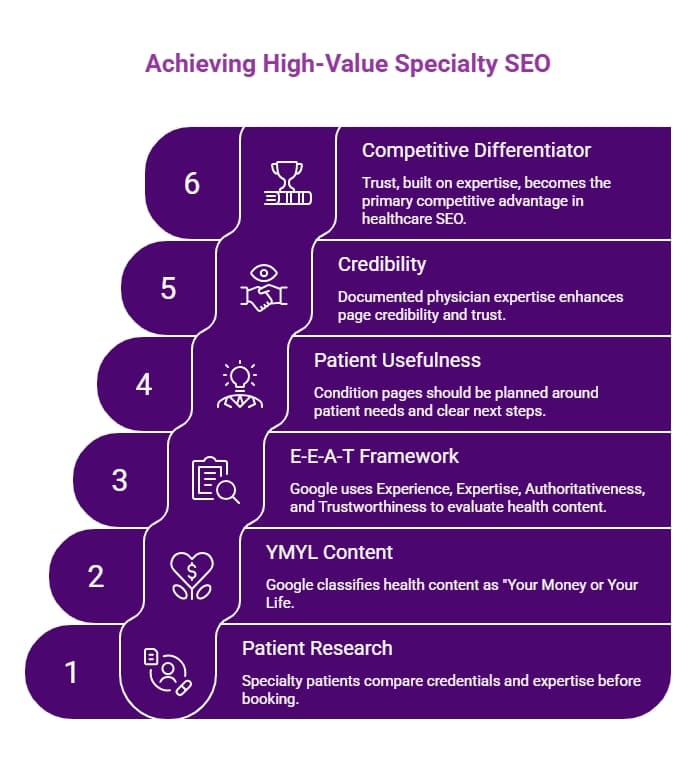
Specialty patients research differently from general-care patients. Before booking — or asking a referring provider to make the call — they typically assess whether the practice has the right clinical depth for their specific situation. They compare credentials, subspecialty focus, referral confidence, and how clearly the practice communicates its scope. This is especially true in longer-consideration specialties like neurology, orthopedics, or gastroenterology, where patients may spend considerable time comparing providers before committing.
Specialty healthcare falls into what Google's Search Quality Rater Guidelines classify as YMYL content — "Your Money or Your Life" — material that can meaningfully affect a reader's health or wellbeing. Google's Search Quality Rater Guidelines help explain how quality raters evaluate pages, but it is worth being precise: quality-rater scores do not directly control individual page rankings. The standard the framework reflects is still meaningful — health content is evaluated on accuracy, trustworthiness, and demonstrated expertise.
This connects directly to E-E-A-T — Experience, Expertise, Authoritativeness, and Trustworthiness — the quality framework Google applies when assessing health-related content. Google’s guidance on creating helpful, reliable, people-first content—now fully integrated into its core ranking systems—emphasizes that content should be useful, reliable, and created for people rather than primarily for search engines. In healthcare-adjacent content, that principle supports a practical editorial standard: condition pages should be planned around patient usefulness, verified expertise, and clear next steps — not superficial search optimization.
Documented physician expertise on a condition page cannot guarantee better rankings. What it can do is make the page more useful, more credible, and better aligned with how patients and referring providers evaluate specialty care during the decision process. That matters most in high-value healthcare SEO, where trust functions as the primary competitive differentiator.
Let Real Physician Qualifications Shape the Condition-Page Map
The most practical starting point is identifying conditions where the practice already has physician expertise, service capability, and a clear appointment pathway — not conditions that happen to show search volume. A practice should not build a condition page simply because a keyword exists. The safer and more useful approach is to prioritize topics where there is a genuine connection between physician expertise, service capability, patient demand, and an appointment path.
Condition pages deserve priority when they involve:
- Conditions the physicians on staff commonly evaluate
- Conditions tied to subspecialty focus areas within the practice
- Conditions connected to procedures or treatment pathways already offered
- Conditions frequently referred by PCPs or other specialists
- Conditions where patients need education before identifying the right type of specialist
- Conditions with a clear physician owner who can review the page for accuracy
Creating pages for conditions outside that scope — solely because a keyword shows demand — creates a credibility problem. A cardiology group should not build condition content around areas it does not evaluate. An orthopedic group should avoid publishing pages that imply procedural availability the practice does not offer. A dermatology group should not frame reviewed treatment options as personalized recommendations. A page implying expertise the practice does not have, or linking to providers who do not evaluate that condition, generates confusion at the exact moment a patient needs confidence.
The practical question is not, "Can this page rank?" It is: "Can this page accurately connect a real patient need to a real physician, service line, and next step?"
Make the Physician-Condition Relationship Visible on the Page
Once the right conditions are prioritized, each page should make the physician-condition connection explicit without making unsupported superiority claims. A referring cardiologist sending a patient for an arrhythmia evaluation needs visible confirmation that the practice has a physician with relevant training — not just a thorough definition of the condition.
A practical physician expertise block can include the following elements:
| Element | Purpose |
|---|---|
| Physician name and specialty | Helps readers identify relevant clinicians |
| Verified credentials | Supports accurate expertise representation |
| Subspecialty or clinical focus | Connects the physician to the condition |
| Relevant services or procedures | Shows the evaluation pathway without giving individualized advice |
| Location or access details | Helps patients understand practical availability |
| Provider bio link | Lets readers evaluate the physician in more depth |
| Clinical reviewer note, if used | Clarifies review accountability and last-reviewed date |
Credential language should be plain and verified. "Fellowship-trained in electrophysiology" is appropriate if documented. "The region's leading arrhythmia specialist" is not, unless independently substantiated and legally reviewed. These modules also support referring providers — a referring provider does not only need a broad service line; they need confidence that the condition, physician focus, location, and appointment pathway align with the referral.
For a hypothetical orthopedic practice, the knee pain page should route the reader to relevant orthopedic physicians on staff, link to related procedure pages, and show which locations handle evaluations — with a note indicating when a clinical reviewer last verified the content. A hypothetical gastroenterology practice's GERD page should connect symptoms and evaluation pathways to the relevant GI physicians and diagnostic procedures the practice offers, making location access clear, while stopping well short of providing individualized diagnostic guidance.
Use Provider Bios as Evidence Hubs, Not Thin Directory Entries

A provider bio listing a name, specialty, and headshot is a directory entry. One that documents qualifications, clinical focus areas, fellowship training, hospital affiliations, accepted case types, and links to relevant condition pages is a credibility asset — and a functional part of the practice's search architecture.
The relationship between condition pages and provider bios should work in both directions. A condition page links to the physicians relevant to that condition. A physician bio links back to the conditions and procedures within that physician's scope. A patient who lands on the bio reaches the relevant condition page without starting over. A patient on the condition page can reach the right provider directly.
This is where medical specialty SEO differs from generic local SEO. The search path needs to connect symptoms, diagnoses, procedures, insurance or access questions, and physician-fit signals so the reader can move from concern to the right specialist pathway. Provider bios are central to that architecture — not a secondary consideration.
Schema markup can support clearer entity relationships when technically appropriate. A practice may evaluate whether Physician or MedicalBusiness schema fits its implementation needs, but this should be confirmed with current technical SEO standards before deployment. For related implementation thinking, see the guide to medical schema for service pages.
Show Expertise Without Turning the Page Into Medical Advice
Plain-language health communication is both a readability standard and a trust signal. Patients who cannot parse a condition page because it reads like a clinical abstract are not well served by it. Neither are patients who receive what amounts to individualized medical guidance from a webpage.
The line to hold is between general education and personalized advice. The CDC's plain language health literacy resources emphasize keeping the reader in mind when making decisions about organization, word choice, and presentation — explaining pathways clearly without oversimplifying clinical accuracy. For condition pages, that means the following:
Safer phrasing choices include "a specialist may evaluate," "depending on the patient's history," and "your physician may discuss options including." Phrasing to avoid includes "you should choose this treatment," "this procedure guarantees relief," and "our physicians deliver the best outcomes."
The AMA Code of Medical Ethics, specifically Opinion 5.021, states that physician communications should not be false, misleading, omit necessary material information, or otherwise deceive. As a general ethical principle, this supports cautious credential representation and careful review of expertise claims before publication. A hypothetical dermatology practice's acne treatment page can describe the general evaluation process, reference treatment categories a specialist may discuss, and link to relevant physicians by clinical focus — without promising outcomes for any individual patient. Verified credentials and transparent review attribution carry more durable credibility than superlatives ever will.
Internal Linking Should Reflect the Real Clinical Pathway
Internal links on a condition page should help patients move through the practice's actual clinical structure — not function as random SEO placements. The natural paths run from condition page to physician bio, from bio back to relevant conditions, from condition page to related procedure, and from condition page to location or appointment access.
| Link Path | Why It Helps |
|---|---|
| Condition page → relevant provider bio | Shows who evaluates the condition |
| Provider bio → condition and procedure pages | Shows physician-condition fit |
| Condition page → related procedure page | Connects education to offered services |
| Condition page → location page | Clarifies access for multi-location practices |
| Condition page → appointment CTA | Gives a clear next step |
| Condition page → insurance or access details | Reduces practical booking friction |
The appointment-first healthcare SEO approach connects condition and physician content directly to the patient's next step, so a motivated reader does not reach a dead end. For practices operating across multiple sites, location pages for multi-specialty clinics clarify where a patient can access evaluation for a specific condition. Consistent provider and location validation beyond the website — through assets such as Google Business Profile for clinics — reinforces these relationships across the channels patients actually use to verify a specialist before booking.
Governance Is What Keeps Expertise Accurate Over Time
Condition pages are not publish-once assets. Physicians join and leave practices. Offerings change. Locations open or close. A page attributing clinical review to a fellowship-trained surgeon who has since left the practice is no longer accurately attributed — a trust problem that surfaces the moment a referring provider or informed patient tries to act on it.
A governance checklist for specialty condition pages:
- Assign a physician reviewer and a marketing owner to each page
- Record and display the last clinical review date
- Verify that listed physicians still evaluate the condition at the practice
- Confirm internal links still point to current bios, procedures, and locations
- Review credential, affiliation, and technology claims for ongoing accuracy
- Remove unsupported or outdated statements
- Trigger a re-review after physician departures, new service lines, new locations, or significant clinical updates
An annual review is a reasonable editorial baseline for most practices. Requirements may vary by specialty, risk tolerance, and compliance process, but the governing principle is the same: governance is where clinical accuracy and search clarity stay aligned — not as a one-time build effort, but as a recurring operational responsibility.
What a Strong Specialty Condition Page Should Include
Google's guidance on helpful, reliable, people-first content asks whether content demonstrates genuine expertise and was made to serve readers rather than search engines. Applied to specialty condition pages, a practical checklist looks like this:
- Plain-language condition overview, written for a patient rather than a clinical peer
- Context for when patients typically seek a specialist, framed generally — not as individualized advice
- How the practice evaluates the condition: process and access, not personal recommendations
- Relevant physicians with verified expertise signals: board certification, fellowship training, subspecialty focus, hospital affiliations
- Related procedures or treatment pathways the practice offers
- Clinical reviewer attribution and last-reviewed date
- Links to physician bios, related service pages, location access, and appointment paths
- A clear CTA and an FAQ section reviewed by a clinical stakeholder
Frequently Asked Questions
Expertise Should Be Built Into the System, Not Added at the End
A condition page that genuinely reflects physician expertise did not get there by having a review label inserted at publication. It got there because the practice identified which conditions deserved pages based on actual clinical scope, built each page around what the relevant physicians could verify, and assigned clear ownership before anything went live.
The three layers — clinical accuracy, physician-fit visibility, and search and AI clarity — only hold together when treated as a system rather than as tasks handed off between teams at different times. That kind of content takes longer to build. It is also more durable, more useful to patients and referring providers, and more consistent with the practice's actual clinical identity than content assembled around search volume alone.
BVM helps specialty practices map condition, procedure, physician, and access content so patients can better understand practice fit before they book. Want to see where condition, physician, and specialty searches are failing to connect back to your practice? Get a visibility analysis of how patients find your specialty online.
This article is intended for general educational and informational purposes only. It does not constitute legal, compliance, or medical advice. Clinical content decisions should be reviewed by qualified physicians and, where applicable, by legal or compliance professionals familiar with applicable professional standards and regulations.
Our Editorial Process: Our expert team uses AI tools to help organize and structure our initial drafts. Every piece is then extensively rewritten, fact-checked, and enriched with first-hand insights and experiences by expert humans on our Insights Team to ensure accuracy and clarity.
By: About the BVM Insights Team
The BVM Insights Team is our dedicated engine for synthesizing complex topics into clear, helpful guides. While our content is thoroughly reviewed for clarity and accuracy, it is for informational purposes and should not replace professional advice.