
 Dustin Ogle
A specialty practice website can look complete at first glance — physician bios, a services overview, location pages, a regularly updated blog — and still fail to appear for the searches prospective patients use when evaluating where to receive care. This disconnect rarely traces back to a lack of content. Most of the time, it is a content architecture problem: not a volume problem, but a mapping problem.
Clinical expertise is organized internally around departments, physicians, and operations. Patients search differently — by condition, procedure, and whether the right specialist is available for their specific situation. Specialty patients evaluate risk, clinical fit, treatment focus, and physician credibility before engaging with a practice. Generic local SEO alone does not speak to those criteria. Medical specialty SEO requires a structural approach built around the relationships between conditions, treatments, physicians, service lines, and appointment paths. Closing the gap starts with understanding what a treatment-intent content gap actually is.
What Is a Treatment-Intent Content Gap?
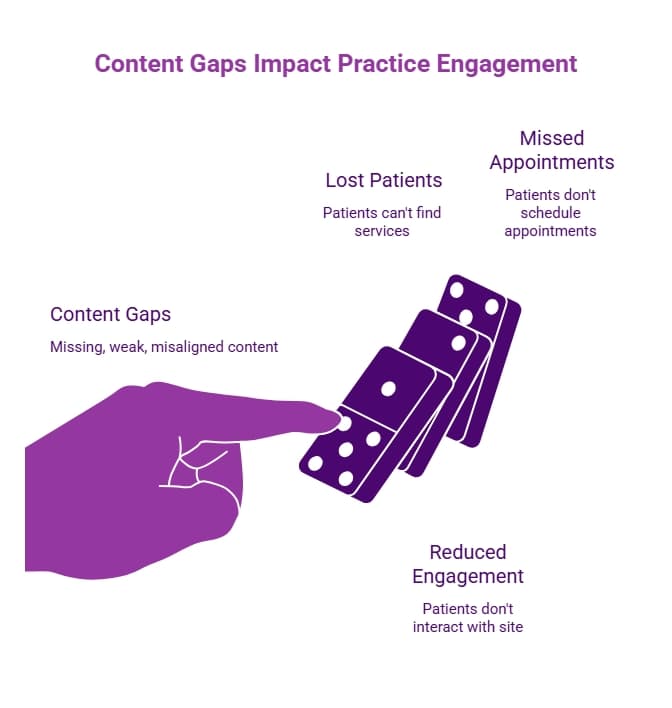
A treatment-intent content gap is a missing, weak, or misaligned content pathway between a condition or treatment search and the practice's relevant physician, service line, location, or appointment path.
These gaps follow predictable patterns. A cardiology group treats atrial fibrillation but the site offers only a broad "Cardiology Services" overview. An orthopedic group performs knee replacement yet the surgeon's bio never links to a knee arthritis or knee replacement page. A gastroenterology practice has colonoscopy content that is entirely disconnected from the physician who performs the procedure, the location where it is available, and what the patient should do next. Sometimes the problem is not a missing page at all — it is a page that uses generic copy that could apply to any practice in the country, with no physician attribution, no condition-specific differentiation, and no clear path to scheduling. That is a harder problem to diagnose than page length, and it is more common than most practice leaders realize.
All condition and treatment examples throughout this article are used as content architecture illustrations. Any such language used in published content should be reviewed by a qualified physician or clinical SME before publication.
Why Specialty Practice Sites Often Miss These Gaps
Broad service pages feel complete from the inside. A practice may know which physicians treat which conditions. Staff may know which location offers a particular procedure. Administrators may understand referral patterns. Physicians may know their subspecialty strengths. But if those relationships are not visible on the website, search engines, AI tools, and prospective patients cannot connect them.
Websites are typically organized around internal categories — departments, physician names, broad service headings — rather than around how patients search. Service pages are built by department rather than by condition. Physician bios prioritize credentials without connecting those credentials to the specific conditions or procedures a physician treats. Blog posts draw informational traffic without routing readers toward appointment-intent pages. Location pages list specialties without the service-line depth that helps patients — and search systems — understand what is actually available at a given site. And when no clinical reviewer is assigned to a service line, content defaults to safe generalities that differentiate nothing.
The website ends up reflecting how the practice operates, rather than how patients evaluate care.
The Content Chain and Where It Breaks
The practical model for a specialty content audit is a five-part chain:
Condition → Treatment → Physician → Location → Appointment Path
Treatment-intent gaps appear wherever a link in that chain is missing. Each break has a distinct signature:
- A condition is represented on the site, but no dedicated treatment page exists for it.
- A treatment page exists, but no physician is identified as the service owner.
- A physician has the right subspecialty credentials, but their bio contains no links to related condition or treatment pages.
- A location page names the specialty without specifying which services are available there.
- A page ranks well enough for search but the appointment or referral path is generic, unclear, or absent.
Identifying which specific link is broken — rather than simply asking whether the site has enough content — is what makes an audit actionable rather than exploratory.
Mapping the Audit: A Six-Layer Framework
A structured audit should move through the following layers for each priority service line:
| Audit Layer | Question to Ask | Example Gap |
|---|---|---|
| Specialty | Which service lines does the practice want to grow? | "Orthopedics" exists, but sports medicine and joint replacement are not separated. |
| Condition | Which conditions do physicians commonly evaluate? | "Hip arthritis" appears only in a blog post. |
| Treatment | Which procedures does the practice offer? | "Knee replacement" is mentioned in one paragraph. |
| Physician | Who has relevant subspecialty expertise? | The bio lists fellowship training but links to nothing. |
| Location | Where can patients access this service? | A location page lists orthopedics but not the treatments available there. |
| Appointment Path | What should the reader do next? | No condition-specific scheduling or referral path exists on the page. |
This is an editorial and content architecture audit, not a clinical appropriateness exercise. The purpose is to map what exists, identify what is missing, and determine which gaps align with the practice's highest-priority service lines.
Cardiology: Gap Patterns to Recognize
Cardiology sites frequently compress a wide range of services behind a single overview page, making it difficult for search systems or prospective patients to connect a specific query — "heart rhythm evaluation," "atrial fibrillation specialist," "heart failure management" — to the right physician or service. Physician bios often mention subspecialty focus such as electrophysiology or interventional cardiology without linking to any relevant condition pages. Diagnostic and monitoring services — cardiac imaging, vascular testing, chest pain evaluation, preventive cardiology — are frequently offered but buried in general copy, with no physician owner named and no appointment pathway attached.
Orthopedics: Gap Patterns to Recognize
Orthopedic sites face an overcompression problem. One service page attempting to cover spine care, sports medicine, joint replacement, hand surgery, and foot and ankle care simultaneously cannot do justice to any of them. When no separation exists at the condition or treatment level, prospective patients cannot determine whether the practice is the right fit, and search systems cannot connect specific queries to specific services.
High-search conditions such as knee arthritis, hip replacement, shoulder pain, and rotator cuff repair often appear as brief mentions within longer overviews rather than as individual pages with physician attribution, location information, and appointment paths. Sports injury evaluation and spine care present similar gaps. Surgeon bios frequently list procedure experience without linking to relevant treatment pages, and location pages often name "orthopedics" without specifying which orthopedic services are available at each site.
A Cross-Specialty View of Gap Patterns
The same structural problems appear across most specialties, with some variation by practice type:
| Specialty | Common Gap Pattern | What to Audit |
|---|---|---|
| Dermatology | Conditions and procedures split across unconnected pages | Skin cancer screening, acne, psoriasis, cosmetic vs. medical pathways |
| Gastroenterology | Procedure pages without condition or physician routing | Colonoscopy, reflux, IBS, liver disease, location and scheduling paths |
| ENT | Symptoms, diagnoses, and procedures disconnected | Sinus care, hearing loss, sleep-related services, pediatric vs. adult pathways |
| Ophthalmology | Procedure pages without condition or physician-fit context | Cataracts, glaucoma, LASIK, retina, provider and location availability |
| Urology | Sensitive conditions underdeveloped or too generic | Kidney stones, prostate care, incontinence, fertility-related services |
| Neurology | Complex conditions underexplained, referral paths unclear | Migraine, epilepsy, movement disorders, diagnostics |
Physician-Service Matching as the Operational Backbone
The question underlying every audit layer is the same: which physician owns this service, at which location, and what is the appropriate next step for the patient or referral source? For each priority condition or treatment, the practice should be able to state which physicians treat it, what credentials or subspecialty focus can be stated and verified, which locations offer the service, which related conditions or treatments should link to it, and who is responsible for reviewing the content for accuracy.
This turns a content project into a cross-functional workflow involving marketing, physicians, administrators, clinical reviewers, and compliance reviewers who can help reduce privacy, regulatory, and claim risk before publication. Practices that build this process produce pages that are more specific, more credible, and more aligned with high-value healthcare SEO goals than those publishing without structured review.
Blog content fits into this framework in a defined supporting role. A post on "what causes knee pain" serves an early-stage reader still determining what is wrong. A knee arthritis condition page and a knee replacement treatment page serve a reader already evaluating whether this practice is the right place to receive care. Supporting content should link into service-line pages rather than substitute for them — that connection between informational content and appointment-intent pages is the foundation of appointment-first healthcare SEO.
How AI-Assisted Search Raises the Bar for Content Structure
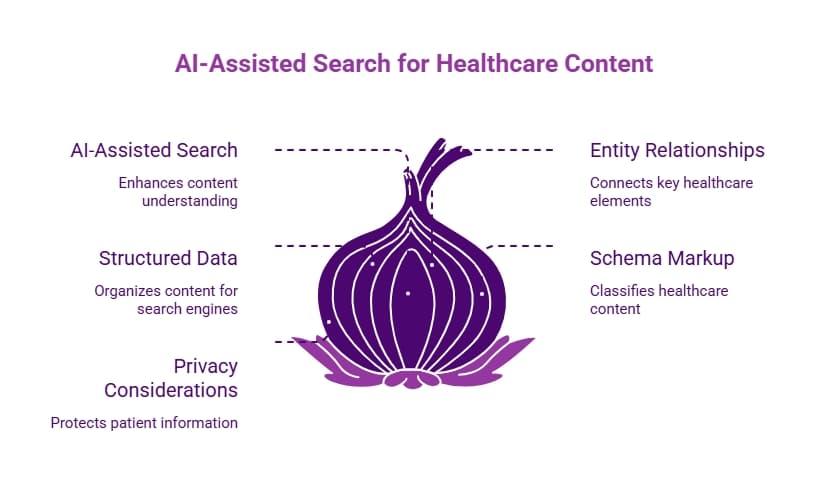
AI-assisted search makes clear entity relationships more important, not just keyword density. For a specialty practice, the entities that matter include the practice, the physician, the specialty, the condition, the procedure, the treatment, the location, the appointment path, and the review and proof signals that establish clinical credibility. When those relationships are clearly expressed in content and reinforced with structured data, search systems can more accurately connect a specific query to the relevant physician, service, and location.
Google's structured data documentation explains how schema markup helps Google understand page content. Google's structured-data guidelines and rich-results testing tools help teams evaluate implementation eligibility. Schema.org includes medical entity types — MedicalClinic, MedicalProcedure, MedicalOrganization — that can help classify healthcare content appropriately. For implementation guidance specific to specialty practices, medical schema for service pages covers how to apply these types in a way that supports content architecture rather than just technical markup. Schema is a support layer — and not every schema type creates a visible rich result in Google Search. The entity relationships need to exist clearly in the content before structured data can communicate them effectively to search systems.
For practices that incorporate patient reviews or testimonials into their visibility strategy, privacy considerations apply. The American Medical Association notes that physicians responding to online reviews must maintain the privacy of protected health information, even when a patient has already shared that information publicly.
Deciding How to Fix Each Gap
Not every gap requires a new page, and building condition pages for every possible topic creates thin, duplicative content that serves neither patients nor search systems well.
Fix an existing page when it already addresses the right intent but lacks depth, internal links, physician attribution, structured data, or a clear next step. A section update or internal-link adjustment may be enough when the topic is a component of a broader service, the existing page already satisfies the main intent, or the primary issue is a weak connection between pages rather than a missing one. Create a new page when the condition or treatment has distinct search intent, a defined physician and service owner, enough reviewed substance to stand alone, and a clear internal link structure to support it. Consolidate or hold when topics would be duplicative, when no clinical reviewer can be assigned, or when the content required would be too thin to be genuinely useful.
Location pages for multi-specialty clinics illustrate this well. A location page that lists a specialty without indicating which services are available there, or which physicians see patients there, is not missing a new page — it is missing a more useful version of the one that already exists.
Strong prioritization considers service-line value, physician availability, clinical review capacity, search intent, patient decision pathways, and operational readiness.
A Treatment-Intent Gap Audit Checklist
Use this as a starting point for any priority service line:
- List the practice's priority service lines and the conditions each one addresses.
- Identify major treatments and procedures the practice wants to be known for.
- Map each condition and treatment to a specific physician owner.
- Map each service to the locations where it is available.
- Confirm that each page includes a clear appointment or referral path.
- Verify that physician bios link to relevant condition and treatment pages.
- Check whether location pages reflect the service lines and treatments available there.
- Identify blog posts that should link into service-line pages rather than stand alone.
- Flag all condition and treatment content requiring clinical review before publication.
- Prioritize fixes by service-line value, search intent, clinical review capacity, patient decision pathways, and operational readiness.
What Practice Leaders Should Do Next
The most practical starting point is narrow: pick one priority specialty or service line, trace the full Condition → Treatment → Physician → Location → Appointment Path chain for it, and identify exactly where the chain breaks. Assign clinical reviewers before expanding any condition or treatment content. Address the highest-value pathways first, then build outward.
Track visibility and appointment-quality signals, not traffic alone. A specialty practice does not need every possible page — it needs clear, reviewed, internally linked pathways that reflect the conditions, treatments, physicians, and service lines it actually wants to grow.
A site that clearly reflects clinical expertise at the condition, treatment, physician, and location level gives the right patients a reason to engage — and gives search systems the structure they need to surface it.
Want to see where your specialty site is missing condition, treatment, physician, and appointment-intent pathways? BVM can map the gaps that may be keeping your highest-value service lines from showing up in search.
Our Editorial Process: Our expert team uses AI tools to help organize and structure our initial drafts. Every piece is then extensively rewritten, fact-checked, and enriched with first-hand insights and experiences by expert humans on our Insights Team to ensure accuracy and clarity.
By: About the BVM Insights Team
The BVM Insights Team is our dedicated engine for synthesizing complex topics into clear, helpful guides. While our content is thoroughly reviewed for clarity and accuracy, it is for informational purposes and should not replace professional advice.