
 BVM Insights Team
The page ranks. The patient still leaves.
A procedure search pathway connects a patient’s procedure or recovery question to the surgeon who performs the work, the proof that earns trust, and a clear consultation step. Without that pathway, a well-ranked procedure page answers the first question and then sends the patient back to search results to finish the evaluation somewhere else.
Picture a prospective patient reading your breast augmentation recovery section to the last line. Then a new browser tab opens, and the search bar fills with surgeons from three other practices.
You have spent months on the build-out, surgeon approvals, and a launch date that will not move. The page is ranking. So why are the consult requests so thin? The page explained the procedure, then left the patient to work out who performs it, why that surgeon deserves attention, and what to do next.
The usual advice is to build procedure pages around procedure keywords and point visitors to a contact button. That holds up until the patient starts weighing recovery, surgeon fit, aesthetic style, credentials, and galleries. Then a keyword-focused page can capture the search and still lose the shortlist.
A procedure search pathway closes that gap. Visibility builds the runway, and the pathway carries the patient from a first question to a confident consultation request without a detour to another practice.
What a Procedure Search Pathway Actually Does
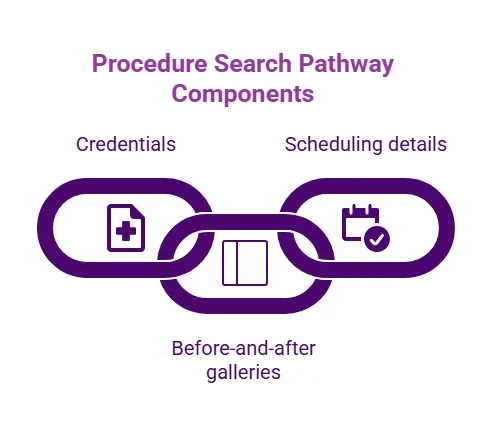
A procedure search pathway keeps a patient’s research moving inside your website. It systematically presents credentials, before-and-after galleries, and scheduling details at the exact moment of intent, ensuring the visitor has no reason to bounce to a competitor.. The procedure page is the entry point, and the connected pages around it complete the evaluation.
The pathway is one part of a broader Procedure-to-Consult Search Strategy, which sits inside plastic surgery SEO launch sequencing for new Texas practices. The same logic applies to any practice preparing to open, relocate, or rebrand. In every case, the pathway’s job is to keep procedure visibility tied to the surgeons who perform the work.
The idea of connecting a search entry point to the next patient question applies across specialties. Elective cosmetic research adds two layers that generic healthcare SEO tends to underweight: aesthetic fit and visual proof. A useful procedure-to-surgeon journey has to carry both.
Timing matters too. Treating search as cleanup for after opening day carries a real risk, because prospective patients may already be building shortlists around practices whose pathways are live.
Why a Procedure Page Alone Can Leave the Patient Stranded
Most cosmetic patients begin with a need, not a surgeon’s name, and a standalone procedure page only answers that need. Documented plastic surgery discovery patterns show research spanning procedure questions, recovery concerns, galleries, reviews, credentials, financing, and location, much of it before any consultation request.
Patients enter that research from different starting points. One person searches “breast augmentation before and after.” Another looks for a plastic surgery consultation in a nearby city. A third already has a surgeon’s name in mind and wants to confirm the choice. These are different research needs, not stages every patient moves through in the same order. Some cosmetic patients also look beyond their own neighborhood, so map visibility alone may not carry the route.
After the first answer, the patient’s task changes. They stop learning about a procedure and start deciding whether a particular surgeon belongs on the shortlist. Broad cosmetic copy cannot settle that question. A contact button placed before those trust questions are answered asks for commitment too early. When the page offers nothing more, the patient returns to Google, asks an AI search assistant, or opens another practice’s website to keep comparing.
Myth: Ranking for the surgeon’s name is enough to generate the patient discovery a practice needs.
Fact: Branded visibility helps people who already know the surgeon. A procedure-driven pathway is designed for patients who begin with a need, procedure, or recovery question and have not yet selected a surgeon.
Under launch pressure, galleries wait on approvals and placeholder copy goes live. More generic pages look like progress. The real gap is usually the missing link between procedure and surgeon.
The Procedure-to-Surgeon Pathway
The pathway connects five patient questions in sequence:
Procedure or Recovery Question → Relevant Surgeon → Credibility and Fit Proof → Gallery or Visual Context → Consultation Action
Use this sequence as a baseline architectural model, adapting it to your practice’s specific scale and procedure mix. Its depth will vary with practice size, surgeon count, and procedure mix.
- Start with the procedure or recovery question. The entry page answers what brought the patient in. A patient researching recovery needs clear, clinically reviewed educational information. A patient comparing procedures needs a plain account of how the options differ and why professional evaluation matters. This is information architecture, not clinical guidance, so know where helpful procedure information ends and clinical advice begins. Getting this right protects clinical credibility from the first click.
- Make the relevant surgeon easy to identify. Patients should not have to dig through a general “Meet Our Surgeons” page. The procedure page should point to the surgeon whose verified procedure focus matches the service. In a multi-surgeon practice, link wherever the procedure-to-surgeon relationship reflects actual clinical responsibilities, and give the roles of physician and procedure pages deliberate thought. Shortlisting starts here.
- Surface credibility and fit proof before asking for commitment. Several factors help a patient decide whether a surgeon deserves further attention:
- board certification
- professional background
- surgeon reputation
- aesthetic philosophy
- facility quality
The American Board of Plastic Surgery offers a public certification lookup, so credentials should be stated accurately and specifically. The American Society of Plastic Surgeons offers further resources on surgeon qualifications. Fit information should explain what the consultation is for, without determining clinical candidacy online. The aim is informed shortlisting, not a claim that one surgeon suits every patient.
- Connect the patient to visual context. Gallery work helps patients judge a surgeon’s style. Present it as context, not as a prediction of any individual result. Every image needs appropriate patient authorization, an accurate description, and responsible presentation. The Federal Trade Commission’s guidance on endorsements and testimonials reinforces that promotional representations must be truthful and not misleading.
- Make the consultation step the natural next action. A consultation request means more when the patient knows whom they are contacting and why. Explain the scheduling route and the initial administrative process, and make clear that a consultation is where surgical suitability gets determined. This does not mean hiding contact details. Patients who are ready to inquire should be able to do so at any point. The primary invitation, however, works best after the trust questions have been answered, so contact access accompanies useful decision information rather than substituting for it.
A procedure page can win the search and still lose the patient if the next trust question sends them somewhere else.
Consider a marketing lead two weeks post-launch. The rhinoplasty page draws steady visits, yet the surgeon’s profile sits three clicks away and the gallery is unlinked. Few requests mention a surgeon by name. The traffic looks healthy, but the consult pipeline does not.
Where Trust Proof Belongs in the Journey
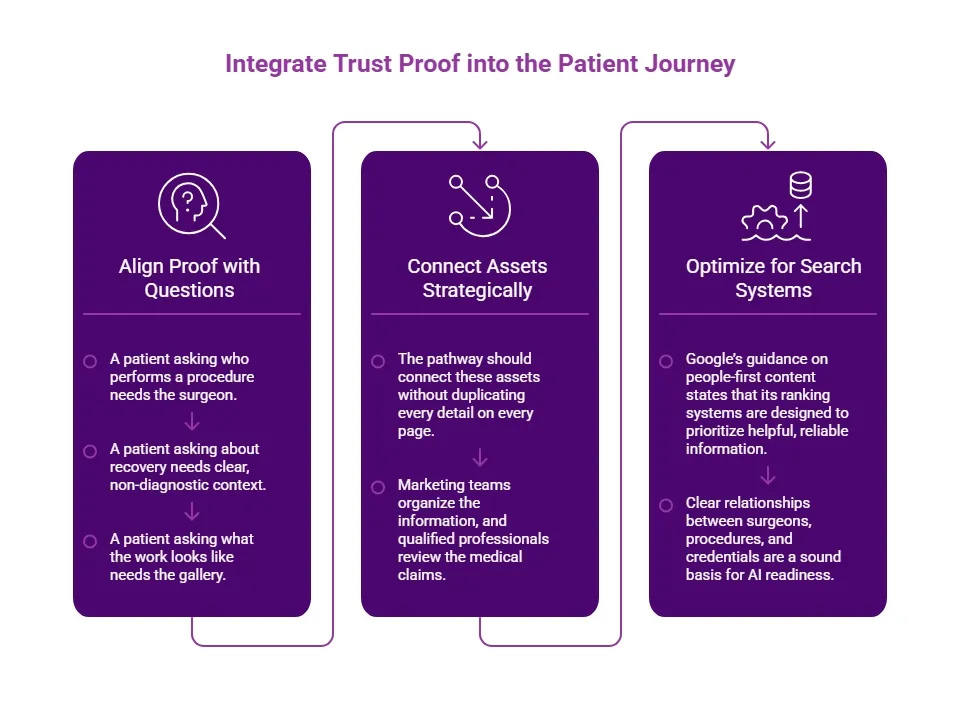
Trust proof belongs next to the question that creates the need for it. Each question calls for a different kind of proof:
- A patient asking who performs a procedure needs the surgeon.
- A patient asking about recovery needs clear, non-diagnostic context.
- A patient asking what the work looks like needs the gallery.
Proof isolated on a separate page often goes unseen when it matters. The pathway should connect these assets without duplicating every detail on every page. Clinical boundaries still apply: marketing teams organize the information, and qualified professionals review the medical claims.
These connections also help search systems interpret a practice. Google’s guidance on people-first content states that its ranking systems are designed to prioritize helpful, reliable information created for people. No structure ensures visibility in search or AI answers. Still, clear relationships between surgeons, procedures, and credentials are a sound basis for AI readiness.
How to Check Whether the Pathway Works
A pathway check takes one priority procedure page and a phone. Open the page and walk through it as a new patient. This is a readiness review, not a technical project:
- Name the procedure or recovery question that brings patients to the page.
- Confirm the relevant surgeon is easy to find without a new search. Ideally that is within the first screen or two, though the right layout varies by page.
- Reach credibility and fit proof without typing a new search.
- Find gallery context where it helps answer the next question.
- Check that the primary consultation invitation follows the trust context, while contact details stay accessible throughout.
Each unanswered question marks a gap in the pathway. The marketing lead can document the navigation and content gaps, while the surgeon or a designated clinical reviewer verifies any medical and professional claims.
Judge results by consult quality and pathway completeness, not traffic alone, because rising visits can coexist with poorly matched requests. Each signal tells you something different:
- Procedure-page visits indicate discovery.
- Surgeon-profile engagement suggests continued evaluation.
- Inquiries that name a specific surgeon or procedure focus are a more useful signal, though thresholds vary by practice.
Inquiry volume alone cannot establish patient suitability, and the pathway’s effect on consultations should be measured within each practice. For a new practice, the immediate priority is establishing these connections before expanding the content program.
What to Build Next
Return to that patient once more. Each question now finds its answer on your site, and the extra browser tab stays closed. Your practice is discoverable, credible, and prepared when research begins.
Procedure visibility is the first layer of a Procedure-to-Consult Search Strategy, not the finish line. The next decision is placement: where recovery answers, galleries, and credentials should sit within this consult-intent architecture.
For a deeper look at how procedure visibility, surgeon credibility, galleries, regional demand, and consultation intent fit together, explore BVM’s Plastic Surgery SEO Services. For an aesthetics-market example of how stronger visibility can change discovery, review the Avere Beauty search case. By anchoring their search strategy in these exact principles, Avere Beauty transformed from a hidden local practice into Pittsburgh's top search result, ultimately achieving 287% traffic growth and a 1,964% ROI. Answer the question. Name the surgeon. Show the proof. Then invite the consultation.
Our Editorial Process: Our expert team uses AI tools to help organize and structure our initial drafts. Every piece is then extensively rewritten, fact-checked, and enriched with first-hand insights and experiences by expert humans on our Insights Team to ensure accuracy and clarity.
About the BVM Insights Team
The BVM Insights Team is our dedicated engine for synthesizing complex topics into clear, helpful guides. While our content is thoroughly reviewed for clarity and accuracy, it is for informational purposes and should not replace professional advice.