
 BVM Insights Team
Your service page ranks on Google. Your credentials are real. But when a procurement manager asks ChatGPT to recommend environmental remediation firms with ASTM D1586 sampling capability, your name doesn't appear.
The screen loads. Three competitors named. Your firm — the one with 22 years of Phase II ESA experience — invisible. They don't even do that work anymore.
Your website buries genuine expertise under vague headlines and keyword-stuffed paragraphs that no AI system can parse or cite. Generative Engine Optimization closes that gap by structuring technical content so platforms like ChatGPT and Perplexity can understand, trust, and reference it. Think of it as placing your firm's expertise directly into the reference materials that advanced AI assistants consult. Instead of dropping keywords onto a page, the goal is to present expertise in a form AI systems can follow like a technical manual.
With this framework, you can audit any technical service page for answer-first structure, entity clarity, proof placement, and citation readiness.
What ChatGPT and Perplexity Need Before They Can Cite a Technical Page
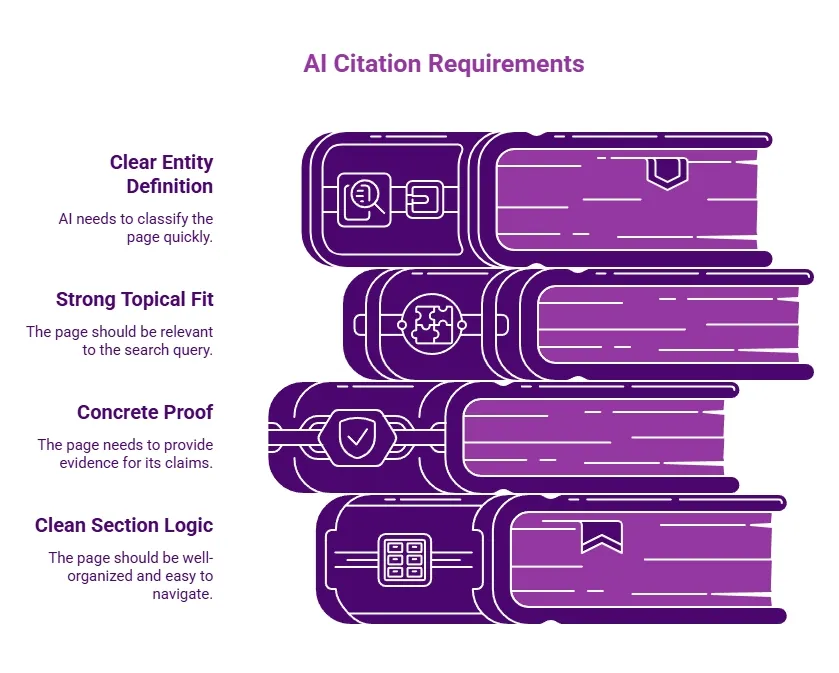
AI systems need a page they can classify in seconds: clear entity definition, strong topical fit, concrete proof, and clean section logic.
In practical terms, a page should make four things obvious within seconds: what the service is, who it is for, what technical or regulatory context defines it, and what proof supports the claim.
A page stuffed with "environmental consulting services" twenty times tells Google the page is about environmental consulting. It tells ChatGPT nothing about which services your firm provides, which standards you follow, or what outcomes you've delivered. AI citation systems synthesize answers from pages where the relationships between entities — organization, services, credentials, results — are explicit.
Generative Engine Optimization rewards semantic clarity over keyword density. "We perform Phase II Environmental Site Assessments in accordance with ASTM E1903" gives AI a quotable fact. "Our team provides comprehensive environmental solutions" gives it nothing.
That same structure helps human buyers. A principal, operations lead, or marketing director does not want to decode vague capability language. A page that defines the service clearly and surfaces proof early reduces friction for both the model and the reader.
Lead with the Answer, Not the Backstory
Every H2 section should open with a direct, standalone answer. Elaboration and proof come after.
Most technical pages start with company history or broad capability overviews, burying the answer three paragraphs down. While AI systems ingest the entire page, retrieval algorithms generally prioritize dense, highly relevant text chunks. If the opening is preamble, the semantic weight of your expertise is diluted, and the page is far less likely to be cited in the generated response.
Before: "Our firm has been a leader in geotechnical engineering for over two decades. With experienced professionals, we offer services designed for today's infrastructure projects..."
After: "Subsurface investigation determines soil composition, groundwater conditions, and load-bearing capacity before foundation design begins. Our team performs SPT borings and CPT soundings per ASTM D2487."
The second version is self-contained and quotable. The first is filler. When the first sentence under a heading can stand on its own, the passage becomes easier to quote, summarize, and evaluate — by AI systems and by the humans using them to build shortlists.
That is also where Generative Engine Optimization services fit naturally into the bigger picture: strong formatting is one part of a broader visibility system, but it is the part that changes how the page reads right now.
Organize Each Page Around Entities, Relationships, and Proof
A well-structured technical page connects six elements: organization, service or capability, expertise area, standards and certifications, outcomes or proof, and expert credibility.
When these connections are explicit, AI systems build a reliable knowledge representation of your firm. When they're scattered across pages or buried in PDFs, the AI has no basis to cite you.
What to Place Above the Fold
Place a precise H1, a short answer-first summary, the buyer context, and at least one immediate trust signal above the fold. For technical firms, trust signals should be concrete: methodologies, compliance markers, certifications, professional qualifications. Not generic statements about excellence.
Good page structure also includes clear H1-H6 hierarchy, strategic internal linking, mobile-first clarity, and clear calls to action — not as separate SEO trivia, but as part of the page architecture itself.
How to Write a Service Definition Block
A service definition block should explain the capability in operational terms. A reliable formula: service + technical scope + buyer context + proof direction.
For example: "Environmental due diligence consulting for industrial and commercial site decisions, including risk review, regulatory context, and supporting technical documentation for redevelopment and transaction teams."
That does more than insert a target phrase. It defines the entity, shows the use case, and creates a clean base for supporting details.
Making Entity Relationships Explicit
Instead of a generic "Our Services" block, state the relationships directly: "Firm X provides RCRA corrective action services. Our team holds PE licenses in Texas and Louisiana. We follow EPA Region 6 guidance and have completed corrective action at 14 petroleum-contaminated sites since 2019."
That connects organization → service → credential → standard → proof in one passage. Each connection strengthens AI confidence.
Use Technical Specs, Certifications, and Constraints as Citation Anchors
Concrete technical qualifiers improve AI confidence because they disambiguate your firm from thousands of generic pages. A phrase like "specialized engineering support" is too vague to classify well. A phrase like "PFAS remediation planning for industrial sites with permitting, groundwater, and redevelopment constraints" gives the reader and the model something specific to work with.
Certifications like ISO 14001, PE license designations, regulatory frameworks (CERCLA, RCRA, TSCA), ASTM standards, and compliance markers such as AS9100 all function as trust signals AI uses to evaluate source authority. The same logic applies to equipment classes, methodology references, and technical specification schema markup — each helps disambiguate expertise.
A common pitfall: listing certifications in footer graphics where AI can't parse them. Certifications belong in body text, connected to the service they validate. "Our Phase I ESAs follow ASTM E1527-21 and are accepted by commercial lenders for CERCLA liability protection" outperforms any logo grid.
If a page depends on standards, methods, or qualifications to establish authority, those signals should not be buried in a footer, hidden in a PDF, or scattered across unrelated pages. They should sit close to the main claim they support.
Build Self-Contained Sections AI Can Quote Without Losing Context
Each section should be understandable if extracted in isolation. A section opening with "We also offer this service..." fails because "this" has no referent outside the page.
The fix: each section names the service, states what it does, identifies who it serves, and references at least one proof point. That structure makes passages quotable by AI systems without requiring surrounding context.
Instead of saying, "This approach reduces risk," say, "Geotechnical due diligence reduces early-stage project risk by identifying subsurface constraints before design and permitting decisions are locked in." The second version carries context with it.
Common Formatting Mistakes That Make Technical Pages Invisible to AI
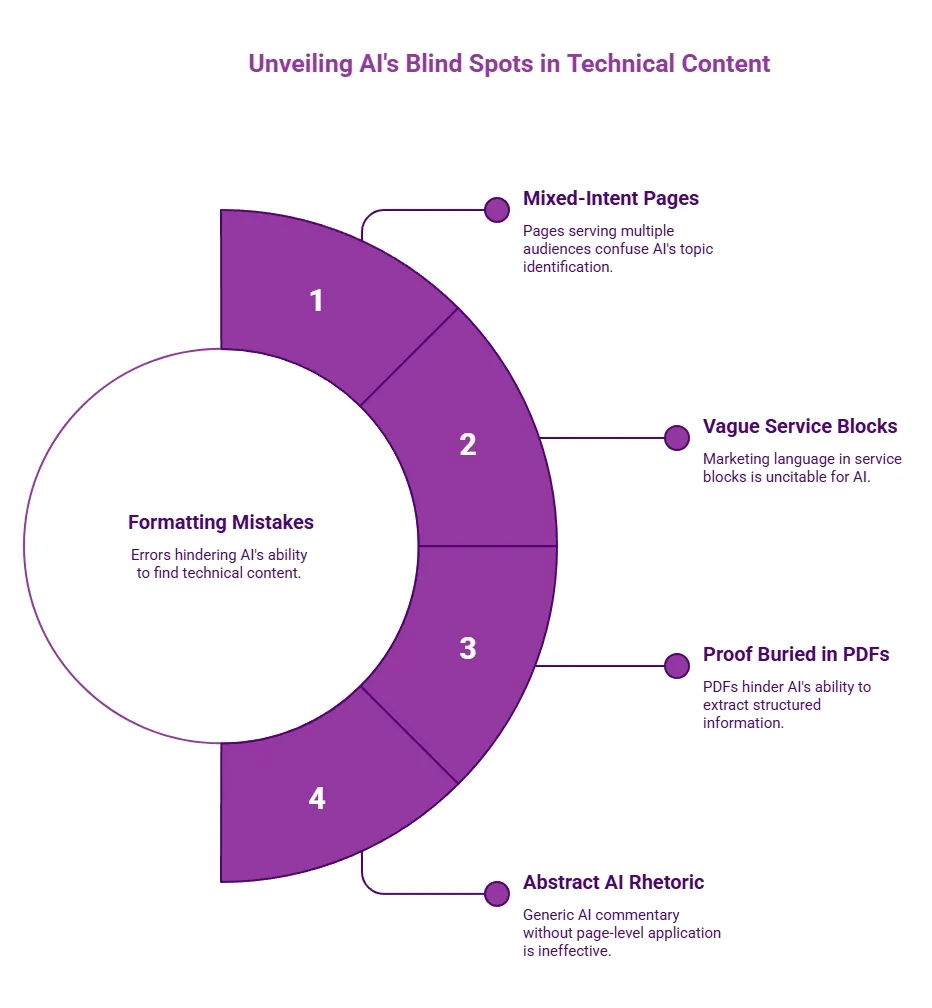
The biggest mistake is asking one page to do everything.
Mixed-intent pages serve too many audiences. A single page covering "Environmental Consulting, Geotechnical Engineering, and Construction Materials Testing" forces AI to guess the topic. Separate pages with clear focus perform better.
Vague service blocks use marketing language instead of technical language. "Comprehensive solutions for your environmental needs" is uncitable. Replace it with the specific service, method, and standard.
Proof buried in PDFs creates severe friction for AI crawlers. While modern search engines and AI agents can technically parse document text, extracting structured entity relationships from downloadable files is generally far less reliable for AI retrieval systems than pulling directly from clean, on-page HTML body text. Case studies and project lists need to live in indexed page body text, not just in downloadable documents.
Abstract AI rhetoric without page-level application is equally wasteful. Drifting into generic "AI is the future" commentary without applying the principle to a specific page accomplishes nothing. The fastest improvement is not more commentary about AI. It is better page structure.
These mistakes are why traditional tactics erase firms from AI searches even when Google rankings look healthy.
Apply this blueprint to any technical service page:
A Reusable Template for an AEO-Optimized Technical Service Page
Answer-First Summary — Open with one or two sentences naming the service and the buyer context. Quotable in isolation.
Entity Definition Block — Define the service in operational terms and connect it to your organization. Use methodology or process as differentiators, not generic "expertise" claims. Clarify the expertise area and adjacent entities.
Technical Specs and Compliance — Standards, certifications, PE licenses, regulatory frameworks, methods, constraints, and deliverables. In body text, not sidebars.
Proof Block — Case-study summaries, white papers, project evidence, methodology showcases, software references, and visible professional qualifications such as PE licenses or comparable credentials. At least one specific, verifiable data point. Surface proof of expertise immediately instead of burying it beneath generic marketing copy. That is where supporting assets like Engineering Firm Service Page SEO: The Practice Area Page Architecture That Generates Commercial RFQs and Establishing Defensible Authority in Geotechnical Engineering via Entity-Based AI Optimization become useful next reads.
FAQ Block — Three to five real technical buyer questions answered with specifics. Each answer self-contained and answer-first. Clarify scope, standards, deliverables, timing, and adjacent services. Do not use FAQs as a dumping ground for thin keyword variations. If FAQs are included and visibly rendered on the page, Schema.org Article can remain the primary schema recommendation for the page itself, while Schema.org Organization and visible FAQ support strengthen the broader entity layer. For implementation guidance, the most reliable references remain Google's documentation on AI features and your website, Google's introduction to structured data markup, OpenAI's overview of ChatGPT search, and the Perplexity documentation.
Internal-Link Support — Connect to related service pages and supporting resources that reinforce topical ownership, such as Securing Citations for Environmental Consulting using Knowledge Graph Optimization and Why Traditional Tactics Erase Your Firm from AI Searches (and the Generative Engine Optimization Alternative).
How to Use Internal Links, Schema, and Supporting Assets Without Clutter
Internal links should connect pages sharing entity relationships. Your geotechnical drilling page links to subsurface investigation, laboratory testing, and your practice area architecture — not unrelated content.
Schema markup — particularly Article and Organization schema — helps AI confirm publisher identity and content authority. But schema supplements strong page structure. It doesn't replace it.
That gap between what your firm knows and what AI can see closes one page at a time. Start with your highest-value service page. Apply the answer-first structure. Surface the proof. The next time an AI system fields a question about your exact expertise, your page gives it a reason to cite you.
If your technical pages are still built like generic SEO pages, the fastest fix isn't more keywords — it's better structure. Start by reviewing how current pages define services, surface proof, and connect related entities. Then use Engineering Services SEO or Generative Engine Optimization services as the next layer of context once the page itself is clear enough to be trusted.
Our expert team uses AI tools to help organize and structure our initial drafts. Every piece is then extensively rewritten, fact-checked, and enriched with first-hand insights and experiences by expert humans on our Insights Team to ensure accuracy and clarity.
Our Editorial Process: Our expert team uses AI tools to help organize and structure our initial drafts. Every piece is then extensively rewritten, fact-checked, and enriched with first-hand insights and experiences by expert humans on our Insights Team to ensure accuracy and clarity.
About the BVM Insights Team: The BVM Insights Team is our dedicated engine for synthesizing complex topics into clear, helpful guides. While our content is thoroughly reviewed for clarity and accuracy, it is for informational purposes and should not replace professional advice.