 Dustin Ogle
- Define Your Firm as a Specific Thing: AI systems need to recognize your company as a distinct entity with clear boundaries - not just another “environmental services” provider, but an expert tied to specific capabilities.
- Build One Deep Topic Before Expanding: Pick one specialty area where you have real proof (like PFAS remediation), then create connected content - service pages, case studies, expert bios - all using the same exact terms.
- Connect Every Related Page to Each Other: When your service pages link to expert bios, which link to project results, which link back to services, AI can follow the trail and see your full authority picture.
- Use Structured Data to Help Machines Read Your Site: Adding Organization and Service markup tells search engines exactly what your business offers, making your expertise easier to interpret and cite.
- Generic Service Pages Signal Nothing Specific: Claiming expertise in everything at once makes you look like a specialist in nothing - each major capability needs its own focused, interconnected presence.
The firms earning citations aren't the ones with the most content - they're the ones whose expertise is organized clearly enough for machines to find and trust.
Environmental consulting leaders seeking AI visibility will gain a practical roadmap here, preparing them for the implementation steps that follow.
Your firm has delivered complex remediation projects, navigated PFAS contamination cases, and built a reputation that wins proposals. Yet when a potential client asks an AI assistant about environmental due diligence consultants, your name doesn't surface. The expertise exists - in project histories, staff credentials, and client relationships - but it isn't structured in a way that machines can interpret and cite.
That changes when you understand how AI systems actually select their sources.
Knowledge Graph Optimization for environmental consulting is the process of structuring a firm's brand, services, expertise areas, and proof assets so search and AI systems recognize it as the authoritative entity for a specific compliance or remediation topic. Rather than optimizing for keywords alone, this approach builds the relationship architecture that makes citation possible.
The path forward has three stages: define one expertise node clearly, connect that node to service pages, experts, and proof, then reinforce those relationships with structured data and internal linking.
How environmental consulting firms earn citations in AI answers
Environmental consulting firms generally earn citations when generative AI systems - which typically rely on Retrieval-Augmented Generation (RAG) - can synthesize clearly connected elements: the firm's identity as a distinct entity, a narrowly defined expertise area, and verifiable proof that supports that expertise claim.
While AI engines rely heavily on vector search and semantic similarity to pull unstructured text, the underlying mechanism for establishing the firm's core authority still follows a straightforward formula:
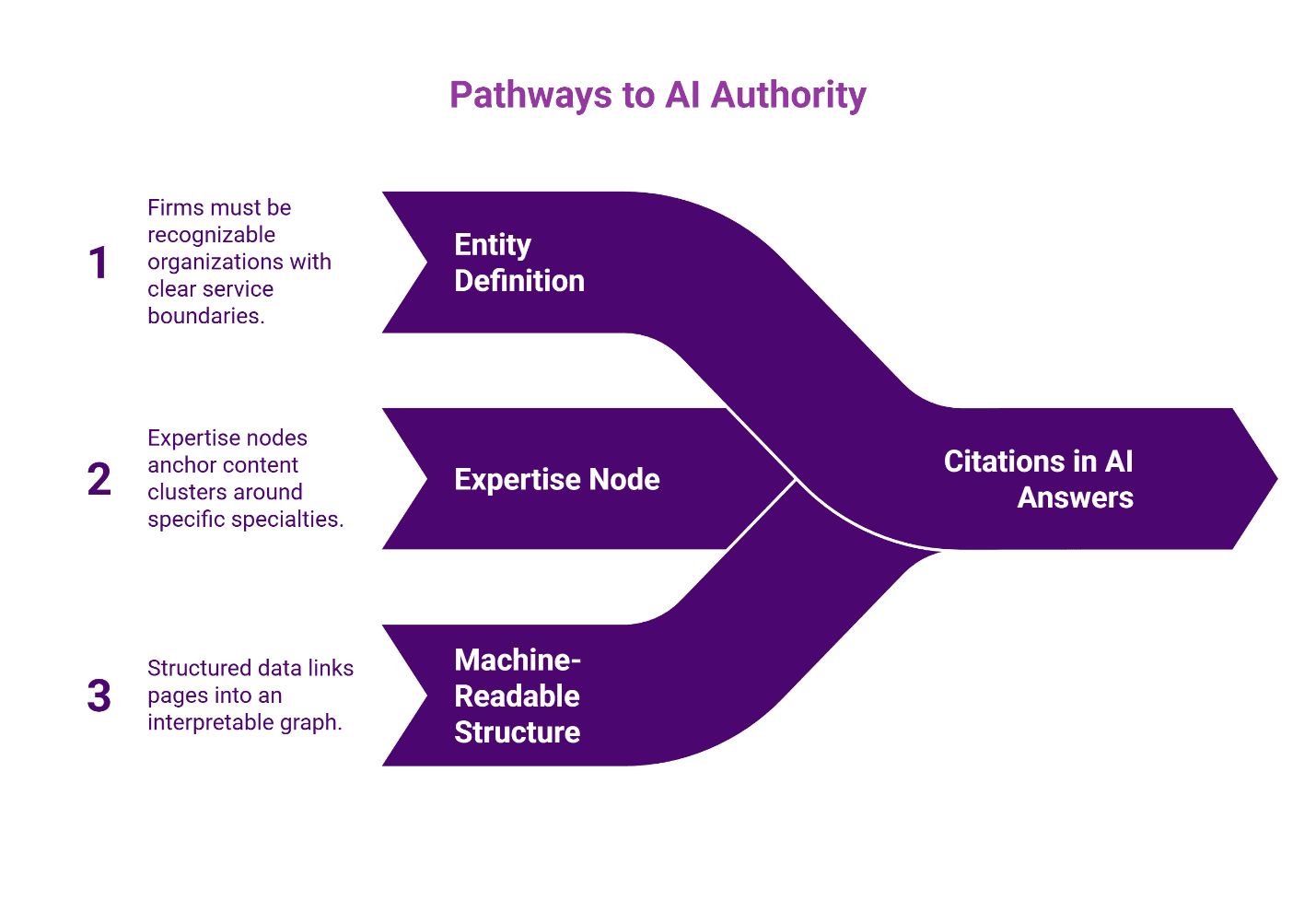
Define the entity. The firm must exist as a recognizable organization with clear service boundaries - not a generic “environmental services” provider, but a specific entity tied to specific capabilities.
Build the expertise node. One compliance topic or technical specialty becomes the anchor. PFAS remediation, Phase I ESA, groundwater contamination response - each requires its own interconnected content cluster.
Connect it with machine-readable structure. Internal linking, consistent terminology, and structured data markup transform isolated pages into an interpretable graph of relationships.
Traditional SEO tries to get your firm listed on the map. Knowledge Graph Optimization ensures the system routes qualified searches directly to you as the correct destination for a specific type of work.
Start by modeling your firm as an entity, not just a website
The shift begins with recognizing that your website is a container, not the asset itself. What matters is how clearly the entities within that container - and the relationships between them - can be understood by automated systems.
Google's own description of the Knowledge Graph centers on “things, not strings.” Machines do not need more adjectives; they need clearer relationships.
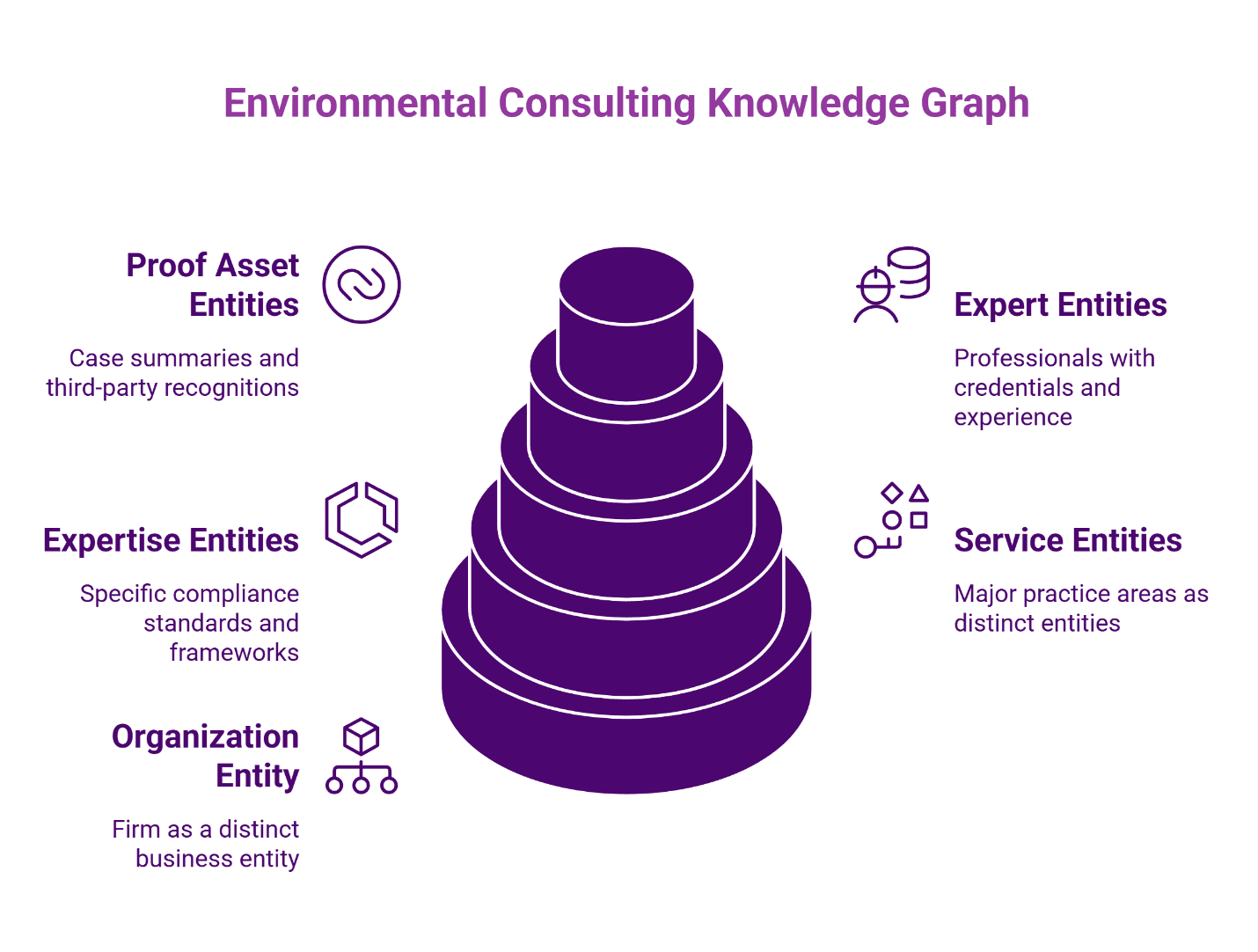
Five entity types form the foundation:
Organization entity. Your firm as a distinct business with a name, location, and defined service scope. This is the anchor that everything else connects to.
Service entities. Each major practice area - remediation consulting, subsurface investigation, environmental compliance - functions as its own entity with defined boundaries.
Expertise entities. The specific compliance standards, contamination types, or regulatory frameworks where your firm demonstrates depth. These are your expertise nodes.
Expert entities. The professionals whose credentials, certifications, and project experience validate the firm's claims. Licensed Professional Engineers (PE), Professional Geologists (PG), and other credentialed specialists become proof assets through their qualifications.
Proof asset entities. Case summaries, project outcomes, certifications, and third-party recognitions that substantiate expertise claims.
When these entities exist as disconnected pages, the authority signal weakens. When they're explicitly connected through internal links, consistent language, and structured markup, the graph becomes interpretable.
Build compliance-specific expertise nodes around the work you actually want
Generic service pages describing “environmental consulting” fail because they lack the specificity that signals true expertise. A firm claiming to do everything appears to specialize in nothing.
The fix isn't more content. It's deeper, more connected content around a single compliance topic.
PFAS is a strong example because it is a recognized environmental topic with a clear regulatory and risk context documented in the EPA's official materials. That makes it easier to anchor vocabulary, supporting content, and proof around one interpretable subject rather than a catch-all services page.
Consider how a PFAS remediation expertise node might look:
- A dedicated service page explaining the firm's PFAS investigation and remediation methodology
- Supporting explainer content covering PFAS regulatory requirements, contamination pathways, and site assessment protocols
- Project summaries demonstrating completed PFAS work with quantifiable outcomes
- Expert bios highlighting staff certifications and PFAS-specific experience
- Consistent terminology throughout - using the same language clients and regulators use
The relationship chain makes authority legible: Brand → PFAS Remediation Consulting → PFAS contamination and compliance topic → project proof or case evidence → expert bio with PE, PG, or relevant credential → structured data markup.
Each piece reinforces the others. The service page links to the expert bios. The explainers reference the project proof. The terminology stays consistent so machines understand these assets describe the same specialized capability.
This same architecture applies to any expertise area: groundwater contamination response, environmental due diligence for transactions, industrial compliance auditing, or subsurface investigation services.
Connect service pages, proof assets, and credentials into one interpretable graph
Disconnected content weakens authority even when individual pages are strong. The invisible expert problem persists when expertise exists across the site but isn't connected in ways machines can follow.
Technical buyers - procurement teams, engineering managers, and technical evaluators - are not persuaded by vague positioning. They want rigor, methodology explanation, and visible qualifications. Content that mirrors their long research cycles earns their trust and their citations.
Mapping the relationships requires deliberate architecture:
- Service pages link to relevant expert bios and cite their specific qualifications for that service area
- Project summaries connect back to service pages and reference the methodologies described there
- Regulatory explainers link to services that address those compliance requirements
- Expert bios reference their project involvement and link to relevant case summaries
- All related assets use identical terminology for key concepts, service names, and compliance standards
The goal is a web of relationships dense enough that any entry point leads logically to supporting evidence. When an AI system evaluates whether your firm is authoritative on PFAS remediation, it should find multiple reinforcing signals - not isolated mentions scattered across unconnected pages.
What structured data to implement first
Structured data provides explicit signals that help search systems understand what your content represents. For environmental consulting firms, prioritize these schema types:
- Organization - Establishes the firm as a distinct entity with defined attributes
- Service - Models each practice area as a formal service offering
- BreadcrumbList - Shows the hierarchical relationship between pages
- Article - Marks educational content appropriately
- FAQPage - Only if FAQ content remains visible on the page, though it should be noted that major search engines have largely restricted FAQ rich results to government and health authorities, making this a secondary priority for general consulting firms
Implementation principles matter as much as the markup itself. Only mark up what's actually true and visible on the page. Keep names, service titles, and terminology consistent between the markup and the content. Use structured data to reinforce clear copy, not compensate for weak content.
Common mistakes that keep environmental firms uncitable
The failure of generic SEO for technical consulting follows predictable patterns:
Over-broad service pages. A single page claiming expertise in remediation, compliance, due diligence, and investigation signals nothing specific. Each major capability needs its own focused presence.
No vocabulary consistency. Calling the same service “environmental remediation,” “contamination cleanup,” and “site restoration” across different pages fragments the authority signal.
Thin proof assets. Project lists without methodology details, outcome metrics, or connections to service capabilities provide weak evidence.
Missing expert attribution. Technical credibility depends on demonstrable qualifications. Anonymous content undermines authority claims. If your page claims authority without project evidence, methodology detail, or visible credentials from licensed professionals, the relationship stays weak.
Structured markup applied to weak content. Structured data can't fix unclear positioning. Markup on a vague page just makes the vagueness more explicit.
Why this works: the role of knowledge graphs in technical authority
Knowledge Graph systems operate on entities and relationships rather than keyword matching alone. When an AI system generates an answer about environmental compliance consulting, it draws from sources it recognizes as authoritative entities connected to that specific topic.
Disambiguation matters. A firm clearly defined as specializing in PFAS remediation for industrial sites is easier to match to a relevant query than a firm with undifferentiated “environmental services” positioning. The more specific and internally consistent the entity definition, the more confidently systems can cite it.
Authority reinforcement follows. When service pages, expert credentials, project evidence, and regulatory knowledge all connect to the same expertise node, each asset strengthens the others. The cumulative signal exceeds what any single page could generate alone.
Next step: audit one compliance topic before you scale the entire site
Start with one expertise node rather than restructuring everything at once.
Choose the topic. Pick a compliance area or service specialty where you have strong existing assets - project history, credentialed staff, and genuine depth.
Inventory related pages. Identify every page that touches this topic: service descriptions, case summaries, staff bios, explainer content, and regulatory references.
Map the connections. Document which pages link to which, where terminology varies, and where proof assets are missing or disconnected.
Implement baseline structure. Add Organization and Service schema. Standardize terminology. Create the internal links that connect related assets into a coherent node.
Measure over time. Citation visibility builds gradually - expect progress over months, not days. Track whether your firm surfaces in AI-generated answers for queries related to your target expertise area, and refine the node architecture based on what you observe.
One well-structured expertise node proves the model works. From there, you can extend the architecture to additional practice areas with confidence in the approach.
The firms earning qualified RFQs from AI-assisted discovery aren't the ones with the most content. They're the ones whose expertise is structured clearly enough that machines can interpret and cite it. For engineering services SEO and Generative Engine Optimization services, that interpretability is the foundation everything else builds on.
Disclaimer: This article is for informational marketing strategy purposes only and should not be treated as environmental, legal, or regulatory advice.
Our Editorial Process: We operate with 100% transparency. Our strategies are built on ethical, sustainable practices that deliver long-term value, not short-term tricks. Our entire process, from keyword research to content creation, is relentlessly focused on one thing: driving measurable, bottom-line growth for your business.
About the BVM Insights Team: The BVM Insights Team is our dedicated engine for synthesizing complex topics into clear, helpful guides. While our content is thoroughly reviewed for clarity and accuracy, it is for informational purposes and should not replace professional advice.