 Dustin Ogle
- Build a Semantic Moat: Competitors can copy your keywords overnight, but they can't quickly replicate deep content that connects your methods, regulations, and expertise.
- Separate Your Specialties: A PFAS remediation page and a soil testing page serve different buyers - lumping them together confuses both humans and AI systems.
- Show Your Work, Not Just Your Services: Explaining how you conduct assessments signals real depth; listing “environmental services” tells AI nothing useful.
- Test Your Replaceability: If a competitor could copy your website's structure and language in 30 days, your content is too thin to protect your position.
- Ask the AI Question: Would an AI assistant recommend your firm for a specific query like “Phase II ESA consultants with PFAS experience in Texas”? If your site doesn't make those connections explicit, you won't get found.
Specific beats generic - structure your expertise so machines understand it as clearly as humans do.
Geotechnical and environmental engineering firms tired of losing visibility to less-qualified competitors will find a framework for building lasting digital authority here, preparing them for the detailed implementation steps that follow.
The AI search query returns three competitors for “subsurface contamination investigation.” Your firm has done this work for decades. You are not among the results.
Meanwhile, the proposal inbox pings with another inquiry for a generic “engineering firm near me” job your senior team should never be screening. That is the problem with shallow visibility. It wastes expert bandwidth, muddies specialty positioning, and leaves you vulnerable to firms with weaker technical depth but cleaner semantic structure.
This is the new visibility crisis. Not a ranking drop you can recover from with tweaks, but structural invisibility - where AI systems do not recognize your authority because your digital footprint never made it legible in the first place.
For environmental and geotechnical engineering firms, the threat is not just algorithm volatility. The deeper problem is replaceability. When your expertise in PFAS remediation, Phase II ESAs, or in-situ treatment gets flattened into generic “geotechnical services” language, competitors can copy your positioning overnight. And AI systems, increasingly mediating how enterprise buyers discover specialized capabilities, generally struggle to distinguish your firm's unique value from anyone else without explicit semantic signals, even if your site possesses strong traditional domain authority
Entity-Based AI Optimization offers a different path: structuring your technical authority so that both human buyers and AI retrieval systems recognize your firm as the credible source for specialized geotechnical queries. This is not about chasing keywords. This is about building a semantic moat that competitors cannot easily replicate.
The Replication Problem: Why Keyword-Level Tactics Fail
Keyword tactics are easy to clone. A competitor can mirror your title structure, reuse broad service language, and publish generic “thought leadership” within weeks. Consider a typical geotechnical firm's service page. It lists capabilities: soil testing, environmental site assessments, geotechnical engineering. Perhaps it includes a few project photos and some boilerplate about experienced professionals.
This content is thin. There is nothing proprietary, nothing that signals operational depth, nothing that distinguishes the firm's actual methodology from any other provider claiming similar capabilities. That is why the failure of generic SEO matters here: generic search visibility usually creates traffic without pipeline.
Thin content creates fragile visibility. When AI systems compare multiple sources on a specialized query - say, “in-situ chemical oxidation for chlorinated solvent remediation” - they look for signals of depth: methodology explanations, regulatory context, case evidence, credential alignment. A page that simply lists “remediation services” without this architecture is indistinguishable from dozens of competitors.
Entity-dense authority works differently. It requires articulating the specific problems you solve, the methods you use, the regulations you navigate, and the contexts where your expertise applies. This cannot be copied quickly because it reflects proprietary operational knowledge - the kind that takes years to accumulate. A generic page about geotechnical engineering can be duplicated. A structured network of pages separating subsurface investigation, in-situ remediation, environmental compliance, PFAS work, methodology notes, credential signals, and project proof is much more difficult to reproduce convincingly.
What Entity-Based AI Optimization Changes
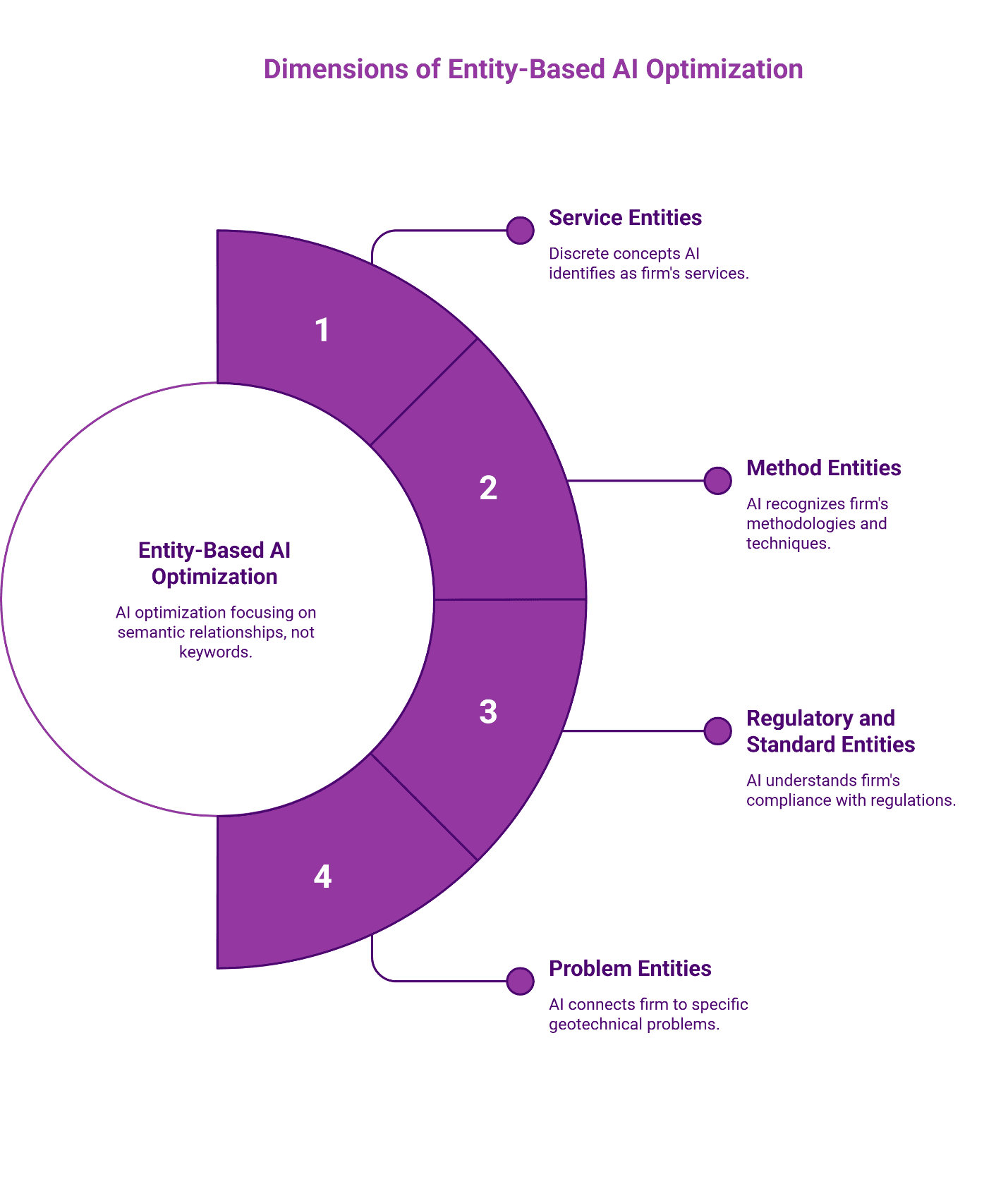
Entity-Based AI Optimization shifts the focus from keyword placement to semantic structure. Instead of asking “What terms should we target?”, it asks “What entities should AI systems associate with our firm, and how do we make those relationships explicit?”
An entity, in this context, is a discrete concept that AI systems can identify and relate to other concepts: a service type, a methodology, a regulation, a geographic region, a problem category. Generative Engine Optimization works by ensuring these entities are clearly defined on your site and connected through logical relationships. GEO focuses on citation patterns, source mapping, content restructuring for AI comprehension, and ongoing authority building across AI-discoverable sources.
For a geotechnical firm, this means structuring content so that AI systems understand:
- Service entities: Phase II ESA, geotechnical drilling, vapor intrusion assessment
- Method entities: cone penetration testing, in-situ remediation, groundwater monitoring
- Regulatory and Standard entities: ASTM E1527, state voluntary cleanup programs, EPA brownfield requirements
- Problem entities: PFAS contamination, chlorinated solvent plumes, soil stability concerns
When these entities are clearly articulated and linked, AI citation logic rewards clarity. The system retrieves your firm not because you used the right keywords, but because your content architecture makes your authority legible for the specific query.
If keyword-era SEO tried to win a page, Entity-Based AI Optimization tries to win recognition as the source of truth.
Constructing Defensible Architecture Around Core Geotechnical Services
This authority is built through practice-area architecture: structuring your site so that distinct engineering disciplines - geotechnical, remediation, environmental compliance - are clearly separated and deeply developed.
Use the specialized-clinic test. A buyer seeking PFAS remediation should not land on a generic geotechnical drilling page any more than a neurosurgery patient should land on a podiatry page. When your site architecture conflates these specialties, you lose both human clarity and AI retrievability. The architecture itself should filter intent. That means fewer low-fit inquiries and more qualified RFQs tied to real specialty demand.
Effective practice-area silos include:
- Dedicated service entities for each specialty (not bundled under “environmental services”)
- Method-level pages explaining specific techniques (direct-push sampling, membrane interface probe surveys)
- Regulation-context pages connecting services to compliance frameworks (CERCLA, state VCP programs)
- Location-relevance signals for regional regulatory variations
These relationships form the moat. A competitor cannot replicate your PFAS remediation authority by copying your headlines - they would need to reproduce the entire web of service-method-regulation-location connections that make your expertise visible to retrieval systems. Deep Content Architecture provides the structural framework for building these defensible relationships.
This is also why engineering services SEO must be specialty-aware. Effective frameworks emphasize engineer-level content, niche precision, qualifications, and long-cycle trust building rather than broad consulting language.
Authority Signals AI Can Actually Interpret
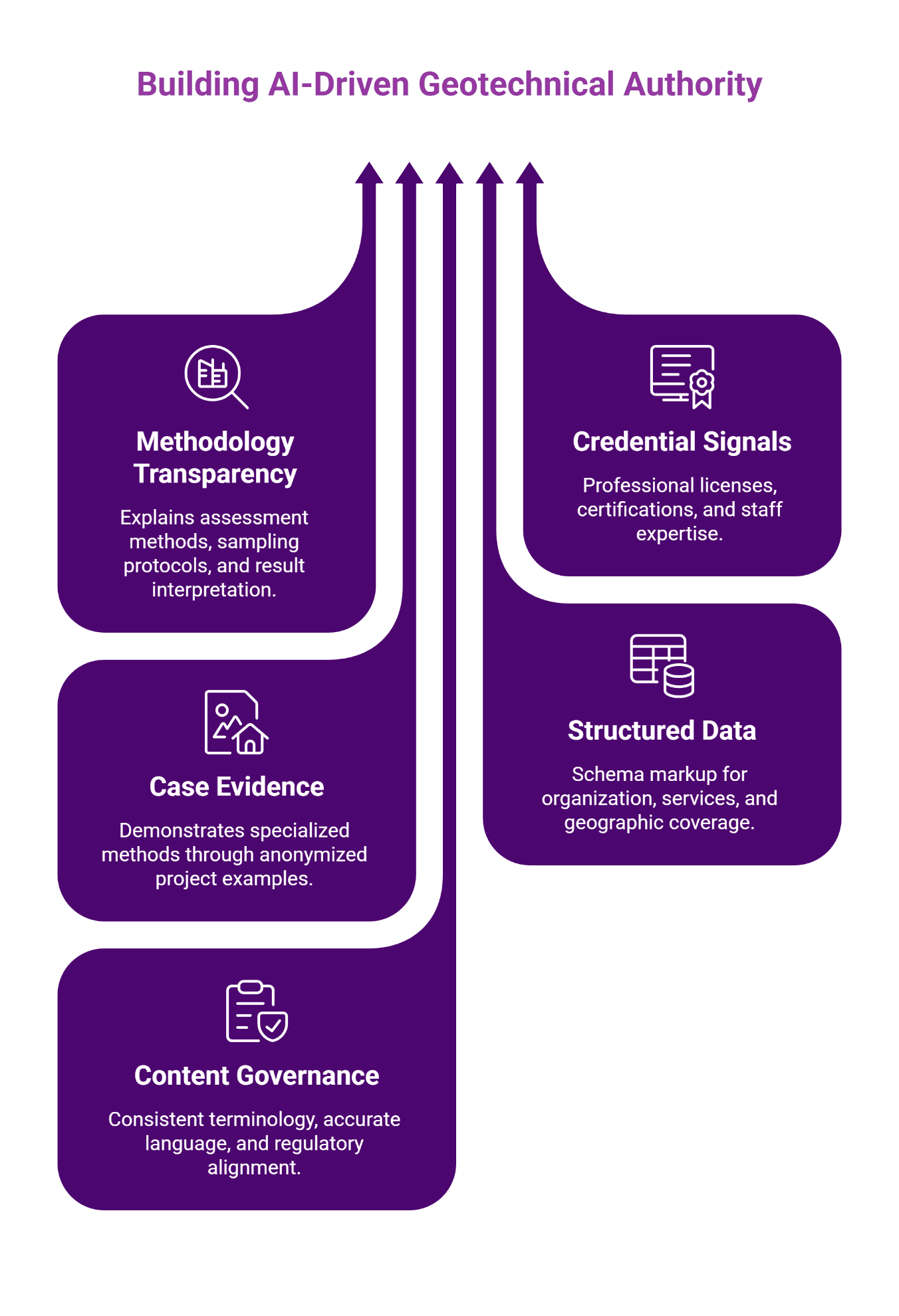
AI systems do not read between the lines. They interpret explicit signals. For geotechnical firms, the authority signals that matter most are:
Methodology transparency: Pages that explain how you conduct Phase II assessments, what sampling protocols you follow, and how you interpret results. This is operational knowledge that signals depth.
Credential and qualification signals: Professional engineer licenses, certifications (ASTM standards, state-specific qualifications), and staff expertise - structured so AI systems can extract and associate them with your firm entity.
Case evidence and project proof: Anonymized or permitted project descriptions that demonstrate application of specialized methods in specific contexts. A vapor intrusion assessment for a commercial transaction tells AI systems more about your capabilities than a generic “commercial real estate services” claim.
Structured data and entity disambiguation: Schema markup that explicitly identifies your organization, services, and geographic coverage. This helps AI systems disambiguate your firm from competitors with similar names or service descriptions.
Content governance: Consistent terminology, accurate technical language, and content that reflects current regulatory frameworks. AI systems trained on authoritative sources recognize - and prefer - content that aligns with established technical standards. A common pitfall is governance failure: technical firms publish pages that look polished but drift away from how the practice actually works. That weakens both buyer trust and machine understanding. Stop Marketing Fluff addresses why governance is part of defensibility, not an editorial afterthought.
Deep Content Architecture organizes the authority map, while The Perfect Page Blueprint improves the page-level clarity that helps systems and buyers interpret each node correctly.
Common Failure Modes That Keep Firms Replaceable
The patterns that create semantic weakness are predictable:
One page trying to rank for everything: A single “geotechnical services” page listing twenty capabilities with no depth on any of them. This fails both human evaluation and AI retrieval. It may look efficient. It destroys clarity.
Undifferentiated thought leadership: Blog posts on industry trends that could have been written by anyone. No proprietary framing, no operational insight, no connection to the firm's actual expertise. Buyers do not need more abstraction. They need evidence of judgment.
Case studies without technical distinctiveness: Project descriptions that mention client names and locations but omit the methodological nuance that signals authority. “We completed a Phase II ESA” tells AI systems nothing about your specialized capabilities. If the reader cannot tell why your team was uniquely suited to the work, the proof does not strengthen authority.
Missing entity relationships: Services described in isolation, without connection to methods, regulations, or problem contexts. The firm does PFAS work, but nothing on the site makes that relationship explicit and retrievable.
Internal politics creating vague architecture: Homepage compromises that give every practice area equal billing result in none being clearly developed. The site signals breadth without depth - the opposite of defensible authority.
The Strategic Next Step
Stop asking whether your pages mention the right words. Ask whether your site expresses the right relationships.
Defensibility is not a one-time fix. It requires evaluating your current semantic architecture, identifying thin-content vulnerabilities, and progressively building entity-dense authority around your core geotechnical specialties.
The firms that will maintain visibility as AI systems increasingly mediate buyer discovery are those building this architecture now - before competitors catch up, before another algorithm shift exposes the fragility of keyword-level tactics.
Explore engineering services SEO approaches designed for technical firms navigating this transition. Review resources on the invisible expert problem to continue evaluating where your firm's authority stands - and where the moat needs to be deeper. If your team is treating the website as long-term infrastructure rather than a content warehouse, Digital Infrastructure: Treating Your Website as a Capital Asset, Not an Expense provides useful next steps.
Our Editorial Process:
Our expert team uses AI tools to help organize and structure our initial drafts. Every piece is then extensively rewritten, fact-checked, and enriched with first-hand insights and experiences by expert humans on our Insights Team to ensure accuracy and clarity.
About the BVM Insights Team:
The BVM Insights Team is our dedicated engine for synthesizing complex topics into clear, helpful guides. While our content is thoroughly reviewed for clarity and accuracy, it is for informational purposes and should not replace professional advice.