
 Dustin Ogle
- AI Needs Relationships, Not Keywords: Search engines matched words to pages, but AI tools need clear links between your firm, your services, and the problems you solve - without those connections, you're invisible.
- Ranking Doesn't Mean Getting Cited: You can show up on Google's first page and still be ignored by ChatGPT or Perplexity if your content isn't structured for AI to extract and trust.
- More Content Won't Fix Bad Structure: Publishing dozens of blog posts creates noise unless your content is organized around real expertise and buyer questions - volume without architecture builds nothing.
- Traffic Metrics Hide the Real Problem: High website visits mean little if the leads don't match your actual capabilities - qualified visibility matters more than raw numbers.
- The Fix Starts With Architecture: Before creating more content, map your expertise clearly so both search engines and AI tools can understand who you are and what you actually do.
Clear structure beats content volume when AI decides who gets recommended.
Technical firms and specialized service providers frustrated by low-quality leads will find a practical framework here, preparing them for the detailed strategy guide that follows.
The rankings look fine. The traffic reports show activity. And yet the phone rings with leads that have nothing to do with your actual capabilities.
Picture the Monday morning debrief. Your technical director just spent 45 minutes on a call with someone who found you through Google but needed residential soil testing - not the complex Phase II ESAs and remediation consulting your firm actually specializes in. Meanwhile, a procurement manager at a regional developer asked ChatGPT for geotechnical firms with ASTM D1586 sampling capabilities. Your firm has done hundreds of these projects. You weren't mentioned.
This disconnect isn't a marketing failure. It's a structural one. Your firm's technical depth exists, but your digital presence is built for a search model that no longer reflects how enterprise buyers actually research.
Traditional SEO tactics optimize pages for keyword placement and blue-link rankings. They assume that if you rank, you're visible. But AI systems - the ones now mediating a growing share of technical procurement research - evaluate content differently. They look for entity relationships, structured authority, and answer-ready formatting. Legacy tactics produce none of these signals.
Generative Engine Optimization is the discipline of optimizing content to be explicitly cited by AI systems and featured in Google's Knowledge Graph - not just ranked in traditional results. Where traditional SEO chases volume, GEO builds the semantic structure that AI platforms require to recognize, trust, and surface your expertise.
Why the Old SEO Playbook Breaks in AI Search
The core assumption behind traditional SEO is straightforward: optimize your pages for keywords, earn backlinks, climb the rankings, win clicks. For a decade, this worked well enough.
But the landscape has shifted beneath it. Enterprise buyers now research capabilities across multiple platforms - Google, yes, but also ChatGPT, Perplexity, Microsoft Copilot, and AI-enhanced procurement tools. Google confirms that AI Overviews and AI Mode surface supporting links for complex questions using "query fan-out" across related searches and sources. OpenAI describes ChatGPT search as a natural-language interface that searches the web and returns linked sources. Microsoft explains that Bing-powered generative systems retrieve, ground, and cite public web content. These systems don't simply match keywords to pages. They extract relationships, evaluate authority signals, and synthesize answers from content they deem structurally credible. (Google for Developers)
Here's the mechanism of failure: traditional tactics optimize for placement, not comprehension. They assume visibility is won through ranking position alone. For technical firms - where buyers search by specific capabilities, compliance standards, and methodology rather than broad category terms - this assumption breaks down.
A procurement team searching for "subsurface investigation firm with CERCLA experience" isn't browsing page one like a consumer comparing coffee makers. They're looking for a direct answer. The same goes for searches like "geotechnical firm for landfill expansion borings," "Phase I ESA consultant for industrial redevelopment," or "groundwater remediation consultant with vapor intrusion experience." These are capability-led queries. They depend on technical relevance, context, and trust.
If your content doesn't communicate entity relationships clearly - if it doesn't connect your firm to specific services, certifications, and outcomes in a way AI can parse - you become invisible at exactly the moment that matters.
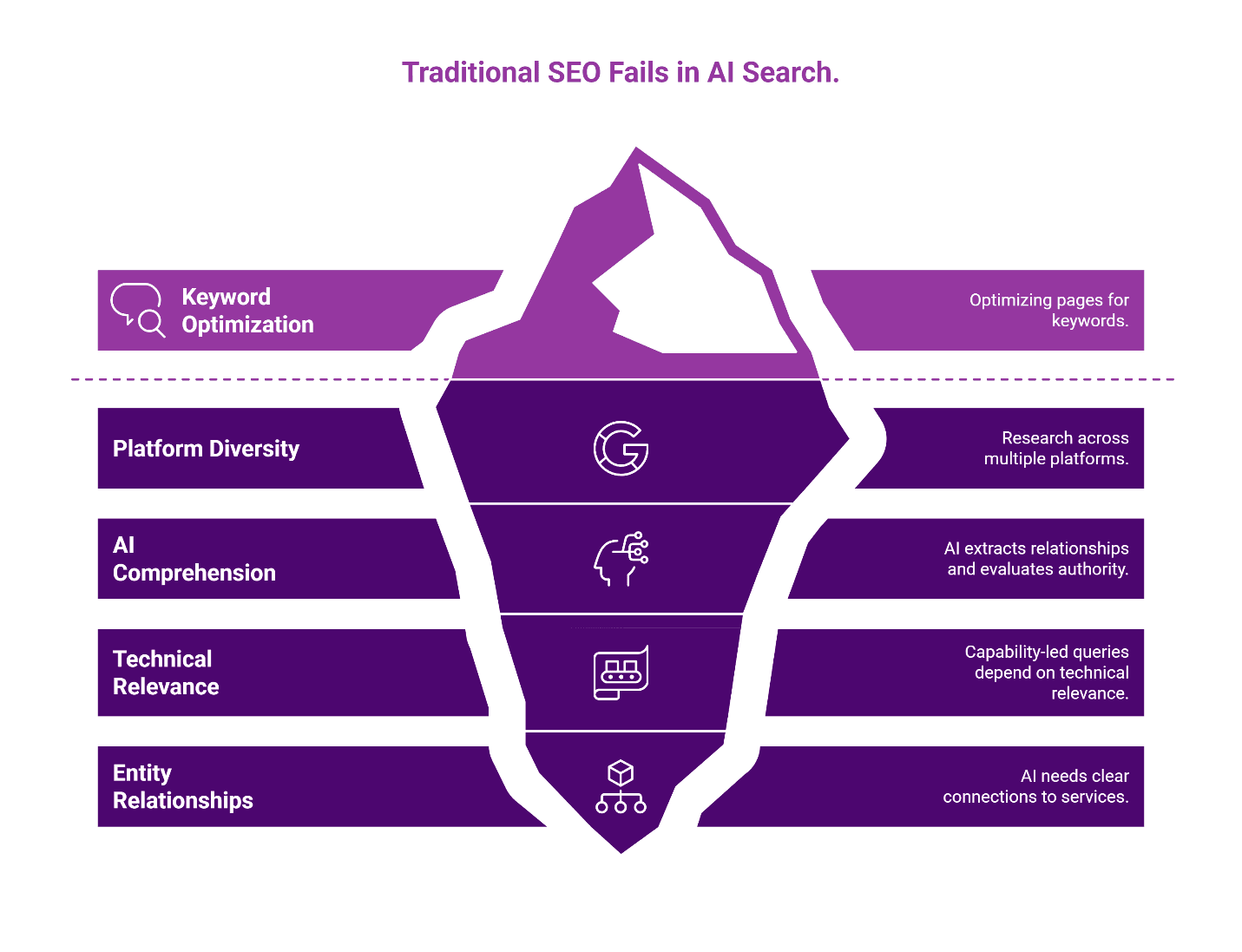
Myth vs. Reality: What Traditional Tactics Still Get Wrong
Myth: Keyword placement equals discoverability.
Placing keywords on a page tells search engines what topics you mention. It does not establish who you are, what you do, or why you're authoritative. AI systems need entity clarity - explicit connections between your firm, your services, your certifications, and the problems you solve. Without these relationships, your content is data noise, not a citable source.
Myth: If you rank on Google, you'll surface in AI tools.
Ranking in traditional search and being cited by AI are increasingly separate outcomes. AI platforms evaluate whether your content is structured for answer extraction, whether your authority signals are consistent across the web, and whether your information can be trusted as a primary source. A page that ranks for a keyword may still be ignored by an AI system that can't extract a clear, authoritative answer from it.
Myth: A well-optimized service page is enough.
One page rarely carries the semantic weight needed for complex engineering buying journeys. Technical buyers move through multiple research stages, asking different questions at each point. A single service page, no matter how polished, cannot address the full range of capability queries, compliance contexts, and proof points that influence procurement decisions.
Myth: More content equals more authority.
Volume without structure creates noise, not trust. Publishing dozens of generic blog posts optimized for long-tail keywords may generate some traffic, but it doesn't build the topical architecture AI systems use to identify genuine expertise. Deep Content Architecture - where content is organized around entities, customer journeys, and interconnected topics - signals authority in ways that raw volume cannot. Google warns that using generative AI to produce large volumes of low-value pages can violate spam policy. The winning move is not more machine-made content. It is better-organized expertise. (Google for Developers)
Myth: Fast paid traffic can bridge the gap.
Rented clicks may fill the top of funnel, but they do not solve the deeper architecture problem that makes your expertise hard to find and cite. When the ads stop, so does the visibility. Paid traffic treats symptoms while the structural disconnect between your capabilities and your digital presence remains unaddressed.
What Generative Engine Optimization Actually Changes
GEO doesn't abandon the foundations of good SEO. It builds on them - then extends into territory traditional tactics ignore entirely.
This nuance matters. Traditional SEO still has value. Google is explicit that there are no extra technical requirements for appearing in AI Overviews or AI Mode beyond being indexed and eligible for Search. The platform still points site owners toward core practices like internal linking, textual clarity, page experience, and structured data aligned with visible content. The mistake is not doing traditional SEO. The mistake is assuming that basic on-page work is the whole strategy. (Google for Developers)
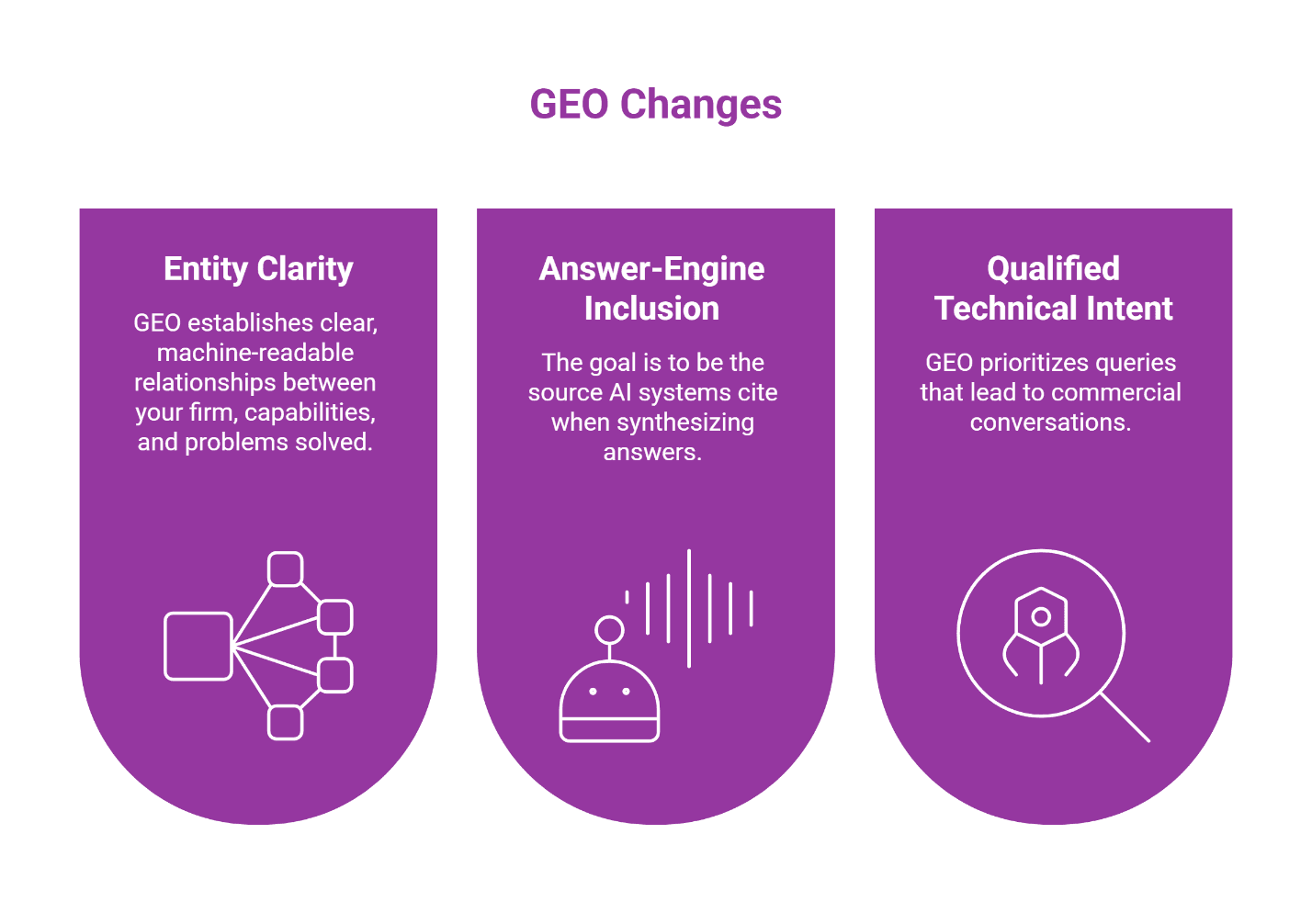
From page optimization to entity clarity. Traditional SEO asks: "Does this page target the right keyword?" GEO asks: "Does this content establish clear, machine-readable relationships between our firm, our capabilities, and the problems we solve?" The shift is structural. It means thinking in terms of entities - your firm, your services, your certifications, your outcomes - and how those entities connect to each other and to the queries buyers actually use.
From blue-link competition to answer-engine inclusion. The goal isn't just ranking - it's being the source AI systems cite when synthesizing answers. This requires content formatted for extraction: clear definitions, explicit relationships, structured data, and consistent naming conventions that AI can parse without ambiguity.
From traffic volume to qualified technical intent. GEO prioritizes the queries that actually lead to commercial conversations. For engineering firms, this means mapping content to the exact search patterns your buyers use - specific methodologies, compliance frameworks, and technical capabilities - rather than chasing generic category terms that attract unqualified traffic.
That is where Deep Content Architecture and Perfect Page Blueprint matter. One builds the structural map of expertise and intent. The other makes core pages easier for search systems and human evaluators to understand. Together, they create the conditions for qualified discovery rather than vanity visibility.
Legacy SEO vs. GEO: A Practical Comparison
| Legacy SEO approach | Generative engine optimization | Commercial effect |
|---|---|---|
| Keyword placement and density optimization | Entity relationship mapping and semantic structure | Better comprehension of who you serve and what you solve |
| Focus on blue-link rankings | Focus on AI citation visibility and Knowledge Graph presence | More visibility in AI-assisted research moments |
| Traffic volume as primary success metric | Qualified technical intent and commercial relevance | Fewer junk leads and better-fit RFQs |
| Generic blog production for long-tail keywords | Answer-engine-ready authority content | Stronger trust with technical buyers |
| Basic on-page optimization (meta tags, headers) | Structured data, entity consistency, and answer extraction formatting | Better internal alignment between marketing and sales |
| Short-term ranking wins | Defensible long-term visibility across both traditional and AI search | More durable competitive positioning |
This comparison isn't about abandoning SEO fundamentals. It's about recognizing that the fundamentals alone no longer guarantee the visibility your firm needs. The firms that will remain visible as AI-mediated discovery grows are those building content architecture designed for comprehension - not just placement.
How Engineering Firms Should Evaluate Their Current Strategy
If you suspect your current approach isn't working, you're probably right. Here's how to pressure-test it.
Five diagnostic questions
- Can your current agency explain how your content maps to specific engineering capabilities, compliance contexts, and buyer research stages?
- Are your pages organized around real technical intent, or around broad category keywords that invite low-fit inquiries?
- Is your internal linking helping search systems understand relationships between services, industries, methods, and proof?
- Are you publishing content that makes your firm easier to cite, or just easier to index?
- Do your reports connect visibility to qualified inquiries and pipeline quality, or mostly to traffic and ranking movement?
If those questions are hard to answer - or if the answers focus exclusively on keywords, backlinks, and ranking positions - you're likely working with a playbook built for a search environment that's rapidly becoming obsolete.
Signs your current playbook is outdated
- Traffic exists, but qualified RFQs remain flat or declining
- Your firm doesn't appear in AI-generated answers for your core capabilities
- Content production focuses on volume rather than topical depth and structure
- Your agency can't explain how AI systems evaluate authority differently than traditional search
What a credible pivot should include
A credible pivot should not start with "more content." It should start with architecture. That usually means clarifying service entities, tightening practice-area structure, aligning pages to technical-commercial search intent, and fixing the gap between what your experts know and what your site actually communicates.
- Deep Content Architecture that builds topical authority through interconnected, entity-driven content
- Perfect Page Blueprint methodology ensuring each page is optimized for both search engines and AI comprehension
- Explicit focus on the queries your actual buyers use - technical specifications, compliance requirements, methodology questions - not generic category terms
The strategic context matters here. As one client described the shift:
"After about 3 months with BVM, our top 10 keywords went from not in the top 500 results on Google to the majority showing on page 1-2. This correlated with exponential growth in sales!" - Dr. Steven K.
That kind of movement doesn't come from more of the same tactics. It comes from restructuring how your content signals expertise to both traditional search and AI systems.
Build Visibility That Survives the Shift to AI
The firms that will thrive in the next era of search are those building digital presences designed for how buyers actually research now - and how AI systems actually evaluate authority.
This isn't about chasing a trend. It's about recognizing that the rules have changed. Legacy tactics may still produce some activity, but they increasingly fail to produce qualified visibility where it counts.
If your current strategy still treats search like a ranking contest, you may keep getting impressions while losing the moments that matter most. If your strategy evolves toward entity clarity, structured answerability, and qualified intent matching, your visibility becomes more durable and more commercially relevant.
For a deeper look at the strategic landscape, explore Your GEO Playbook for 2025 or read more about The Failure of Generic SEO and The Invisible Expert Syndrome - the pattern where technical expertise exists but digital presence fails to communicate it.
When you're ready to discuss what a credible pivot looks like for your firm, start your strategy session.
Our Editorial Process
Our expert team uses AI tools to help organize and structure our initial drafts. Every piece is then extensively rewritten, fact-checked, and enriched with first-hand insights and experiences by expert humans on our Insights Team to ensure accuracy and clarity.
About the Brazos Valley Marketing Insights Team
The Brazos Valley Marketing Insights Team publishes research-backed perspectives on AI-powered SEO, technical content architecture, and dual-search visibility. Grounded in a decade of hands-on SEO experience and a methodology centered on transparency, measurable growth, and long-term authority, the team focuses on helping specialized brands compete across both traditional search and AI-driven discovery.