 Dustin Ogle
- Assign Page Ownership First: Decide which page “owns” each service line before touching any technical fixes - this prevents overlap from returning.
- Link With Purpose: Supporting blogs should always point to (and strengthen) your commercial service pages, never compete with them for the same keywords.
- Build Separate Silos: Keep geotechnical and remediation content in distinct lanes so search engines know exactly which page to show for each type of buyer.
- Create Governance Rules: Require approval before new pages go live to catch overlap early and route content correctly from the start.
- Measure Pipeline, Not Traffic: Success isn't more visitors. It is qualified RFQs from buyers who found the right page.
Clear ownership beats noisy overlap - every time.
Marketing leads and practice directors at multi-team engineering firms will gain a practical framework for ending internal competition, preparing them for the 30-day cleanup checklist that follows.
The practice leads are in the conference room. Geotechnical wants homepage placement. Remediation wants top-level navigation. Meanwhile, your soil testing blog just outranked your commercial testing services page for the third quarter in a row.
This is the quiet cost of cannibalization in multi-team engineering firms. It's not a duplicate content nuisance. It is a structural failure in practice-area architecture that suppresses visibility for the pages most likely to generate qualified commercial inquiry.
What Cannibalization Means for Engineering Firms
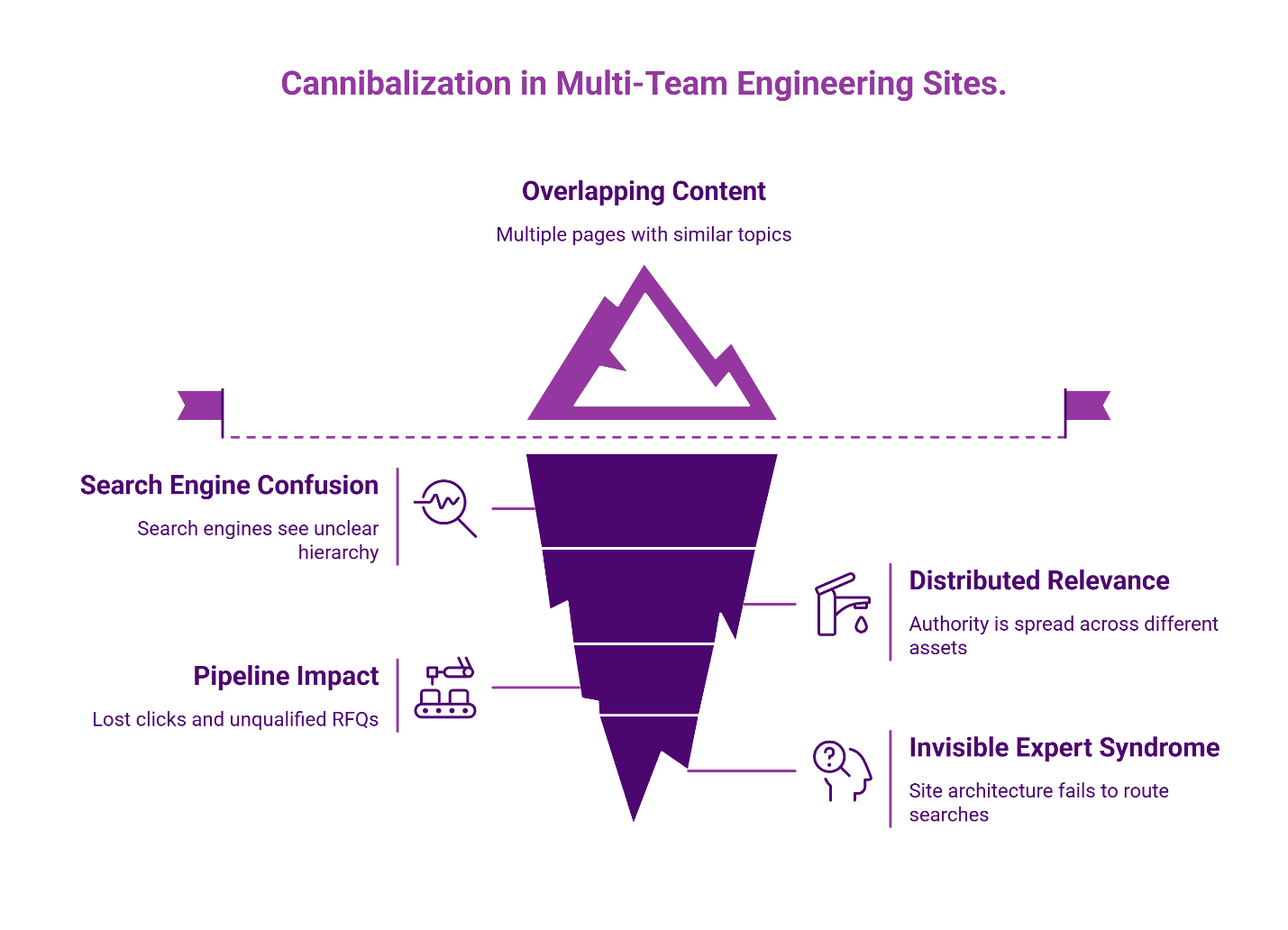
Cannibalization occurs when multiple pages on your site compete for the same search intent because ownership, hierarchy, and internal linking haven't been defined. The result: Google receives mixed relevance signals across assets that should never compete, and your highest-value commercial pages lose ranking priority to broad educational content. Rather than 'splitting' authority, the search engine simply struggles to determine which page is the best answer for the user's query, often defaulting to the broader informational page.
Why This Matters
When geotechnical and remediation pages overlap in scope, three things break simultaneously. Commercial service pages lose visibility to informational blogs. Sales and technical staff waste time fielding unqualified inquiries from generic searches. Pipeline quality degrades because buyers searching specific methodologies - PFAS in-situ remediation, subsurface investigation protocols, environmental compliance consulting - land on the wrong page or never find you at all.
The fix requires three foundational steps: assign page ownership, route authority through disciplined internal linking, then govern future page creation so the problem doesn't return.
If you're looking for generic traffic without strong inquiry intent, this approach is not for you. Deep Content Architecture is built to protect commercial lanes first.
Why Google Gets Mixed Signals When Geotechnical and Remediation Pages Overlap
The mechanism of failure is straightforward. Without distinct silos, search engines struggle to differentiate between a general soil testing blog and a commercial testing service page. Both use similar terminology. Both link to related content inconsistently. Both compete for overlapping query clusters.
Consider the difference between three page types that commonly exist on engineering firm websites:
An educational blog titled “Understanding Soil Contamination Assessment Methods” builds awareness and captures early-stage researchers. A commercial service page for “Geotechnical Investigation Services” should rank for buyers ready to request proposals. A capability page covering “PFAS Remediation and Environmental Compliance” positions specific technical expertise for compliance-driven searches - expertise grounded in frameworks like EPA's PFAS guidance and EPA's remediation technology materials.
Each serves a distinct intent. When internal linking treats these pages as interchangeable - or worse, when anchor text randomly distributes authority across all three - Google receives mixed signals about which page deserves priority for which query. The result mirrors what happens when generic SEO fails technical buyers: you attract traffic without pipeline impact.
Keyword cannibalization actively suppresses the ranking potential of your most profitable service lines. A rigid Deep Content Architecture provides clear signals to search engines about which page serves which specific intent.
Start With Page Ownership Before You Touch Canonicals
The instinct to reach for canonical tags to fix overlapping intent is understandable but fundamentally flawed. Google's guidance on consolidating duplicate URLs emphasizes that canonical tags are strictly for duplicate or near-duplicate content. You cannot use a canonical tag to point a broad educational blog to a commercial service page; Google will simply ignore the tag because the page intents are different.
Before any technical implementation, you need to answer ownership questions.
Which page is the commercial owner for each service line? This is the page that should rank for RFQ-ready queries. For a geotechnical team, it might be “/services/geotechnical-investigation” rather than a blog post about soil testing methods.
Which page is the parent explainer? Parent pages provide comprehensive topic coverage and link downward to specific service pages. They capture broader informational queries and route authority to commercial children.
Which pages are supporting educational assets? Blogs, guides, and methodology explainers should support commercial pages, not compete with them. Their job is to build topical authority and funnel link equity upward to your core commercial pages - not to rank for the same queries as your service pages.
Only after ownership is defined should you map out structural fixes: 301 redirects for redundant content, hard content consolidation, or distinct keyword siloing. Attempting to canonicalize pages with different intents just papers over the structural problem. Six months later, you'll face the same cannibalization from a different angle.
Build a Parent-to-Child Internal Linking Matrix
This matrix is the operational core of practice-area architecture. It forces each page to earn a job and helps you evaluate how authority flows through your site.
| Page Type | Primary Intent | Must Link To |
|---|---|---|
| Parent Service Hub | Comprehensive overview of a practice area (e.g., “Environmental Services”) | All child service pages within that practice area |
| Child Service Page | Commercial conversion for a specific offering (e.g., “PFAS Remediation Services”) | Parent hub, related capability pages, relevant case studies |
| Supporting Resource | Educational authority building (e.g., “Guide to In-Situ Remediation Methods”) | Parent hub and relevant child service page; never competes for same commercial keywords |
The linking direction matters. Google's internal link guidance emphasizes that anchor text and cross-linking help both users and search engines understand site structure. When a broad resource links to a commercial service page with descriptive anchor text, it passes authority and signals intent hierarchy. When the same resource links generically to the homepage or competes for the same keywords, authority dissipates.
For engineering firms with distinct geotechnical and remediation teams, this often means building two parallel silos.
The geotechnical silo flows from a parent hub to child pages for specific services (soil testing, subsurface investigation, foundation analysis) to supporting educational content.
Similarly, the remediation architecture routes users from its central hub into dedicated specialty pages (PFAS remediation, contaminated site assessment, environmental compliance), which are in turn buttressed by foundational educational content.
Each silo owns its intent lane. Cross-linking between silos happens at the parent level for related services, not at the child level where it would create competition.
Create Governance Rules for Marketing, Practice Leads, and SMEs
The hidden friction in most engineering firms isn't technical. It is political. Practice leads want visibility. Marketing wants content production velocity. SMEs want their expertise represented accurately. Without governance rules, these competing priorities create the overlap that causes cannibalization.
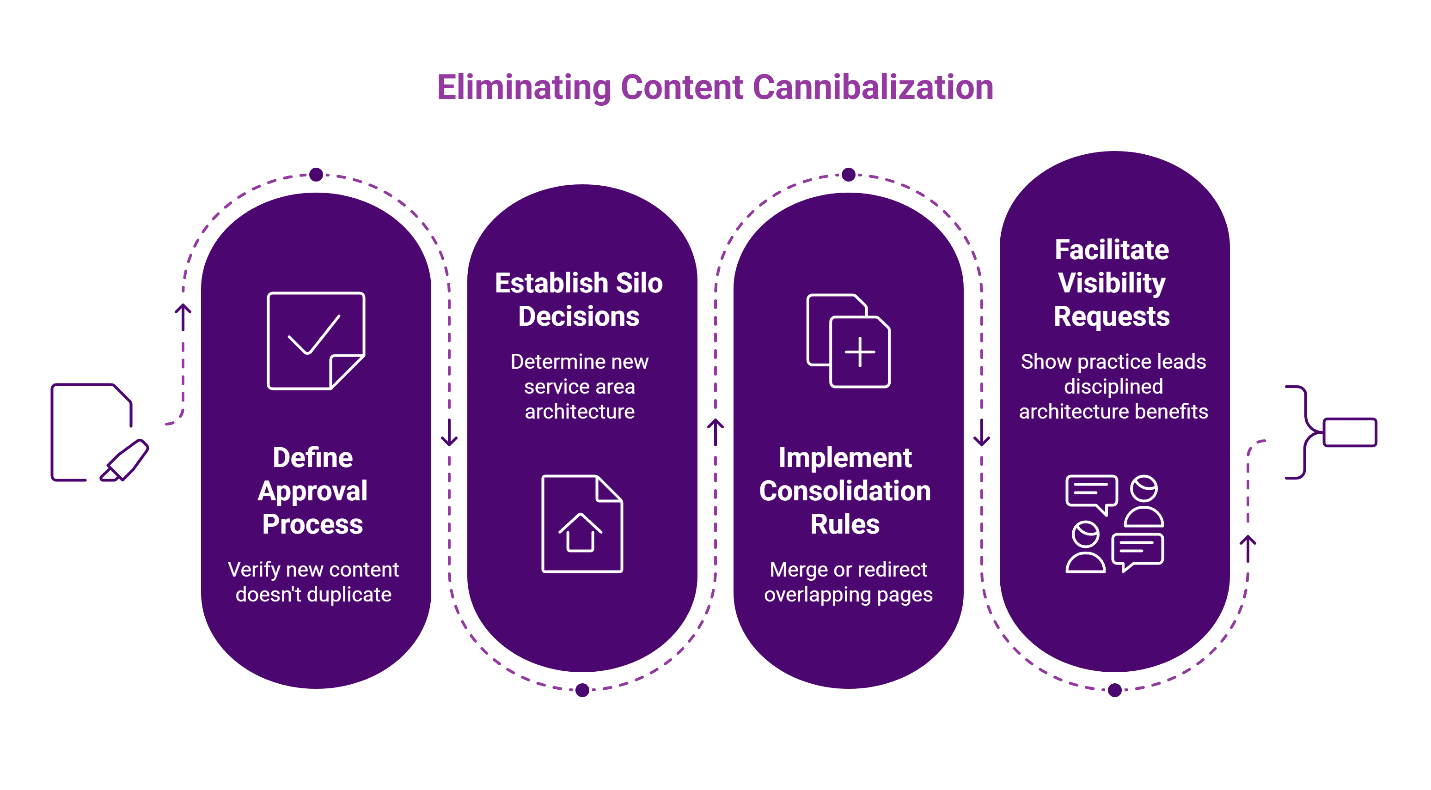
Effective governance requires clear answers to four questions.
Who approves new page creation? Before any new service page, capability page, or resource goes live, someone must verify it doesn't duplicate existing intent coverage. This isn't about blocking content. It is about routing it correctly. A new blog on soil testing methods might be valuable, but it should link to and support the existing commercial soil testing page, not compete with it.
Who decides when a topic deserves a new silo? Expanding into new service areas - say, adding geophysical services to a geotechnical practice - requires architectural decisions. Does this become a child page under the existing geotechnical hub, or does it warrant its own silo with a dedicated parent page? The answer depends on search volume, commercial value, and internal team structure.
When does overlap trigger consolidation? If two pages target the same intent and neither clearly owns the commercial conversion, they need to be merged or one needs to be redirected. Governance should define the threshold: perhaps when both pages appear in search results for the same query cluster, or when analytics show split traffic without clear winner.
How can practice leads request visibility without breaking architecture? This is where the political friction lives. The solution isn't telling technical directors they can't have prominent service pages. It is showing them that disciplined architecture serves their goals better than homepage competition. A well-structured child page with proper internal linking and clear intent ownership will outperform a generic page fighting for position against three other internal competitors.
These workflows prevent the intent drift that erodes technical content credibility over time.
A 30-Day Cannibalization Cleanup Checklist for Engineering Firms
Implementation follows diagnosis. This checklist provides a structured sequence for resolving existing cannibalization and preventing future recurrence.
Week 1: Inventory and Diagnosis
Export all geotechnical and remediation URLs from your sitemap. Map each URL to its intended purpose: commercial service, capability page, educational resource, or other. Identify overlapping URLs - pages targeting similar query clusters or using interchangeable anchor text. Flag pages where a blog or resource currently outranks a commercial service page for the same intent.
Week 2: Ownership Assignment
Assign commercial owner pages for each distinct service line. Define parent vs. child hierarchy for each practice area. Identify supporting resources and specify which commercial pages they should strengthen. Document decisions in a shared reference that marketing, practice leads, and web teams can access.
Week 3: Internal Linking Remediation
Update internal anchors to point to correct commercial owner pages. Ensure supporting resources link to (not compete with) their designated service pages. Verify parent hubs link comprehensively to all children within their silo. Remove or redirect circular links that distribute authority without clear hierarchy.
Week 4: Technical Cleanup and Governance
Review canonicals only after ownership is defined - apply them to consolidate true duplicates, not to mask structural problems. Consolidate or redirect dead-end overlapping pages that serve no distinct purpose. Establish governance rules for future page creation: approval process, overlap checks, and visibility requests. Schedule quarterly audits to catch drift before it compounds.
Risk Points to Monitor
Watch for these common failure patterns that trigger renewed cannibalization: mixed internal anchors pointing the same keyword phrase to different pages, commercial pages losing rank to broad blog content for high-intent queries, canonical tags applied before ownership decisions are finalized, and new URLs created by different teams without cross-checking existing architecture.
Treating your website as digital infrastructure rather than a marketing expense means measuring success by qualified RFQs and pipeline influence - not traffic volume. Cannibalization cleanup isn't complete when rankings stabilize. It's complete when the right pages attract the right buyers and your sales team stops fielding inquiries from students and researchers who found your educational content instead of your commercial services.
Engineering firms that implement this architecture don't just resolve current overlap. They build a system where geotechnical and remediation teams stop competing against each other in search and start competing together against external competitors who haven't figured this out yet.
Clear ownership beats noisy overlap. Every time.
Explore our Engineering Services SEO framework to see how practice-area architecture applies to your firm's specific service lines, and read Why Bad Leads Are Killing Your Sales Team's Morale to understand the commercial consequence of letting this problem persist.
Our expert team uses AI tools to help organize and structure our initial drafts. Every piece is then extensively rewritten, fact-checked, and enriched with first-hand insights and experiences by expert humans on our Insights Team to ensure accuracy and clarity.
About the BVM Insights Team
The BVM Insights Team is our dedicated engine for synthesizing complex topics into clear, helpful guides. While our content is thoroughly reviewed for clarity and accuracy, it is for informational purposes and should not replace professional advice.