
 Dustin Ogle
A specialty practice can employ strong physicians, run a deep service line, and carry years of clinical credibility, and still fail to appear when someone searches for the exact condition or procedure it treats. When that happens, the assumption is usually that the website needs more authority or better optimization. Often the real problem is quieter: the practice is asking one broad service page to answer several different questions at once.
A single page can introduce a service well. What it usually cannot do, on its own, is explain a condition, walk a reader through a treatment path, and validate which physician is the right fit. Those are different jobs, for different searchers, at different points in one decision. The question worth asking is not "do we need more pages?" but "when does a high-value service deserve separate, connected paths, and when is one page enough?"
One Service Page Usually Cannot Answer Every Specialty Search Intent
A broad specialty page can still be useful. It can explain the service line, introduce the practice's capabilities, and route readers toward more specific information. The problem appears when that one page is expected to answer every question a high-intent searcher might have.
Specialty-service searches often split into four different evaluation jobs:
| Search Intent | Reader Question | Best Content Role | What Happens Without It |
|---|---|---|---|
| Condition understanding | "What is this problem?" | Explain the condition context and route next steps | Readers land without a clear path forward |
| Treatment evaluation | "Is this option relevant?" | Explain the care option or procedure path at a general level | Treatment pages feel disconnected from the concern that led there |
| Physician fit | "Who is credible for this concern?" | Validate specialist focus, credentials, access, and relevance | Expertise stays invisible to anyone evaluating fit online |
| Access validation | "Where can care happen, and what is the next step?" | Clarify location, referral, intake, and appointment paths | Referral momentum stalls before scheduling |
This is a content architecture issue, not just a keyword issue. Google has consistently advised creating helpful, reliable, people-first content built for users rather than content assembled mainly to rank. In practice, that means specialty pages should answer the reader's actual decision need, not simply place every related term on one page.
A page that strains to serve every intent often serves none of them, and that gap shows up as weak visibility on exactly the high-intent terms a practice most wants to win.
Condition Pages Explain the Problem Context
Condition pages help readers who are still trying to understand the problem category. Their job is to help the practice surface for diagnosis-, symptom-, and condition-led searches, then guide the reader toward the relevant treatment and physician content.
For specialty practices, this should remain general educational content. A condition page should not diagnose the reader, recommend a specific treatment, or suggest that one care path is right for everyone. Its role is to explain the condition at a high level, describe the types of evaluation questions that may matter, and guide the reader toward relevant treatment and physician content.
A useful condition page addresses questions such as:
- What is the condition, in general educational terms?
- What kinds of symptoms or concerns commonly lead people to seek specialist evaluation?
- When might specialist evaluation be relevant?
- Which treatment or procedure pages are related to this condition?
- Which physicians or subspecialty teams are most relevant?
- What is the appropriate next step for someone seeking professional evaluation?
The final question is especially important. A condition page should not become an endpoint. It should route the reader to the next useful decision point.
Consider how this plays out across specialties. An orthopedic practice might build separate condition content for knee arthritis, shoulder instability, or spinal stenosis, since each represents a distinct starting concern. A dermatology group might do the same for acne scarring, where the searcher wants to understand the issue before weighing any procedure. Each condition page becomes an on-ramp, not a destination.
That routing is where many specialty practice content gaps begin. The site may mention the condition somewhere, but the content does not connect the condition to relevant procedures, physicians, locations, or appointment paths. As a result, the practice's real clinical organization stays hard to understand online.
Health sits squarely within what Google's Search Quality Rater Guidelines treat as a high-stakes topic, where low-quality content can affect a person's well-being, so the bar for accuracy and care on these pages is higher than on ordinary marketing content.
Treatment Pages Explain the Care Option or Procedure Path
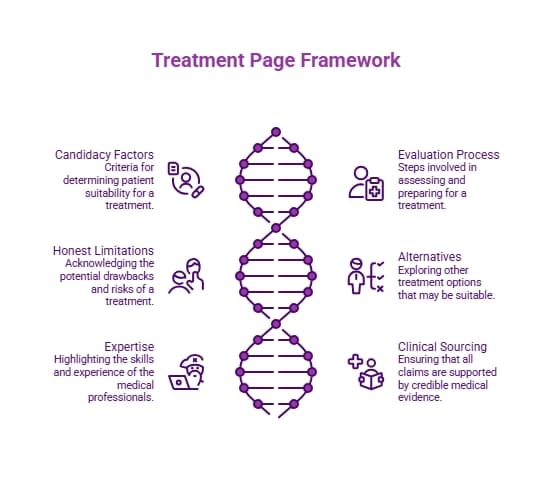
A treatment page serves a more advanced reader: someone who already knows the procedure they are weighing and wants to evaluate it. The intent has moved from "what is wrong with me" to "is this option relevant to my situation."
These pages are strongest when they focus on candidacy factors, the general evaluation process, honest limitations, alternatives worth discussing with a physician, and the expertise behind the procedure. Claim discipline matters most here. Outcome guarantees, success rates, and recovery timelines should stay off the page unless they are clinically sourced and reviewed. The FTC's health products compliance guidance reinforces a broader principle worth applying even when a page sells visibility rather than a treatment: benefit and safety claims should be truthful, substantiated, and not misleading.
A treatment page should also connect back to its related condition pages. Otherwise, the treatment can appear disconnected from the original concern that led the reader there. Pair a dermatology laser resurfacing page with the acne scarring condition it addresses, or a gastroenterology endoscopy page with the reflux concern that often leads there, and the procedure stops reading as a disconnected service. It becomes a logical next step in a path the reader recognizes.
This separation also reduces duplication. The condition page does not need to become a full treatment guide. The treatment page does not need to repeat every condition overview. Each page earns its role by answering a distinct intent.
Physician Pages Validate Specialist Fit
Physician bio SEO is often underestimated. Many specialty practices have physician pages, but those pages read like thin directories. They may include a photo, title, training, board certification, and a scheduling button. Those elements matter, but they may not answer the reader's central question: "Is this physician relevant to the condition or treatment being researched?"
A stronger physician page connects professional credibility to decision context. For a specialty practice, that page should include subspecialty focus, conditions treated, procedures performed, credentials and training, practice locations, referral context, the appointment or access path, and links to relevant condition and treatment pages.
This is where condition-to-physician mapping becomes most important. BVM's medical specialty SEO approach emphasizes connecting symptoms, diagnoses, procedures, access questions, and physician-fit signals so a specialty search path points toward the appropriate specialist, not just a general service line.
In multi-physician groups, this matters even more. If different physicians handle different subspecialty areas, the website should not make them look interchangeable. A physician page should clarify fit in a way that helps the reader, supports referral validation, and reflects the actual structure of the practice. For a gastroenterology group, that means a GI physician page that ties back to the reflux condition content and the endoscopy procedure page, so a reader can trace a clean line from concern to specialist.
This is the layer where many practices quietly lose ground. Their expertise is real, yet it stays invisible to anyone evaluating fit online, and it never gets mapped to the conditions and procedures it should anchor.
The Three Paths Should Connect, Not Compete
Separating these paths is not about producing three versions of the same page. The better model is connected differentiation: each page serves a distinct intent, then hands the reader to the next sensible decision point.
| Page Type | Primary Search Intent | Best Job | Should Link To |
|---|---|---|---|
| Condition page | "What is this problem?" | Explain the condition and route next steps | Treatments, relevant physicians, locations |
| Treatment page | "Is this option relevant?" | Explain the treatment path and evaluation factors | Related conditions, physicians, FAQs |
| Physician page | "Who should evaluate me?" | Validate specialist fit | Conditions treated, procedures, location and access |
A simple architecture might look like: reflux condition page → endoscopy procedure page → GI physician page. That is a structural example, not a clinical recommendation. The condition page helps the reader understand the topic category. The procedure page helps the reader understand the care-option category. The physician page helps the reader evaluate whether a specific doctor or team is relevant.
The failure mode to avoid is duplication. When the condition page, treatment page, and physician page all carry near-identical copy, they compete with one another and dilute the clarity each was meant to provide. Distinct intent on every page, joined by clear internal links, is what turns three pages into a connected decision-support system instead of three thin variations. Google's Search Essentials guidance points the same way: use the language real people use in titles, headings, and link text, and keep internal links crawlable so the relationships between pages stay easy to follow.
When Separate Paths Are Usually Worth Building
Building separate paths is an investment, so it deserves a deliberate decision rather than a default. The case grows stronger when the service line draws from multiple high-value conditions, when patients search by condition, by procedure name, and by physician name, and when different physicians own different subspecialty areas.
Suspected referral leakage is another signal. A referred patient may still go online to validate the doctor, the condition focus, and the appointment path before scheduling. If the website does not support that validation, the referral can lose momentum. So is the telltale overloaded page that tries to explain symptoms, diagnoses, treatments, credentials, locations, and appointment steps all at once.
There is a search-systems dimension too. For high-value healthcare SEO, this issue becomes more visible because the reader's evaluation is more deliberate. Patients, caregivers, and referring providers often compare treatment paths, providers, and logistics before they commit. The clearer the relationships among physicians, conditions, procedures, and locations, the easier those entities are for search and AI systems to interpret. The more evaluation a service line invites, the more separate paths tend to earn their keep.
When One Page May Still Be Enough
Separation is not a universal rule, and treating it as one would be its own mistake. One page may be perfectly adequate when the service is low-complexity and patients evaluate it quickly, or when there is a single physician, one location, and little treatment variation. The same holds when search demand is mostly branded rather than condition- or procedure-led, or when the condition and treatment terms are not meaningfully distinct in how people search.
Capacity matters as much as demand. A practice that cannot yet keep multiple pages accurate and clinically sound is usually better served by fewer pages it can stand behind. Google's Search Quality Rater Guidelines describe YMYL topics — health, safety, financial stability, and well-being — as requiring very high page-quality standards precisely because low-quality content in these categories can cause real harm. A narrow, accurate, clinically reviewed page is better than multiple thin pages that drift into unsupported medical explanation. In healthcare, an extra page that drifts out of date is not an improvement; it is a liability.
How to Audit a Specialty Service Line Before Adding Pages
Before building anything, it helps to look at one priority service line the way a practice leader would, not a developer. A short executive-level audit surfaces where clarity is actually missing.
1. Name the priority service line you most want to grow.
2. Identify the common conditions that lead patients into that service.
3. Identify the treatments or procedures patients search for by name.
4. Map which physicians are best aligned with each condition or procedure.
5. Check whether existing pages clearly connect those entities, or only mention them in passing.
6. Flag overloaded pages carrying too many unrelated intents.
7. Decide which single missing path would most improve clarity right now.
This audit often reveals one of three problems. A condition may be mentioned but not connected to a physician. A treatment page may exist but feel disconnected from the condition that led the reader there. Physician bios may list credentials but fail to explain how the physician fits the reader's concern.
The solution is not always a new page. Sometimes it is better internal linking, clearer headings, stronger physician content, or a more focused service page. The architecture should follow the reader's decision path.
That decision should not be the last gate. Before any of these pages goes live, content that carries clinical meaning belongs in front of qualified medical reviewers. Condition descriptions, treatment explanations, candidacy or eligibility language, and any reference to risks, alternatives, or recovery should be confirmed by appropriate clinical stakeholders. Page structure, internal linking, and marketing framing are the practice's call. Anything that could shape how a patient understands their care is a clinical review item.
What This Means for AI Search and Specialist Discovery
AI-assisted discovery depends on clear source material. To represent a practice accurately, these systems need to understand what it does and how its physicians, conditions, treatments, and locations relate. When those relationships sit buried inside one broad page, they are harder to interpret. When they live in connected paths with explicit links, they become legible.
This should be framed carefully. Google describes structured data as a way to help search engines understand a page's content — not as a guarantee of visibility — and the same caution applies to AI mentions. A connected content architecture may make relationships clearer for crawling, interpretation, and source evaluation. It does not guarantee rankings, AI citations, patient volume, or service-line growth.
Well-organized content paths can help here. For teams thinking seriously about this layer, the discipline behind AI and generative engine optimization rests on entity clarity and source quality, not on claims about results. Those entities — physician, condition, procedure, specialty, location, and appointment path — become clearer to both humans and systems when they live in a structured, connected architecture rather than a single overloaded page.
Build Paths Around the Decision, Not the Department
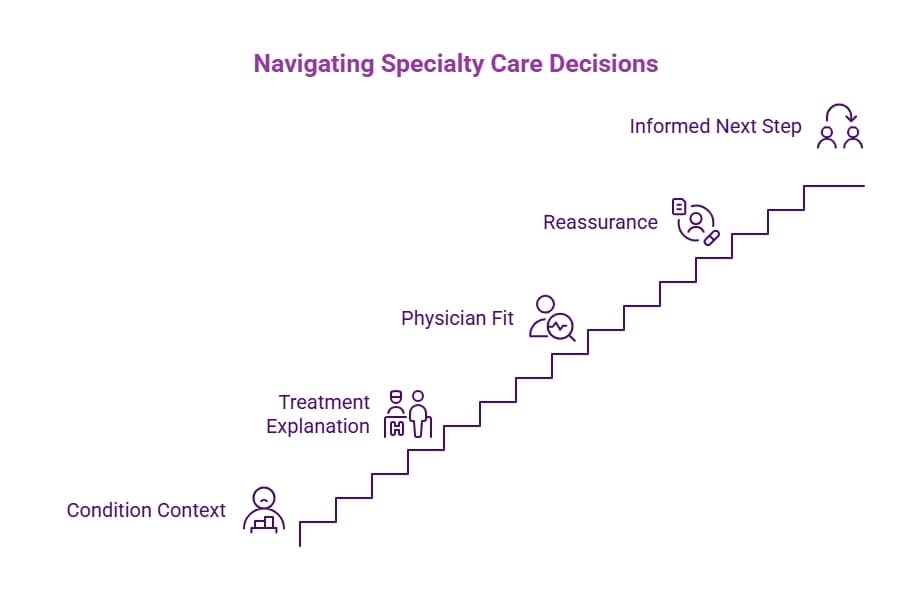
Specialty-practice websites should not be organized only around internal departments. They should reflect how serious patients, caregivers, and referring audiences actually evaluate care.
Condition-first readers need problem context. Treatment-intent readers need a general explanation of the care option or procedure path. Physician-fit readers need to evaluate whether a specific doctor is relevant to their concern. Referred patients may need reassurance that the recommendation matches what they find online. A single broad page collapses that sequence and leaves the reader to untangle it. Separate, connected paths follow the decision instead of the org chart.
The strategic goal is not to publish more pages for its own sake. The goal is to build specialty healthcare content paths that help readers move from uncertainty to a more informed next step — while preserving clinical accuracy, marketing ethics, and professional review.
If your priority service lines are still represented by one broad page, it may be worth reviewing whether your condition, treatment, and physician paths are clear enough for patients, referring providers, and search systems to understand. Get My Specialty Search Audit.
Frequently Asked Questions
Disclaimer: This article is for healthcare marketing and content strategy education only. It is not medical advice and should not be used to guide diagnosis, treatment, or individual patient decisions. Clinical content should be reviewed by qualified medical professionals before publication.
Our Editorial Process: Our expert team uses AI tools to help organize and structure our initial drafts. Every piece is then extensively rewritten, fact-checked, and enriched with first-hand insights and experiences by expert humans on our Insights Team to ensure accuracy and clarity.
By: About the BVM Insights Team
The BVM Insights Team is our dedicated engine for synthesizing complex topics into clear, helpful guides. While our content is thoroughly reviewed for clarity and accuracy, it is for informational purposes and should not replace professional advice.