
 Dustin Ogle
A physician bio page has three jobs: trust, routing, and governance. Most practices invest in the first and neglect the other two — which is why so many bios confirm that a physician is qualified without helping a patient decide whether that physician is relevant to their specific concern, or without staying accurate long enough to remain useful.
The opportunity for specialty practice marketers is not a longer bio. It is a more deliberately structured one — a page that confirms physician fit, routes the patient toward relevant condition and treatment content, and remains accurate enough to be trusted over time.
The Real Job of a Physician Bio Page

A physician bio page serves three distinct functions, and conflating them tends to weaken all three.
The first is trust. A bio should help a patient understand whether a physician may be relevant to their concern. Google's helpful content guidance asks whether content comes from a source with clear background information, whether it reflects genuine expertise, and whether it has received appropriate expert review. A bio that answers those questions directly — confirmed credentials, a specific clinical focus, and a governance note about content review — gives patients the kind of signal they need before selecting a specialist. Google explicitly states that E-E-A-T is not a specific ranking factor in isolation; trust remains its most consequential dimension, particularly for medical topics. A bio that accurately represents a physician builds that trust. One padded with marketing superlatives tends to undermine it.
The second function is routing. A bio page is a junction, not a destination. Its job is to connect the patient to the condition pages, treatment pages, and access information most relevant to that provider. A patient who confirms clinical fit and then finds a clear path to related condition content can continue making progress. One who encounters a dead end typically leaves. For specialty practices — orthopedics, dermatology, gastroenterology, ENT, ophthalmology, urology, neurology, cardiology, fertility, pain management, and others — bio pages should make real areas of focus easier to understand without exaggerating authority. Their physicians should not look interchangeable online.
The third is governance. Physician bios are high-visibility pages that age poorly without oversight. Outdated affiliations, changed credentials, and inaccurate condition lists accumulate quietly. Treating each bio as a governed content asset — with a defined reviewer and an update schedule — protects the practice from carrying claims it can no longer verify. As a practical standard: bio content should be useful, accurate, and reviewable.
What Each Physician Bio Should Include
A useful physician bio does not need to become a long autobiography. It needs the right information in the right structure, with the right review owner.
| Bio Element | Why It Matters | Review Owner |
|---|---|---|
| Full name and credentials | Accurately identifies the provider for patients and credentialing purposes | Practice admin / physician |
| Specialty and subspecialty focus | Connects the bio to specialty-intent searches; helps patients confirm clinical fit | Physician / clinical lead |
| Conditions treated | Maps patient concerns to physician relevance | Physician reviewer |
| Procedures or treatments offered | Links physician expertise to treatment pages | Physician reviewer |
| Training, board certification, affiliations | Supports trust when current and verifiable | Credentialing / admin |
| Locations and appointment access | Reduces booking friction | Operations |
| Insurance / access notes if approved | Helps patient decision-making when accurate and approved | Operations / compliance |
| Related condition and treatment links | Supports internal patient routing | Marketing + clinical reviewer |
| Reviewer / last-reviewed note when used | Supports content governance | Content owner |
The review owner column is not a formality. It is what keeps provider bio content from drifting into unsupported clinical or credential claims. Marketing can usually draft the page structure, write plain-language copy, and recommend internal links. The physician or clinical lead should confirm clinical focus, condition language, procedures, affiliations, and credential representation. Operations should confirm location, scheduling, and insurance details. Compliance or leadership should review sensitive claims before publication.
Credentials require verification, not assumption. The American Medical Association notes that physician profiles include education, training, board certifications, and state license data — information credentialing professionals rely on to help verify qualifications. A lapsed certification or a former hospital affiliation still listed on the bio page creates a credibility problem the moment a patient attempts to confirm it independently.
Conditions treated and procedures offered require clinical confirmation. Drafting these from specialty type alone, without physician review, risks either understating the physician's actual clinical focus or listing services they no longer provide. Neither outcome serves the patient or the practice.
How Bios Should Connect to Condition and Treatment Pages
The routing architecture matters as much as the bio content itself. Each page in the specialty site should perform a clear job, and the bio should connect naturally to each of them. A useful structure looks like this:
Provider bio → condition page → treatment page → location/access page → appointment path.
A physician whose clinical focus includes a specific condition should link directly to the practice's relevant condition page. That link answers the patient's immediate question — this physician evaluates what I am researching — without requiring independent navigation. Where a physician performs or evaluates a specific procedure, a corresponding link to the treatment page gives the patient practical context about what engagement with that physician looks like. Treatment pages should describe the procedure and make the appointment path clear, while stopping short of implying any physician is automatically the right choice for every patient. That determination is clinical, not editorial.
Condition pages also benefit from identifying which physicians in the group evaluate that condition — a clinically verified subset, not the full provider directory. Practices building this kind of routing, as outlined in a Medical Specialty SEO strategy for physician-fit search paths, create a more useful experience for patients who begin with a symptom and need to find the right specialist. For higher-trust care decisions — where patients are evaluating complex conditions, treatment programs, or specialist teams — the depth of that provider-to-condition connection becomes significantly more important, and High-Value Healthcare SEO approaches address it accordingly.
Internal links should be earned by relevance. If a dermatologist's reviewed clinical focus includes psoriasis and eczema, those links make sense. If every physician appears on every condition page, the site may look comprehensive, but the experience becomes less useful for patients trying to evaluate specialist fit. A clear link from the physician bio to the relevant office location removes one more decision obstacle for patients who have confirmed clinical fit but still need to confirm logistical fit. For groups managing multiple sites, well-structured location pages for multi-specialty clinics make that routing more consistent to maintain.
How to Show Expertise Without Overclaiming
The difference between a weak bio and a useful one is specificity grounded in verified content — not the strength of the language used to describe the physician.
The following examples are hypothetical and for illustrative purposes only.
Weak: "Dr. Smith is the best knee surgeon in Texas."
That sentence creates several problems. "Best" is a comparative superiority claim. "Texas" adds a broad location-based assertion. "Knee surgeon" may be too vague unless the practice has verified that language. Without strong support and appropriate review, the sentence should not be used.
Stronger: "Dr. Smith is a board-certified orthopedic surgeon whose clinical focus includes knee injuries, arthritis care, and knee replacement evaluation. The practice's knee-related content should be reviewed for accuracy by the appropriate clinical reviewer."
This version describes what Dr. Smith evaluates at a level of detail a patient can act on, and treats review as a forward-looking governance standard rather than a vague credential claim. The structure is stronger because it is specific, reviewable, and less promotional.
Weak: "Dr. Lee is a highly respected gastroenterologist with years of experience treating digestive conditions."
"Highly respected" is vague. "Years of experience" requires verification. "Digestive conditions" is too broad to guide a patient or a content reviewer.
Stronger: "Dr. Lee is a board-certified gastroenterologist who evaluates adults for digestive symptoms and conditions such as reflux, inflammatory bowel disease, colon polyps, and liver-related concerns. Related practice pages should link to the appropriate condition and procedure pages only after clinical review."
Both stronger versions share a common structure: named credentials, a specific clinical focus, and a governance note that signals the content is subject to review. Specific focus areas, when verified, are more useful than polished-sounding generalizations.
Google's E-E-A-T guidance should be handled with equal care. E-E-A-T is not a badge to add to copy — it should be reflected in accurate content, clear sourcing where relevant, appropriate review, and transparent provider context. For physician bio pages, that means trust is earned through what the page actually says and can verify, not through language designed to signal authority without supporting it.
Clinical Review Workflow for Bio-Linked Content
A physician bio without a review process is likely to carry outdated or inaccurate information within one or two service-line changes. A repeatable five-step workflow prevents that accumulation.
1. Marketing drafts structure and internal links. The marketing team builds the bio framework — page structure, internal links to condition and treatment pages, location information, and appointment pathways. This is architecture work, not clinical validation.
2. Physician confirms clinical content. The physician reviews and confirms conditions treated, procedures offered, credential language, and specialty description. Any list the physician has not confirmed should remain a draft.
3. Operations confirms access information. Location details, scheduling, and insurance information — where included and approved — change more frequently than clinical focus. Operations should verify these on a defined schedule, not only at launch.
4. Compliance or leadership reviews sensitive claims. Any reference to outcomes, rankings, or language that carries compliance exposure should be reviewed before publication. This is especially important for board certification, awards, affiliations, outcome language, and treatment-suitability language.
5. Content owner records the review date and sets a trigger. Review triggers include new practice locations, physician credential changes, revised service lines, new condition or treatment pages, and updated affiliations.
This governance layer protects the website from two common problems: outdated bios and overbroad internal linking. It also gives the marketing team a repeatable process instead of forcing every provider bio update to become a custom judgment call. Integrating bio review into a broader appointment-first healthcare SEO content governance process — rather than treating bios as a one-time launch task — is what separates a maintainable program from one that quietly degrades between campaign cycles.
Structured Data and Entity Clarity
Structured data can help search systems understand what a physician bio page represents, but only when it accurately mirrors visible page content.
Schema.org provides a Physician type—a sub-type of MedicalBusiness—designed to mark up the business entity of an individual physician or a physician's office. This allows for the structured inclusion of professional properties, including available services, hospital affiliations, medical specialties, and U.S. National Provider Identifier (NPI) numbers. The MedicalBusiness schema supports practice-level entity information: address, area served, member and memberOf relationships, and offers-related properties. Together, these vocabularies give specialty sites a structured way to express provider and practice relationships that prose alone may leave ambiguous for search systems.
A practical rule applies here: if the practice would not be comfortable displaying a claim visibly on the page, it should not be placed in schema markup. Schema should clarify entities and page relationships — not introduce unsupported claims or serve as a vehicle for hidden assertions.
What structured data does not do is guarantee rankings, rich results, or AI visibility. Schema is only as reliable as the content it describes. Implementing Physician markup on a page with thin, outdated, or inaccurate content creates inconsistency rather than credibility. The structured data should follow the visible content, not precede it. For practices extending schema across condition, treatment, and provider pages, the resource on medical schema for service pages covers implementation across the broader site structure.
Common Mistakes That Weaken Physician Bio Pages
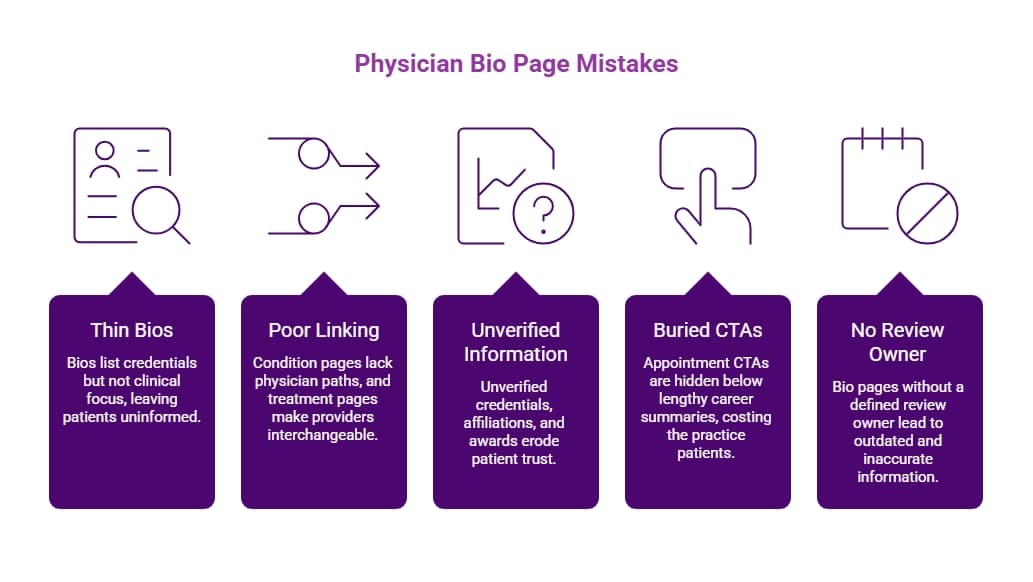
The most persistent bio problems are structural rather than stylistic, and they are predictable enough to prevent.
Thin bios that list credentials but not clinical focus leave patients without the information they came to find. Knowing a physician attended a respected institution tells a patient very little about whether that physician evaluates their specific concern. Condition pages with no path to relevant physicians force patients to navigate independently — and treatment pages that present every provider as interchangeable prevent patients from identifying which physician to consider for a specific procedure.
Linking every doctor to every condition may look like SEO coverage, but it confuses users and reviewers alike. Better links reflect actual clinical relevance. Unverified credentials, affiliations, and awards compound the problem — even when a claim is true, it should be current and reviewed before it goes live.
Appointment CTAs buried below lengthy career summaries cost the practice patients who confirmed fit but could not locate the next step. A biography can be warm and informative, but the path to booking should not disappear beneath the narrative.
Finally, bio pages without a defined review owner are not a minor operational gap. They are the primary source of the outdated affiliations, changed credentials, and inaccurate condition lists that erode patient trust without the practice realizing it.
Turn Bios Into Governed Search Pathways
The goal is not a longer bio. It is a clearer, verified, better-connected one — a page that reduces patient confusion, supports the right internal routing, and stays accurate enough to remain useful as the practice evolves.
A strong physician bio page helps a specialty practice show who the physician is, what clinical focus has been reviewed, which condition and treatment pages are relevant, where access is available, and how the visitor can move forward. When those elements are in place — and maintained — the bio functions as a genuine content asset rather than a static placeholder.
If you would like to see how your practice's physician pages fit into a larger specialty SEO strategy, Get My Visibility Analysis.
Frequently Asked Questions
Disclaimer: This article is for healthcare marketing and content strategy purposes only. It is not medical advice, legal advice, or compliance advice. Physician credentials, clinical focus areas, condition descriptions, procedure information, and appointment-access details should be reviewed by the appropriate clinical, operational, and compliance stakeholders before publication.
Our Editorial Process: Our expert team uses AI tools to help organize and structure our initial drafts. Every piece is then extensively rewritten, fact-checked, and enriched with first-hand insights and experiences by expert humans on our Insights Team to ensure accuracy and clarity.
By: About the BVM Insights Team
The BVM Insights Team is our dedicated engine for synthesizing complex topics into clear, helpful guides. While our content is thoroughly reviewed for clarity and accuracy, it is for informational purposes and should not replace professional advice.