
 Dustin Ogle
A specialty practice can produce fifty new condition and physician pages in a quarter. Whether the organization can govern fifty new sets of clinical relationships, page owners, review decisions, appointment routes, and measurement requirements is a separate question entirely.
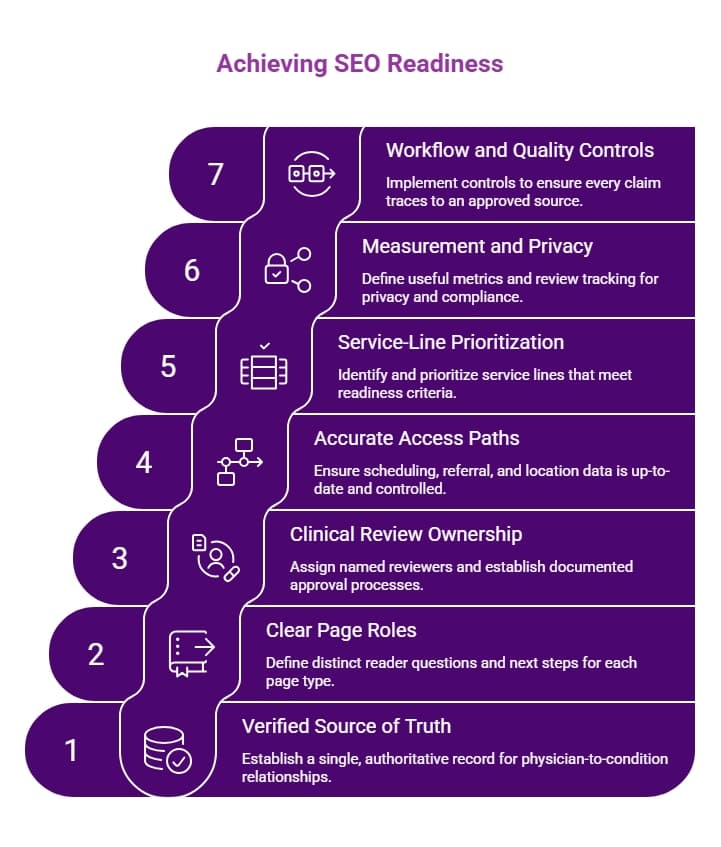
Expanding condition-to-physician content — pages that connect specific medical conditions to the physicians qualified to treat them — across multiple service lines does not simply increase page count. It increases the number of verified facts, responsible owners, approval workflows, access paths, and reporting obligations that must remain accurate as physicians move, services change, and scheduling systems update. Condition-to-physician mapping is the documented relationship between a condition page and the physicians, services, locations, and access paths it may appropriately connect to. Treat this as a governance question, not just a publishing task. The seven readiness questions below will clarify whether your practice should scale broadly, pilot one service line, or fix governance first.
Condition-to-Physician Scaling Readiness Scorecard
This is an editorial planning framework, not a validated clinical, legal, HIPAA, or compliance audit.
| Question | Ready | Needs Control | Stop Before Scaling |
|---|---|---|---|
| 1. Verified source of truth | Single authoritative record with a named owner | Data exists in multiple systems without clear precedence | Relationships cannot be verified; marketing builds associations independently |
| 2. Clear page roles | Each page type owns a distinct reader question and next step | Some overlap exists but is documented | No clear intent owner; pages compete for the same queries |
| 3. Clinical review ownership | Named reviewers, documented approvals, defined re-review triggers | Capacity or process is inconsistent | Review is ad hoc or no documented approval history |
| 4. Accurate access paths | Scheduling, referral, and location data has a named owner and update process | Routes are mostly current but depend on ad hoc notification | Stale routes cannot be controlled; no process to propagate changes |
| 5. Service-line prioritization | At least one service line passes all readiness checks | Controls need testing | Publishing pressure drives scope; no service line meets minimum governance requirements |
| 6. Measurement and privacy | Useful metrics defined; tracking reviewed for privacy/compliance | Metrics exist but attribution is unclear or privacy review is incomplete | Tracking is unreviewed |
| 7. Workflow and quality controls | Every claim traces to an approved source; review capacity matches throughput | Drafting workflow exists but traceability or review bottlenecks remain | Automation spreads unverified relationships |
1. Do You Have One Verified Source of Truth for Physician-to-Condition Relationships?
Before a single new page is drafted, the practice needs to define what it considers authoritative for physician specialties, subspecialties, conditions treated, procedures performed, locations, credentials, and availability. That definition should identify one system or record as the master, name who owns updates, and separate two different decisions: marketing may want to associate a physician with a condition, while the practice still needs to verify that clinical relationship through its approved source and reviewer.
The website should consume approved data rather than become the unofficial master record. A published bio is an artifact, not automatically the operational source of truth. When the site itself is the only place where a physician-condition association is documented, every new page risks copying an unverified relationship. Marketing databases, credentialing systems, and scheduling platforms may not agree on the same physician-condition pairings, and scaling content from a mismatched source multiplies the discrepancy.
Consider a hypothetical practice where two orthopedic surgeons both appear relevant for shoulder injuries. One focuses on rotator cuff repair; the other specializes in shoulder replacement. If the source of truth does not distinguish their subspecialty scopes, a content team building condition pages may assign both physicians to the same broad condition without recognizing the clinical difference. A simple one-condition, one-physician assignment would hide that distinction. The question is not which name marketing prefers — it is whether the practice can document the approved relationship and its source. That error is manageable on one page. Across a dozen condition pages, it becomes a pattern.
A practical test: if two teams independently built the same condition page, would they select the same physicians and source those associations from the same record? If the source of truth is unclear, pause expansion and fix ownership first. For a deeper look at evaluating this foundation, see how to assess condition-to-physician SEO readiness.
2. Does Every Condition, Treatment, Physician, and Location Page Have a Clear Job?
Content expansion becomes disorganized when condition pages, treatment pages, physician bios, and location pages all compete to answer the same patient query. Each page type needs a distinct reader question it owns and a clear next step it supports.
The two-surgeon hypothetical from above illustrates the structural side of the same problem. If the practice has not assigned the "shoulder pain" intent to a specific page type, every page touching that topic may try to answer the same question. Define a primary owner for each intent before multiplying supporting pages. One keyword does not automatically require one page, every condition does not automatically deserve a dedicated page, and this framework does not imply any universal page-count target. Page creation should follow a distinct reader need, a verified clinical relationship, and clear page ownership.
Condition pages explain what the condition involves and who may help. Physician pages establish the doctor's verified scope. Treatment pages clarify what a procedure addresses. Location pages confirm where care is available. Cross-links between them should clarify the care path, not imply a diagnosis or clinical recommendation.
A practical test: can the team explain in one sentence why each page exists and which page should own a new condition query? If the answer is not consistent, adding more pages will expand ambiguity rather than resolve it. A content audit can reveal overlap, but an audit alone does not assign owners or establish ongoing governance.
3. Who Owns Clinical Review, and What Triggers Re-Review?
Clinical review in many practices functions as a final proofreading step rather than a governed approval process. Scaling content without fixing that distinction means multiplying unapproved clinical statements.
Assign reviewers by claim type. A marketing editor can approve tone, structure, and formatting. A physician or clinical designee should approve condition descriptions, treatment characterizations, credential claims, and scope-of-practice language. These are different approval decisions, and conflating them creates gaps. Record what wording was approved and when, so re-review has a documented baseline.
Define the events that trigger re-review: physician departure, scope change, updated treatment protocol, location move, referral-rule revision, or material content revision. Without defined triggers, outdated clinical statements persist quietly across a growing page inventory. The review plan should also account for capacity. "Our physicians will catch mistakes" is not a governance plan; review must be assigned, scheduled, and scoped. If draft volume can increase but factual review cannot, the practice is not ready to increase throughput.
The AMA Code of Medical Ethics states that physician advertising and publicity should not be false or materially misleading, and that objective claims about experience, competence, or quality should be factually supportable. That standard is difficult to maintain at scale if clinical review capacity cannot keep pace with production volume. This is professional ethics guidance, not legal advice or a substitute for the practice's clinical, compliance, or legal process.
For teams building this process from scratch, a guide to constructing a clinical review workflow for condition-to-physician content covers the structural details.
4. Can Appointment, Referral, and Access Paths Stay Accurate as Service Lines Change?
Content is not ready to scale if the "next step" on a page becomes stale faster than anyone updates it. Every condition or physician page that includes a scheduling link, referral instruction, office location, or record requirement creates an operational dependency.
Imagine a physician who relocates from one office to another within the same health system. That single change can affect the physician's bio page, every condition page linking to that doctor, location pages listing available specialists, appointment routing for the affected service line, and internal links connecting related content. Without a named owner for non-clinical operational updates and a defined process for propagating changes, some of those pages will remain inaccurate until a patient or staff member notices.
Before scaling, confirm which office, scheduling route, referral requirement, and service pathway each page references. Build a process for removing or redirecting outdated routes. The operational question is straightforward: if a physician changes location tomorrow, how many pages and systems must change, and who knows where all of them are? This is also why maintenance belongs inside the scaling decision, not after it.
For practices already managing this challenge, a resource on keeping physician content accurate when service lines change addresses the maintenance side in more detail.
5. Which Service Lines Are Actually Ready to Scale First?
The impulse to publish content across every service line at once usually outpaces governance capacity. A more reliable approach is to identify which service line has the strongest combination of business relevance and operational readiness.
Evaluate each candidate against a simple matrix:
- Verified physician-condition relationships exist
- A clinical review owner is assigned
- Access and appointment paths are current
- Page roles are defined and non-overlapping
- A measurement approach is in place
- A maintenance owner can handle ongoing changes
No universal scoring formula is required. The purpose is to expose weak dependencies before they spread. Prioritize the service line that scores strongest across these dimensions, not the one with the largest keyword opportunity. A service line with verified data, a willing clinical reviewer, and a reliable scheduling path will produce safer, more sustainable content than one with high search volume but no governance foundation.
When several controls remain immature across the board, a controlled pilot in the strongest service line is the better first move. A pilot can expose governance gaps before they spread across service lines — testing whether updates propagate correctly, reviewers can sustain the workload, page roles remain distinct, and reporting produces useful information. "We can fix governance after publishing" reverses the safer sequence.
6. Can You Measure Useful Outcomes Without Creating Privacy or Attribution Problems?
Measurement design should precede scale, not follow it. Before adding more pages, define what constitutes a useful outcome at the service-line and page-path level. Aggregate sessions and broad ranking positions rarely tell practice leaders whether the right service lines are gaining meaningful visibility or whether content is connecting patients to appropriate next steps. "Traffic will tell us whether this worked" is incomplete. Reporting should identify relevant visibility and pathway signals without overstating causation.
The opposite simplification is also risky: privacy concerns do not mean a practice can measure nothing. Where analytics platforms, scheduling tools, intake forms, or third-party tracking technologies may collect or process information related to patient interactions, the configuration may require privacy and compliance review. HHS OCR has stated that HIPAA obligations can apply when tracking technologies used by regulated entities involve the collection or disclosure of protected health information. That guidance also carries a June 2024 court-order limitation concerning certain unauthenticated public-page and IP-address scenarios, so the regulatory picture requires qualified interpretation rather than blanket conclusions.
The practical takeaway is not that measurement is prohibited. Measurement configurations should be reviewed by someone with the appropriate privacy or compliance expertise before the practice expands tracking alongside content. Assuming that compliance prevents all measurement is as risky as assuming that aggregated analytics data is automatically safe. A deeper discussion of designing measurement for referral-validation SEO without exposing patient information is available for teams working through this challenge.
7. Can Your Workflow Scale Without Quality Drift, Including AI-Assisted Drafting?
AI tools can assist with drafting, research organization, and structural formatting. They do not replace the source-of-truth data, review ownership, or approval rules that govern what gets published. Draft throughput and governance capacity are separate constraints, and confusing them is one of the fastest ways to scale errors.
Consider a hypothetical scenario: an AI drafting tool is given a physician-condition mapping spreadsheet that has not been updated in six months. The tool efficiently produces condition pages that associate a recently departed physician with procedures that doctor no longer performs at the practice. The outdated source relationship is now reproduced across dozens of pages instead of one. Templates create a similar risk — they can scale stale language as efficiently as current language.
Before increasing throughput, require traceability from every published claim back to its approved source. Establish versioning so the team knows which version of the physician-condition data a page was built from, and define re-review controls so that a source update triggers a content update.
According to Google Search Central, content should be created primarily to help people, and trust is especially important for topics that could significantly affect health, financial stability, or safety. That guidance also emphasizes appropriate consideration of how automation is used in content creation. For specialty practices, production speed is valuable only when governance keeps pace. If factual validation is already the bottleneck, producing drafts faster does not make the practice more ready to scale.
Scale the Controls Before You Scale the Page Count
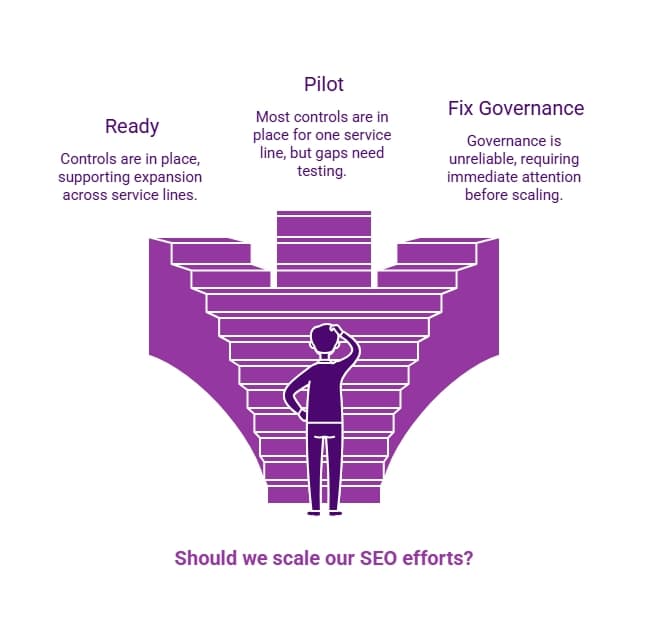
The seven questions above sort into three outcomes:
Ready: Controls exist, owners are named, and the governance foundation supports expansion across multiple service lines.
Pilot: Most controls are in place for at least one service line, but untested gaps remain. A controlled pilot exposes those gaps before they spread.
Fix governance first: Physician-condition relationships, review ownership, access paths, or measurement remain unreliable. Scaling now would multiply those problems.
Before approving a broader rollout, have the leadership, clinical, marketing, and operations owners answer these seven questions for one priority service line. The answers will reveal whether the next step is expansion, a focused pilot, or a governance fix.
For practices that want a structured evaluation of their specialty search readiness, BVM offers medical specialty SEO services built around condition and physician-fit search pathways. To start that conversation, request a Specialty Search Audit.
Frequently Asked Questions
Disclaimer: This article is for general informational purposes only and does not constitute medical advice, diagnosis, or treatment. Readers should consult a licensed healthcare professional for guidance specific to their health, symptoms, medications, or treatment options.
Our Editorial Process: Our expert team uses AI tools to help organize and structure our initial drafts. Every piece is then extensively rewritten, fact-checked, and enriched with first-hand insights and experiences by expert humans on our Insights Team to ensure accuracy and clarity.
By: About the BVM Insights Team
The BVM Insights Team is our dedicated engine for synthesizing complex topics into clear, helpful guides. While our content is thoroughly reviewed for clarity and accuracy, it is for informational purposes and should not replace professional advice.