
 Dustin Ogle
A large health system may publish hundreds of healthcare pages across dozens of service lines. That volume can make the competitive picture feel settled before a specialty practice even opens a spreadsheet. The useful question, though, is not "who has more pages?" A system with 400 condition pages can still leave a patient unclear about which physician handles a specific problem, what evidence supports that physician's expertise, or what happens after the informational page ends.
The audit that matters compares clarity, not inventory: how well each site makes verified specialty relationships visible, from symptom to relevant specialty, condition to qualified physician, treatment to appropriate provider, and information to a concrete next step. These seven criteria give your team a structured way to run that comparison using observable evidence rather than ranking speculation.
Start With Observable Evidence, Not Rankings Alone
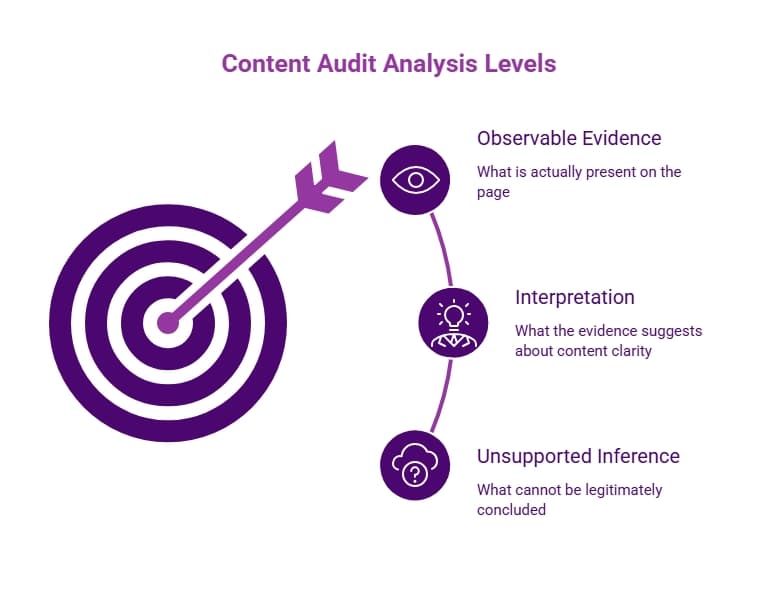
Before scoring a single page, establish what your audit will and will not measure. The discipline requires separating three levels of analysis throughout every criterion:
- Observable evidence: what is actually present on the page.
- Interpretation: what that evidence suggests about content clarity.
- Unsupported inference: what you cannot legitimately conclude about clinical appropriateness, algorithms, or business performance.
Record what the page actually explains, not what you assume it implies. A page titled "Shoulder Pain" may exist on a competitor's site, but existing is different from explaining which specialty may be relevant, why, and what the reader should do next.
Do not infer medical appropriateness from search visibility. A competitor appearing in search results does not confirm that its content is accurate or current. Do not infer ranking causation from a competitor's page structure. You can observe what a page contains. You cannot observe why it ranks.
When possible, compare like-for-like search journeys: choose a symptom, condition, or treatment your practice genuinely serves and trace the path a reader would follow on each site. The working method: observe, document, verify, classify the gap, and prioritize.
This distinction matters internally as well. Marketing may see a missing connection that a physician considers clinically inappropriate, or a physician may treat a condition but not want it positioned as a core focus. Some of those gaps can be resolved editorially. Others require clinical or operational review before anything changes. Keeping the levels of analysis separate helps each team contribute the judgment it is qualified to make.
The 7-Criterion Symptom-to-Specialist Competitive Audit
Use the evaluation matrix below to organize your observations before reading the detailed criteria. Record evidence for each criterion on both the competitor's site and your own.
| Criterion | What to Inspect | Evidence to Record | Clinical Review Needed? |
|---|---|---|---|
| 1. Symptom/concern → specialty clarity | Does the page explain why a specialty may be relevant? | Wording, links, cautious language, next step | Yes, if routing language is specific |
| 2. Condition → physician/subspecialty clarity | Can a reader identify physicians with verified relevant expertise? | Physician links, subspecialty distinctions, consistency | Yes, for expertise claims |
| 3. Treatment/procedure → physician relationship | Does the treatment page connect to the appropriate physician or service? | Named relationships, candidacy vs. education distinction | Yes, for treatment claims |
| 4. Physician expertise → visible proof | Does the bio show verified clinical focus, not just credentials? | Training, focus areas, authorship, unsupported superlatives | Yes, for clinical-focus claims |
| 5. Referral, location, and appointment-path clarity | Does the reader know what happens next? | Referral steps, location options, contact specificity | Operational review for accuracy |
| 6. Entity and terminology consistency | Are names, specialties, conditions, and treatments consistent across pages? | Mismatches, broken internal links, structured-data alignment | If inconsistencies affect clinical meaning |
| 7. Clinical review, authorship, and evidence governance | Is there evidence of accountable content review? | Reviewer names, update dates, source traceability | Review-process verification |
1. Symptom or Concern → Specialty Clarity
Look for whether the page explains why a given specialty may be relevant to the symptom or concern described. Where a symptom could involve more than one specialty, check whether the content acknowledges that ambiguity rather than forcing a single routing answer. For example, if a patient searches for 'chronic pelvic pain,' the relevant specialist might be a gynecologist, a urologist, or a gastroenterologist depending on accompanying symptoms.
Consider a hypothetical: a patient searches for a symptom that could reasonably involve two or three specialties. If the competitor's page names only one without acknowledging the others, that is observable evidence of oversimplified routing. If it explains the ambiguity and helps the reader understand the distinctions, that is evidence of responsible clarity. Concluding that one approach ranks better would be an unsupported inference.
Record whether the page offers a sensible next informational step. A symptom page that educates but dead-ends leaves the reader stranded. If your practice's own page needs a specific symptom-to-specialty relationship stated, that relationship requires clinical review before publication.
2. Condition → Physician or Subspecialty Clarity
Check whether a reader on a condition page can identify which physicians have relevant, verified expertise. A directory link to every physician in the practice is not the same as a meaningful connection between a condition and the clinicians whose training or documented experience supports that relationship.
Where subspecialty differences genuinely matter, note whether the competitor explains them. A page that names "our specialists" without distinguishing subspecialty focus leaves the reader guessing. Verify whether the condition-to-physician relationship is consistent across the condition page and the corresponding physician page.
This is also where a practice may discover that its real clinical differentiation is poorly represented online. Document the relationship first, then confirm it with the appropriate physician or clinical owner before strengthening it on the site. A physician may treat a condition without wanting that topic positioned as a defining area of focus, and the audit should surface that distinction rather than override it.
3. Treatment or Procedure → Physician Relationship
Examine whether treatment pages identify the appropriate physician or service relationship. A strong treatment page educates the reader about what the procedure involves. A stronger one connects that information to a qualified provider so the reader does not have to search separately.
Note whether the page distinguishes treatment education from candidacy. Content explaining what a procedure involves is different from content implying that any reader is a suitable candidate. Check whether treatment claims are consistent with the corresponding physician and service pages; a mismatch is a gap worth documenting.
Do not reproduce a competitor's treatment relationships simply because those pages rank or appear comprehensive. Your practice must be able to support its own relationships independently. That distinction matters for clinical accuracy and for keeping content architecture clean across symptom, condition, treatment, and specialist pages.
4. Physician Expertise → Visible Proof
A physician bio that lists board certifications and training institutions establishes credentials. The observable evidence question is whether the bio also connects those credentials to a verified clinical focus, specific conditions managed, or treatments performed.
Imagine two hypothetical profiles for the same specialty. One lists credentials and a generic paragraph. The other connects fellowship training and clinical interests to the conditions and procedures the practice positions under that physician's care. The first confirms the physician exists. The second helps the reader understand why this physician may be relevant. That gap between presence and usable relationship clarity is what physician bio pages need to close.
Flag any page using unsupported superlatives ("leading expert," "best surgeon," "top-rated specialist") without visible evidence. Then compare the bio with the condition and treatment pages that reference the physician. If those pages make stronger expertise claims than the bio supports, you have an evidence or consistency gap worth prioritizing.
5. Referral, Location, and Appointment-Path Clarity
Strong informational content loses value when the reader reaches the end and cannot determine what to do next. Check whether the page makes referral requirements, location choices, records requirements, and contact paths clear where relevant.
Consider a hypothetical condition page that gives thorough educational information, then ends with a generic "Contact Us" form offering no explanation of referral steps, location options, or appointment pathway. The page succeeded at education but failed at routing. Document whether the competitor provides that specificity and whether your own site does. Record only what is visibly stated.
Appointment workflows may legitimately vary by physician, location, insurance status, or referral requirement, so do not assume what the correct operational process should be. In many organizations, marketing cannot rewrite these details without operational approval. Record what is clear, what is absent, and who owns the missing information.
6. Entity and Terminology Consistency Across Pages
Compare how physician names, credentials, specialty labels, condition names, treatment names, and location names appear across pages. Inconsistencies (a physician listed as an "orthopedic surgeon" on one page and a "musculoskeletal specialist" on another) erode trust for both human readers and search systems.
Check whether internal links reinforce real relationships or point to outdated destinations. If structured data is present, note whether it mirrors visible page content. Structured data should represent what the reader can already see, not introduce hidden relationships the visible content does not support.
7. Clinical Review, Authorship, and Evidence Governance
Look for evidence that higher-risk clinical content has an accountable reviewer: a named medical reviewer, a "reviewed by" attribution, or a meaningful review/update date. The presence of these signals does not guarantee accuracy (that would be an unsupported inference), but their absence on clinical pages is observable evidence worth noting.
Check whether the practice can trace a published claim to a responsible subject-matter expert. Note whether physician or service information appears stale. A bio listing a physician who left the practice, or a service page describing a procedure no longer offered, is a governance gap your audit should capture.
Physicians may disagree about wording, and marketing teams may not always have the authority to resolve those disagreements unilaterally. The audit should expose the governance question so the right stakeholders can address it, not pretend the marketing team can settle it alone.
Symptom-to-Specialist Competitive Audit Scorecard
Use this worksheet to record findings for each criterion. Rate each using qualitative statuses: Clear, Partial, Missing, or Needs Clinical Verification.
| Criterion | Competitor Evidence | Our-Site Evidence | Gap Type | Clinical Review Needed? | Priority | Notes / Source URL |
|---|---|---|---|---|---|---|
| 1. Symptom → specialty | ||||||
| 2. Condition → physician | ||||||
| 3. Treatment → physician | ||||||
| 4. Expertise → proof | ||||||
| 5. Referral/location/path | ||||||
| 6. Entity consistency | ||||||
| 7. Review and governance |
If multiple teams will participate, add an owner and next-action column to your working version. That makes the worksheet useful for prioritizing scarce physician-review time and for showing clinicians exactly what marketing has observed rather than what marketing has concluded.
Turn the Audit Into a Gap List, Not a Copy List
Classify each finding. Not every difference is a gap worth closing, and not every gap requires a new page.
| Gap Type | Definition |
|---|---|
| Clarity | Information exists, but the relationship is unclear |
| Coverage | An important reader question has no supported answer |
| Evidence | A claim exists without visible proof or internal support |
| Routing | Content educates but does not lead to physician, service, or access information |
| Consistency | Pages disagree about names, expertise, treatments, or locations |
| Governance | Content lacks clear review ownership or includes stale information |
The decision rule: do not create content solely because a competitor has it. A topic is actionable only when it matches a real patient or referrer need, your practice has verified information to address it, and your team can maintain the content. That standard applies to page scope as well. A practice does not need a separate page for every symptom; each page decision should depend on legitimate reader need, clinical support, distinct search intent, and whether the practice can responsibly maintain it.
Using AI tools to draft missing pages faster does not change this standard. Drafting efficiency does not remove the need for source verification, clinical review, and current physician and service information.
What the Audit Cannot Tell You
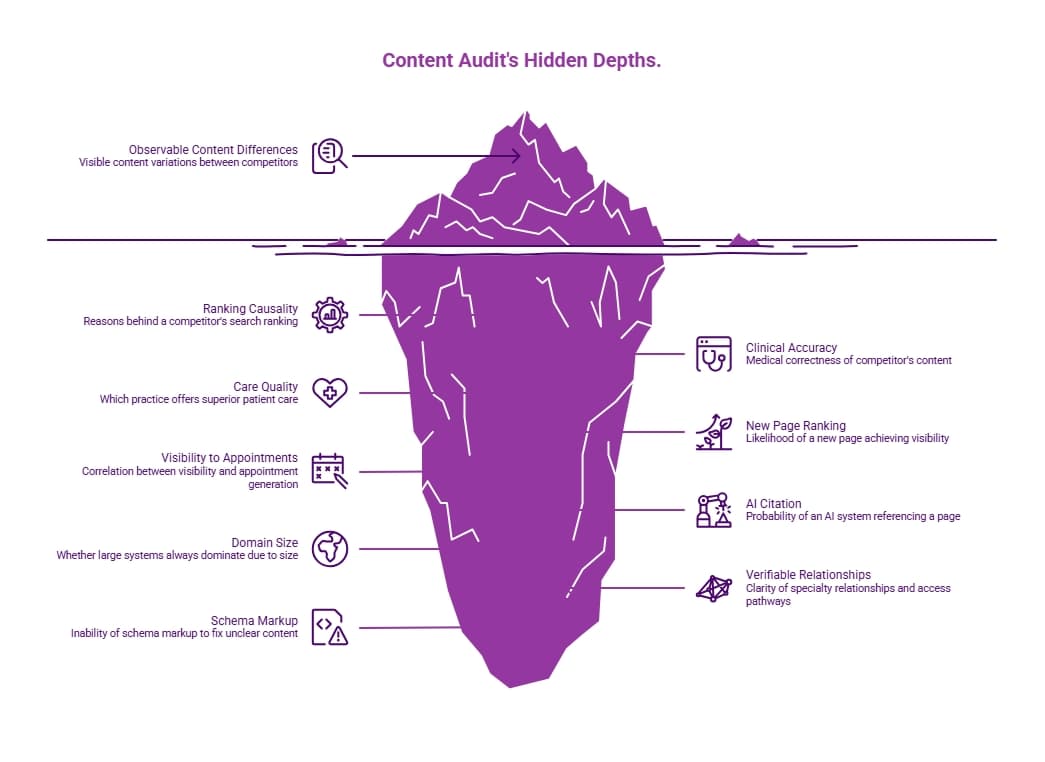
This exercise identifies observable content differences. It cannot establish why a competitor ranks, whether a competitor's clinical content is medically correct, which practice offers better care, whether a new page will rank, whether visibility will produce more appointments, or whether an AI system will cite a page.
If the concern is that large systems will always win on domain size alone, this audit reframes the question. Turning an observable content problem into an unsupported algorithm claim is not a useful audit conclusion. The comparison is not about matching institutional scale. It is about whether your practice communicates verifiable specialty relationships and access pathways more clearly within the areas you actually serve.
The same principle applies to structured data. Schema markup cannot compensate for unclear visible content, and a competitor's implementation does not by itself prove expertise or explain its visibility. Acknowledging these boundaries keeps the framework credible.
Choose One Pathway to Investigate First
Select one high-value journey: a symptom or condition your practice genuinely serves, traced through to the relevant physician, treatment information, and access step. Audit that pathway end-to-end on the competitor's site and your own. Record observable evidence, classify each gap, and verify findings with clinical and operational owners before making content decisions.
Starting with one complete pathway produces usable findings faster and gives your team a concrete basis for the next conversation with physicians, administrators, or a specialty search partner.
If your team is ready for outside perspective on where specialty and condition searches may be missing your practice, Get My Specialty Search Audit.
Frequently Asked Questions
Disclaimer: This article is intended for marketing and content-planning purposes. It is not medical advice. Clinical relationships, patient-facing descriptions, and treatment information referenced in a competitive audit should be reviewed by appropriately qualified medical professionals before publication.
Our Editorial Process: Our expert team uses AI tools to help organize and structure our initial drafts. Every piece is then extensively rewritten, fact-checked, and enriched with first-hand insights and experiences by expert humans on our Insights Team to ensure accuracy and clarity.
By: About the BVM Insights Team
The BVM Insights Team is our dedicated engine for synthesizing complex topics into clear, helpful guides. While our content is thoroughly reviewed for clarity and accuracy, it is for informational purposes and should not replace professional advice.