
 Dustin Ogle
A specialty-practice page can be well written, medically accurate, and still leave its most important clinical relationships unclear. The copy may describe advanced care and experienced physicians without stating the relevant specialist, supporting evidence, service location, or information owner.
That is a clarity and governance problem, not proof that a site needs a secret AI format. AI-mediated search refers here to search or discovery experiences in which a generative system retrieves, organizes, or summarizes information. These systems do not all work identically. Google Search Central states that established SEO remains relevant to its generative Search features and that special AI markup and mandatory micro-chunking are not required. Indexing or serving is never guaranteed.
Ai-Readable Clinical Content Makes Important Relationships Explicit
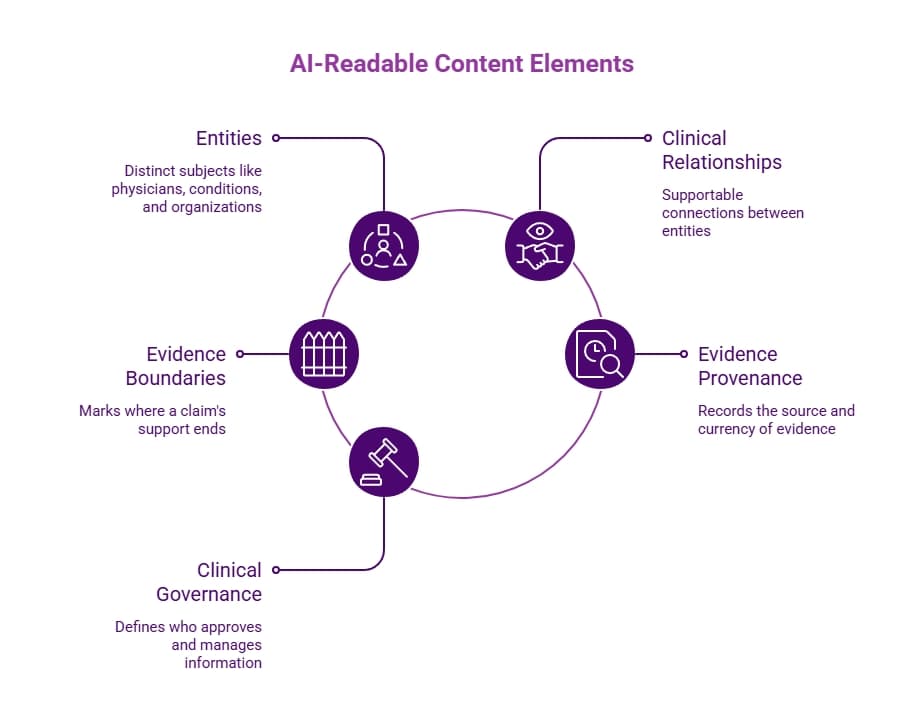
AI-readable specialty-practice content identifies the relevant subjects and states how they relate.
An entity is a distinct subject, such as a physician, specialty, condition, procedure, location, organization, evidence source, or access path. A clinical relationship is a supportable connection between entities, such as a physician’s verified association with a service line. An editorial link does not establish treatment suitability, exclusivity, or specialist fit.
An evidence boundary marks where a claim’s support ends. Evidence provenance records its source, currency, scope, and approval. For example, if a clinical study validates a treatment only for severe cases, the copy must explicitly state that limitation rather than implying universal candidacy. Clinical governance defines who may approve, publish, review, and update medically specific information.
This is not merely a wording exercise. Human clarity and machine clarity often overlap, but clear prose does not prove clinical accuracy. A relationship still needs appropriate evidence and qualified review.
Vague: “Our experts offer advanced options for these conditions.”
Clearer: “This page explains which physicians are associated with this area of care, what evaluation or treatment information the practice provides, and where readers can find the relevant access details.”
The clearer example is structural. It does not assert a real clinical pairing.
Map The Entities And Relationships Each Page Is Responsible For
A specialty-practice content system may need to distinguish among the practice, specialty, physician, condition or concern, procedure or treatment, location, evidence source, and access path. Not every page needs every entity. Each page needs a defined job and the relationships required to complete that job.
A useful structural sequence is:
Condition or concern → relevant specialty or physician → evaluation or treatment information → location or access path
Any real condition-to-treatment, symptom-to-specialist, candidacy, or physician-fit statement requires suitable evidence and clinical approval.
Condition pages should not silently carry physician, treatment, location, and access claims through navigation alone. Treatment pages should explain the intervention within approved boundaries. Location pages should identify only services and physicians actually available there. Physician profiles should connect verified qualifications and clinical focus to relevant content rather than function as undifferentiated credential lists. Guidance on what physician bio pages need to support condition and treatment discovery can help strengthen that provider layer.
Legacy CMS templates may make these page types indistinguishable. A complete rebuild is not always the first step. As a general implementation principle, teams can first define the fields each template must support: page role, associated physician or specialty, approved service relationships, evidence source, reviewer, location availability, update owner, and access path.
Creating a page for every possible question is not the goal. Overproduction can produce thin, repetitive pages, conflicting ownership, and a larger medical-review burden. Build around durable reader needs and distinct page roles. A specialty SEO taxonomy organized around conditions, treatments, physicians, and locations can help define those roles.
Show Who Created, Reviewed, And Maintains The Information
A “medically reviewed” label is weak evidence of accountability when the page does not explain the process behind it. Editorial review and medical review serve different purposes.
Marketing or content teams generally own findability and publishing. Physicians or clinical leaders own medical accuracy. Web or SEO teams own implementation and consistency. Legal or compliance may review claims and disclaimers, while practice leadership sets priorities. Responsibilities vary, but marketing ownership is not authority over clinical truth.
The National Library of Medicine’s MedlinePlus guidance for evaluating health information recommends examining site ownership, writer qualifications, expert or editorial review, source references, balanced claims, and written, reviewed, or updated dates. These are trust and accountability signals; they are not guaranteed ranking or citation factors.
For clinically specific statements, evidence should be close enough to show what it supports, its scope, and its limitations. A paragraph-level citation should not imply support for claims the source does not address. Practice-specific physician, service, and location associations also need an approved internal source of truth.
When physician time is limited, prioritize treatment benefits and risks, candidacy, standards-of-care statements, physician-procedure associations, and condition-treatment claims. A reusable approval record can capture the approved relationship, wording, evidence, reviewer, locations, caveats, and review triggers. It reduces repeated review without making one approval valid in every context.
Review timing should reflect clinical risk, rate of change, and internal policy. There is no universal cadence for every page.
Keep The Same Clinical Meaning Across Pages And Systems
Consistency means preserving the same verified facts and relationships, not copying identical sentences everywhere.
A physician bio should not describe one clinical focus while a service page implies another. A location page should not present a procedure as available when the relevant service or physician is not offered there. A directory or structured-data field should not add credentials, conditions, or treatments that the visible page cannot support.
A governed source of truth can maintain physician names and approved credentials, specialty descriptions, verified condition and procedure associations, locations, access statements, evidence provenance, and review ownership. When one record changes, the practice should know which pages, directories, profiles, and structured fields depend on it.
Minor wording differences are not automatically contradictions. The concern is a material difference in who provides care, what is offered, where it is available, or what evidence supports the statement. Correct the visible content first, then update dependent representations.
Use Structured Data To Reinforce Accurate Visible Content
Structured data is machine-readable information that labels content in a defined format. According to Google Search Central’s structured-data documentation, it can provide Google with explicit clues about a page’s meaning and classification. Schema.org’s health and medical vocabulary offers terms for representing health-related information on the web, but it is not designed as a clinical data-exchange or medical-validation system.
While properties like MedicalCondition, MedicalProcedure, and Physician help categorize information, they do not verify it.
| Structured data can | Structured data cannot |
|---|---|
| Reinforce visible entities and classifications | Establish clinical truth |
| Express supported relationships consistently | Repair vague or unsupported copy |
| Help systems interpret labeled information | Guarantee rankings, citations, rich results, or recommendations |
Google currently says no special structured data is required for its generative Search features. The responsible order is to verify the visible statement, obtain required approval, make the relationship clear to readers, and then apply markup that accurately reflects the page. Detailed implementation belongs in a separate workflow, such as a review of medical schema for service pages.
FAQ formatting, short paragraphs, and answer-first copy can improve scanning in some contexts. They do not resolve unsupported relationships, unclear ownership, or contradictory clinical meaning.
Write Passages That Preserve Meaning When Read Independently
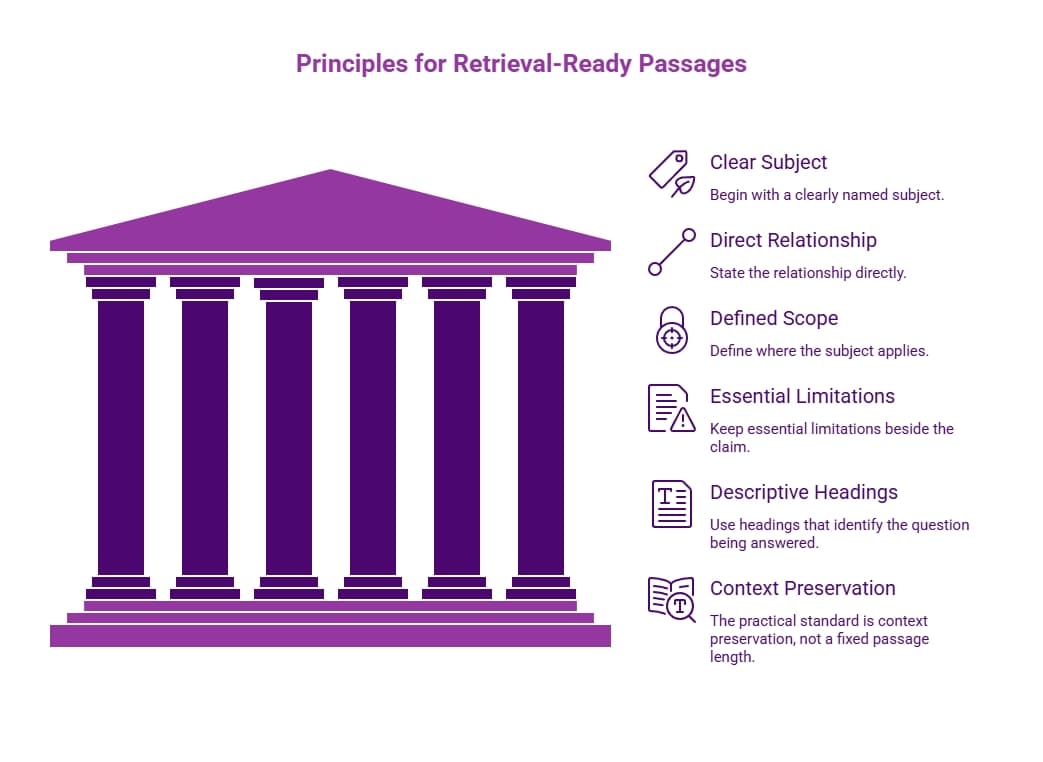
A retrieval-ready passage retains its subject, relationship, scope, and necessary caveat when read apart from surrounding copy. This is a reader-centered editorial principle, not a proven universal ranking factor.
Begin with a clearly named subject. State the relationship directly. Define where it applies. Keep essential limitations beside the claim. Use headings that identify the question being answered. Avoid pronoun-heavy passages whose meaning depends on several preceding paragraphs, and do not remove uncertainty merely to create a more decisive answer.
Retrieval-ready does not mean mechanically repeating the same answer block on every condition, treatment, physician, and location page. Reusable structures can support governance, but the wording still needs to reflect the page’s actual subject, evidence, scope, and access details.
Google’s guidance for generative Search features does not require content to be broken into tiny chunks. It also does not establish that shorter passages or answer-first formatting cause citations. The practical standard is context preservation, not a fixed passage length.
Run A Six-Question Legibility Review Before Restructuring The Whole Site
Start with one priority specialty or service line rather than waiting for a sitewide rewrite.
| Review question | Passing condition | Common failure signal | Primary owner |
|---|---|---|---|
| Is the entity named clearly? | The physician, condition, procedure, location, or organization is unambiguous. | Generic terms such as “our experts.” | Marketing/content |
| Is the relationship explicit? | The page states how the relevant entities relate. | The relationship exists only in navigation or inference. | Marketing and clinical reviewer |
| Is the statement supportable? | Evidence or approved practice information supports it. | Broad treatment, expertise, or outcome claims. | Clinical reviewer |
| Is ownership visible? | Appropriate author, reviewer, and update responsibility are identifiable. | A decorative review label with no process. | Governance owner |
| Is the meaning consistent? | Bios, service pages, locations, directories, and structured data agree. | Conflicting specialties, services, or locations. | Web/content operations |
| Does the passage retain context? | It keeps its subject, scope, and caveat. | An extracted sentence becomes broader than the page. | Writer and clinical reviewer |
Apply the review in seven steps:
- Select a service line with consequential claims or an important decision path.
- Identify its condition, treatment, physician, and location pages.
- Complete the six questions for each page.
- Record contradictions, unsupported relationships, and missing provenance.
- Assign clinical, editorial, and implementation owners.
- Correct visible content before changing structured data.
- Retest the path to the physician, location, and appropriate next step.
Search volume alone should not set the order. Prioritize where unclear or outdated meaning creates the greatest clinical, operational, or reader risk.
Use the six-question checklist to review one specialty service line before commissioning a sitewide rewrite.
Frequently Asked Questions
Disclaimer: This article is for general informational purposes only and does not constitute medical advice, diagnosis, or treatment. Readers should consult a licensed healthcare professional for guidance specific to their health, symptoms, medications, or treatment options.
Our Editorial Process: Our expert team uses AI tools to help organize and structure our initial drafts. Every piece is then extensively rewritten, fact-checked, and enriched with first-hand insights and experiences by expert humans on our Insights Team to ensure accuracy and clarity.
By: About the BVM Insights Team
The BVM Insights Team is our dedicated engine for synthesizing complex topics into clear, helpful guides. While our content is thoroughly reviewed for clarity and accuracy, it is for informational purposes and should not replace professional advice.