
 BVM Insights Team
A competitor just got cited in Perplexity. Your marketing director forwarded the screenshot. The conference room went quiet.
Your site has service pages, a few case studies buried in PDFs, and an About page that hasn't been touched since 2021. Much of it may lack the specific architecture suited for the emerging, AI-driven ways technical buyers are beginning to find firms now. The first fix isn't a full rebuild. It's a 48-hour triage.
Generative Engine Optimization (GEO) means targeting ChatGPT and Perplexity citations rather than relying solely on traditional Google rankings to capture technical search intent. Think of it as turning your site into a trusted reference manual instead of a marketing brochure — placing your firm's expertise directly into the sources that AI assistants pull from when answering complex engineering questions. When a prospect asks an AI to recommend firms for geotechnical remediation, the firm is either structurally visible or absent. This requires shifting from keyword placement to structuring knowledge that AI engines inherently trust and reference. For a deeper look at why traditional tactics fail in this environment, BVM's resource library covers the mechanics.
What AI Search Is Actually Evaluating
When a project manager asks Perplexity "which firms specialize in PFAS remediation in the Southeast," the AI doesn't scan for keyword density. It looks for clearly bounded concepts, explicit definitions, verifiable credentials, and structured relationships between them.
Vague "we do everything" service pages get skipped. A page titled "Environmental Services" that covers soil sampling, remediation design, compliance consulting, and phase assessments in a single scroll generally gives an AI system fewer specific, well-bounded entities to confidently cite. Clear definitions, explicit relationships, and visible proof improve structural trust. That principle aligns with general search guidance — Google Search Essentials and Google's introduction to structured data both reinforce the value of clear, accessible, machine-readable content.
For environmental and geotechnical firms, this matters because enterprise-level or complex project buying cycles typically run 6 to 12 months or longer. A prospect may research for months before making contact. That means the site needs to do more than rank. It needs to explain, disambiguate, and build confidence over time.
This isn't a website redesign. It's a structural cleanup — tightening what already exists so machines can parse it accurately. The raw material is there. The problem is organization, not substance.
Hours 0–8: Define the Entities Your Site Must Make Obvious
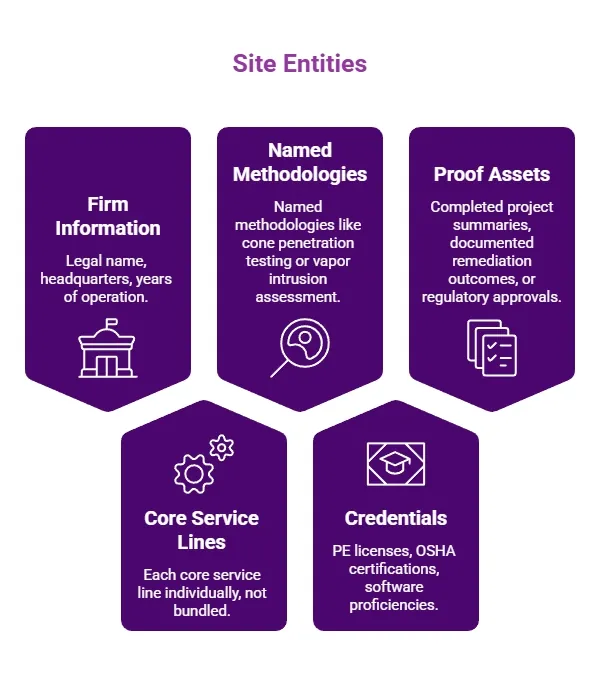
Before touching a single page, list the distinct concepts your site needs to communicate. Not keywords — entities. These are the factual building blocks an AI system uses to understand what your firm does.
Start with five categories. The firm itself: legal name, headquarters, years of operation. Each core service line — individually, not bundled. Phase I Environmental Site Assessments are a different entity than groundwater monitoring or geotechnical foundation design. Named methodologies like cone penetration testing or vapor intrusion assessment. Credentials: PE licenses, OSHA certifications, software proficiencies like GeoStudio or MODFLOW. And proof assets — completed project summaries, documented remediation outcomes, or regulatory approvals.
In practice, that usually means separating items such as geotechnical investigation, due diligence, remediation planning, PFAS-related work, permitting support, groundwater assessment, and construction materials testing instead of forcing them into one catch-all page. The exact service mix will vary by firm. The principle does not. One concept should be easy to identify on one page.
This is also the stage to surface qualifications and proof. Engineering buyers look for PE licenses, software expertise, industry certifications, and technically detailed case studies because those are credibility markers, not decoration.
This entity inventory becomes the blueprint for every structural decision in the next 40 hours.
Hours 8–24: Audit Existing Pages for Structural Clarity
Walk through the site with fresh eyes — reading it like an operator, not a brand manager. The goal is to flag pages that would confuse a machine trying to understand what each one is about.
The most common problem is the multi-intent page — a single URL trying to serve geotechnical drilling clients, environmental compliance buyers, and construction materials testing prospects all at once. Each practice area needs its own clearly scoped page. That may look efficient internally. It is usually confusing externally.
Check whether the H1 on each page matches what it actually covers. "Our Capabilities" tells an AI nothing. "Phase II Environmental Site Assessment Services" tells it everything. Flag H1s and H2s that sound polished but fail to define the actual service, deliverable, or project type.
Replace vague marketing language with precise technical definitions. "Industry-leading solutions" means nothing to a machine. "ASTM E1903-compliant Phase II assessments including soil gas sampling and groundwater monitoring" gives an AI system what it needs to form a citation.
Flag critical proof that lives only in downloadable PDFs — case studies and methodology descriptions locked inside proposal archives are significantly harder for AI systems to parse and structure compared to marked-up HTML, as Google's documentation on search essentials reinforces. If a project outcome or methodology matters, it should appear on an indexable page.
Check whether each major practice area has a clear parent-child relationship in the site structure. A remediation page should sit under a defined environmental services parent, not float alongside unrelated capabilities. If that hierarchy doesn't exist, map one. Clear service-line ownership and parent-child architecture are stronger than a flat pile of disconnected URLs. For firms managing multiple practice areas, preventing content cannibalization through structured architecture is worth reviewing early. Engineering Firm Service Page SEO: The Practice Area Page Architecture That Generates Commercial RFQs and The First Step to AI Visibility: Preparing Your Firm for Generative Engine Optimization extend this service-line-first logic further.
Hours 24–48: Strengthen the Signals That Make Your Firm Citable
The final stretch focuses on trust signals and disambiguation.
Start with the About and Contact pages — often the most neglected on engineering sites, yet they carry outsized weight. The About page should state the firm's legal name, founding year, service geography, and core capabilities. The Contact page needs a physical address and direct phone line. Review your leadership page for explicit author identification too. When a case study names the PE who led the work, AI systems treat that content as more authoritative.
Add Organization structured data to disambiguate your firm. Article markup on blog posts and case studies clarifies authorship and publication context, using vocabulary defined at Schema.org. For methodology pages or step-by-step tutorials, HowTo markup may also be justified depending on how the page is published. The exact schema stack should match the published page type and site architecture.
Then strengthen internal links. Your geotechnical drilling services page should link to your testing methodology page, which links to a project case study, which links back to the practice area. These connections help AI systems map relationships between capabilities — the kind of knowledge graph structure that earns citations for environmental and geotechnical firms. Establishing Defensible Authority in Geotechnical Engineering via Entity-Based AI Optimization is a useful follow-on resource for deepening that trust layer.
The 48-Hour Checklist
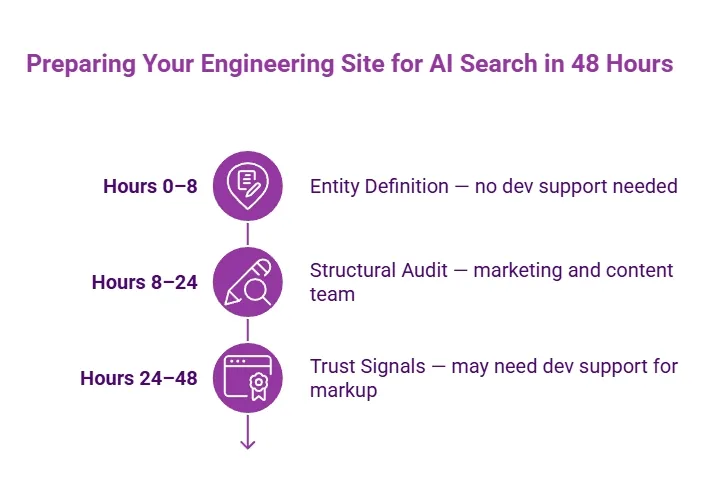
Hours 0–8 (Entity Definition — no dev support needed):
- List the firm's legal name, location, and years of operation
- Separate each core service line into a distinct named entity
- Document methodologies, certifications, and PE licenses
- Identify all proof assets (case studies, project summaries, regulatory approvals)
Hours 8–24 (Structural Audit — marketing and content team):
- Flag multi-intent pages that mix practice areas or audiences
- Verify each page has a single-topic H1 matching its actual content
- Replace vague marketing language with precise technical definitions
- Identify critical content buried in PDFs that should be on indexable pages
- Map parent-child relationships between major practice areas in the site structure
Hours 24–48 (Trust Signals — may need dev support for markup):
- Update About and Contact pages with firm details and leadership
- Add or verify Organization, Article, and HowTo structured data where applicable
- Build internal links between related service, methodology, and proof pages
- Surface case studies and credentials on visible, crawlable pages
Common Mistakes to Avoid in the First Two Days
Resist the urge to publish thin "AI-optimized" pages just to move fast. A page with 200 words of generic content adds noise, not authority.
Don't collapse multiple engineering specialties onto one catch-all page. Geotechnical investigations and environmental compliance consulting are separate entities with separate buyer intent. Don't rely on exact-match keyword stuffing either — repeating the same phrase fourteen times does nothing for AI citation mechanics. Clarity and structure matter more.
Don't hide your best proof in PDF-only formats. That remediation case study with quantified outcomes belongs on an indexable web page.
And don't use broad marketing language where a precise engineering definition is needed. AI relies on clear definitions.
What to Do After the First 48 Hours
The first two days are triage. They are not the entire program.
The next phase involves structuring technical content specifically for AI citation — moving beyond cleanup into building entity-based authority that earns placement in AI-generated shortlists. That means mapping internal content architecture across practice areas, expanding proof assets with documented outcomes, and governing the site as a connected knowledge system rather than a brochure.
Engineering Firm Case Studies as SEO Authority: Converting Project Archives into Commercial Search Visibility and Digital Infrastructure: Treating Your Website as a Capital Asset, Not an Expense are the best next reads for extending triage work into durable strategy.
The firms that structure expertise for AI search now will be the ones cited when a prospect asks an AI to build a shortlist. That's a pipeline advantage.
Clear structure. Defined entities. Visible proof. That is what earns a citation.
For firms ready to turn this first-pass cleanup into a governed content system, explore our guides on BVM's resource hub.
Our expert team uses AI tools to help organize and structure our initial drafts. Every piece is then extensively rewritten, fact-checked, and enriched with first-hand insights and experiences by expert humans on our Insights Team to ensure accuracy and clarity.
Our Editorial Process: Our expert team uses AI tools to help organize and structure our initial drafts. Every piece is then extensively rewritten, fact-checked, and enriched with first-hand insights and experiences by expert humans on our Insights Team to ensure accuracy and clarity.
About the BVM Insights Team: The BVM Insights Team is our dedicated engine for synthesizing complex topics into clear, helpful guides. While our content is thoroughly reviewed for clarity and accuracy, it is for informational purposes and should not replace professional advice.