 Dustin Ogle
- Your Expertise Must Be Machine-Readable: Technical authority only matters if AI systems can find, connect, and cite your capabilities - buried PDFs and generic service pages leave you invisible.
- Structure Beats Scattered Proof: When your certifications, methods, and case studies exist as disconnected prose, AI cannot connect the dots to recommend your firm.
- Organize by Buyer Intent, Not Org Chart: Each practice area - remediation, compliance, geotechnical - needs its own structured page showing methods, credentials, and outcomes.
- Start With Your Highest-Value Services: Audit where your most profitable capabilities are hidden or blurred, then prioritize making those visible to AI systems first.
- Align Marketing and Technical Teams: SMEs must validate that content accurately reflects your methods, while marketing ensures it's structured for machine discovery.
The firms AI systems can read get shortlisted. The firms AI systems can't read get skipped.
Executive teams at technical engineering firms competing for high-value contracts will gain a clear framework for protecting market position, preparing them for the detailed visibility strategy that follows.
The conference-room monitor glows from the last pursuit review. Someone types “PFAS in-situ remediation consultant” into ChatGPT, then tightens the prompt with coastal subsurface conditions, PE oversight, and environmental compliance constraints. The first firms named in that moment start shaping the shortlist. Quietly.
Two weeks later, the RFP notification arrives. Your firm wasn't on it. Again.
Your geotechnical team has 40 years of combined experience in PFAS remediation. Your environmental compliance record is spotless. Your methodology documentation could fill a small library. But the buyer's procurement team had already narrowed their options before your name ever came up - because their AI-assisted research never surfaced your firm in the first place.
This is the new reality for technical engineering firms. The question is no longer whether your expertise is real. The question is whether AI systems can read, interpret, and cite it when enterprise buyers conduct their initial research.
For technical engineering firms, LLM visibility is a board-level market access issue. If AI answer engines cannot interpret your entities, capabilities, and proof, you risk exclusion before buyers ever issue an RFP. This is not a marketing tactic. It is a strategic requirement for maintaining your position in the digital procurement process.
Why LLM Visibility Is Now a Strategic Requirement for Technical Engineering Firms
Enterprise buyers have changed how they build shortlists. Before formal procurement begins - before RFP documents are drafted, before capability questionnaires are circulated - project managers and technical evaluators conduct research using AI-assisted tools. They ask ChatGPT about remediation methodologies. They use Perplexity to compare geotechnical investigation approaches. They expect immediate, authoritative answers.
The firms that appear in those answers get considered. The firms that don't get excluded before the process officially begins.
Technical buyers no longer move through a simple Google-only journey. They move across search results, AI summaries, internal discussions, and procurement research workflows. Google's documentation on AI Overviews (formerly SGE) and its evolving guidance on Schema.org structured data make the direction clear: AI-driven synthesis is now the primary discovery layer for complex queries. Google explicitly notes that structured data helps its systems - including large-scale retrieval models - to ‘understand the content of the page’ and ‘enable special search result features and enhancements’ (Google Search Central, 2025), which directly influences how AI agents cite technical authorities.
The governance lens matters here as well. While the NIST AI Risk Management Framework (AI RMF 1.0) primarily focuses on the safety and trustworthiness of AI systems being deployed, its core pillars - Govern, Map, Measure, and Manage - provide leadership teams with a vital vocabulary for treating the integrity of organizational data as an operational risk. Ensuring your firm's technical entities are accurately represented to external models is a logical extension of managing AI-related ‘reputational and information risks’ (NIST AI RMF, §1.2). That is the appropriate level for this conversation.
This shift has nothing to do with traditional SEO metrics. Traffic volume is irrelevant if the traffic consists of unqualified searches. Keyword rankings matter little if your firm never appears when a procurement manager asks an AI system about subsurface investigation specialists with specific compliance certifications.
The strategic stakes are clear: visibility in AI-assisted research workflows now determines which firms make the initial consideration set. For technical engineering firms competing for high-value contracts in environmental compliance, geotechnical investigation, or remediation consulting, this is a market-share defense issue. That is why Generative Engine Optimization belongs in the same discussion as pipeline protection and future-proof discovery.
Before: How Technical Firms Become Invisible in AI Search
Most engineering firms have invested in some form of digital presence. They have websites. They have service pages. They may even have blog content. So why do AI systems struggle to recognize their technical authority?
The problem lies in how that authority is structured - or rather, how it isn't.
Generic SEO approaches emphasize broad category terms and thin content designed to capture maximum search volume. A firm might optimize for “environmental consulting services” without ever clarifying which specific remediation methodologies they specialize in, which regulatory frameworks they operate under, or what distinguishes their subsurface investigation approach from competitors. This is the failure of generic SEO in action: visibility without qualification produces traffic without pipeline.
Technical expertise gets trapped in unstructured formats. Case studies exist as PDFs buried three clicks deep. Capability statements read like brochures rather than structured proof. Practice areas blur together on multipurpose service pages that fail to distinguish between geotechnical drilling, in-situ remediation, and environmental site assessments. A credentials page that mentions PE licenses, OSHA readiness, PFAS experience, or subsurface investigation depth without tying those signals to specific practice areas and buyer problems sends a weak signal to machines trying to assemble a credible answer.
AI systems need entity relationships to generate accurate answers. They need to understand that your firm performs PFAS contamination assessment, that this capability relates to specific regulatory compliance requirements, that your team holds relevant PE licenses, and that your methodology has been validated through documented project outcomes. When this information exists only as scattered prose across disconnected pages, AI systems cannot reliably connect the dots.
The mechanism of failure is straightforward: traditional SEO ignores the structured entity relationships that AI citation logic requires. The result is invisibility in AI-assisted research - or worse, complete exclusion from consideration sets at the moment buyers form their shortlists. Your technical authority stays real, but unreadable. Invisible to the machine.
After: What Visibility Looks Like When AI Can Recognize Your Technical Authority
The goal is not vanity metrics. The goal is recognition at the moments that matter.
When your firm's digital presence is structured for AI comprehension, something different happens. A procurement manager researching “geotechnical engineering firms with coastal remediation experience” receives an answer that includes your firm - not because you optimized for that exact keyword, but because AI systems can trace the entity relationships connecting your capabilities, credentials, methodologies, and proof.
Your technical specialties become legible. Your qualifications become findable. Your case evidence becomes citable.
Practice areas are separated by capability and intent. Methods are attached to real problem contexts. Qualifications surface as trust markers - PE oversight, regulatory familiarity, software expertise, methodology depth - rather than being buried in boilerplate. Case studies demonstrate proof with enough specificity to support capability evaluation.
This creates alignment between your actual technical authority and your digital discoverability. Marketing leadership and technical SMEs can finally point to the same visibility model. The website transforms from a static brochure into a structured proof environment that machines can interpret and buyers can trust.
The practical outcome is straightforward: your firm appears in AI-generated answers for the specific engineering problems you actually solve. You get considered for the contracts you're genuinely qualified to win.
Bridge: The Operating Principles Behind LLM Visibility Strategies
Moving from invisible to discoverable requires a different architecture than traditional SEO provides.
A useful way to think about the difference is this: traditional SEO can feel like putting a billboard on the highway. Generative Engine Optimization is closer to making sure you are the direct answer the GPS gives when someone asks where to go.
Some teams call this approach AI Answer Engine SEO or Entity-Based AI Optimization. Whatever the terminology, the operating model ties practice-area architecture, entity clarity, structured data, and knowledge-graph-aware visibility together. That bridge rests on four operating principles.
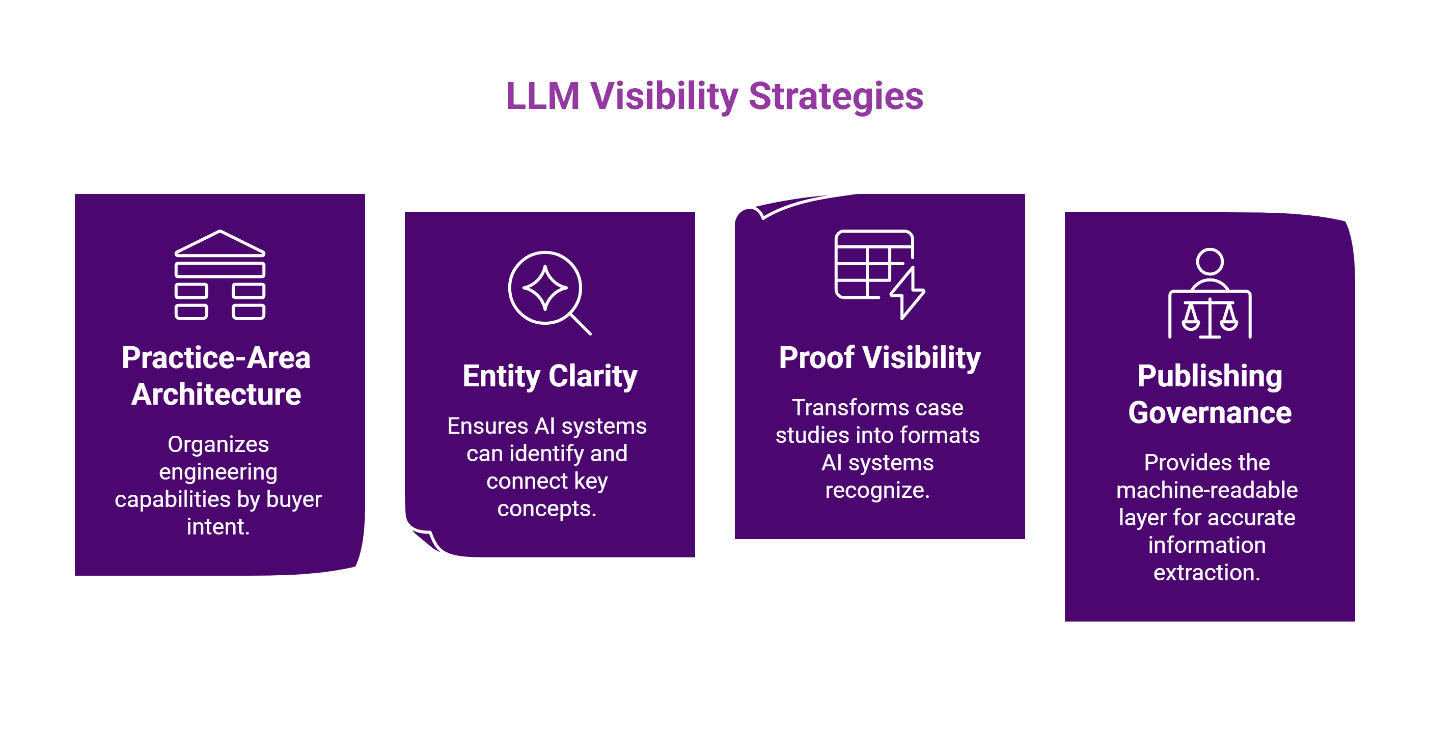
Practice-Area Architecture organizes your engineering capabilities by buyer intent rather than internal org charts. Instead of a single “Services” page listing everything your firm does, each distinct practice area - geotechnical investigation, environmental compliance, remediation consulting - gets structured as its own entity cluster with clear relationships to specific methodologies, certifications, and outcomes. This is why support frameworks like Deep Content Architecture™ matter. They separate signal from noise.
Entity Clarity ensures that AI systems can identify and connect the key concepts that define your expertise. Search systems need to understand who you are, what you do, where you do it, which qualifications you hold, and how those elements relate. This means explicitly structuring the relationships between your firm, your capabilities, your credentials, and your proof points using schema markup and knowledge graph principles that machines can parse.
Proof Visibility transforms your case studies, methodologies, and qualifications into formats that AI systems recognize as authoritative evidence. Technical authority becomes citation-worthy when methods, qualifications, project evidence, and problem-solution relationships are easy to interpret. This means moving beyond brochure language toward technically precise documentation that demonstrates real capability. That is where The Perfect Page Blueprint™ becomes practical, not cosmetic.
Publishing Governance provides the machine-readable layer that enables AI systems to extract and cite your information accurately. Your SMEs, marketers, and practice leads need a system that preserves methodological accuracy while still producing content at the pace required for long-cycle visibility. Without governance, marketing drifts into fluff. With governance, your digital footprint starts to sound like your actual firm. As Google's documentation on AI features makes clear, websites that provide well-structured, authoritative content are better positioned to appear in AI-generated answers.
The relationship between these elements is complementary: practice-area architecture provides the foundational structure and intent mapping; Generative Engine Optimization leverages that structure to secure citations in AI-generated answers and knowledge graph visibility.
What Executive Teams Should Prioritize First
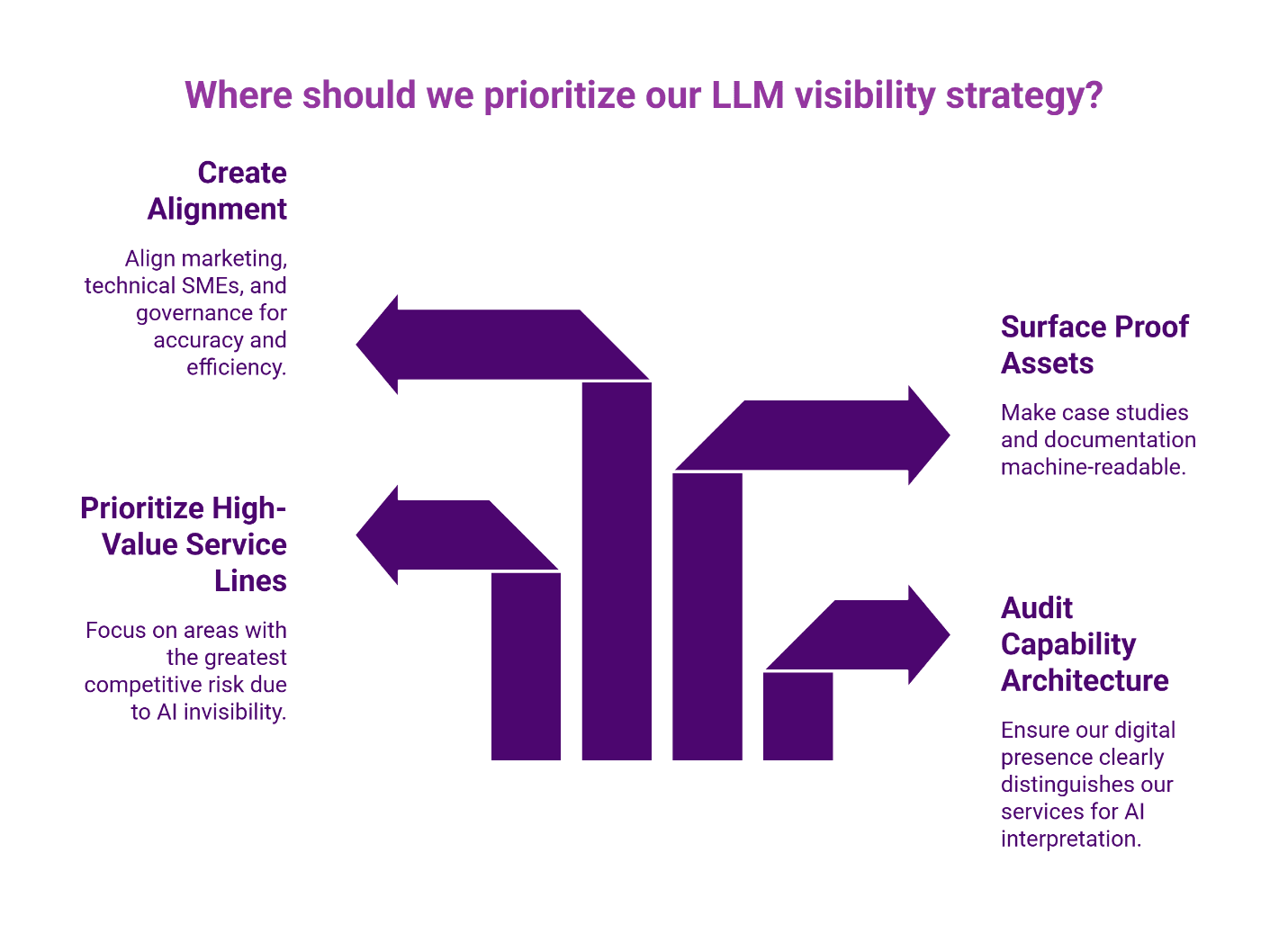
Strategic infrastructure changes require sequenced implementation. For executive teams evaluating where to begin, four priorities stand out.
Audit capability architecture and entity clarity. Before building new content, assess whether your current digital presence clearly distinguishes your practice areas, methodologies, and credentials in ways that machines can interpret. If a procurement manager asked an AI system about your specific capabilities, could the system find and connect that information? Identify where your highest-value service lines are blurred, merged, or buried.
Prioritize the highest-value technical service lines. Not every practice area requires immediate attention. Focus first on the capabilities that drive your most valuable contracts - the ones where invisibility in AI-assisted research poses the greatest competitive risk. The strongest service lines should have method-specific pages, technically precise case evidence, and visible trust markers.
Surface proof assets. Inventory your existing case studies, methodology documentation, and credential evidence. Assess whether these assets are structured for machine readability or trapped in unstructured formats that AI systems cannot parse.
Create alignment between marketing, technical SMEs, and publishing governance. Visibility strategies for technical firms cannot be delegated entirely to marketing. Technical accuracy matters. Subject matter experts must validate that the structured content accurately represents your methodologies and qualifications. Governance processes must ensure consistency across your digital presence. Marketing should not be forced to guess at technical nuance, and technical SMEs should not be pulled into endless rewrite loops.
That sequence gives leadership something boardroom-ready: a strategic answer to what is changing, what is at risk, and what must become true.
A Boardroom-Ready Summary of the Shift
For leadership teams who need to communicate this strategic shift to stakeholders, the core argument is simple.
What is changing: Enterprise buyers increasingly use AI-assisted tools during the research phase that precedes formal procurement. The firms that AI systems can interpret and cite get considered. The firms that AI systems cannot read get excluded before the process officially begins.
What is at risk if ignored: Continued investment in generic SEO approaches that generate traffic without qualified pipeline. Progressive exclusion from consideration sets as competitors structure their digital presence for AI comprehension. Loss of market position that becomes increasingly difficult to recover as AI-assisted procurement becomes standard.
What must be true for your firm to remain visible: Your technical capabilities, credentials, methodologies, and proof must be structured in formats that AI systems can parse, connect, and cite. Your digital presence must function as a structured proof environment, not a brochure. Your engineering services visibility strategy must address how buyers actually research - not how they researched five years ago.
What leadership should do next: Treat LLM visibility as strategic infrastructure. Audit capability architecture. Clarify entities. Surface proof. Govern publishing.
Return to that glowing screen in the conference room. The firms that appear in those early research moments do not always have the best technical team. They have the clearest digital signal.
Technical authority still matters. Now it also has to be legible. Clear enough to understand. Structured enough to trust. Visible enough to be chosen.
See where you're missing technical buyers, then explore our engineering SEO resources to understand how practice-area structure, entity clarity, and proof assets shape shortlist visibility over time.
Our Editorial Process:
Our expert team uses AI tools to help organize and structure our initial drafts. Every piece is then extensively rewritten, fact-checked, and enriched with first-hand insights and experiences by expert humans on our Insights Team to ensure accuracy and clarity.
About the BVM Insights Team:
The BVM Insights Team is our dedicated engine for synthesizing complex topics into clear, helpful guides. While our content is thoroughly reviewed for clarity and accuracy, it is for informational purposes and should not replace professional advice.