 Dustin Ogle
- Fix Your Pages Before Writing New Ones: Most firms think AI visibility starts with new content, but it actually starts by cleaning up confusing service pages that bundle too many things together.
- One Service, One Page: When your website lumps remediation, permitting, and assessments onto one generic page, AI tools can't tell what you actually specialize in - and neither can buyers.
- List What You Want to Be Known For: Create a simple inventory of your services, methods, certifications, and the problems you solve - then check if your website actually reflects that list.
- Connect Related Pages Clearly: Link your specialized pages to each other so both humans and AI can see how your capabilities fit together without blurring the boundaries.
- Check Each Page Against a Clarity Checklist: If a page doesn't name one clear service, one clear audience, and one clear outcome in the first two paragraphs, it's essentially invisible to AI-powered search.
Clear structure beats clever marketing when AI builds the shortlist.
Technical services firms competing for complex projects will find a practical roadmap here, preparing them for the detailed restructuring steps that follow.
The RFQ lands in your inbox. Your technical director opens it, scans the scope, and sighs. Another residential project. Another homeowner who found your firm through a generic "environmental consultant near me" search and assumed you handle backyard soil tests. Meanwhile, the complex, six-figure Phase II ESA your team is qualified to execute went to a competitor whose website clearly communicated their remediation capabilities to the buyer - and to the AI tool that generated the shortlist.
This is the new reality of technical services visibility. Your firm's expertise is real. Your track record is strong. But if AI systems cannot interpret what you do, who you serve, and how your services relate to each other, you become invisible at the exact moment qualified buyers are building their consideration set.
Generative Engine Optimization addresses this gap. GEO is the work of making your expertise understandable enough to be cited in AI-driven discovery, not just ranked in traditional search. It is not a replacement for technical SEO fundamentals - it is the next layer. And contrary to what many assume, the first step is not publishing more content. It is preparing and restructuring what you already have so that both traditional search engines and Large Language Models can accurately represent your firm when engineering buyers ask detailed questions.
Why AI Visibility Starts Before "AI Optimization"
Search is becoming conversational, shortlist-driven, and citation-sensitive. When a project manager asks an AI assistant to identify firms with ASTM Phase I ESA experience in a specific region, the response draws from content the AI has determined to be authoritative and clearly structured. Firms with ambiguous service pages, collapsed practice areas, and generic descriptions do not make that list.
For engineering firms, that distinction matters. A buyer may not search "engineering consultant" anymore. They may ask for Phase I ESA support tied to acquisition due diligence, a remediation approach for a defined contaminant profile, or permitting help for a specific project type. If your site collapses those capabilities into broad category pages, your expertise becomes hard to separate, hard to trust, and hard to surface.
The problem is structural, not promotional. If your firm's services, methods, and compliance expertise are not clearly organized, AI systems cannot confidently surface you when buyers ask detailed engineering questions. Clear service hierarchy improves AI visibility by making the relationship between services, methods, compliance topics, and buyer problems explicit enough for search systems to interpret and reuse.
This is also where many firms lose the plot. They assume AI visibility starts when they publish "AI content." In practice, it usually starts when they clean up the pages they already have.
Audit Your Current Service and Practice-Area Pages for Machine Readability
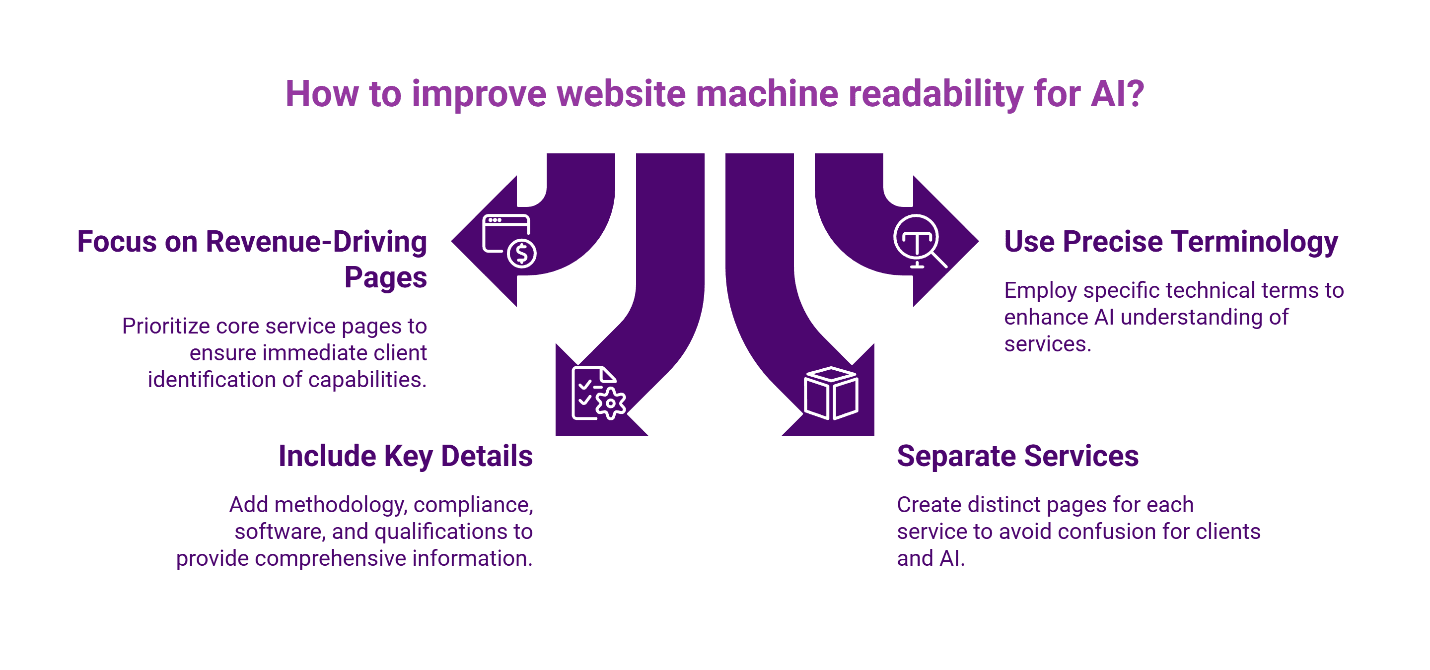
Start with your revenue-driving pages, not your blog archive. Pull up your core service pages and answer these questions honestly:
Does this page describe one clear service, or does it bundle several disciplines together? Can a prospective client immediately identify the core capability? Are the primary title and lead copy utilizing precise technical terminology? Are methodology, compliance frameworks, software, and technical qualifications visible in the body content? Could both a human evaluator and an AI system determine exactly what each page is about within the first two paragraphs - and tell how this page differs from the next one?
Many engineering firms built their websites to impress - not to inform. The result is elegant but vague service descriptions that sound professional to humans but communicate almost nothing to machines. A page titled "Environmental Consulting" that mentions remediation, permitting, and due diligence in passing gives AI systems no confidence about what your firm actually specializes in.
A broad page called "Environmental Services" is rarely enough. A buyer looking for permitting support should not have to infer that you also handle site investigation, remedial design, and regulatory coordination. Different entities deserve different homes.
Define the Entities Your Firm Must Own
This is where practice leads and technical directors should be involved early. They know where the wording is too generic, where key methodologies are missing, and where one page is pretending to represent four different capabilities.
Entities are the concepts, services, methods, and problem-solution relationships that should be associated with your brand in both traditional and AI-powered search. Before you restructure pages, define what your firm needs to be known for.
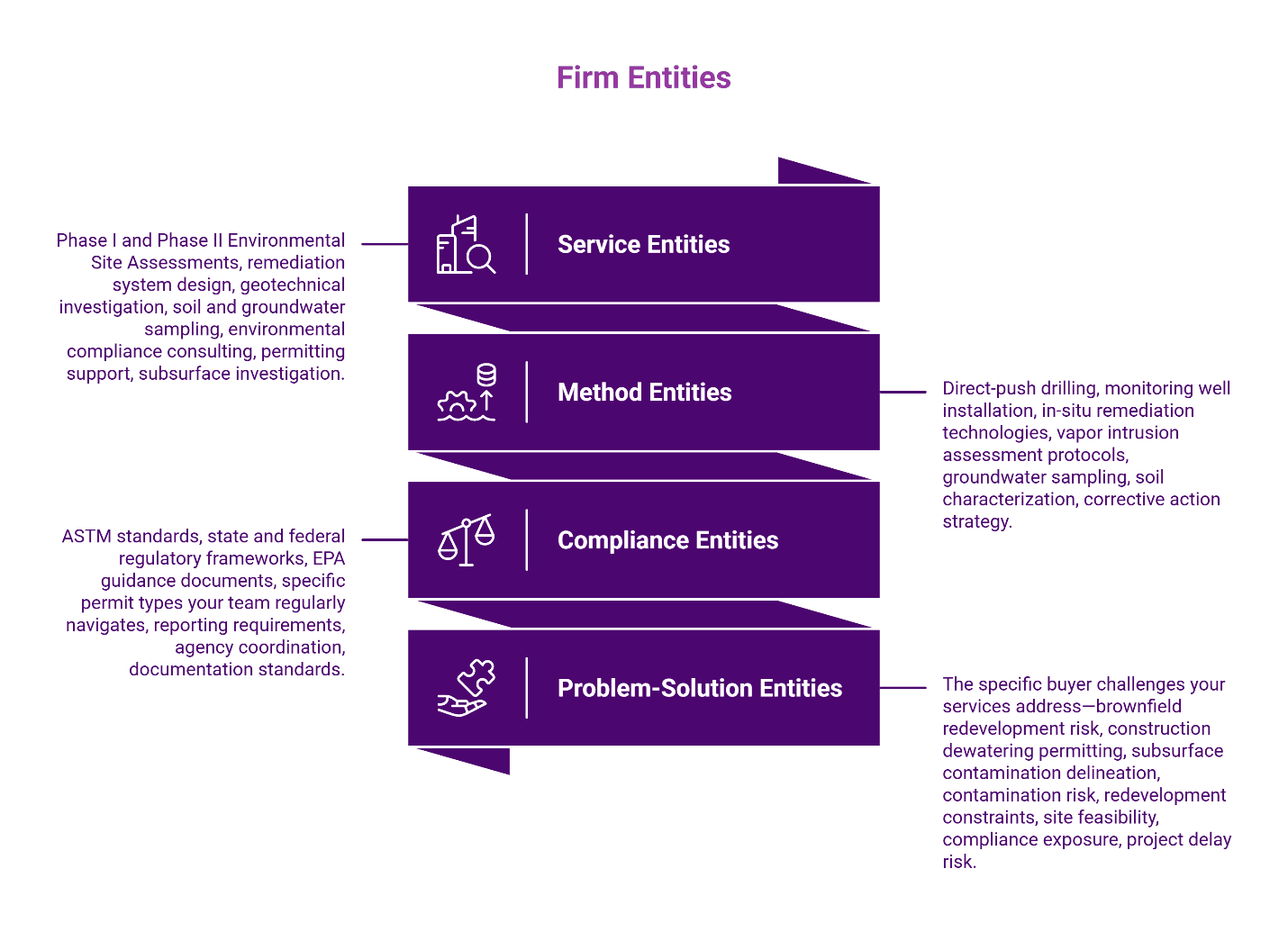
For environmental and geotechnical firms, these entities typically fall into four groups:
Service entities: Phase I and Phase II Environmental Site Assessments, remediation system design, geotechnical investigation, soil and groundwater sampling, environmental compliance consulting, permitting support, subsurface investigation.
Method entities: Direct-push drilling, monitoring well installation, in-situ remediation technologies, vapor intrusion assessment protocols, groundwater sampling, soil characterization, corrective action strategy.
Compliance entities: ASTM standards, state and federal regulatory frameworks, EPA guidance documents, specific permit types your team regularly navigates, reporting requirements, agency coordination, documentation standards.
Problem-solution entities: The specific buyer challenges your services address - brownfield redevelopment risk, construction dewatering permitting, subsurface contamination delineation, contamination risk, redevelopment constraints, site feasibility, compliance exposure, project delay risk.
Entity clarity improves buyer confidence by giving technical evaluators and AI systems the same signal: this firm knows exactly what it does, where it fits, and how its capabilities connect.
Do not make this theoretical. Build a working inventory. List your top services, the methods that support them, the regulations or frameworks tied to them, and the buyer problems each one solves. Then compare that inventory against your live site. The gaps will show up fast. This inventory becomes the foundation for restructuring your content architecture.
Restructure Practice-Area Architecture So AI Can Distinguish Your Expertise
This step represents the strategic center of your AI readiness work.
If your site still treats geotechnical, environmental, remediation, and due-diligence services as one undifferentiated block, AI systems have very little to work with. So do buyers. A buyer searching for vapor intrusion assessment expertise should not land on a broad environmental services page and hope to find a relevant paragraph buried in the middle.
Think in paths, not piles. A stronger structure usually looks like this: one page for each core service, one clear parent-child relationship between broader practice areas and narrower capabilities, and internal links that explain how those capabilities connect without blurring them together.
Separate first. Connect second. A due-diligence page can point to related investigation services. A remediation page can point to the assessment methods and compliance topics that support it. A permitting page can connect to project types or jurisdictions where your expertise matters.
A coherent practice-area framework ensures that AI models can map the interplay between specific methodologies and regulatory environments without conflating distinct service lines. When your site separates geotechnical investigation from environmental due diligence from remediation design - and connects them through logical internal linking - AI systems can accurately represent your capabilities in response to specific queries.
Consider how a technical buyer actually searches. They do not type "environmental engineering firm." They search for "Phase II ESA consultant petroleum contamination" or "groundwater monitoring well installation services." Your architecture should mirror this specificity. This is also the discipline behind strong Engineering Services SEO: precise service language, tighter intent mapping, and architecture that reflects how technical buyers actually evaluate vendors.
Add Foundational Signals That Improve AI Comprehension
With your content restructured, reinforce machine readability through technical signals.
Page hierarchy: Ensure each page has a single, clear H1 that names the specific service. Use subheadings to organize supporting content logically - methodologies, applications, compliance context, project types.
Entity-Based Schema Markup: Implement schema markup to help search engines understand your content. Google Search Central's explanation of structured data confirms that structured data gives Google explicit clues about a page's meaning and can support richer search appearances through rich results. Schema.org provides the standard vocabulary for this markup, and the SEO Starter Guide offers broader context for implementation.
For most firms, the practical starting set includes: Service markup to define specific engineering capabilities, Article markup for technical resources, Breadcrumb for site hierarchy, and Organization or Professional Service details to anchor your firm as a verified entity. Google Search's structured data gallery lists supported markup types including Article, Breadcrumb, and Organization - a useful reminder that not every page needs an exotic implementation to become easier to understand.
Do not treat markup as the whole answer. It is reinforcement. If the copy is vague, the headings are generic, and the service boundaries are muddy, structured data cannot rescue the page. Helpful content still needs to be clear, useful, and easy for search systems to find and interpret.
Strategic internal linking: Connect related practice areas explicitly. Link your remediation design page to your groundwater assessment page. Link your permitting support page to the specific compliance frameworks you navigate. These connections reinforce entity relationships for both humans and machines.
Clear service descriptions: Replace marketing language with precise capability statements. Instead of "We provide innovative environmental solutions," write "We design and implement in-situ remediation systems for petroleum-contaminated soil and groundwater."
If your team needs a more concrete model for page structure, The Perfect Page Blueprint™ provides a step-by-step framework.
Build an AI Readiness Checklist
Use this checklist to score your current priority pages:
[ ] Each core service has its own dedicated page with a specific, descriptive H1
[ ] The page names one clear audience, one clear problem, and one clear service outcome
[ ] Methodologies are explicit rather than implied
[ ] Page hierarchy is explicit - H1, H2, and H3 tags reflect logical content organization
[ ] Compliance, regulatory, or documentation knowledge is visible where relevant
[ ] Technical terminology, standards, and compliance frameworks are explicitly named
[ ] Licenses, certifications, software expertise, and technical qualifications are easy to find
[ ] The page sits in a clear parent-child hierarchy
[ ] Internal links connect related entities logically (services to methods, methods to compliance frameworks)
[ ] Structured data is implemented where appropriate (Organization, Service, Article)
[ ] Service descriptions are specific enough for a technical evaluator to trust
[ ] Authority signals, source pages, and supporting documentation are visible
[ ] Success is measured by qualified inquiries, pipeline value, and CRM-linked outcomes - not traffic alone
If a page fails half of this list, you do not have an AI problem. You have a clarity problem. Pages that fail multiple items are effectively invisible to AI-driven discovery. Pages that pass most items are positioned to be cited, recommended, and surfaced when qualified buyers research specific capabilities.
Prioritize the First Round of Fixes
You do not need to restructure your entire website in a single sprint. Sequence your work by impact.
First priority: Highest-revenue service pages. These represent your core practice areas and attract the buyers you most want to reach. Fix these first.
Second priority: Most generic or confusing pages. These actively harm your visibility by diluting your expertise into vague categories. Either restructure them into specific service pages or consolidate their content elsewhere.
Third priority: Pages tied to authority and trust. Your credentials page, your methodology descriptions, your compliance expertise summaries - these reinforce the signals that make AI systems confident in citing you.
Fourth priority: Supporting links and schema. Once your core pages are restructured, add the technical infrastructure that reinforces entity relationships.
Ongoing: Test and iterate. Monitor which queries drive qualified traffic, which pages generate RFQs, and where gaps remain between your capabilities and your visibility. Engineering buying cycles are long. Most firms are not trying to win a click today. They are trying to stay visible through months of evaluation, shortlist-building, and internal review. Better page structure compounds over time.
Precision beats breadth here. A page built around a niche methodology, application, regional requirement, or compliance context will usually outperform a page trying to rank for a broad category term and appeal to everyone. That is not a writing preference. It is a qualification strategy.
Preparing Your Firm Now Prevents Invisible Expertise Later
The firms that will dominate AI-driven discovery are not necessarily the largest or the most technically advanced. They are the firms that have made their expertise legible - to humans, to search engines, and to the Large Language Models increasingly shaping how buyers build shortlists.
Generative Engine Optimization begins with preparation. Audit your current content. Define the entities you must own. Restructure your practice-area architecture so that a buyer searching for specific remediation expertise or subsurface investigation capabilities finds exactly what they need - on a page that clearly communicates your qualifications.
For a deeper exploration of how AI search is reshaping B2B visibility, explore BVM's Interactive Report: Your GEO Playbook for 2025. If your team is still filtering low-intent visibility from high-value demand, Part/Spec/Application Intent Mapping: The Secret to Capturing Engineering Buyers adds a useful layer.
Prepare the structure. Clarify the entities. Earn the citation.
Our editorial process: Our expert team uses AI tools to help organize and structure our initial drafts. Every piece is then extensively rewritten, fact-checked, and enriched with first-hand insights and experiences by expert humans on our Insights Team to ensure accuracy and clarity.
About the BVM Insights Team: The BVM Insights Team creates and edits educational content on AI-powered SEO, technical content architecture, and Generative Engine Optimization for growth-focused B2B firms.