
 Dustin Ogle
Search systems need explicit relationships. Clinical reality often requires uncertainty.
That tension becomes difficult when the same symptom appears across several service lines. A digital team may want one clear destination, while physician reviewers recognize that symptom wording alone cannot establish a cause, diagnosis, or appropriate specialty.
MedlinePlus explains that different conditions can produce similar symptoms. That broad clinical principle matters for website architecture: a symptom keyword does not establish one clinical destination.
Hiding uncertainty leaves users and search systems with weak connections. Overstating certainty creates medical and governance risk. A stronger symptom-to-specialist content architecture documents page roles, relationship strength, internal-link rationale, evidence, and physician review before claims are published.
Make the Relationship Explicit Without Making It Absolute
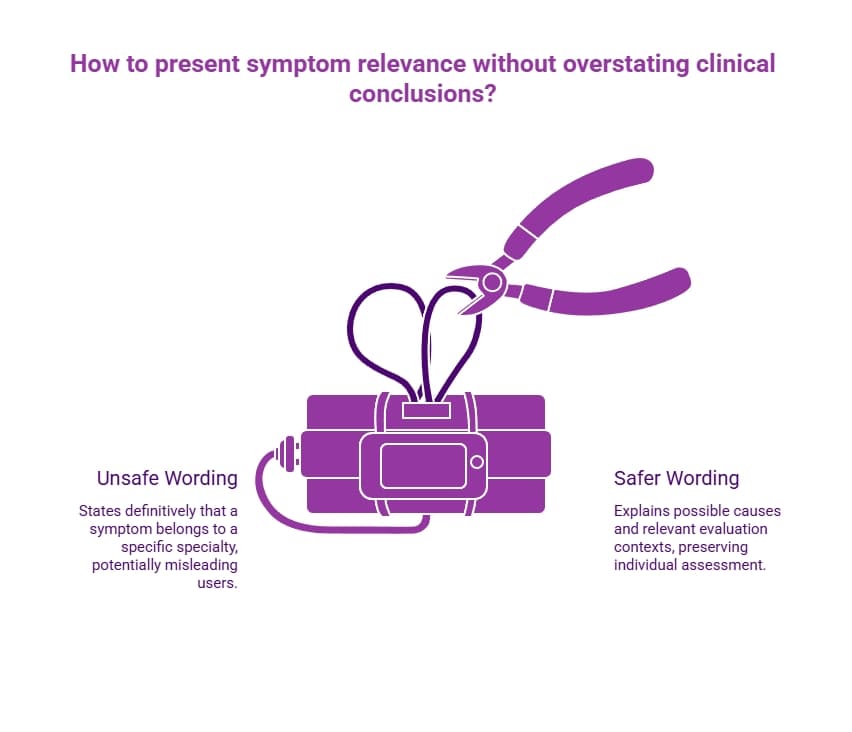
Clear content does not require a definitive clinical conclusion. A symptom page can explain possible relevance while preserving the role of individual evaluation.
The difference is visible in the wording:
Unsafe: “This symptom belongs to our specialty.”
Safer direction: “This symptom can have several possible causes. Different evaluation contexts may be relevant depending on the person’s history, associated symptoms, and clinical assessment.”
This is an illustrative editorial example, not approved clinical language for a specific symptom or specialty. Any named symptom, condition, service line, physician, test, referral, or treatment relationship requires current supporting evidence and review by an appropriately qualified clinical professional.
Adding “may” to an otherwise absolute claim is not enough. The surrounding heading, links, calls to action, and page structure must preserve the same uncertainty.
A disclaimer cannot correct overconfident body copy. Clinical relevance depends on context and must be qualified where the relationship is first presented.
Some teams object that qualified wording will weaken search performance. That assumption confuses clarity with certainty. Google’s own people-first content guidance favors useful, trustworthy content rather than exaggerated claims. This is Google-specific publishing guidance, not medical evidence or a ranking guarantee.
Give Each Page Type a Distinct Job
Page overlap usually begins when symptom, condition, treatment, specialty, physician, and access pages attempt to perform the same task. A clearer architecture gives each page a defined role.
| Page type | Primary job | Permitted relationship | Common overreach |
|---|---|---|---|
| Symptom page | Provide general educational information, preserve clinical uncertainty, and introduce approved evaluation contexts. | May link to reviewed condition, specialty, or physician information when the reason is stated clearly. | Presenting one specialty as the presumed destination. |
| Condition page | Explain a diagnosed or clinically defined condition and its verified relationships. | May connect the condition to reviewed symptoms, evaluations, treatments, and physicians. | Treating the presence of a symptom as proof of the condition. |
| Treatment page | Explain an intervention, its boundaries, risks, and the clinicians who provide it. | May connect to confirmed condition contexts without implying candidacy. | Suggesting that a symptom makes someone suitable for treatment. |
| Specialty page | Define the service line’s approved scope and expertise. | May describe reviewed contexts in which the specialty could be relevant. | Claiming every symptom encountered by the service line. |
| Physician page | Establish verified credentials, expertise, conditions treated, and procedures performed. | May support a relationship when the expertise is documented and current. | Adding symptom terms that are not supported by verified expertise. |
| Location or access page | Explain where and how approved services are available. | May support navigation after the clinical relationship has been established elsewhere. | Carrying the primary medical explanation. |
These roles are an editorial framework, not a universal clinical taxonomy. Organizations may adapt them to their structure.
Page ownership is also not clinical ownership. Editorial ownership identifies who maintains the explanation, vocabulary, links, and review record. It does not declare that one service line exclusively owns the symptom.
A shared CMS template does not require identical claims. The same module design can support different, reviewed language for each service line rather than repeating one symptom list across every page.
Practices that need stronger separation can use distinct condition, treatment, and physician content paths to prevent different page types from competing for the same job.
Classify the Symptom-to-Specialist Relationship Before Drafting
Relationship strength should be approved before a writer develops headings, paragraphs, links, or calls to action. A four-level model gives marketing, editorial, search, physician, and compliance stakeholders a shared decision framework.
1\. Directly established relationship
The organization has verified expertise, an appropriate source basis, and clinical approval for the connection. The page may use clear contextual language and a prominent link.
Even at this level, the copy should not diagnose the reader or imply universal suitability.
2\. Possible or conditional relationship
The specialty may be relevant in some contexts, depending on the suspected cause, presentation, or clinical assessment.
The wording must explain the condition of relevance. A vague qualifier attached to an absolute statement does not adequately preserve uncertainty. For example: 'While cardiology focuses on heart health, chest pain may also require evaluation by gastroenterology or pulmonology depending on accompanying symptoms.'
3\. Contextual educational relationship
The destination helps explain a related condition, physician role, evaluation concept, or treatment topic but should not appear to be a likely next step.
These links usually deserve lower prominence and a clear educational rationale.
4\. Unsupported or inappropriate relationship
No approved source or physician rationale supports the connection.
The claim and link should not be published for search coverage. Search volume, competitor content, or a broad service description does not establish clinical relevance.
Symptom-to-Specialist Relationship Matrix
Complete this matrix before drafting. It is a governance document, not a diagnostic or patient-routing tool.
| Symptom or topic | Page owner and role | Relationship and approved wording | Destination and link rationale | Evidence, reviewer, limitation, and review trigger |
|---|---|---|---|---|
| General symptom topic | Identify the proposed owner and the page’s unique job. | Record the approved level and exact wording, or document an omission decision. | Identify the approved page and explain why the reader needs it. | Name the source, qualified reviewer, unresolved limits, and update trigger. |
| Participating service line | Define the service line’s narrow editorial role. | Record only the context approved for that service line. | Link to a condition, physician, specialty, treatment, or no destination. | Assign the reviewer with authority for that relationship. |
| Supporting physician page | Confirm that the page represents verified expertise. | Use credential- or expertise-based language rather than broad symptom ownership. | Connect only when provider information supports the reader’s approved evaluation context. | Record the credential source and event-driven review requirement. |
Specific medical rows require authoritative evidence and physician review. Do not assign numerical scores that could be mistaken for clinical probabilities.
When reviewers disagree, record the disagreement, rationale, and unresolved limitation. Neutral treatment—or omission—may be more defensible than forcing a relationship.
Build Internal Links That Explain Why the Destination Matters
An internal link is an entity relationship: it states that two pages are connected. In medical content, the sentence around the link can also imply clinical ownership, likelihood, or treatment suitability.
Google’s link best practices recommend descriptive, relevant anchor text. That guidance can improve destination clarity, but it does not establish medical appropriateness.
Link according to the destination’s job. A condition page may provide condition context. A physician page may establish verified expertise. A treatment page should appear only when the relationship is supported and candidacy is not implied. A specialty page should explain the service line’s limited role rather than present itself as the universal next step.
Several destinations can be appropriate, but each needs a distinct rationale. Avoid generic lists of every physician, service, or treatment.
Internal-Link Rationale Checklist
Before approving a link, record:
- Destination role: What specific job does the linked page perform?
- Reason for the link: What information does the reader need next?
- Anchor clarity: Does the anchor accurately describe the destination?
- Relationship level: Is the connection direct, conditional, contextual, or unsupported?
- Reviewer: Who approved the clinical rationale and wording?
The same method applies when deciding whether a condition page should link to a physician page, a procedure page, or both.
Schema.org health and medical types can represent visible medical entities and relationships. Schema cannot validate a clinical connection, establish treatment suitability, create rich-result eligibility, or replace reviewed page copy.
Govern Service-Line Overlap Before It Produces Contradictory Claims
Consider a hypothetical multi-specialty group with three service-line pages that mention the same broad symptom. Each page presents its service as the natural destination.
Editing those drafts independently will not resolve the structural conflict. The team must first decide which page owns the general explanation, why each service line is connected, how strong each relationship is, and who has authority to approve it.
A governance record should identify the editorial owner, participating specialties, approved vocabulary, relationship levels, evidence, destination pages, prohibited claims, reviewers, and review triggers.
One page may own the general symptom explanation. Specialty pages can then describe only their approved contexts. Physician biographies should reflect verified expertise rather than absorb every symptom keyword.
Reviewer assignment must follow clinical scope. One physician should not be assumed to have authority over every service line. Depending on the organization, different relationships may require different physicians, a multidisciplinary committee, compliance review, or legal review.
Clinical or physician review is required for named symptom examples, symptom-to-condition and symptom-to-specialty relationships, referral or evaluation language, tests, procedures, treatments, emergency guidance, claims about physician expertise, treatment-suitability language, and the final disclaimer.
Legacy pages create another governance problem when no current reviewer owns their claims. Do not recommend redirects, canonical changes, consolidation, or deletion without a separate technical and content audit. URL handling cannot resolve an unsupported clinical relationship.
An approved vocabulary and ownership register can also reduce terminology drift when the organization lacks a formal taxonomy. A broader specialty SEO taxonomy may support that work.
Early success should be measured through clearer page roles, fewer contradictory claims, documented link rationales, traceable approvals, and defined update triggers—not assumed rankings, AI citations, traffic, appointments, or referral outcomes.
Run a Five-Question Review Before Publication
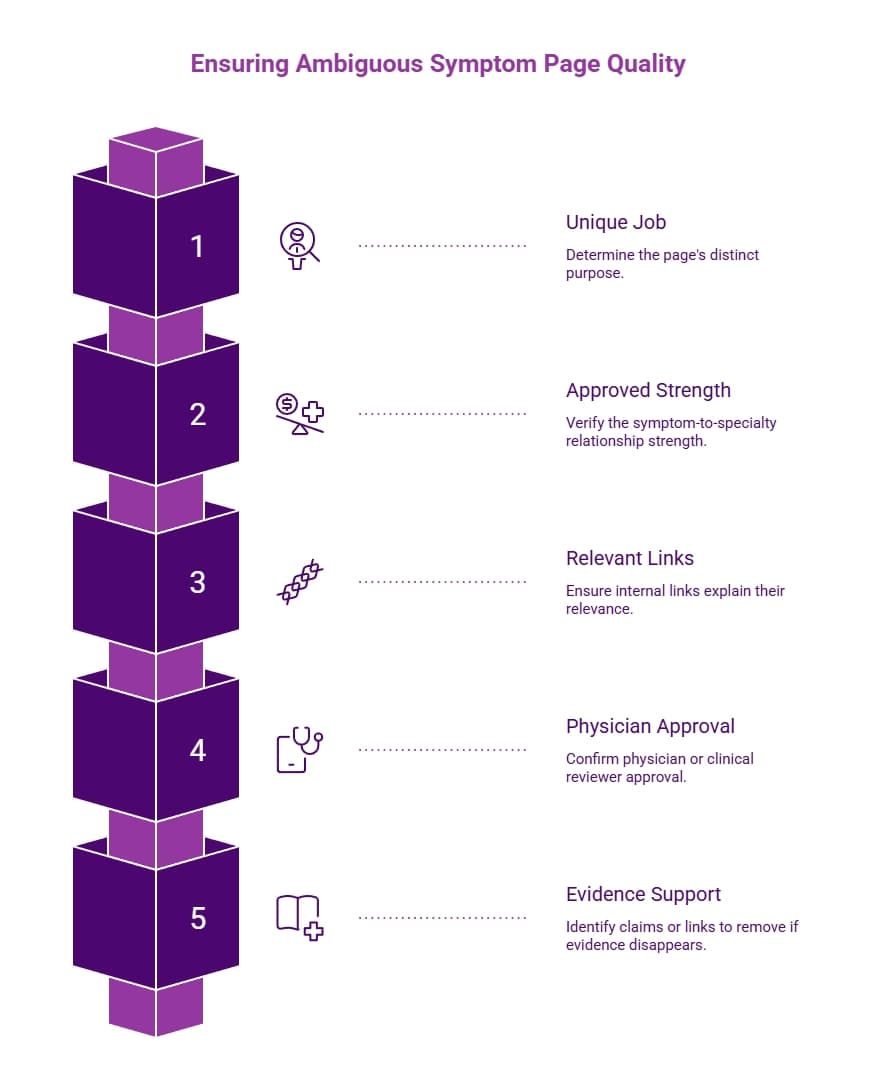
Use this checklist before publishing an ambiguous symptom page, claim, or link:
- What job does this page perform that no other page performs?
- What is the approved strength of each symptom-to-specialty relationship?
- Does every internal link explain why its destination is relevant?
- Which physician or qualified clinical reviewer approved the wording?
- What claim, link, or page would be removed if its supporting evidence disappeared?
Then confirm that the page preserves uncertainty in the main copy, avoids diagnosis and treatment suitability, separates durable expertise from changing access details, and includes a periodic or event-driven review trigger.
If emergency language is included on a patient-facing page, it must come from current authoritative guidance and receive review for that exact context. Generic warnings copied from another website are not a substitute.
Test the process on one high-overlap symptom before applying it across the site.
Frequently Asked Questions
Disclaimer: This article is for general informational purposes only and does not constitute medical advice, diagnosis, or treatment. Readers should consult a licensed healthcare professional for guidance specific to their health, symptoms, medications, or treatment options.
Our Editorial Process: Our expert team uses AI tools to help organize and structure our initial drafts. Every piece is then extensively rewritten, fact-checked, and enriched with first-hand insights and experiences by expert humans on our Insights Team to ensure accuracy and clarity.
By: About the BVM Insights Team
The BVM Insights Team is our dedicated engine for synthesizing complex topics into clear, helpful guides. While our content is thoroughly reviewed for clarity and accuracy, it is for informational purposes and should not replace professional advice.