 Dustin Ogle
One condition may appear on a practice-wide page, two specialty pages, several physician bios, a treatment page, and an educational article. Each URL may be useful, yet several may begin appearing for the same searches.
That pattern does not automatically mean every page should be merged. SEO cannibalization is a practical label for multiple URLs competing to serve substantially the same search need; it is not a formal diagnosis published by Google. The central question is whether the pages perform distinct jobs for the reader.
Start by assigning one primary intent owner to the broad search need. A primary intent owner is the page responsible for answering the main question, while supporting pages handle narrower physician, treatment, specialty, educational, or access needs. Technical directives should follow that decision, and qualified practice personnel must validate named medical relationships.
Start By Separating Topical Overlap From Real Seo Cannibalization
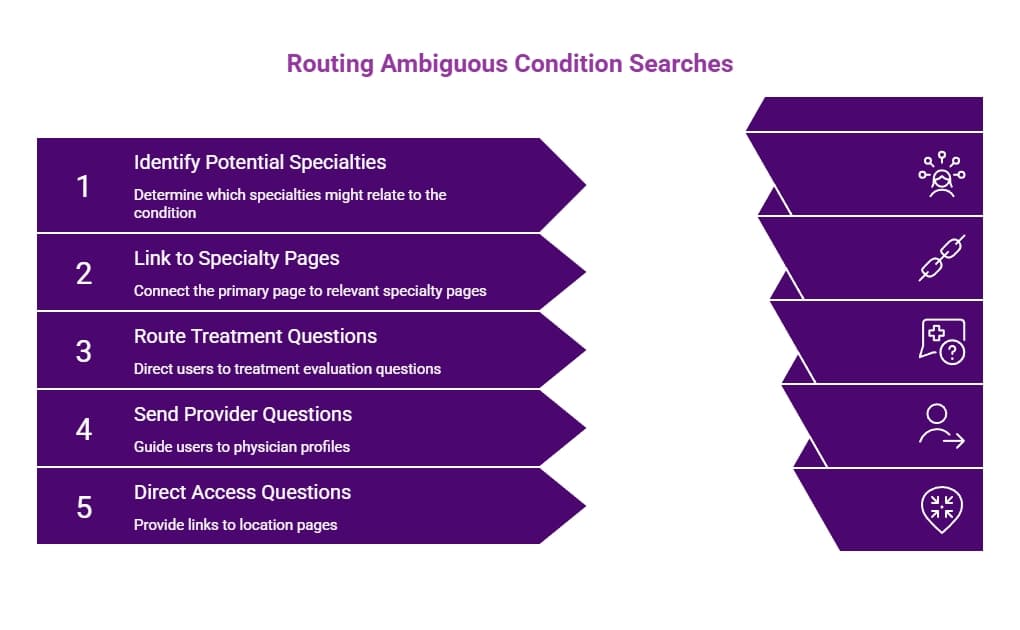
Search intent is the main task a person expects a page to help complete. Two pages can mention the same condition without serving the same intent. A condition hub may provide broad education and navigation, while a physician bio establishes provider credentials and a treatment page supports treatment evaluation.
Concern is more reasonable when several URLs target substantially the same query cluster, answer the same primary question, seek the same next action, and lack a distinct specialty, physician, treatment, audience, or access role.
| Useful overlap | Likely intent duplication |
|---|---|
| Different primary question | Same primary question |
| Distinct page type or audience | Same page role |
| Different next step | Same next step |
| Unique expertise or access context | Mostly repeated information |
Begin with evidence, not titles. Google Search Console’s Performance report provides breakdowns by queries and pages, which can help teams compare URL behavior. Google Search Console Help also explains that data may be aggregated by page or property and that much performance data is assigned to the canonical URL. One report, a short date range, or a single manual search therefore cannot confirm that two pages are cannibalizing each other.
Also avoid “duplicate content penalty” framing. Google’s SEO Starter Guide states that content accessible through multiple URLs is inefficient but does not, by itself, cause a manual action. Page overlap can still create unclear ownership or an inefficient user journey, so the correct response requires site-specific review.
Build a Page Intent Ownership Matrix before changing any URLs
First, inventory the complete cluster: condition pages, specialty pages, physician profiles, treatment pages, location pages, FAQs, and related articles. Then record each URL’s primary job. Wording differences do not create a distinct intent if the pages still answer the same question and lead to the same destination.
Use a Page Intent Ownership Matrix as a general planning framework:
| URL or page | Page type | Primary reader question | Intended intent | Unique role or evidence | Primary destination | Recommended action |
|---|---|---|---|---|---|---|
| /conditions/condition-a/ | Condition hub | “What should be understood about Condition A and the available content pathways?” | Broad education | Central explanation and reviewed navigation | Supporting pages | Primary owner |
| /physicians/physician-one/ | Physician bio | “What establishes this physician’s professional fit?” | Provider evaluation | Credentials and practice-approved scope | Condition hub or access path | Retain as support |
| /treatments/treatment-b/ | Treatment page | “What does Treatment B involve?” | Treatment evaluation | Treatment-specific information | Condition hub or reviewed next step | Differentiate |
For every row, also document the target audience or context, clinical or operational owner, desired next step, current internal-link role, and available proof. These details may sit in an accompanying worksheet when the published table needs to remain concise.
The primary owner should be the page that most completely serves the central search need. It is not automatically the oldest, longest, highest-ranking, highest-volume, or physician-preferred URL. Performance is one input; page purpose, clinical scope, unique information, URL history, referral paths, and operational ownership also matter.
A useful page-role model separates five jobs: condition pages own broad condition education, treatment pages own treatment evaluation, physician pages own provider-fit information, specialty pages explain the broader service line, and location pages provide access context. These roles can overlap without becoming interchangeable. The related guide to separate condition, treatment, and physician content paths expands on those distinctions.
The matrix does not replace Search Console analysis, crawling, URL-history review, or clinical confirmation. Without practice-specific evidence, it identifies possible overlap rather than proving a performance problem.
Choose The Remedy That Matches The Overlap Pattern
Each condition cluster may require a different response. Choose the technical action after the page role is defined.
Keep both pages and differentiate their jobs
Retain both URLs when each serves a distinct question, treatment stage, physician-evaluation need, or access purpose. Clarify the H1, opening, evidence, and next action. Remove repeated boilerplate, and use reciprocal links without turning both pages into condition hubs.
Location pages should generally own access context, not repeat the main condition explanation. Different location names alone may not justify near-identical condition pages.
Consolidate and permanently redirect
Consider consolidation when two pages answer the same question, repeat most information, share an appointment path, and lack distinct specialty or location context. Preserve unique material in the selected owner.
A permanent redirect sends an old URL to a replacement when the move is intended to remain in place. Google Search Central’s redirect documentation says permanent redirects signal that the new target should appear in search results. Review inbound links, campaign URLs, referral resources, printed materials, and URL history; then update internal links and monitor indexing. A redirect does not guarantee complete or immediate signal preservation.
Re-scope one page as supporting content
A supporting page is a useful URL with a narrower job than the primary owner. A physician bio, treatment page, FAQ, or article may remain valuable after its lead, headings, anchor text, and next step are revised.
An article appearing instead of the intended condition page may be retained for one educational question and linked to the hub. Physician visibility can likewise rely on robust bios and approved links rather than a separate condition page for every physician. The guide to when a condition page should link to a physician or procedure page covers that narrower decision.
Use Canonicalization Only For Duplicate Or Very Similar Versions
Canonicalization indicates which URL should represent duplicate or highly similar versions. It is not the default remedy for independently useful pages with unclear roles.
Google Search Central’s canonicalization documentation identifies redirects and rel="canonical" annotations as strong signals, while sitemap inclusion is a weaker signal. It also advises against using noindex merely to influence canonical selection. A noindex directive removes a page from Google Search after Google processes it, so use it only when the page should not appear in Search. Google may still select a different canonical from the one specified.
Acquired-practice pages require the same decision. Do not canonicalize operationally distinct pages merely because their wording is similar; first determine whether each remains independently useful.
Route Ambiguous Condition Searches Without Making Clinical Decisions
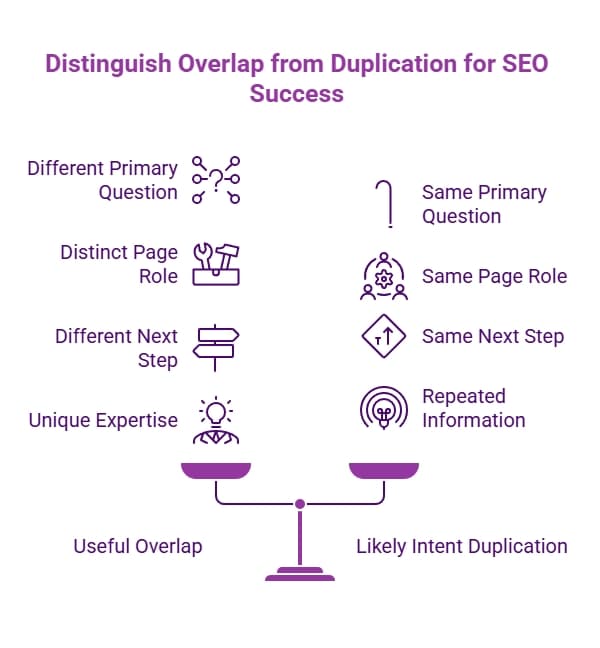
When several specialties, physicians, or treatments may legitimately relate to Condition A, the primary condition page can serve as a neutral content-routing hub. It may explain the practice’s information pathways, link to reviewed specialty pages, connect treatment-evaluation questions to treatment pages, send provider-fit questions to physician profiles, and direct access questions to location pages.
A qualified clinical reviewer—not the marketing team—must determine whether and how Specialty One, Specialty Two, a named physician, or a treatment should be represented. Search-intent routing organizes content and navigation. It does not diagnose, triage, establish clinical superiority, or replace intake and professional evaluation.
Internal links should reinforce the hierarchy that the ownership decision created. Google Search Central’s link guidance recommends descriptive, concise, contextual anchor text that helps people navigate and helps Google understand the linked page. More links cannot compensate for undefined page purpose.
The owner page might link to a physician profile using anchor text that describes the profile’s scope, while the profile links back to the condition hub for broader education. A treatment page may link to the hub when readers need context beyond that treatment. Location pages should connect visitors to access information without claiming ownership of repeated clinical content. Supporting links should describe their destinations naturally rather than repeat one exact-match phrase throughout the cluster.
This structure also addresses organizational pressure. Physicians can retain individual visibility through bios, specialties can preserve clinically valid distinctions, and one page can still own the broad condition intent. Teams needing a more detailed relationship model can use a governed approach to build a specialty SEO taxonomy.
Prevent Future Cannibalization With Multi-Specialty Content Governance
Preventing recurrence requires a lightweight ownership record before drafting begins. For each proposed page, document the URL or working title, page type, primary intent, existing owner page, unique role, specialty or service-line owner, accountable clinical reviewer, internal-link plan, CTA or destination, merge or retirement trigger, and review date. Assigning one accountable clinical owner concentrates limited review time and avoids conflicting approvals.
A general approval sequence can be adapted to the organization:
- Marketing defines the reader’s primary need.
- SEO checks the existing URL inventory and page ownership.
- The accountable clinical reviewer validates named medical relationships.
- The service-line owner confirms operational fit.
- The publisher records the decision in the content map.
- The team reviews performance and navigation after implementation.
Do not approve a new condition page until the team can explain in one sentence how its job differs from every existing page in the cluster.
Governance should also cover migrations. After a redirect goes live, update internal links, check referral and campaign destinations, monitor URL behavior, record the ownership change, and prevent another team from recreating the retired role. “Google will figure it out” is not a substitute for explicit ownership, and a sitewide template cannot resolve every cluster. The appropriate action depends on the site’s content, evidence, technical constraints, and clinical review process.
Frequently Asked Questions
Disclaimer: This article is for general informational purposes only and does not constitute medical advice, diagnosis, or treatment. Readers should consult a licensed healthcare professional for guidance specific to their health, symptoms, medications, or treatment options.
Our Editorial Process: Our expert team uses AI tools to help organize and structure our initial drafts. Every piece is then extensively rewritten, fact-checked, and enriched with first-hand insights and experiences by expert humans on our Insights Team to ensure accuracy and clarity.
By: About the BVM Insights Team
The BVM Insights Team is our dedicated engine for synthesizing complex topics into clear, helpful guides. While our content is thoroughly reviewed for clarity and accuracy, it is for informational purposes and should not replace professional advice.