
 BVM Insights Team
The site has 200 pages. Nobody can find anything.
Blog posts from 2019 sit next to project announcements from last quarter. The remediation page tries to serve both RFQ-ready buyers and first-time researchers. Case studies are buried three clicks deep, disconnected from the service pages they should support. We built all this content. Why doesn't it work?
That gap between expertise and visibility is where most engineering firms get stuck. Your team holds PE licenses, decades of field experience, and deep methodological knowledge — but the website reads like a filing cabinet someone knocked over.
Deep Content Architecture is the deliberate structuring of service pages, topic hubs, supporting spoke articles, and proof assets into a hierarchy aligned with entities and buyer research stages. That hierarchy is what turns engineering expertise into durable topical authority — for human buyers and AI systems alike. It is also the foundational prerequisite that allows Generative Engine Optimization to work, because both buyers and AI need clear relationships between topics, services, methods, and proof.
What Deep Content Architecture Means in an Engineering Context
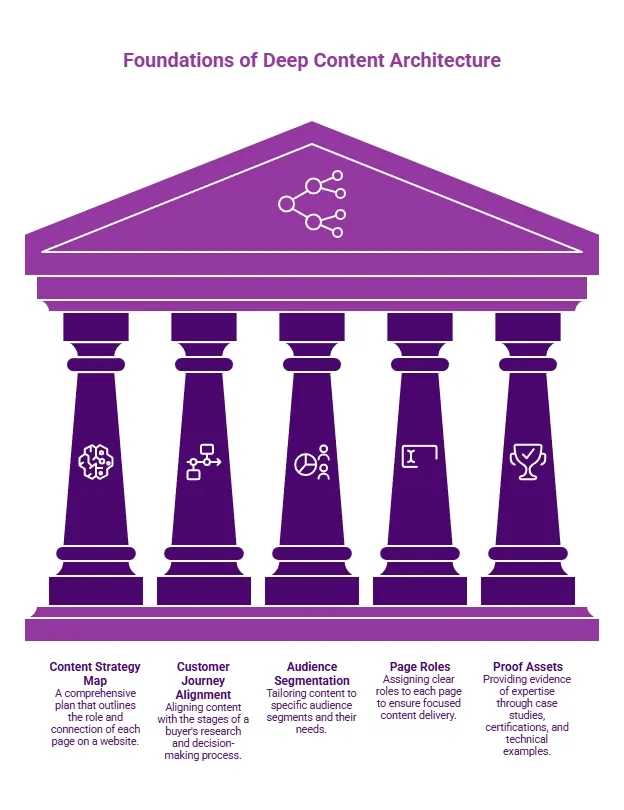
Deep Content Architecture is a comprehensive content strategy map — not a content calendar. It is the system that assigns every page on your site a clear role, connects those pages through intentional hierarchy, and organizes the whole structure around the entities and topics your firm actually serves. That map aligns customer journey stages, audience segmentation, and page roles inside one structure.
Your buyers don't browse casually. They research methodologies, compare regulatory compliance approaches, and evaluate technical qualifications across pursuit cycles that generally range from a few weeks for standard assessments to 6-to-12 months for complex infrastructure projects. A site that dumps all of that into a single "Services" page and a chronological blog archive makes their job harder — and makes your expertise harder for search engines and AI models to interpret.
One page owns the broad topic. Another owns the commercial service intent. Supporting pages answer narrower questions about methods, regulations, due diligence, remediation scenarios, specs, and permitting realities. Proof assets show that the expertise is real through case studies, qualifications, certifications, software expertise, and technical examples.
The distinction matters: isolated posts generate noise. A deep content architecture generates authority.
Why Most Engineering Websites Never Reach Topical Authority
The failure is rarely a lack of content. It is a lack of structure. Several overlapping problems compound across engineering firm websites, and understanding why generic SEO fails for technical engineering firms is the first step toward fixing them.
Disconnected blog archives. Posts published over years with no clear relationship to service lines or buyer questions. Phase II ESA methodology lives in the same flat archive as a company picnic recap. These posts do not accumulate into authority because nothing ties them together.
Mixed-intent pages. A single page attempts to define a service, explain a methodology, and display project credentials simultaneously. It serves no audience well, and search systems struggle to classify it. One URL forced to explain a service, answer a technical question, and prove credibility at the same time cannot do any of those jobs effectively.
Collapsed service lines. Geotechnical, environmental, and construction materials testing all share one umbrella page. Buyers searching for specific capabilities — PFAS remediation consulting, say, or drilled shaft design — find nothing that matches their precision. The firm's real specialization stays hidden behind vague categories.
Weak internal linking. Pages exist in isolation. Educational content doesn't point to service pages. Case studies don't connect back to the capabilities they demonstrate. No visible path exists from "learning" to "evaluating" to "trusting." Internal links often follow publishing chronology instead of hierarchy.
This structural disorder doesn't just frustrate human visitors. AI systems that evaluate which firms to cite depend on clear entity relationships between an organization, its services, and its evidence of expertise. Scattered content weakens that interpretability.
Random publishing creates noise. Architecture creates authority.
How to Map the Buyer Journey into Your Content Hierarchy
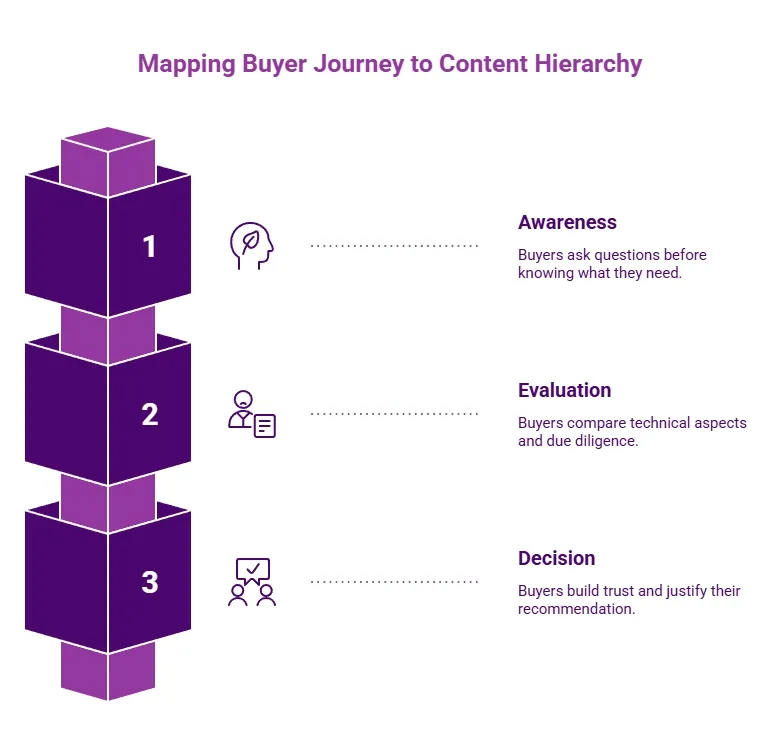
Structure alone isn't enough. The architecture must reflect how engineering buyers actually research, evaluate, and select firms.
Awareness-stage content answers the questions buyers ask before they know what they need. "What triggers a Phase II ESA?" or "When is a geotechnical investigation required?" — these are spoke articles that bring qualified traffic into your hierarchy. At this stage, buyers are trying to define the problem. They search questions about contaminants, methods, regulations, site conditions, due-diligence risks, or permitting obstacles.
Evaluation-stage content supports technical comparison and due diligence. Method-versus-method pages, regulatory comparison guides, and detailed capability descriptions help buyers narrow their shortlist. This means content framed around methodologies, applications, and regional requirements — not broad category terms. Buyers at this stage want to know whether a firm understands the relevant methodology, application, and regional requirement. Mapping permitting specs to search intent is where service-line pages and deeper comparison content matter most.
Decision-stage content builds final trust. Case studies with quantified project outcomes, qualification displays (PE licenses, ISO certifications, software expertise), and project-specific documentation help the buyer justify their recommendation internally. Engineering sales cycles span months with multiple stakeholders reviewing your materials. The architecture must support that repeated, deepening engagement.
Each stage maps to a layer in the architecture. Awareness content lives in spokes. Evaluation content appears in service-line pages. Decision content is your proof-asset layer. When the hierarchy is clear, the buyer's research journey and your site's structure move in the same direction.
A practical way to start that mapping:
- List your core service lines.
- Assign one clear commercial page to each.
- Identify the methods, regulations, project stages, and buyer questions that support each service line.
- Attach proof assets to the service line they validate.
- Rebuild internal links so the path from awareness to trust is obvious.
For many firms, auditing practice-area architecture in the first 30 days is the fastest next step.
Why This Structure Matters for Generative Engine Optimization and AI Citations
Deep Content Architecture is the foundational prerequisite for effective Generative Engine Optimization. The connection is structural, not theoretical.
AI systems — whether powering search overviews, chatbot recommendations, or procurement research tools — need to understand the relationships between an organization, its capabilities, and its evidence. When your site is a flat archive of disconnected posts, those relationships are ambiguous. A structured hierarchy makes the interpretation straightforward. Architecture does not guarantee visibility on its own, but architecture improves interpretability — and interpretability is what AI systems require before they can cite you with confidence.
Google's own guidance emphasizes that helpful, people-first content built with clear structure is what search systems reward. The same principle extends to AI citation: models favor pages where entity relationships — who does what, supported by what evidence — are unambiguous. Structured data reinforces this, but the content hierarchy itself is the foundation.
At the implementation level, page architecture, internal linking, schema support, visible hierarchy, user experience, and CTA clarity should be treated as one coherent action plan rather than isolated tactics. For engineering firms, Schema.org Organization, Schema.org Service, and Schema.org Article define the entity types that support classification clarity. Use Article and BreadcrumbList on article templates, support publisher identity sitewide with Organization, and apply Service on relevant service pages rather than forcing every service attribute into the article page.
Random publishing creates noise. Architecture creates authority.
A Practical Starting Blueprint for Firms with Existing Content Chaos
Most engineering firms aren't starting from zero. They have years of accumulated content that needs reorganizing, not replacing. Start with the site you have, not the one you wish you had.
Inventory every page by role. Classify each existing page as a hub, service page, spoke, proof asset, or orphan with no clear purpose. Auditing your firm's practice-area architecture provides a structured approach for this first step.
Group pages by service line and buyer question. Cluster content around the practice areas your firm actually sells — not around the dates they were published.
Identify gaps and overlaps. Where do you have three posts on the same topic but no service page for a core offering? Where are buyers' evaluation-stage questions going unanswered? One page may be swallowing several service lines. Another may be attracting the wrong audience. A third may be useful but sitting outside the hierarchy entirely.
Rebuild internal links around the hierarchy. Every spoke should link to its parent service page. Every service page should link to its hub and strongest proof assets. Remove links that send readers sideways into unrelated content. Preventing cannibalization across geotechnical teams is a good model for that governance work.
Create one visible architecture map. A single document that shows every hub, its service pages, its spokes, and its proof assets. This becomes the operating system for all future content decisions.
The point is not to publish faster. The point is to make the firm legible — to procurement teams running due diligence, project managers building shortlists, and AI systems summarizing who does what best. That map is the difference between publishing content and building authority. It is the shift from scattered blog pile to engineered system. Once that structure is in place, the rest of the strategy has somewhere to live.
Your firm already has the expertise. The structure is what makes it findable.
Explore the related engineering SEO resources to continue building on this foundation, or learn more about how BVM approaches engineering services SEO.
Disclaimer: This content is provided for educational and informational purposes. Specific outcomes depend on your firm's existing content, competitive landscape, and implementation approach.
Our Editorial Process: Our expert team uses AI tools to help organize and structure our initial drafts. Every piece is then extensively rewritten, fact-checked, and enriched with first-hand insights and experiences by expert humans on our Insights Team to ensure accuracy and clarity.
By the BVM Insights Team: The BVM Insights Team creates practical, evidence-led search strategy content for technical and high-value B2B markets, with a focus on SEO architecture, GEO, and long-cycle pipeline visibility.