
 Dustin Ogle
- One Page, One Buyer Problem: When a single page tries to serve geotechnical, remediation, and compliance audiences at once, it ranks for none and converts no one.
- Generic Headings Hide Your Expertise: "Environmental Services" loses to competitors using specific terms like "PFAS Groundwater Remediation" that match what buyers actually search.
- Put Proof Where It Belongs: Certifications and project examples need to live on the service pages they support, not buried on a generic "About" page.
- Internal Links Should Point to Money Pages: Blog posts and educational content should link to your commercial service pages, directing authority where it generates qualified leads.
- Audit Before You Publish: A 30-day review of your current pages reveals where buyers get confused - fix that map before creating anything new.
Clear structure routes the right buyers to the right pages - every time.
Engineering firm marketing leads and practice area directors will find a practical 30-day audit framework here, preparing them for the detailed implementation steps that follow.
The pipeline report shows 47 inquiries last quarter. Twelve were qualified. The other 35 came from prospects who thought your geotechnical team handled remediation work - because your website told them it did.
Your site may not need more content yet. It may need to stop sending PFAS remediation buyers to generic drilling pages.
Before publishing another blog post or rebuilding navigation, run this 30-day audit. The goal is simple: find where your current practice-area architecture blurs disciplines, buries technical specs, and confuses buyer intent. That clarity comes before any new content investment makes sense.
Start Here: What This 30-Day Audit Should Reveal
A broken practice-area architecture routes the wrong traffic to the wrong pages. Geotechnical capabilities get mixed with remediation services. Environmental compliance content sits orphaned from the commercial pages it should support. Buyers searching for "in-situ PFAS treatment" land on a page titled "Environmental Services" - and bounce.
The business consequences are predictable. Sales teams field poor-fit inquiries. Technical staff spend time clarifying scope too early in the conversation. Qualified RFQs become harder to win because your expertise is not obvious at first glance.
The audit should answer three questions within the first week: Which pages blend unrelated buyer intents together? Where do technical specs disappear behind generic headings? And which service lines are competing with each other for the same search queries?
A successful week-one outcome is a documented inventory showing exactly where intent confusion lives. That inventory becomes your prioritization tool for everything that follows.
Build a Complete Inventory of Your Current Practice Areas
Your first job is to build a full inventory before you judge performance. List every page that represents a service, capability, or technical discipline. Include top-level service pages, child pages, blog posts, resource hubs, case studies, and any location or industry variants. This is your source-of-truth document.
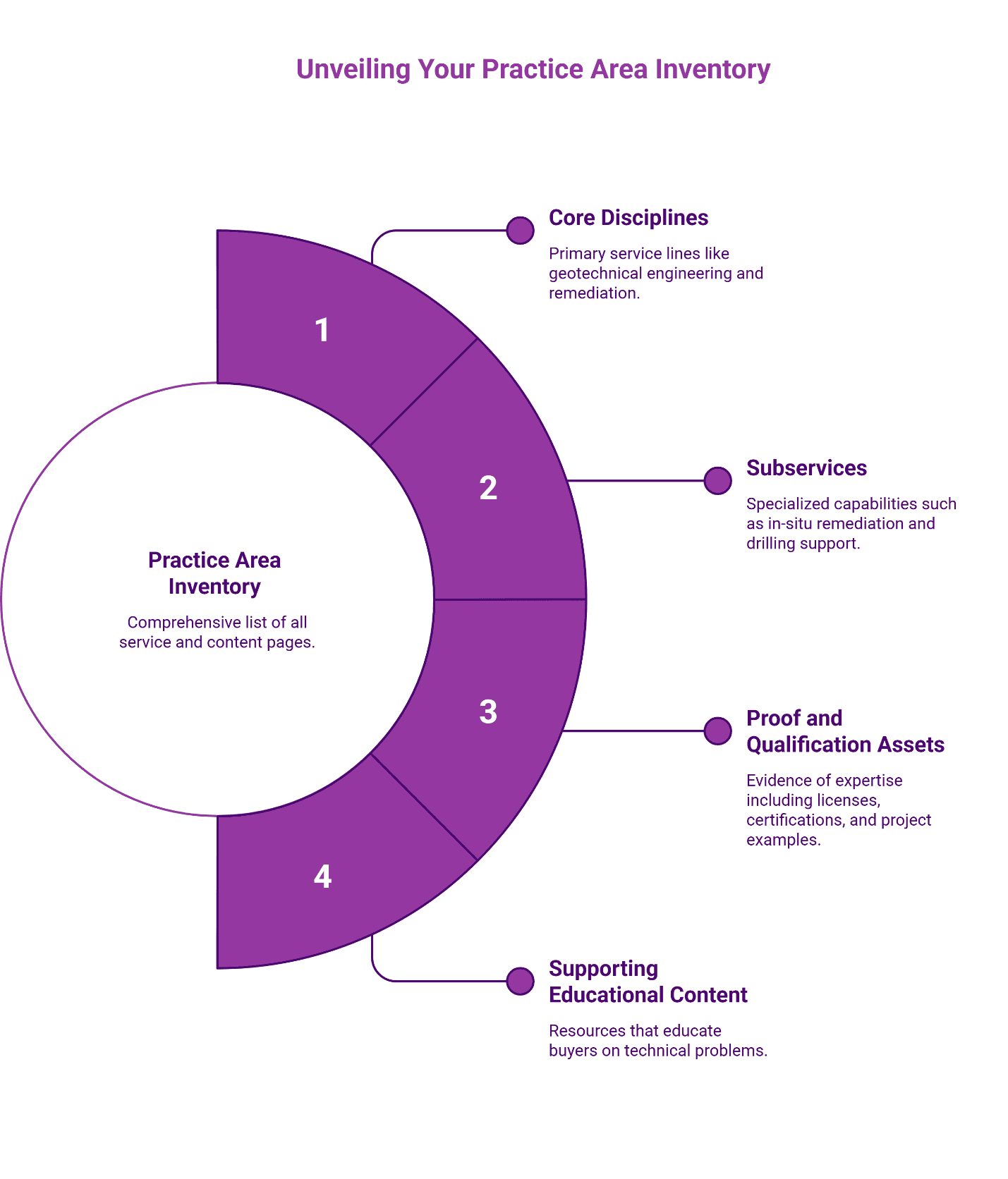
Separate that inventory into four practical buckets:
- Core disciplines. Geotechnical engineering, remediation, environmental compliance, subsurface investigation, and other primary service lines.
- Subservices. Capabilities such as in-situ remediation, drilling support, site characterization, materials testing, or PFAS-related work.
- Proof and qualification assets. Licenses, certifications, methodologies, software expertise, project examples, and team credentials.
- Supporting educational content. Resources that help buyers understand technical problems without replacing the main commercial page.
Separate Core Disciplines from Subservices
Geotechnical engineering, remediation consulting, and environmental compliance are distinct disciplines with distinct buyers. If your site treats them as interchangeable subcategories under a single "Services" umbrella, you are blending search intent at the structural level.
Map each page to one primary discipline. If a page serves multiple disciplines, flag it for splitting.
Flag Pages That Bundle Unrelated Buyer Intents
A page titled "Site Assessment Services" might attract prospects searching for Phase I environmental assessments, geotechnical investigations, and remediation feasibility studies - three different buyer problems requiring three different technical responses. When one page tries to answer all three, it answers none of them well enough to rank or convert.
Run the 5-Point Website Taxonomy Audit
This checklist determines whether your current structure answers spec-level buyer intent or buries it.
1. Does each page map to one clear discipline and buyer problem?
Pass: The page addresses a single technical capability and a single buyer need.
Fail: The page mixes geotechnical, remediation, and compliance topics - or tries to serve multiple buyer personas simultaneously.
Consequence: Search engines cannot determine relevance, and buyers cannot determine fit.
2. Do URLs reflect technical intent instead of generic categories?
Pass: URLs include discipline-specific and method-specific terms (e.g., /services/pfas-remediation/ or /geotechnical/slope-stability-analysis/).
Fail: URLs use broad labels like /services/environmental/ or /what-we-do/.
Consequence: You surrender ranking potential for spec-level searches to competitors with clearer URL signals.
3. Do H1s and page headings match spec-level search language?
Pass: Headings use the terminology buyers actually search - material specs, compliance frameworks, remediation methods.
Fail: Headings stay at category level ("Our Remediation Services") while competitors rank for "pump-and-treat groundwater remediation" and "soil vapor extraction design."
Consequence: Technical authority gets buried under generic labels.
4. Do proof assets and qualifications sit on the right pages?
Pass: Certifications, project experience, and methodology details appear on the specific service pages they support.
Fail: All credentials live on an "About" page while commercial service pages lack technical proof.
Consequence: Buyers evaluating your PFAS capabilities never see your PFAS-specific qualifications.
5. Do internal links reinforce the commercial hierarchy?
Pass: Educational content links to relevant service pages. Service pages link to detailed capability pages. The link structure points authority toward pages that generate qualified RFQs.
Fail: Blog posts link only to other blog posts. Service pages link generically to "Contact Us." Internal linking ignores commercial priority.
Consequence: The pages that should rank for high-intent searches lack the internal authority signals to compete.
If a page fails three or more of these tests, it does not need minor polish. It needs structural attention.
Find Where Technical Specs Disappear in Your Current Structure
Engineering buyers search by method, material, and compliance requirement - not by category. When your headings and navigation stay broad, you lose visibility for the exact searches that produce qualified RFQs.
Examples of Spec-Level Intent Gaps
A prospect searching "in-situ chemical oxidation remediation" will not find your firm if your site only mentions "remediation services." A project manager evaluating "ASTM D1586 SPT borings" will not discover your geotechnical capabilities if your page titles stop at "Subsurface Investigation."
The gap between what buyers search and what your headings say is where technical authority disappears.
Why Depth Matters Over Time
Buyers in the AEC (Architecture, Engineering, and Construction) sector typically evaluate firms for an estimated six to twelve months before shortlist formation, depending on project complexity. Your architecture has to support awareness, evaluation, and credibility-building across that entire research cycle - not just initial discovery. This is why Engineering Services SEO requires engineer-level depth, visible qualifications, and content that reinforces technical authority at every stage.
Identify Overlap, Cannibalization, and Internal Friction
Two pages targeting the same buyer intent split your authority and confuse search engines about which page to rank. This happens more often than most firms realize.
Commercial Page vs. Educational Page Conflicts
Your service page for "Geotechnical Engineering" and your blog post titled "What Is Geotechnical Engineering?" may compete for similar queries. The service page should rank for commercial intent. The blog post should rank for informational intent - and link to the service page.
If both pages blur the line, neither performs optimally.
Homepage Politics vs. Search Intent Reality
Internal stakeholders often want their practice area featured prominently on the homepage. That political reality can distort information architecture in ways that hurt search performance. The audit should document where internal preferences override buyer intent logic - so leadership can make informed tradeoffs.
Prioritize the First 30 Days by Business Risk and Search Confusion
Not every finding requires immediate action. Prioritize by two filters: where commercially important intent is being blurred, and where technical capability is missing from current structure. The metrics that matter are project inquiry volume, qualified RFQs, organic-attributed pipeline value, and CRM-traceable journey quality - not traffic alone.
- Pages to rename: Headings that use generic labels instead of spec-level language.
- Pages to split: Single pages attempting to serve multiple disciplines or buyer intents.
- Pages to consolidate: Multiple thin pages competing for the same topic that would perform better combined.
- Pages that need net-new child pages: Service categories missing dedicated pages for specific methods, compliance frameworks, or technical capabilities that buyers actually search.
A 30-Day Rollout Plan for Engineering Marketing and Practice Leads
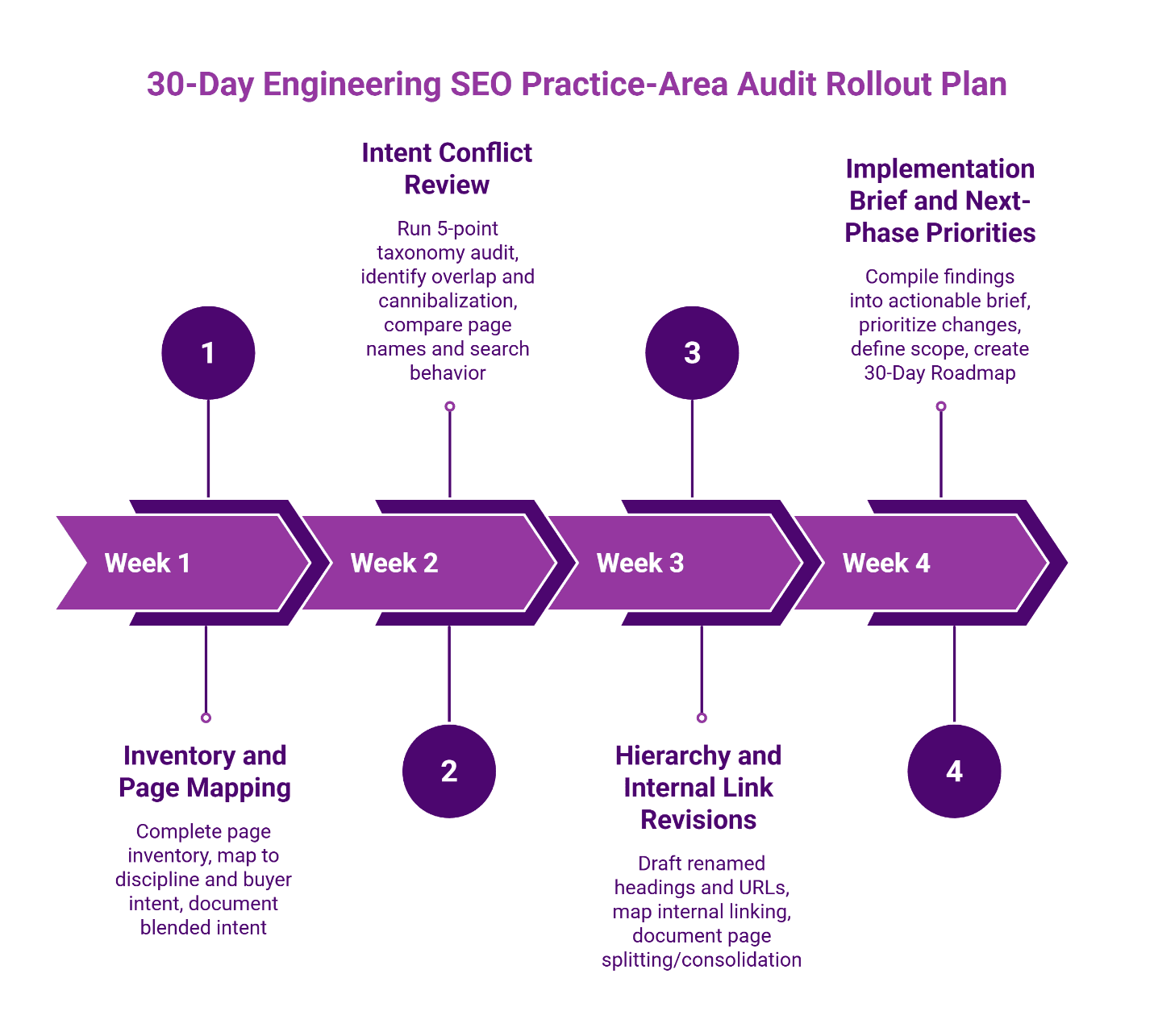
Week 1: Inventory and Page Mapping
Complete the full page inventory. Map each page to a single discipline and buyer intent. Document every instance of blended intent or missing spec-level language.
Week 2: Intent Conflict Review
Run the 5-point taxonomy audit on priority pages. Identify overlap and cannibalization. Flag pages where internal linking contradicts commercial hierarchy. This is where marketing and technical leadership should compare page names, headings, and real search behavior together.
Week 3: Hierarchy and Internal Link Revisions
Draft renamed headings and URL recommendations. Map the internal linking structure that should exist. Document which pages need splitting and which need consolidation. The Perfect Page Blueprint and Deep Content Architecture provide useful execution models for this phase.
Week 4: Implementation Brief and Next-Phase Priorities
Compile findings into an actionable brief. Prioritize changes by business impact. Define the scope of work required before publishing new content. Structure your recommendations into a clear 30-Day Roadmap that can be shared across teams.
This sequencing mirrors the discovery-to-implementation rhythm that separates effective Engineering Services SEO from random content production.
What Good Looks Like Before You Publish More Content
Do not scale content on a broken structure. Before the next content sprint begins, verify these readiness signals:
Ensure structural and topical alignments perfectly match the baseline criteria established in your 5-Point Taxonomy Audit. Internal links point authority toward high-intent commercial pages. No two pages compete for the same search intent.
When the architecture passes these checks, new content amplifies a clear signal instead of adding noise to a confused one. Strong practice-area architecture also makes your expertise easier for AI systems to interpret and cite when buyers research complex capabilities - an increasingly important factor as search behavior evolves.
The firms that win qualified RFQs through search are not the ones with the most content. They are the ones whose practice-area architecture routes technical buyers to exactly the right page - every time.
If your current structure still blends service lines, hides qualifications, or routes authority inconsistently, pause content expansion and fix that map first. When you are ready to extend the audit into implementation, useful next steps include Digital Infrastructure for treating your website as a capital asset, Why Bad Leads Are Killing Your Sales Team's Morale if pipeline quality is the pressing concern, and The Invisible Expert Syndrome if your site already feels technically strong but commercially invisible.
Our Editorial Process: Our expert team uses AI tools to help organize and structure our initial drafts. Every piece is then extensively rewritten, fact-checked, and enriched with first-hand insights and experiences by expert humans on our Insights Team to ensure accuracy and clarity.
About the BVM Insights Team: The BVM Insights Team is the editorial and strategy group behind Brazos Valley Marketing's technical search content. We combine AI-assisted organization with human rewriting, fact-checking, and industry-specific SEO judgment to produce practical guidance for complex B2B markets.