
 Dustin Ogle
A symptom page, condition page, procedure page, and physician bio may all need to mention the same clinical terms. That shared vocabulary is not automatically a content problem.
Search overlap becomes more serious when two pages answer the same reader question, emphasize the same primary entity, repeat the same evidence, and lead to the same next step. At that point, the pages are not merely related. They are performing the same job.
The governing rule is straightforward: assign every page a distinct primary question, primary entity, and next decision. Then use internal links to connect those roles into a clinically validated patient pathway.
Separate Pages by the Job They Perform, Not the Words They Share
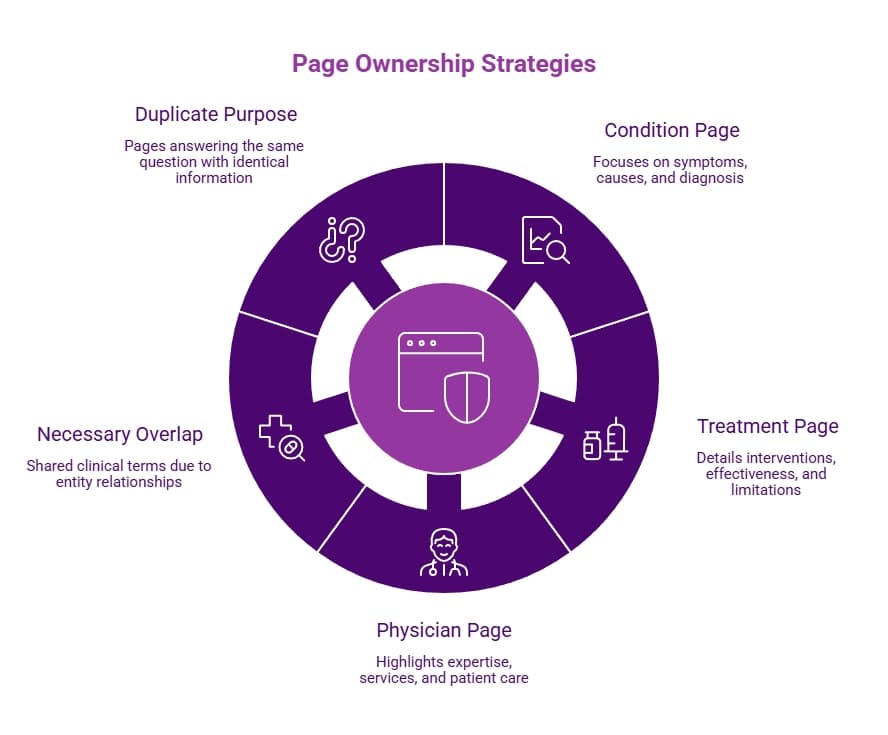
A page role is the specific decision-making job a page performs for its reader. Its primary intent is the central question it resolves, while supporting entities are related symptoms, conditions, treatments, physicians, or locations that provide context without taking over the page.
This distinction matters because closely related healthcare pages cannot avoid shared terminology. A condition page may discuss symptoms. A treatment page may name conditions for which an intervention may be considered. A physician page may reference both.
The difference lies in ownership. A treatment page may mention related conditions, but it should still own the intervention, evaluation process, verified limitations, and suitability questions. It should not become another version of the condition page.
Practices developing separate condition, treatment, and physician content paths should distinguish between what each page must own and what it may mention.
Necessary overlap: Pages share clinical terms because the entities are genuinely related.
Duplicate purpose: Pages answer the same question, contain substantially the same unique information, and direct the reader toward the same decision.
This is not a “one entity, one page” rule. Some entities may need several pages because readers approach them from materially different questions. Other entities may not justify a dedicated page because the practice lacks enough distinct, clinically supported information.
Use a Page-Role Matrix to Assign Content Ownership
The matrix below provides an editorial framework rather than a clinical protocol. Exact wording, page modules, and routing decisions may vary by specialty, service line, physician structure, and access model.
| Page Type | Primary Reader Question | Primary Entity | Information the Page Must Own | Supporting Entities It May Mention | Required Next-Step Links | Clinical Reviewer | Main Overlap Warning |
|---|---|---|---|---|---|---|---|
| Symptom page | “What could this concern mean, and what kind of evaluation may be appropriate?” | The symptom or concern | Description, relevant patterns, uncertainty, evaluation context, and clinically approved escalation wording | Condition categories, specialties, tests, treatments, and access options | A validated condition, specialty, physician, or access path | Clinician familiar with symptom evaluation and practice scope | It presents one condition or specialist as universally correct |
| Condition page | “What is this condition, how is it evaluated, and what care paths may be considered?” | The named condition | Definition, evaluation context, associated symptoms, care categories, and relevant expertise | Treatments, physicians, locations, and appointment information | A treatment, physician, location, or access page | Clinician responsible for the condition or service line | It becomes a generic symptom page or repeats procedure education |
| Treatment or procedure page | “What is this intervention, when may it be considered, and what does evaluation involve?” | The intervention | Purpose, process, suitability questions, verified limitations, risks, and evaluation requirements | Conditions, physicians, alternatives, and recovery topics | A verified physician, consultation, or access page | Clinician who performs or oversees the intervention | It rewrites condition content or implies a guaranteed outcome |
| Specialist or physician page | “Why might this physician be relevant to this type of need?” | The physician and verified clinical fit | Credentials, subspecialty focus, conditions evaluated, procedures performed, locations, and access | Short condition and treatment summaries | An appointment path or relevant clinical resource | The physician or designated clinical reviewer | It duplicates full condition or procedure pages or overstates expertise |
| Specialty or service-line hub | “What does this service line cover, and where should the reader go next?” | The specialty or service line | Scope, taxonomy, major pathways, and navigation | Summaries of symptoms, conditions, treatments, physicians, and locations | The most relevant child page | Service-line clinical leader | It tries to become the definitive page for every underlying topic |
The primary entity column helps resolve a common source of disagreement. A condition page and physician page may both discuss the same condition, but they should not own it in the same way. The condition page owns the condition. The physician page owns verified provider fit.
A specialty SEO taxonomy can help teams organize these entities into a coherent hierarchy. The taxonomy should guide ownership and navigation rather than create a new URL for every phrase variation.
Operational information also needs deliberate placement. Appointment logistics, office availability, and location details can change more frequently than clinical education. Where possible, clinical pages should link to maintained access sources instead of duplicating volatile details across the site.
Every real relationship entered into this matrix requires clinical validation. Marketing can define the architectural framework, but a qualified reviewer must confirm claims connecting symptoms, conditions, procedures, specialties, and named physicians.
Link Pages According to the Reader’s Next Reasonable Decision
Internal links should not exist merely because two pages share a keyword. Each link should help the reader resolve the next question in the evaluation process.
For instance, a symptom page might link to a condition page when the relationship is clinically supported and carefully qualified. In other situations, the more useful destination may be a specialty overview, physician page, or general access path.
Conversely, a condition page often points to treatment education when readers need to understand available care categories. It may link to a physician page when the unresolved question is provider fit. Guidance on when a condition page should link to a physician or procedure page can help teams avoid adding both destinations mechanically.
Finally, treatment pages should connect to physicians who perform or oversee the intervention only after that relationship is verified. Physician pages should then link back to deeper condition and procedure resources rather than reproducing each explanation in full. A strong bio establishes credible fit and provides access; it does not need to become a miniature service-line website. Teams can review what physician bios need to support condition and treatment discovery for deeper guidance.
Service-line hubs should distribute readers to more specific pages. They clarify scope and pathways but should not absorb every child page’s intent.
Google’s official link best-practices guidance recommends relevant internal links and descriptive anchor text that helps people understand the destination. That guidance supports clear navigation, but it does not establish a fixed link count or guarantee a ranking outcome.
Contextual links within explanatory copy are usually more useful than a large block linking every page to every related URL. Small pathway modules may also help when they reflect genuine reader decisions and clinically approved relationships.
Preserve Uncertainty When a Symptom Can Lead to Several Pathways
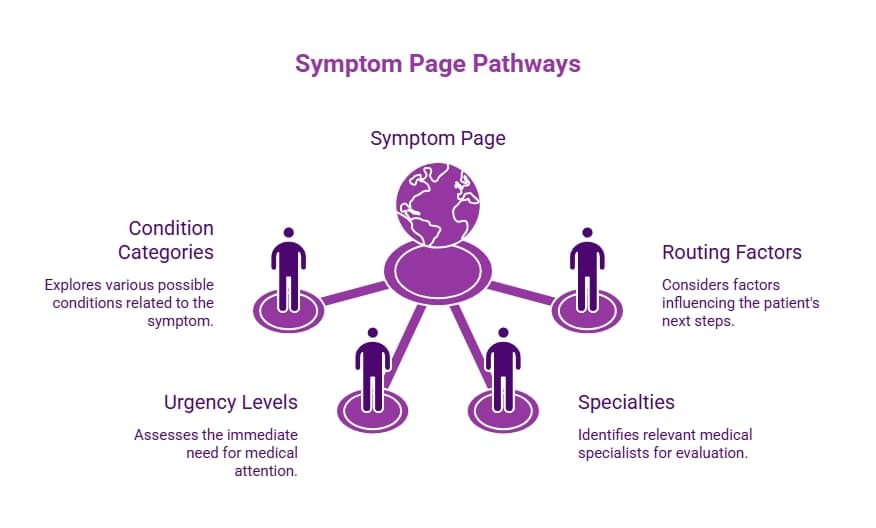
Symptom-led architecture presents the greatest clinical risk because a symptom or concern is not a confirmed condition. Depending on the presentation and clinical context, the same concern may relate to several possible conditions, systems, urgency levels, or specialties.
A symptom page should therefore preserve uncertainty. It can explain why evaluation may be appropriate, identify broad factors that influence routing, and show where the practice has verified relevance. It should not turn that uncertainty into a deterministic marketing funnel.
Consider a hypothetical symptom page that could connect to several condition categories. The page should not declare one explanation, recommend one intervention, or direct every reader to a single specialist. It could instead explain that the appropriate pathway may depend on associated concerns, medical history, clinical findings, and the practice’s actual scope.
This branching structure keeps the page roles distinct:
A symptom page owns the concern and evaluation context. A condition page owns the named condition. A treatment page owns the intervention. A physician page owns verified provider fit. The service-line hub helps readers navigate among them.
Clinical-review time should be concentrated on these relationship statements. Reviewers do not necessarily need to reconsider every generic sentence with equal intensity. They do need to verify which entities may be connected, how much certainty the wording implies, and whether the practice genuinely provides the represented pathway.
The National Library of Medicine’s MedlinePlus guidance for evaluating health information emphasizes source reliability, expert review, transparency, and current information. Those principles are useful when teams select sources for clinical terminology, although an external definition does not validate a practice-specific mapping.
Run a Five-Question Overlap Audit Before Merging or Rewriting Pages
Do not consolidate two pages simply because they repeat terminology. Evaluate whether they have become functionally interchangeable.
| Audit Question | What a “Yes” Suggests |
|---|---|
| Do both pages answer the same primary reader question? | They may own the same intent. |
| Do both pages center the same primary entity? | Their subject ownership may be unclear. |
| Do they contain substantially the same unique information, so removing one would leave the other nearly complete? | One page may add little independent value. |
| Do they direct the reader to the same next decision or access path? | Their pathway roles may be duplicated. |
| Can stakeholders explain the difference between the pages in one sentence? | A “no” indicates weak differentiation or governance. |
This is an editorial diagnostic, not a validated ranking formula.
Four or five overlap signals indicate a strong consolidation or repositioning candidate. Two or three suggest that headings, ownership, evidence, and link roles need clarification. Zero or one usually means the shared terminology is necessary rather than duplicative.
The result should not automatically be a redirect. Possible outcomes include keeping both pages and differentiating them, consolidating them, repositioning one as a hub, removing unsupported claims, or declining to create another page until a distinct reader job exists. Redirect decisions should follow content and technical review rather than keyword similarity alone.
Two governance questions complete the audit: Who is the clinical reviewer, and who owns future updates? A page without both forms of ownership is more likely to become stale, contradictory, or indistinguishable from adjacent content.
CMS templates also deserve review. Shared components can improve consistency, but they should not force symptom, condition, treatment, and physician pages to use identical headings or fulfill identical purposes.
Frequently Asked Questions
Disclaimer: This article is for general informational purposes only and does not constitute medical advice, diagnosis, or treatment. Readers should consult a licensed healthcare professional for guidance specific to their health, symptoms, medications, or treatment options.
Our Editorial Process: Our expert team uses AI tools to help organize and structure our initial drafts. Every piece is then extensively rewritten, fact-checked, and enriched with first-hand insights and experiences by expert humans on our Insights Team to ensure accuracy and clarity.
By: About the BVM Insights Team
The BVM Insights Team is our dedicated engine for synthesizing complex topics into clear, helpful guides. While our content is thoroughly reviewed for clarity and accuracy, it is for informational purposes and should not replace professional advice.