
 Dustin Ogle
A referral coordinator knows why a caller reached out. A marketing dashboard does not need that level of detail. It needs to know whether the interaction fits a useful reporting category. Problems begin when those two data needs are treated as identical.
Specialty practices want evidence that organic content supports referral journeys, but calls, forms, and appointment workflows contain far more information than a growth report requires. When that detail flows into marketing systems without review, it creates privacy and governance complexity most practices are not prepared to manage. Understanding how referred patients validate a specialist before requesting an appointment is useful context, but reporting on that behavior does not require recreating the patient's story.
This article offers a minimal taxonomy and boundary matrix for categorizing referral-related inquiries while defining what marketing reports should leave behind.
Start with the Decision Your Report Needs to Support
Most measurement problems start with tools and events. A more useful starting point is the management question the report exists to answer: Are referral-focused pages producing more qualified inquiry activity? Are appointment requests increasing? Which landing pages generate referral-related validation, and which generate unrelated traffic?
Each of those questions requires a reporting category, not a patient record. Three terms clarify what a reporting framework actually involves. A taxonomy is a defined set of labels used to classify interactions consistently. Attribution is the process of deciding what marketing activity can reasonably be connected to an observed outcome. A data boundary defines what information stays in an operational system and what information is allowed to move into a reporting layer.
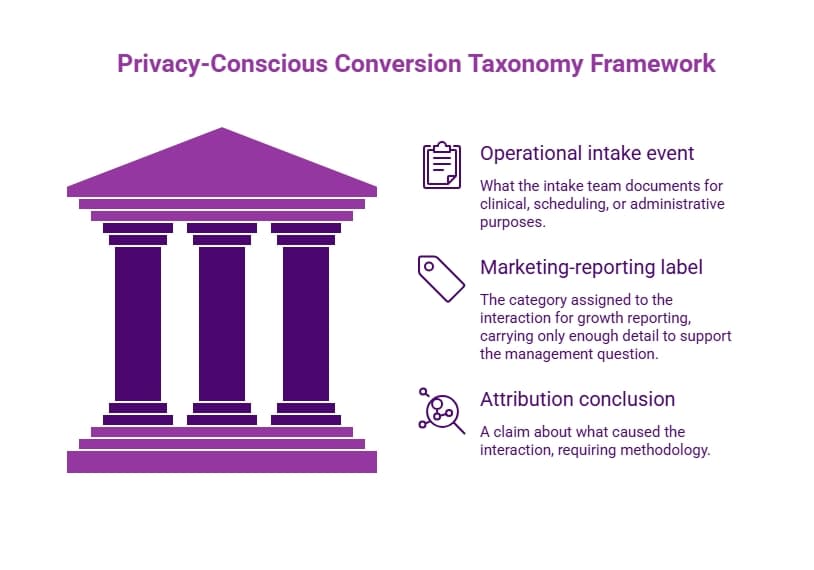
Before selecting tools or configuring events, define three layers:
Operational intake event: What the intake team documents for clinical, scheduling, or administrative purposes.
Marketing-reporting label: The category assigned to the interaction for growth reporting, carrying only enough detail to support the management question.
Attribution conclusion: A claim about what caused the interaction. This requires methodology, not just a label.
Use the category to answer a management question, not to recreate the patient's story. When a category demands more patient-level context than the decision requires, the taxonomy has drifted beyond its purpose. A generic "lead" label can hide the exact distinction leadership is trying to measure, and because "referral" can describe different operational situations — a physician recommendation, a patient word-of-mouth mention, a formal records transfer — shared definitions matter before any tracking configuration is built.
Use a Small Referral-Conversion Taxonomy
Five categories can cover most of the reporting territory a specialty practice needs while keeping the framework manageable, reviewable, and useful across teams.
Referral-validation inquiry. The interaction suggests a referral or recommendation is being validated. Example: A caller mentions they were referred and wants to learn about the practice before scheduling. Marketing reporting records a reviewed category without carrying patient identity, referring-provider name, diagnosis, or treatment detail into the dashboard.
Appointment request. A scheduling-intent event. Decide whether the operational stage means request started, request submitted, or scheduling completed, and keep the marketing label focused on the reviewed event or status needed for analysis. Example: A visitor submits a request through the practice's scheduling path. Reporting records whether the request occurred and its general status (requested, completed, abandoned), subject to system configuration and privacy review. Reason-for-visit details belong in the operational record.
Referral-process question. The inquiry concerns logistics: how to send records, what documentation is needed, or where to route a referral. Example: A caller asks about the steps required to transfer imaging results. These interactions reveal patterns about process friction without requiring clinical content in a growth report.
General or unclear inquiry. Referral context cannot be determined without requesting additional detail. Example: A form submission or call does not indicate whether a referral was involved. Classify it as unknown rather than pressuring staff to collect more sensitive information solely for attribution. That label can reveal where definitions or workflows need improvement.
Excluded/non-marketing administrative interaction. Operational contacts that should not be treated as acquisition or referral marketing conversions. Example: An existing patient calls to reschedule, request billing clarification, or follow up on records.
These labels are example categories for internal design, not legal standards. Each practice should adapt the framework to its own reporting needs, intake workflows, and review requirements.
Separate the Intake Record from the Marketing Report
The most important boundary in referral measurement is the line between what the intake team documents and what the marketing report contains.
Intake and scheduling teams may need clinical context, insurance details, referring-provider information, and patient identity. Marketing reporting typically needs a decision signal: did a referral-validation inquiry occur, did an appointment request happen, and which channel was involved? Treat the marketing report and the intake record as different data products.
Consider a hypothetical referred caller who mentions they were recommended by another provider and wants to understand the practice before scheduling. The intake workflow may require additional context to prepare for the visit. The marketing report records only a reviewed category, the traffic source, and the landing page. Clinical details, referring provider, and insurance information stay in the operational system.
Now consider a hypothetical form submission. A visitor completes an appointment-oriented form. The reporting question is whether the request occurred, not whether analytics receives every answer entered into the form. Review whether integrations, tags, URL parameters, or downstream systems transmit field-level content alongside the event.
The same principle applies to appointment workflows. Define which stage marketing reporting needs to observe and confirm that clinical context does not pass into marketing-accessible systems. Removing obvious identifiers or reporting in aggregate does not automatically satisfy applicable privacy or de-identification requirements. The organization must determine appropriate treatment with qualified reviewers.
A useful audit question is not only "Are we tracking a conversion?" It is also "What information is already reaching the marketing report, and does the reporting decision require it?" That reframing shifts the review from whether data exists to whether the report should contain it.
Referral Measurement Boundary Matrix
| Operational Interaction | Marketing-Reporting Category | Minimum Signal Needed | Details Excluded from Marketing Reporting | Decision Supported | System / Owner | Review Status |
|---|---|---|---|---|---|---|
| Caller validates a referred provider | Referral-validation inquiry | Source, landing context, reviewed category label | Patient identity, referring provider, diagnosis, treatment detail, recording/transcript | Are referral-focused pages generating validation activity? | Call platform / intake lead | Requires review |
| Visitor submits appointment-oriented form | Appointment request | Form-submit event, source, landing page | Field values (symptoms, medications, insurance, provider) | Are appointment requests increasing from organic landing pages? | Form platform / marketing lead | Requires review |
| Caller asks about referral logistics | Referral-process question | Source, landing context, reviewed category label | Clinical content, records detail, patient identity | Is referral-process content reducing friction? | Call platform / referral coordinator | Requires review |
| Inquiry with unclear referral context | General or unclear inquiry | Source, landing context, "unknown" label | Do not collect additional sensitive detail solely for classification | Where do definitions or workflows need improvement? | Intake lead | Requires review |
| Existing-patient scheduling, billing, records | Excluded from marketing attribution | None required for marketing reporting | All interaction detail | Keeps acquisition reporting accurate | Operations / admin lead | Requires review |
Present this matrix as a governance worksheet for internal review, not as a compliance template. For a broader framework, see measuring referral-validation SEO without exposing patient information.
Apply the Taxonomy Differently to Calls, Forms, and Appointment Requests
Each channel exposes different data, and the boundary between a reporting signal and sensitive operational detail shifts accordingly.
| Channel | Observed Event (Marketing-Reporting Signal) | Potentially Sensitive Payload (Requires Separate Review) | Key Review Question |
|---|---|---|---|
| Calls | Source, landing context, answer/missed status, reviewed category label | Recordings, transcripts, caller identity, clinical content | What does the call platform transmit, store, and make accessible beyond the event? |
| Forms | Form-submit event, source, landing page | Field values (symptoms, conditions, medications, insurance, provider names) | Do analytics integrations, tags, or URL parameters carry field-level content? |
| Appointment requests | Request event and general status (requested, submitted, completed) | Reason-for-visit, clinical context, patient-specific scheduling detail | Does the scheduling system pass clinical or patient detail into marketing-accessible tools? |
A "call conversion" in a dashboard is not permission to use the full content of the conversation. A form-submit event does not mean every answer should reach analytics. An appointment request event does not mean every scheduling stage belongs in a marketing report.
For forms, event tracking and payload tracking are different decisions. Focus exclusively on capturing the submit event itself, auditing your tracking configuration to ensure downstream analytics tools do not inadvertently ingest hidden fields or parameter-rich payloads containing sensitive patient inputs.
For calls, do not equate a call conversion with permission to use raw call content for marketing qualification. For appointment workflows, define the stage precisely and confirm with qualified legal, privacy, security, and clinical stakeholders which reporting boundary is appropriate for the actual systems involved.
When implementation claims depend on a particular platform's behavior, verify them against current official documentation and have the configuration reviewed by qualified privacy, security, and legal/compliance stakeholders.
Make Attribution Limits Part of the Taxonomy
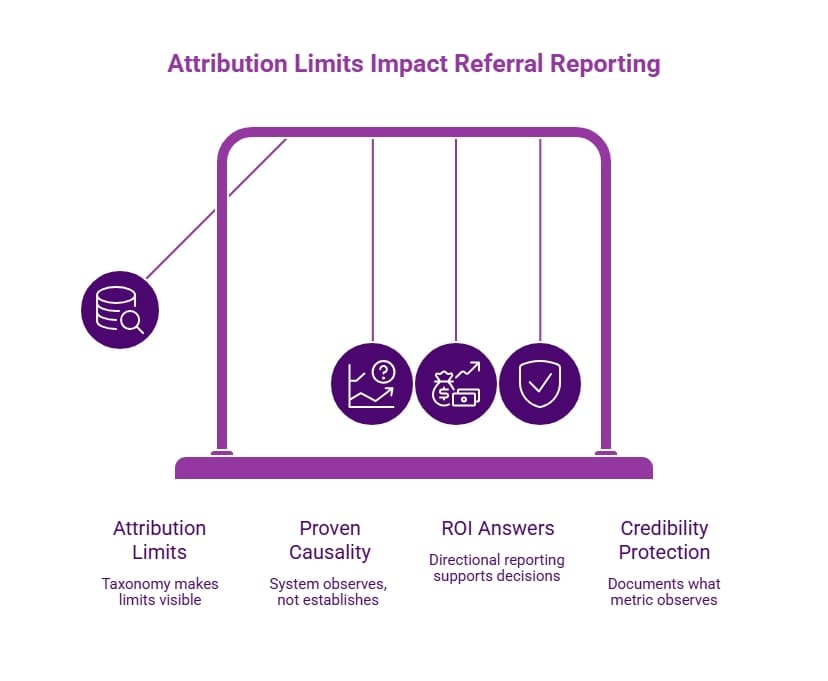
A referral-validation signal does not prove search caused the referral. A landing-page visit followed by an appointment request does not reveal the full patient journey. The taxonomy should make these limits visible rather than hiding them behind confident-sounding metrics.
Observed signal ≠ proven causal attribution. Report what the system observed, not what it cannot establish. The taxonomy supports directional patterns and trend analysis. It does not prove that a specific marketing channel caused a specific patient to complete a referral journey.
Recommended phrasing for internal reports: "Observed referral-validation inquiry activity increased from organic landing pages" rather than "SEO generated X referrals." The stronger claim requires an attribution methodology most specialty practices do not have in place.
This distinction becomes especially important when executives want a direct return-on-investment answer. More patient-level detail may increase privacy and governance risk without resolving causality. Directional reporting can still support decisions about content, landing pages, staffing, and workflow quality without pretending the dashboard knows more than it does. When leadership asks for that answer, explain what the taxonomy can support — directional evidence of inquiry patterns, volume trends, content relevance — and what it cannot prove. Document what the metric observes and what it does not prove. That distinction protects the credibility of the reporting program.
Put Governance Around the Taxonomy Before Scaling It
A taxonomy without governance becomes inconsistent within weeks. Before expanding tracking or changing configurations, complete these steps:
- Define each category in one sentence that intake staff and marketing leads both understand.
- Assign an operational owner for each category.
- Define the minimum reporting signal for each interaction type.
- Document which fields, details, or content are excluded from marketing reporting.
- Identify every source and destination system involved in the data flow.
- Review access permissions for marketing-accessible platforms and dashboards.
- Review data retention for each system that touches inquiry data.
- Review vendor relationships and contracts where applicable. Whether a vendor relationship requires specific contractual provisions depends on the vendor's role, the data involved, and applicable requirements. Have qualified stakeholders evaluate each relationship rather than assuming a single contractual instrument resolves the question.
- Test tags, events, and integrations for unintended data transmission.
- Establish an "unknown" classification path so staff are not pressured to collect unnecessary detail.
- Document what the dashboard can claim and what it cannot.
- Obtain privacy, security, legal/compliance, and clinical review before treating the taxonomy as an implementation standard.
Review definitions again when workflows, systems, integrations, vendor relationships, or reporting decisions materially change rather than relying on an arbitrary universal review schedule.
Common Objections and Why They Need Resolution Before Implementation
"More detail gives us better attribution." More detail may increase risk and still not establish causality. Start with the minimum signal required for the decision.
"If the form submitted, every field is safe to report." A submit event and the form payload are different things. Review what actually reaches reporting systems.
"A referred patient should always be tagged as a referral conversion." Record what was actually observed. Do not turn a category into a causal conclusion.
"Unknown inquiries make the data worse." Unknown prevents forced classification and can reveal where definitions or workflows need improvement.
"The vendor says its healthcare product is compliant." Product claims do not replace review of the actual configuration, contracts, data flows, and applicable requirements.
" A Business Associate Agreement (BAA) settles the question." Do not assume that. Specific contractual and regulatory obligations depend on facts that require current qualified review.
"Call transcripts help marketing qualify conversions." Raw communication may contain far more detail than marketing reporting needs and should be treated separately and reviewed carefully.
Better Taxonomy, Not More Patient Detail
Better referral reporting comes from consistent definitions and controlled boundaries, not maximum data collection. A small taxonomy with clear exclusions, honest attribution limits, and cross-functional governance gives a practice something more valuable than a dashboard full of unreviewed detail: a measurement framework the entire organization can trust.
Map one referral journey through the boundary matrix before changing any tracking configuration. Document the minimum reporting categories the practice needs and have privacy, security, clinical, and legal/compliance stakeholders review the boundaries.
The related guide on measuring referral-validation SEO without exposing patient information extends this framework into reporting design. Practices exploring broader specialty-search strategy can review medical specialty SEO services.
Frequently Asked Questions
Disclaimer: This content is for informational purposes only. Laws, definitions, and deadlines change. Verify current requirements through official sources. This content is not legal advice. No attorney-client relationship is formed through this content. Please consult a qualified attorney in your jurisdiction for legal advice specific to your situation.
Our Editorial Process: Our expert team uses AI tools to help organize and structure our initial drafts. Every piece is then extensively rewritten, fact-checked, and enriched with first-hand insights and experiences by expert humans on our Insights Team to ensure accuracy and clarity.
By: About the BVM Insights Team
The BVM Insights Team is our dedicated engine for synthesizing complex topics into clear, helpful guides. While our content is thoroughly reviewed for clarity and accuracy, it is for informational purposes and should not replace professional advice.