
 BVM Insights Team
A specialty practice can have dashboards, call tracking, form analytics, and a CRM connected to its website and still lack trustworthy evidence about whether organic search supports referral validation. More tracking does not automatically produce better answers.
Referral validation (the online checking or research that can occur around a professional recommendation) is difficult to observe completely. The journey may include search, direct visits, physician pages, reviews, calls, and offline conversations. Patient-related interactions create boundaries beyond typical marketing analytics, and a single attribution (assigning credit for an outcome to a specific channel) number can conceal more uncertainty than it resolves.
The practical path forward is a measurement-boundary framework: choose a small signal set, document what each signal can and cannot establish, and report directional evidence without overstating what the data proves.
Start With the Decision, Not the Tracking Tool
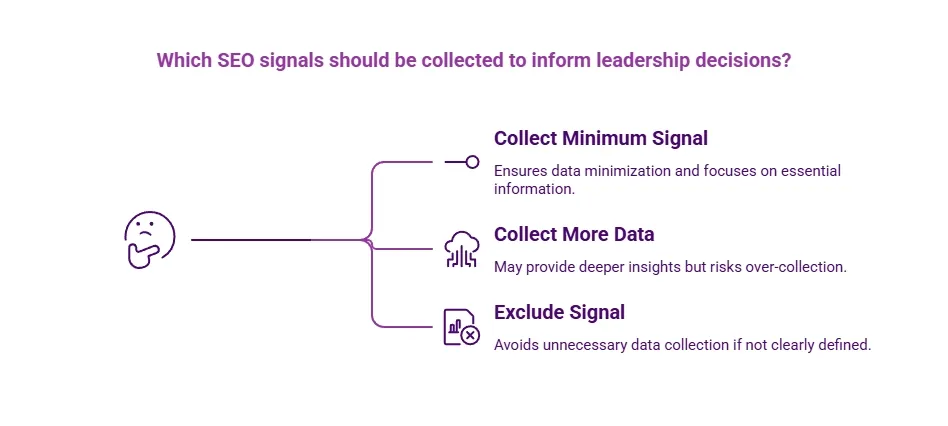
Before selecting a platform or enabling a feature, identify the leadership decision the measurement is meant to inform. The question might concern content prioritization, physician-page visibility, referral-support gaps, or inquiry quality. Each question requires a different signal, and most require far less data than default analytics collects.
Consider a common scenario: leadership asks whether SEO "generated" referrals. That question implies a causal link no available signal can establish. A more answerable version: "Can referred audiences find our physician and treatment information through search?" That narrower question can be informed by aggregated search-demand patterns without identifying individual patients.
Apply data minimization (collecting only what is necessary for a defined purpose) to every proposed signal by asking three things:
- What is the minimum signal that could inform this decision?
- What can that signal not establish?
- Who must review the measurement design before data collection begins?
If the practice cannot explain why a signal is necessary, who will review it, and how it will be interpreted, exclude it or postpone collection until those questions are resolved.
The Referral-Validation Measurement Boundary Matrix
Use a measurement-boundary matrix like the one below to document each proposed signal alongside its purpose, limits, and review requirements.
| Business Question | Possible Signal | Aggregation Level | Data Not Required | May Indicate | Cannot Prove | System or Vendor | Required Reviewer | Approval Status | Reporting Language |
|---|---|---|---|---|---|---|---|---|---|
| Are referred audiences finding physician pages? | Branded and physician-name query impressions | Query group totals | Patient names, appointments, IP-level behavior | Demand consistent with referral validation | That a specific referred patient searched | Search performance tool | Privacy, security, legal/compliance | Pending review | "We observed increased physician-name query impressions." |
| Is treatment content visible for specialty searches? | Condition, treatment, and specialist-intent query impressions | Aggregated by query category | Individual sessions, diagnoses | Visibility for topics referred audiences may research | That visibility caused an appointment | Search performance tool | Marketing, clinical content | Pending review | "Specialty content appeared for condition-related queries." |
| Are inquiries arriving through referral-relevant pathways? | Aggregate inquiry count by source category | Category totals per period | Caller identity, diagnosis, free-text content | Volume patterns across source categories | That search caused the inquiry | Intake, form platform, call vendor | Privacy, legal/compliance, operations | Pending review | "Inquiry volume from organic pathways increased." |
| What inquiry types are reaching the practice? | Inquiry taxonomy (new patient, second opinion, referral follow-up) | De-identified category counts | Individual patient records, outcomes | Distribution of inquiry types | That inquiry quality improved because of SEO | Intake team, CRM if applicable | Privacy, compliance, operations | Pending review | "The share of referral-related inquiries was consistent." |
Every row should pass the same test: Is the proposed data necessary for the defined decision, and has the design been reviewed?
Use a Layered Signal Set Instead of Patient-Level Attribution
Rather than attempting to reconstruct individual journeys, organize measurement into three layers. No single layer represents the full referral journey. Each answers a different operational question and carries its own review requirements.
Aggregate Search-Demand Signals
Branded practice queries, physician-name queries, condition or treatment query groups, and specialist-intent searches can indicate whether search demand aligns with topics a referred audience might research. Landing-page impressions for physician profiles and treatment pages add context. These signals operate at the query-group or page level and do not identify who searched or why.
Treat search-demand data as directional. Branded queries may come from referrals, existing patients, prior patient awareness, employees, media exposure, or offline advertising. A rise in physician-name queries after referral-support pages improve may be consistent with referral validation, but it does not establish that referred patients caused the increase. Report branded demand as an observed pattern rather than a referral count.
On-Site Content and Pathway Signals
Aggregate visits to physician profiles, treatment pages, referral information, insurance details, access pages, and location pages can show whether referral-relevant content is being used. Where appropriately reviewed, page-category navigation patterns may help identify missing or difficult pathways without connecting activity to an individual. Avoid session-level tracking that could reconstruct an individual's path through sensitive content unless privacy, security, legal/compliance, and technical stakeholders have reviewed the workflow.
De-Identified Operational Feedback
An inquiry taxonomy is a controlled classification system that uses standardized categories such as professional referral, search, existing relationship, second opinion, offline promotion, or unknown. Standard definitions prevent marketing, operations, and compliance teams from interpreting the same category differently. Train intake staff to ask, record, and categorize source information consistently, and aggregate call or form counts sorted by source category to provide a periodic signal when reviewed for data-handling requirements. An effective, privacy-safe question might be: "Who can we thank for referring you to our practice today, or did you find us on your own?
Intake-team qualitative feedback can supplement digital signals. A receptionist who notices callers mentioning a specific physician or treatment page offers context no dashboard captures, provided the feedback is recorded without patient identifiers. Periodic comparison of search-demand patterns with inquiry-category trends can suggest whether visibility and volume move together, but that comparison supports only a directional interpretation. It must not be presented as proof that the same people produced both patterns.
| Signal | May Indicate | Cannot Prove | Review Need |
|---|---|---|---|
| Branded query impressions | Demand aligned with practice recognition | That referred patients generated the queries | Marketing; privacy if granular data is accessed |
| Physician-name query group | Interest consistent with referral validation | That queries came from referred patients | Marketing; clinical content review |
| Specialist-intent query group | Demand for specialty-specific information | That searchers were validating a referral | Marketing; confirm reporting method |
| Aggregate inquiry counts | Volume patterns across source types | That search caused any individual inquiry | Privacy, security, legal/compliance, operations |
| Intake-team qualitative notes | Anecdotal context about caller awareness | Attribution, volume, or behavioral trends | Privacy review for recording and storage |
Draw the Boundary Around Forms, Calls, Analytics, and Vendors
Forms, calls, analytics platforms, and vendor integrations represent the highest-risk area in referral-validation measurement. The data fields, metadata, recordings, identifiers, retention, and downstream recipients may carry privacy, security, contractual, and compliance implications beyond what a marketing team typically evaluates.
Call and form interactions are sometimes treated as ordinary marketing conversion events, but the content submitted, metadata transmitted, recordings stored, access granted, and retention practiced can each change the risk profile. A contract, consent banner, data-processing agreement, or business associate agreement addresses only part of that review. No named analytics, form, call, CRM, or tracking tool can be declared universally appropriate for every specialty practice. Suitability depends on the organization, purpose, data, configuration, contracts, recipients, and applicable requirements.
Pre-Implementation Data Inventory Checklist
Before enabling or expanding any measurement system, inventory what it collects:
- Data fields: Does the form, call platform, or CRM capture information beyond what the business question requires? Could a free-text field invite health-related details? To prevent this, replace open message boxes with standardized dropdown menus for inquiry types.
- Metadata and identifiers: Do URLs, referral parameters, session identifiers, or IP-based signals travel with the submission?
- Recordings and transcripts: Does the call platform record conversations, generate transcripts, or export summaries? Who can access them?
- Retention: How long is data kept, and is retention aligned with the stated purpose?
- Vendor data flows: Does the vendor share or subprocess data to third parties? Are contracts and security controls documented?
- Access: Who within the organization and at the vendor can view, export, or query the data?
Each question may require review by privacy, security, legal/compliance, and technical stakeholders. A vendor contract alone does not resolve whether underlying data flows are appropriate. De-identification (removing or transforming data so an individual cannot be readily identified) does not automatically eliminate risk, particularly when volumes are small or datasets can be cross-referenced. Professional review should determine whether aggregated reporting remains appropriate at very small volumes.
Applying These Boundaries in Practice
Consider these clearly hypothetical situations to see how the framework operates:
A practice improves its referral-support pages and later observes more physician-name searches. The change may support further content work, but it does not identify the searchers or establish causation. An executive asks how many referrals SEO generated. The reporting team reframes the request around trends, limitations, and the decisions those observations can support rather than presenting a single attribution number.
A form includes a free-text field where a person could enter health information. Reviewers determine whether the field is necessary and examine where its contents travel, what metadata accompanies the submission, and who receives the data. Separately, a call vendor records conversations and exports summaries. The practice reviews recording, access, retention, deletion, contract, and downstream transfer details before using counts or summaries in any reporting.
A reporting dashboard separates observations, interpretations, limitations, missing data, confidence levels, and supported decisions instead of presenting one attribution figure. That separation requires more effort than a single number but produces a more defensible account of what the practice knows and does not know.
External Reporting and Vendor Access
When an SEO agency or marketing vendor needs reporting access, share only approved, purpose-limited information. Prefer aggregate categories and exclude patient-level details, message content, recordings, unnecessary identifiers, and unrestricted system access unless a separately reviewed purpose requires them.
Report What the Evidence Suggests and What It Does Not Prove
When reporting to leadership, separate six elements in every finding:
| Element | Example |
|---|---|
| Observation | "Physician-name query impressions increased 18% over the reporting period." |
| Interpretation | "This pattern is consistent with growing awareness among audiences who may be validating a referral." |
| Alternative explanations | "Other channels may contribute to this pattern, including media exposure, existing-patient searches, prior patient awareness, and employee activity." |
| Limitation | "The data does not distinguish referred patients from other sources of branded search." |
| Missing data and confidence | "Searcher identity and intent remain unknown. This finding should be weighted as directional evidence, not confirmed attribution." |
| Decision supported | "Continue investing in physician-profile content and monitor whether the trend persists alongside inquiry-category patterns." |
Frame each report using these phrases: "We observed…," "This is consistent with…," "Other explanations include…," "It does not establish…," "What remains unknown is…," and "The decision supported by this signal is…"
Last-click attribution (assigning credit to the final touchpoint before a conversion) is particularly misleading for referral validation because it ignores multi-touch and offline interactions. Pair digital indicators with operational feedback without claiming a deterministic journey.
Four common misconceptions deserve correction. Privacy constraints do not make SEO measurement impossible; they require a narrower question and stronger governance. Data with names removed is not automatically risk-free, because context, group size, and data combinations matter. A disclaimer at the end of a report cannot repair unnecessary collection or an inadequately reviewed workflow. And a vendor agreement cannot approve every field, transfer, configuration, or downstream use.
Use a Cross-Functional Review Before Implementation
Assign responsibilities before implementation. Marketing defines the decision and proposed signals. Operations validates intake processes. Privacy examines collection and use. Security reviews access and controls. Legal or compliance evaluates applicable obligations and contracts. Technical teams map configurations and transfers. A named owner maintains the complete record across internal systems and vendors.
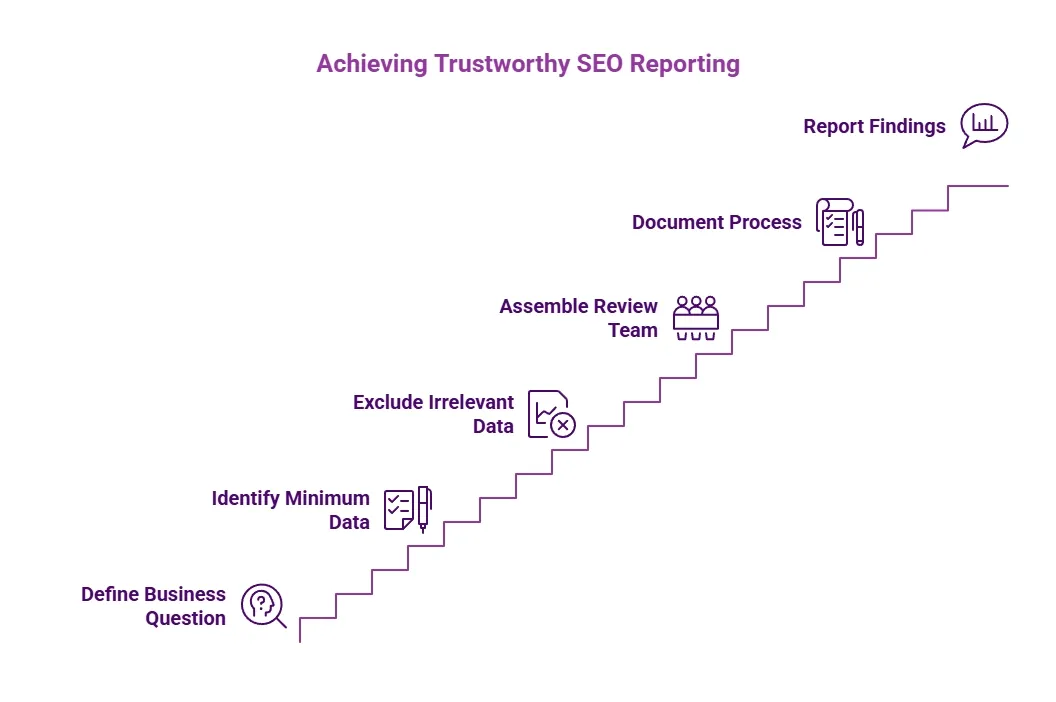
Before implementing or modifying any referral-validation tracking, work through these steps:
- Define the business question and identify the decision owner.
- List minimum proposed signals using the boundary matrix.
- Record excluded data — fields, identifiers, content, and systems — and document why it will not be collected.
- Map systems, vendors, access, retention, and deletion for every platform touching the data.
- Document interpretations, alternatives, limitations, and confidence before collecting data.
- Record each reviewer's approval, conditions, rejection, or required remediation from privacy, security, legal/compliance, and technical reviewers.
- Approve reporting language and the permitted audience, separating observation, interpretation, limitation, and decision.
- Schedule reassessment when tools, requirements, vendors, contracts, or workflows change.
Unresolved signals should remain disabled or excluded until review is complete. Conditional approval should identify the required change, the responsible owner, and the completion status.
This sequence is not a substitute for organizational policies, professional counsel, or regulatory guidance. It is a starting point for assembling the right reviewers and documenting the right boundaries before data collection begins.
A Smaller, Better-Governed Signal Set Is More Defensible
Useful measurement does not require reconstructing every search, call, and appointment into a single patient journey. A documented signal set organized around defined business questions, with explicit boundaries and qualified review, can support decisions while preserving the uncertainty that the data cannot resolve.
The practice that narrows its question, collects only what that question requires, and reports what the evidence does and does not prove will produce more trustworthy reporting than one that maximizes data collection and presents the result as certainty. Practices evaluating how medical specialty SEO measurement or high-value healthcare SEO supports referral journeys can apply this boundary-first discipline to their reporting.
Document one business question, the minimum data required, the data you will exclude, and the reviewers needed before changing your tracking.
Frequently Asked Questions
Disclaimer: This article provides general educational information about SEO measurement and privacy-conscious planning. It is not legal, compliance, security, technical, or medical advice and does not establish that any analytics, form, call-tracking, CRM, vendor, or reporting configuration complies with HIPAA or other applicable requirements. Have qualified privacy, security, legal/compliance, and technical reviewers evaluate your organization, data flows, vendors, contracts, configurations, and applicable laws before implementation.
Our Editorial Process: Our expert team uses AI tools to help organize and structure our initial drafts. Every piece is then extensively rewritten, fact-checked, and enriched with first-hand insights and experiences by expert humans on our Insights Team to ensure accuracy and clarity.
By: About the BVM Insights Team
The BVM Insights Team is our dedicated engine for synthesizing complex topics into clear, helpful guides. While our content is thoroughly reviewed for clarity and accuracy, it is for informational purposes and should not replace professional advice.