
 BVM Insights Team
A specialty practice can pass every technical SEO audit and still be unprepared to scale condition-to-physician content. Crawlability, page speed, and metadata are necessary, but they cannot tell you whether the right physician is connected to the right condition, whether anyone owns that relationship, or whether the appointment path still works.
When leadership considers expanding this content across multiple providers or service lines, the question shifts from "Can search engines find our pages?" to "Can we keep every clinical relationship, access detail, and page connection verified as we grow?" That pressure often intensifies when smaller practices try to match the content coverage of larger health systems. Adding pages before resolving ownership, physician fit, and access questions can multiply conflicting information and expose internal disagreement about service-line priorities. Clinical teams are not obstacles in this process. Their authority is one of the controls that makes growth defensible.
The seven-part assessment below addresses these harder questions. After working through it, you should be able to classify your practice as ready to scale, better served by a controlled pilot, or in need of foundational remediation.
What "Ready" Means for Condition-to-Physician SEO
Condition-to-physician SEO is the governed connection among condition, treatment, physician, location, and appointment pages on a practice website. The goal is to help the right searcher reach the right physician through an accurate, maintained route. This is not clinical guidance. Connecting a condition page to a physician page means the practice has verified that the physician treats the condition, practices at the listed location, and is reachable through the pathway shown. That verification belongs to qualified practice personnel, not a marketing team or SEO tool.
Four terms anchor the framework. A source of truth is the current, practice-approved record used to verify a published claim. Page ownership identifies which URL has a distinct purpose and who maintains it. Clinical review is the qualified evaluation of clinical relevance, credentials, treatment language, and patient-facing implications. A readiness pilot is a limited service-line test of whether those controls work together before broader expansion.
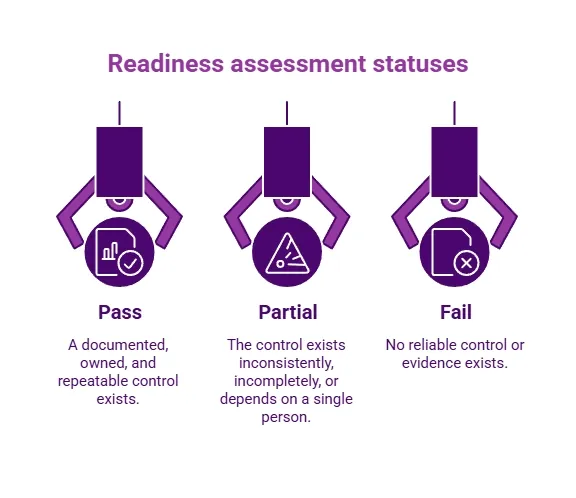
The assessment uses three statuses:
- Pass: A documented, owned, and repeatable control exists.
- Partial: The control exists inconsistently, incompletely, or depends on a single person.
- Fail: No reliable control or evidence exists.
This is an editorial decision framework designed for self-assessment. It is not a validated industry benchmark or certification.
The Seven-Part Readiness Scorecard
1. Page Ownership and Pathway Architecture
Check whether every condition, treatment, physician, location, and appointment page has a distinct purpose and an assigned owner. Look for duplicated intent, orphaned physician bios, circular navigation, and links that imply unverified care relationships. Some links may be technically valid yet imply relationships that have not been clinically reviewed, a subtlety that standard crawl reports will not flag.
If multiple physicians treat the same condition, do not assume one shared page is enough. Verify the distinctions (subspecialty focus, location, referral requirements) and confirm each page serves a defined purpose with appropriate pathways before deciding on structure.
The audited pathway follows this chain: Condition → Treatment → Physician → Location → Appointment path (e.g., Endometriosis → Laparoscopic Excision → Dr. Jane Doe → West Clinic → New Patient Surgical Consult). Each step should lead the visitor closer to a verified, reachable provider. If any link dead-ends, loops, or connects to an unverified relationship, the architecture has a gap. For a deeper look, see finding treatment-intent content gaps across specialty sites.
Pass: Every page type has an owner, a defined purpose, and no unresolved overlaps. Partial: Ownership exists for some page types but not all, or purpose distinctions remain informal. Fail: No documented ownership, widespread duplication, or orphaned pages.
2. Verified Physician and Service-Line Data
Every physician-condition connection should trace back to a maintained source of truth covering credentials, subspecialty focus, conditions treated, procedures, locations, referral requirements, and access constraints. That record needs an owner and a review date. Physician relationships should be verified against practice-controlled records, not inferred from marketing copy or external directories.
A physician bio helps, but it is not automatically authoritative if other internal sources (directories, scheduling systems, department pages) contradict it. For instance, a condition page might link to three physicians, but only one currently treats that condition at the listed office. The other two route visitors toward appointments that cannot be fulfilled. One condition may map to several physicians differently because of subspecialty, location, referral type, or case complexity, and each of those distinctions may require its own verified pathway. For more on what these pages require, see what physician bio pages need to support condition and treatment discovery.
Pass: A maintained, owned source record exists and connects to published pages. Partial: Records exist but are incomplete, outdated, or owned by one person informally. Fail: No centralized source of truth; the practice relies on outdated copy, a third-party directory, marketing assumptions, or AI inference to establish physician fit.
3. Clinical Review and Change Governance
Identify who reviews clinical relevance, credentials, treatment language, and access information before a connection publishes. A governed workflow defines risk tiers, approved wording, escalation paths, and re-review triggers for events such as physician departures, new service lines, changed procedures, and relocated clinics. A prior approval does not remain accurate indefinitely; source changes should consistently trigger re-review.
In a hypothetical scenario, marketing can publish quickly, but clinical approval depends on one physician with no documented backup. That works until the reviewer is unavailable and content either stalls or publishes without verification. For a detailed approach, see how to build a clinical review workflow for condition-to-physician SEO content.
Pass: Defined reviewers, documented criteria, escalation paths, and change-event triggers. Partial: Reviews happen informally, without documented criteria or backup reviewers. Fail: No clinical review process; content publishes on marketing judgment alone.
4. Patient-Access and Appointment-Path Accuracy
A page can correctly identify the right physician and still fail the visitor if the appointment path is wrong. Confirm that each page leads to the correct location, scheduling option, referral requirement, and next step. A clinically relevant physician is not automatically available through the pathway being promoted.
Separate "clinically relevant physician" from "currently available through this pathway." Insurance participation, scheduling availability, and referral requirements change faster than core clinical copy. Assign maintenance ownership so updates happen when information changes, not on a quarterly content calendar.
Pass: Access details are maintained by an assigned owner and verified against current scheduling and referral data. Partial: Access information is present but updated only during periodic reviews. Fail: No ownership of access data; appointment paths may reflect outdated locations, schedules, or requirements.
5. Technical and AI-Legibility Foundations
Confirm that condition, physician, and location pages are crawlable, indexable, and canonically owned. Check that internal links reflect verified relationships and structured data mirrors visible, approved content.
Structured data can help search engines and AI systems understand page relationships, but it cannot compensate for unclear, unverified, or contradictory content. Schema naming a physician as treating a condition carries no weight if the visible page does not support that claim. Neither structured data nor AI-oriented formatting should be treated as a promise of rankings, citations, or recommendations. For a deeper look at entity clarity, see what makes specialty-practice content legible to AI search systems.
Pass: Pages are crawlable, internally linked per verified relationships, and structured data matches visible content. Partial: Technical foundations are sound, but structured data or internal links do not consistently reflect verified relationships. Fail: Significant crawlability, indexation, or canonical issues; structured data contradicts visible content.
6. Measurement Tied to Pathway Quality
Track more than aggregate traffic. Where analytics and privacy processes allow, track priority-query visibility, landings on intended page types, movement to physician and location pages, appointment-path engagement, and qualified inquiries. Distinguish diagnostic indicators (did the visitor follow the intended route?) from business outcomes (did a qualified appointment result?).
A click on a condition page does not prove the visitor reached the correct physician or a functional booking path. Build reporting within approved analytics and privacy processes that reflects pathway quality, not just volume. Any tracking involving sensitive information should use approved privacy and compliance processes; SEO reporting alone is not clinical or compliance approval.
Pass: Reporting tracks pathway-level engagement and distinguishes routing quality from raw traffic. Partial: Some pathway indicators exist, but reporting focuses on sessions and rankings. Fail: No measurement beyond general traffic; no way to evaluate whether visitors reach intended physicians or paths.
7. Operating Capacity and Service-Line Prioritization
Assess whether your CMS supports page ownership, approval workflows, update tracking, and scheduled reviews. Evaluate reviewer availability against your intended publishing pace. If AI-assisted tools support drafting or organization, confirm they use controlled sources, preserve source dates, approved wording, and version history, and remain subject to human clinical and operational review.
Prioritize one service line with verified physician-fit data, stable access information, identifiable demand, and available reviewers. Suppose one service line has complete records, a stable access path, and two reviewers while others have scattered data and no assigned reviewer. That contrast is why a pilot often makes more sense than full expansion.
Pass: CMS supports governance; reviewer capacity matches publishing plans; AI tools operate within controlled workflows. Partial: Capacity exists for limited scope but cannot sustain broad expansion. Fail: No CMS governance, no reviewer availability, or AI tools operate without source controls.
How to Interpret the Result: Scale, Pilot, or Remediate
Do not calculate readiness by counting passes. Clinical validation, source-of-truth ownership, page ownership, and access accuracy are critical safeguards. One failure in these areas can outweigh several successful technical or reporting controls. Document the evidence behind each result. Beside every Partial or Fail, name the responsible owner, corrective action, and point of re-evaluation. This prevents a scorecard from becoming another static audit that loses relevance after staff, services, or access information changes.
| Decision | Qualifying Conditions | Next Action |
|---|---|---|
| Ready to scale | No failures in clinical validation, source-of-truth ownership, page ownership, or access accuracy. Remaining controls are repeatable. | Expand to additional service lines with documented owners, reviewers, and measurement. |
| Pilot first | Critical safeguards pass, but capacity, measurement, or maintenance remains partial. | Select one priority service line, run the full workflow, and evaluate before expanding. |
| Remediate first | Any critical clinical, data, ownership, or access control fails. | Resolve failing controls before publishing new condition-to-physician content. |
Critical safeguards outweigh the number of passed items. A practice that passes six criteria but fails clinical validation is not ready to scale. Readiness may vary by service line, location, or physician group, so assess each area you plan to expand rather than applying one score to the entire organization. Document owners and remediation actions beside every partial or fail so the assessment produces accountability, not just a status.
This decision table is editorial guidance. It does not certify readiness or predict rankings, inquiries, appointments, revenue, or return on investment. Adjust the weight of each criterion to your practice's risk tolerance and structure.
What a Responsible Pilot Should Prove
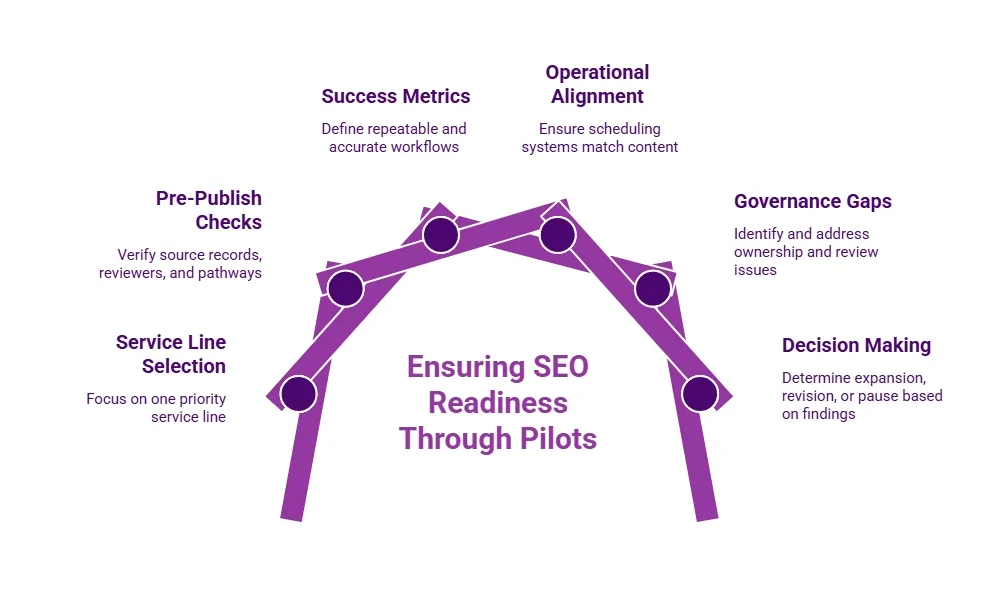
Do not assign a practice-wide readiness score if service lines, physician groups, or locations operate differently. Select one priority service line rather than attempting to validate the entire practice at once. Confirm the source record, reviewers, page owners, intended pathways, change process, and measurement plan before publishing.
Define success as a repeatable, accurate workflow: verify physician-condition relationships, publish approved content, maintain access details, track pathway engagement, and respond to change events within a documented process. If that workflow holds, the pilot has demonstrated readiness for expansion.
Consider a different scenario: a practice possesses an exhaustive directory of physician subspecialties, but the scheduling system cannot differentiate between them. The content capacity is high, but the operational access is disconnected, resulting in a Partial governance capacity. A pilot should reveal whether ownership, review timing, source updates, and exception handling work under normal operating pressure.
If the pilot reveals governance gaps, bottlenecks, or access-data drift, those findings should determine whether to expand, revise, or pause. A pilot that exposes a weak control has produced useful evidence, even when it does not justify scaling. A reliable process matters more than a short-term ranking improvement.
Readiness Mistakes That Create False Confidence
Several patterns create a misleading sense of preparedness:
- Treating technical health as full readiness. A clean crawl report does not verify clinical relationships, ownership, or access accuracy.
- Counting pages instead of validating relationships. More condition pages without verified physician connections add volume, not value.
- Assuming one condition always maps to one physician. A single condition may require different pathways depending on subspecialty, location, referral type, or case complexity.
- Deciding one shared page is sufficient because several physicians treat the same condition. Each physician's scope, location, and access path may differ enough to require distinct pages.
- Depending on one knowledgeable employee. If one person holds the source-of-truth knowledge, the program is fragile.
- Publishing first, reviewing later. These relationships carry trust implications that should be approved before publication, not corrected afterward.
- Measuring traffic without pathway quality. Session growth cannot tell you whether the intended physician or appointment path was reached.
- Assuming structured data repairs unclear content. Schema can describe what a page says, but it cannot fix what the page fails to verify.
- Scaling automation before governance. AI-assisted tools scale errors as easily as content when source controls and approvals are missing.
Each mistake conceals a different ownership, evidence, or maintenance weakness. The relevant relationship should be verified, clinically reviewed, and connected to the correct operational pathway before more content is added.
Scale Only What the Practice Can Keep Accurate
Apply this assessment to one priority service line. Score each criterion, document owners and gaps, and decide whether to scale, pilot, or remediate based on what you find. A controlled start that protects clinical accuracy will serve the practice better than rapid expansion on unverified relationships.
If you want help identifying specialty and condition search opportunities across your site, Get My Specialty Search Audit.
Frequently Asked Questions
Disclaimer: This article provides general educational information about healthcare website and content governance. It is not medical, legal, or compliance advice. Clinical claims, physician-condition relationships, and patient-facing pathways should be reviewed by qualified clinical and compliance personnel before publication.
Our Editorial Process: Our expert team uses AI tools to help organize and structure our initial drafts. Every piece is then extensively rewritten, fact-checked, and enriched with first-hand insights and experiences by expert humans on our Insights Team to ensure accuracy and clarity.
By: About the BVM Insights Team
The BVM Insights Team is our dedicated engine for synthesizing complex topics into clear, helpful guides. While our content is thoroughly reviewed for clarity and accuracy, it is for informational purposes and should not replace professional advice.