
 Dustin Ogle
A physician bio describes a “clinical interest in Condition X.” A condition page calls the same physician an “expert specialist,” while the structured information uses a third description. Which version is the practice prepared to verify?
Specialist relevance should be established before content optimization begins. A supportable claim connects exact wording to current evidence, an accountable owner, the appropriate reviewer, and every publishing surface where that meaning appears.
Repetition does not turn an unsupported statement into proof. Neither an author box, a medical-review label, an internal link, nor technical markup can supply evidence that the practice does not have.
A claim-to-evidence matrix gives marketing, credentialing, clinical, compliance, and technical teams a shared method for deciding what may be published, what needs narrower wording, and what must remain on hold.
Start With the Exact Claim, Not the Page
A specialist-relevance claim is a statement connecting a physician or practice to a specialty, credential, condition, treatment, procedure, location, or patient need.
Review the statement itself rather than submitting an entire page for broad approval. “Learn more about Condition X” is general navigation. “Physician A treats Condition X at Location B” asserts clinical scope and geographic availability. Each part of the second statement requires support.
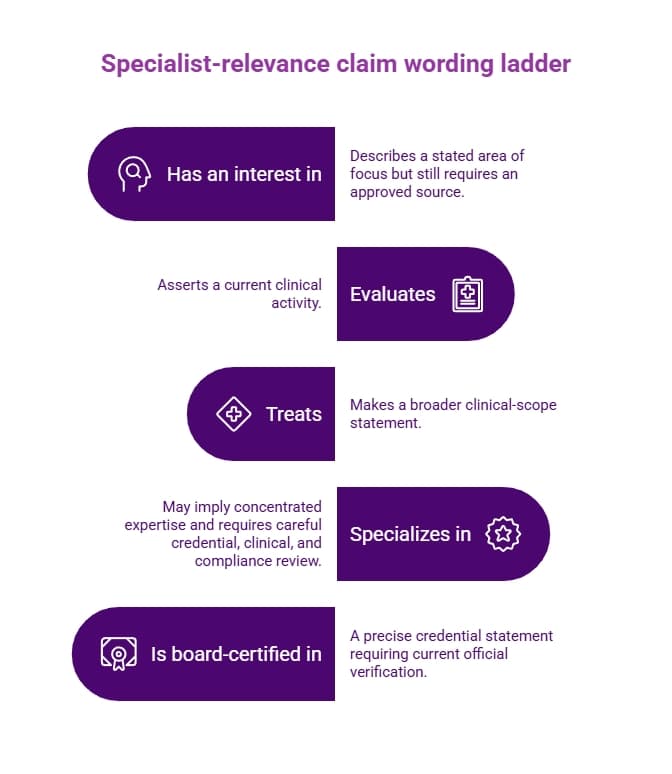
Wording strength also matters. The following ladder is an editorial tool, not a legal classification:
- “Has an interest in” describes a stated area of focus but still requires an approved source.
- “Evaluates” asserts a current clinical activity.
- “Treats” makes a broader clinical-scope statement.
- “Specializes in” may imply concentrated expertise and requires careful credential, clinical, and compliance review.
- “Is board-certified in” is a precise credential statement requiring current official verification.
These phrases are not interchangeable. A record supporting an interest does not necessarily support “treats,” and a credential does not automatically establish every condition, procedure, or location relationship associated with that specialty.
The evidence should support the exact wording used. Where current records justify only a narrower statement, publish the narrower version. When no reliable evidence supports the proposed meaning, hold or remove the claim rather than infer it.
Match Each Claim Type to the Right Evidence
Practice-controlled evidence is a record the organization can verify, assign to an owner, and govern through an approval process. The appropriate source depends on the type of claim.
Identity and Credential Evidence
Identity, licensure, board certification, fellowship training, academic appointments, and professional titles require current evidence appropriate to the statement.
Relevant sources vary by claim type and may include:
- The applicable state medical licensing authority
- An official specialty-board verification source
- Verified education or training records
- Current practice credentialing records
The Federation of State Medical Boards provides a directory of state medical boards that can help a practice locate the applicable licensing authority. The individual board’s current record—not an undated biography or search-result snippet—should support a license claim.
For an ABMS certification statement, Certification Matters provides officially recognized ABMS certification data. Professional credentialing use may require additional verification through the appropriate ABMS service or member board. A verified certification should not be extended into an unsupported claim about every condition, treatment, procedure, or outcome.
The CMS National Provider Identifier system may help reconcile provider identity. However, CMS describes the NPI as a unique provider identifier, and its guidance states that the number itself does not carry information about specialization. An NPI should not be treated as conclusive proof of expertise or clinical scope.
An existing bio can document approved facts, but it should not become its own evidence source. Practices reviewing these records may also need to examine what physician bio pages need to support condition and treatment discovery.
Clinical Scope and Service Evidence
Statements about conditions evaluated, treatments offered, procedures performed, or patient types accepted generally require current practice records and qualified clinical review.
Depending on the practice, support may come from a current service-line inventory, a physician-approved scope description, applicable privileging or operational records, and confirmation from the clinical owner.
A clinical reviewer is the qualified person responsible for confirming the clinical meaning of a proposed statement. The reviewer does not necessarily own the underlying record. Credentialing may own certification data, operations may own location availability, and a physician or service-line leader may own clinical-scope confirmation.
Relationship Evidence
Many specialist claims involve a relationship rather than one isolated fact:
- Physician to condition
- Physician to treatment or procedure
- Physician to location
- Service to location
Each relationship requires separate support because its components may change independently. A physician may evaluate a condition but not at every location. A procedure may be offered by a practice without being performed by every listed physician.
Governance Evidence
A supportable claim also needs:
- An evidence owner
- An approval record
- Approved wording
- A verification date
- An appropriate reviewer
- A future review trigger
The evidence owner is the person or function accountable for confirming the underlying record. The owner may be credentialing, clinical leadership, a service-line leader, compliance, or operations, depending on the claim.
Evidence Is Not the Same as Presentation
| Evidence | Presentation |
|---|---|
| Current licensing or certification record | Physician biography |
| Approved service or scope record | Condition or treatment page |
| Physician and clinical-review confirmation | Author or medical-review label |
| Current location-service mapping | Directory or location page |
| Approval record and review trigger | Schema, internal links, or repeated wording |
Presentation can communicate an approved fact. It cannot establish that fact independently.
Build a Specialist Claim Evidence Matrix
A claim-to-evidence matrix turns scattered records and informal approvals into a reusable workflow. It is useful only when evidence owners and reviewers actively maintain it; a spreadsheet alone does not resolve governance.
Use the following process:
- Record the proposed claim exactly as it would appear.
- Classify its category and level of risk.
- Attach the strongest current evidence available.
- Assign an evidence owner.
- Draft the narrowest supportable wording.
- Route the claim and evidence to the appropriate reviewer.
- Record every digital property where the meaning appears.
- Assign a status and future review trigger.
Specialist Claim Evidence Matrix
| Proposed claim | Category | Entity or relationship | Evidence source | Evidence owner | Verified | Approved wording | Reviewer | Affected surfaces | Status | Next review trigger |
|---|---|---|---|---|---|---|---|---|---|---|
| Hypothetical: “Physician A evaluates Condition Category at Location B.” | Clinical scope and location | Physician A → Condition Category → Location B | Current service-line record and physician confirmation | Service-line owner | Current review date | “Physician A evaluates selected cases within Condition Category at Location B.” | Clinical owner | Bio, condition page, location page, directory, and structured field | Revise, then approve | Physician, service, or location change |
The hypothetical row demonstrates why evidence and approved wording require separate fields. The general relationship may be supported while the original sentence remains broader than the available records.
Use four clear statuses:
- Approve: Current evidence and review support the wording.
- Revise: The underlying relationship is supported, but the language is too broad or imprecise.
- Hold: Evidence or required approval is incomplete.
- Remove: Current records contradict the statement, or no supportable version remains.
Reviewing reusable claims centrally can reduce the need to approve the same relationship independently on every page. Clinical reviewers can evaluate discrete statements, while writers and technical teams receive wording that has already passed the appropriate review.
Keep Approved Meaning Consistent Across Every Publishing Surface
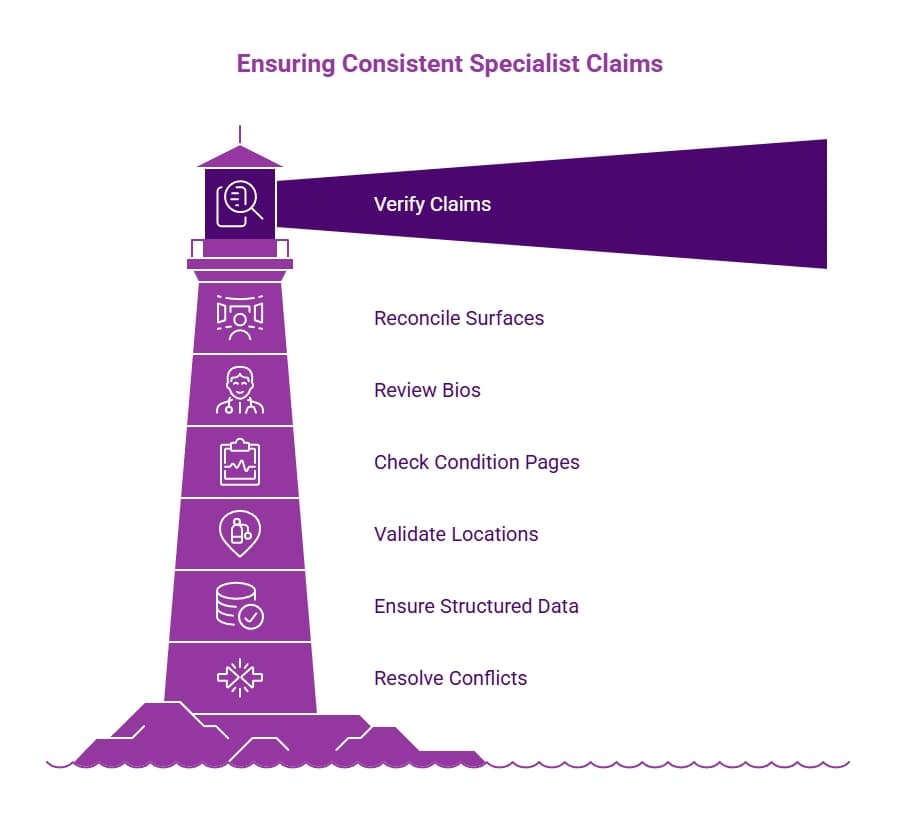
Verification establishes what the practice may say. Reconciliation checks whether every digital surface preserves that approved meaning.
A physician bio may emphasize qualifications; a condition page explains clinical relevance, and a location page addresses availability. The wording may change with context, but the credential, scope, and relationship should not become broader or materially different.
This principle applies to:
- Physician biographies
- Condition and treatment pages
- Procedure and location pages
- Provider directories
- Author and reviewer information
- Third-party profiles the practice manages
- Structured information
- Internal links and retrieval-ready passages
A retrieval-ready passage, used here as an editorial concept, is a self-contained passage that states an approved relationship clearly enough to be understood without relying on vague surrounding copy. It does not guarantee retrieval, rankings, or AI citations.
Condition pages require particular care because physician lists can imply that every provider handles every presentation of the condition. Guidance on how physician expertise should shape condition pages can help separate general education from reviewed physician relationships.
Structured information should reflect the approved meaning visible on the page rather than introduce a stronger hidden assertion. Google describes structured data as a standardized way to provide information about page content, and its guidelines emphasize that markup should accurately represent the content users can see. This platform-owned guidance does not establish the truth of a credential or clinical claim and does not guarantee a particular search result.
Before publishing, answer five questions:
- Does the visible page support the structured field?
- Does the physician bio support the relationship stated on the condition or treatment page?
- Is the physician-to-location or service-to-location relationship current?
- Was the claim reviewed by the appropriate credential, clinical, compliance, or legal owner?
- Does an external profile contradict the practice-controlled record?
When sources conflict, do not choose the most promotional version. Compare their authority, scope, and currency, then return the claim to the responsible evidence owner.
Govern Updates and Hold Unsupported Claims
A statement that was accurate during a previous review may no longer reflect current credentials, services, or availability. Practices generally need both scheduled review and event-based triggers, but no universal review interval applies to every organization or claim.
Useful triggers may include:
- Physician onboarding or departure
- Credential or professional-title changes
- A new or discontinued service
- Location or availability changes
- Service-line restructuring
- A website redesign
- A contradiction discovered in a directory or profile
Avoid copying old bios, treating repeated wording as proof, allowing schema to exceed visible content, or adding reviewer labels without evidence ownership. Prior approval does not establish that a claim remains current.
Where evidence is missing, the safe content-governance choices are to narrow, hold, omit, or remove the statement. Search goals do not justify temporarily strengthening a claim.
Requirements may vary by jurisdiction, organization, and claim type. Named credentials, professional titles, clinical scope, and healthcare-advertising language should be routed to the appropriate credentialing, licensed clinical, compliance, or legal reviewer.
Frequently Asked Questions
Disclaimer: This article is for general informational purposes only and does not constitute medical advice, diagnosis, treatment, credentialing advice, legal advice, or a determination of any physician’s qualifications or scope of practice. Practices should confirm credential, clinical, advertising, and compliance statements with the appropriate licensed, credentialing, legal, or compliance professional.
Our Editorial Process: Our expert team uses AI tools to help organize and structure our initial drafts. Every piece is then extensively rewritten, fact-checked, and enriched with first-hand insights and experiences by expert humans on our Insights Team to ensure accuracy and clarity.
By: About the BVM Insights Team
The BVM Insights Team is our dedicated engine for synthesizing complex topics into clear, helpful guides. While our content is thoroughly reviewed for clarity and accuracy, it is for informational purposes and should not replace professional advice.