
 Dustin Ogle
A specialty-practice service page can accurately describe what the practice offers and still fail to answer the question that started the search: which specialist may be relevant to evaluating this concern?
The page may list services, conditions, and physicians. Yet the symptom-to-specialist pathway remains unclear when it does not explain how a symptom-led concern connects to an evaluation context, relevant expertise, supporting clinical information, and an appointment or access path.
The problem is often relational, not a lack of content or clinical capability. Adding more copy will not fix an architecture in which every page contains useful information but no page clearly owns the handoff to the next one.
The Missing Connection Is Architectural, Not Clinical Expertise
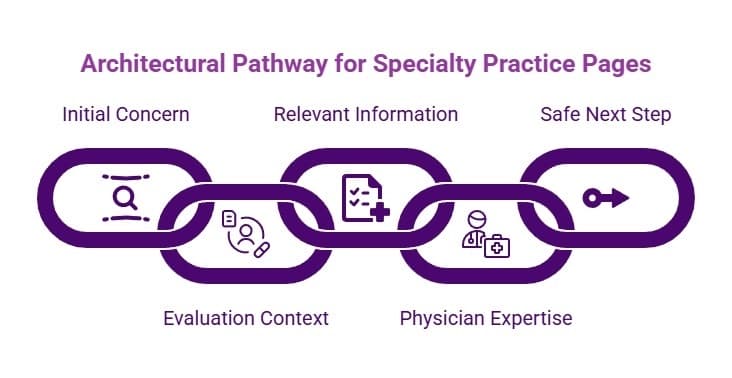
Clinical expertise may already appear across physician bios, condition pages, treatment or procedure pages, and broad service-line pages. The relationship may be present in the practice, but absent from the page.
A useful pathway connects five ideas without pretending to diagnose anyone: the concern that begins the search, a possible evaluation context, relevant condition or treatment information, physician expertise, and a safe next step. Each connection must be explicit enough for a reader to understand and cautious enough for a clinical reviewer to approve.
Start with one priority service line. List the pages that supposedly support the journey, then read them as a connected sequence rather than as isolated assets. Can a reader move from the initial concern to the page that explains the context, identify why a particular physician or service may be relevant, and find an appropriate access path?
If the answer depends on inference, the architecture is incomplete. Search systems may also use visible content and links to interpret page relationships, but their internal decision processes should not be treated as known or predictable. The practical goal is clearer communication, not an algorithmic guarantee.
Five Content Entities Must Perform Different Jobs
An entity is a distinct subject represented on the website, such as a symptom, condition, treatment, physician, or service line. A page role is the primary job a page performs for the reader.
| Entity or page type | Primary job | Connection it must make |
|---|---|---|
| Symptom content | Acknowledge a concern in non-diagnostic language | Point toward possible evaluation contexts |
| Condition page | Explain a diagnosed or clinically defined problem | Connect to relevant physicians and treatment information |
| Treatment or procedure page | Explain an available service | Present candidacy or clinical details only when verified |
| Physician bio | Demonstrate relevant expertise and fit | Link back to supported conditions, treatments, and locations |
| Service-line or access page | Orient the reader and provide a next step | Connect the pathway without replacing clinical evaluation |
One page may support more than one role, but its primary job should remain obvious. A broad service page should not become a symptom encyclopedia. A physician bio should not function as a disconnected credential list. A condition page should not end before showing who evaluates or treats the condition and where the reader can continue.
The objective is not to create a separate URL for every term. It is to organize separate condition, treatment, and physician content paths so each page contributes something distinct.
These roles describe content responsibilities. They are not a medical-triage system.
Where Does the Symptom-to-Specialist Connection Break?
The disconnect usually appears at a handoff between pages.
Symptoms may be buried in generic service copy without an explanation of what evaluation context follows. Physician expertise may be confined to bios that condition and service pages never reference. One long page may try to handle symptoms, conditions, treatments, physician selection, and appointment information at once, leaving no dominant role.
Overlap creates another failure. Several pages may repeat the same concern or procedure language, but none is designated as the primary explanation. That makes page ownership, internal linking, and clinical review inconsistent.
Navigation can also disguise the problem. A link to “Our Doctors” or “Services” moves the reader somewhere, but it does not explain clinical relevance. A contextual link should reinforce a relationship already stated in the copy and point to the precise physician, condition, or treatment page that continues the question.
Hypothetical example: A service page mentions a broad concern. A separate condition page explains one possible context, while two physician bios list relevant areas of expertise. All four pages may be accurate, yet the pathway remains unclear when none explains or links the relationship. Information exists; the connection does not.
Legacy content-management templates may intensify this gap when they lack fields for related physicians, contextual explanations, or access modules. In that situation, better writing helps, but the template may also need a structural change.
How Should the Pathway Be Built Before More Copy Is Added?
Start With the Symptom-Led Question
Identify the concern a person may describe before knowing the diagnosis or specialist category. Use language approved by a qualified clinician. The task is to recognize the content entry point, not determine what the symptom means. For instance, a patient searching for 'chronic heel pain in the morning' is describing a symptom-led concern, whereas 'plantar fasciitis treatments' is a diagnosis-led search.
Assign One Page the First Explanation
Choose whether the initial context belongs in a symptom section, condition page, service-line page, or supporting article. The decision should reflect the reader’s need and the practice’s actual clinical structure, not merely the current navigation menu.
The owning page should explain enough to guide the next step without absorbing every related condition, treatment, and physician detail.
Explain the Evaluation Context Without Implying a Diagnosis
Define the relationship cautiously. Phrases such as “may be relevant,” “could warrant evaluation,” or “depending on the clinical context” preserve uncertainty the website cannot resolve.
Complete omission is not the only safe option. Qualified, clinically reviewed wording can acknowledge the concern without turning the page into a symptom checker.
Connect the Relevant Physician and Service Content
Visible language should explain why the destination matters before the link appears. Descriptive anchor text is more useful than “learn more” because it identifies the next page’s role.
A condition page may link to a physician bio when verified expertise helps the reader evaluate fit. It may link to a procedure page when the reader needs approved treatment information. This decision is explored further in guidelines detailing when a condition page should link to a physician or procedure page.
Use bidirectional linking where it preserves context. A physician bio can link back to conditions and treatments the physician actually supports. A treatment page can identify physicians who provide that service. A location page belongs in the pathway only when the physician or service is genuinely available there.
Complete the Access Path and Review Loop
The final step may be a specific appointment route or a broader practice-contact path. Do not force a one-to-one physician match when the relationship cannot be stated responsibly.
A lightweight governance record can keep the pathway current. Record the page owner, the proposed relationship, the physician or clinical reviewer, the approved wording, and the review date. This can be as simple as a shared spreadsheet tracked by the content team, ensuring that when clinical guidelines change, the corresponding web pages can be quickly identified and updated.
In a typical handoff, marketing proposes the relationship, a clinical reviewer approves or narrows it, the web team implements the context and links, and the content owner records the decision. The exact workflow may vary by practice, but clinical accountability should not be assigned to the SEO or web team alone.
Ambiguous Symptoms Need Routing Language, Not Diagnostic Certainty
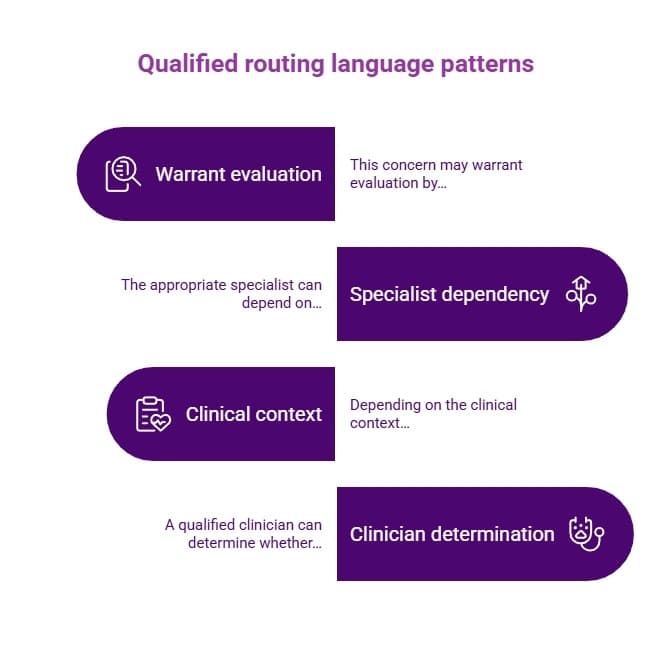
Some symptoms may have several possible causes, evaluation paths, or relevant specialties. The page should preserve that uncertainty rather than resolve it through marketing copy.
Qualified routing language
“This concern may warrant evaluation by…”
“The appropriate specialist can depend on…”
“Depending on the clinical context…”
“A qualified clinician can determine whether…”
These are writing patterns, not preapproved clinical statements. A qualified reviewer must approve the specific relationship that completes each sentence.
When several physicians or service lines may be relevant, explain their differences only when those distinctions are accurate and reviewed. Otherwise, route the reader toward a broader evaluation or contact path. Information architecture can make available options understandable; it cannot determine the care an individual needs.
Run the Symptom-to-Specialist Connection Test
Apply this audit to one high-priority service line before commissioning more pages. Mark each relationship as Clear, Partial, Missing, or Requires Clinical Review.
| Audit question | Status |
|---|---|
| What symptom-led concern starts the journey, and is the wording clinically approved? | Clear / Partial / Missing / Requires Clinical Review |
| Which page owns the initial explanation? | Clear / Partial / Missing / Requires Clinical Review |
| Is the condition, evaluation, or treatment context explained without implying diagnosis? | Clear / Partial / Missing / Requires Clinical Review |
| Which physician or specialist page provides verified proof of fit? | Clear / Partial / Missing / Requires Clinical Review |
| Which contextual links connect the pages in both directions where useful? | Clear / Partial / Missing / Requires Clinical Review |
| What safe and clear appointment or access path is available? | Clear / Partial / Missing / Requires Clinical Review |
Record weak explanations, missing page roles, vague anchors, duplicated ownership, and unresolved review dependencies. This is a content-architecture audit, not a clinical-safety or compliance assessment. Any clinical mapping entered into the framework still requires qualified review.
Frequently Asked Questions
Disclaimer: This article is for general informational purposes only and does not constitute medical advice, diagnosis, or treatment. Readers should consult a licensed healthcare professional for guidance specific to their health, symptoms, medications, or treatment options.
Our Editorial Process: Our expert team uses AI tools to help organize and structure our initial drafts. Every piece is then extensively rewritten, fact-checked, and enriched with first-hand insights and experiences by expert humans on our Insights Team to ensure accuracy and clarity.
By: About the BVM Insights Team
The BVM Insights Team is our dedicated engine for synthesizing complex topics into clear, helpful guides. While our content is thoroughly reviewed for clarity and accuracy, it is for informational purposes and should not replace professional advice.