
 Dustin Ogle
A specialty practice can list dozens of conditions, treatments, physicians, and locations it could turn into search content. That inventory is not the same as readiness. Before approving expansion, leadership needs evidence that existing pages attract the right searches, route people to verified physicians, support meaningful appointment actions, and can stay clinically current after publication.
There is a harder question underneath the obvious one. If the organization has been treating content production as progress, that may be because it lacks a better operating metric. The correct first question is not "How many pages can we publish?" It is "Do our existing systems produce trustworthy signals?"
Six readiness signals answer that question. The matrix below organizes them into a repeatable pre-expansion review.
Use A Six-Signal Readiness Matrix Before Approving Expansion
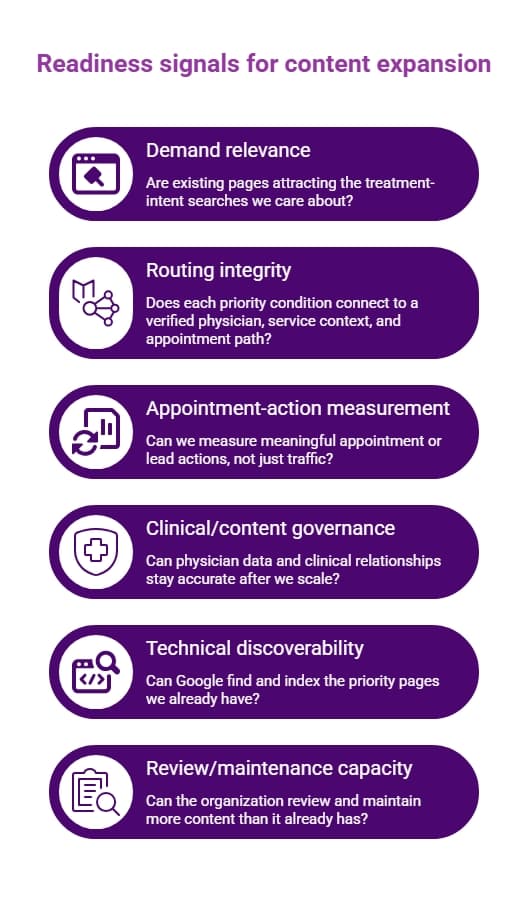
Score each signal using three non-numeric states: Ready to scale selectively, Evidence incomplete, or Remediate before scaling. No universal pass/fail threshold exists. The goal is an honest internal inventory, not a standardized benchmark.
| Readiness Signal | Question Leadership Must Answer | Evidence to Collect | Current Owner | Status | Action Before Expansion |
|---|---|---|---|---|---|
| 1. Demand relevance | Are existing pages attracting the treatment-intent searches we care about? | Search Console query/page data for priority service lines | Marketing / SEO | ___ | ___ |
| 2. Routing integrity | Does each priority condition connect to a verified physician, service context, and appointment path? | Internal condition-to-physician map and clinical source of truth | Marketing + clinical lead | ___ | ___ |
| 3. Appointment-action measurement | Can we measure meaningful appointment or lead actions, not just traffic? | GA4 key-event configuration and downstream CRM or scheduling data | Marketing / analytics / operations | ___ | ___ |
| 4. Clinical/content governance | Can physician data and clinical relationships stay accurate after we scale? | Source-of-truth records, page owners, review dates, change-trigger workflow | Clinical lead + content owner | ___ | ___ |
| 5. Technical discoverability | Can Google find and index the priority pages we already have? | URL Inspection and index-coverage reports for a representative sample | SEO / web team | ___ | ___ |
| 6. Review/maintenance capacity | Can the organization review and maintain more content than it already has? | Unresolved review backlog, unowned pages, stale content inventory | Operations / clinical lead | ___ | ___ |
Each section below explains how to inspect one signal. For a deeper implementation-oriented audit, see the companion guide on condition-to-physician SEO readiness assessment.
1. Measure whether existing pages attract the right treatment-intent searches
Before multiplying URLs, confirm that the pages you already have are reaching the searches your practice actually wants. Google Search Console's Performance report exposes clicks, impressions, click-through rate, average position, queries, and landing pages, giving leadership a diagnostic view of which content attracts which type of demand.
Review priority condition and physician pages by query and landing page. Where practical, separate branded, broad informational, symptom, condition, treatment, physician, location, and appointment-oriented searches. Search demand can be distributed across these categories, so one URL may not produce enough volume for a clean standalone conclusion. In that case, inspect patterns across related pages or a service-line group rather than judging a single page in isolation.
The patterns that matter most are mismatches: a condition page surfacing for unrelated educational queries, physician pages appearing only for branded name searches, or a service-line page accumulating broad impressions with little connection to the treatments the practice prioritizes.
For example, a hypothetical condition page might gain steady impressions, but closer inspection reveals that most visible queries are broad symptom education terms rather than specialist or treatment-intent searches. The implication is "investigate fit before expanding," not "publish five more pages to capture the volume."
Compare these patterns over a meaningful time range rather than a single ranking screenshot. Clicks, impressions, CTR, and position are diagnostic signals that help identify whether content is reaching relevant demand. A strong ranking does not prove the page is working if the queries it attracts have nothing to do with the service line the practice prioritizes. And traffic growth alone does not justify adding pages. Rising visits may reflect broad informational demand rather than treatment-intent searches.
Competitor page count is also not a readiness metric. Another practice publishing 200 condition pages tells you nothing about whether your own measurement, routing, and governance can support expansion. Before expanding, flag thin or overlapping pages and ask whether weak performance stems from demand mismatch, content quality, routing gaps, access friction, or technical discoverability problems. Evaluate internal evidence first.
If leadership cannot explain which existing pages attract which type of demand, the demand-relevance signal is incomplete.
2. Measure whether each priority condition has a verified physician, service, access, and next-step path
Condition-to-physician mapping is the structured link between a condition or treatment page and the specific physician, service context, location, and appointment path a searcher should reach. The chain looks like this:
Condition → service or treatment context → verified physician → location or access → appointment or referral step
Content expansion assumes every new page will maintain that link accurately. That assumption breaks more often than most teams expect.
For each priority service line, audit the route a searcher would follow:
| Step | What to Verify |
|---|---|
| Condition page | Accurate condition or treatment description |
| Service/treatment context | Correct service line, procedure, or treatment scope |
| Verified physician | Current, clinically reviewed physician relationship |
| Location/access | Correct office, hours, and availability for that service |
| Appointment path | Working next step (booking, referral, phone, form) |
Measure coverage completeness as an internal inventory. How many priority routes are fully verified? How many have missing physicians, outdated service descriptions, or broken next-step links? Which pages depend on a single outdated bio or an unowned spreadsheet that no one updates? Inventory each priority pathway as verified, unknown, or conflicting so that additional pages do not multiply uncertainty.
Consider a hypothetical scenario: a condition page still lists a physician whose clinical focus shifted six months ago, and the office location shown no longer offers that treatment. A searcher following the page's guidance reaches the wrong provider at the wrong location. When content like this already exists, scaling means multiplying the problem.
Search relevance and clinical appropriateness are different judgments. Any physician-condition or physician-treatment relationship used in content requires verification from the practice's own clinical source of truth — the single authoritative record for physician and service-line facts — not from cached bios or third-party directories.
Not every condition needs its own dedicated page. Page architecture should depend on distinct search needs, clinical relationships, and page purpose rather than a blanket one-condition-one-page rule.
For a closer look at how physician and service-line changes affect content accuracy, see the resource on keeping multi-physician specialty content accurate.
3. Measure meaningful appointment actions rather than just traffic
Traffic tells you how many people arrived. It does not tell you whether they took a step that matters to the practice. The distinction between diagnostic SEO metrics and meaningful business actions is worth making explicit:
| Layer | What It Tells You | Example |
|---|---|---|
| Search visibility | Whether content appears for relevant queries | Impressions, position, CTR in Search Console |
| Page interaction | Whether useful on-page behavior is visible, where relevant | Scroll depth, engagement events, content interaction |
| Appointment/lead key event | Whether visitors take an action the practice defined as important | Appointment request, qualified call, referral form |
| Downstream internal outcome | Whether that action resulted in a real business result | Confirmed appointment, scheduled procedure, completed referral |
Before expanding, define what counts as a meaningful action. Possible examples include an appointment-request submission, a booking completion, a qualified phone call, a referral form completion, or another internally defined workflow stage. In Google Analytics 4, a key event is an action the business identifies as important to measure. Google also documents recommended lead-generation event structures that practices can adapt to their own booking or referral workflows.
A hypothetical practice sees form submissions climbing after publishing new condition pages. Leadership reads this as proof of demand. But when operations compares the submissions to actual scheduled appointments, fewer than half correspond to qualified inquiries for the relevant service line. A form fill is not automatically a qualified patient or booked appointment. The gap often involves call center triage, insurance verification, scheduling availability, or referral processing. For instance, a 'Book Appointment' button click recorded in GA4 might represent a user entering the scheduling portal, while the CRM reveals that user abandoned the process upon seeing a three-month wait time. Unless those systems communicate, marketing claims a conversion that operations never sees
This is why "we already track form fills" is not enough. Marketing systems, appointment platforms, call-tracking tools, and CRMs may each use different definitions for the same concept. Search Console sees search behavior while the CRM sees downstream outcomes, and connecting them is often imperfect. A form submission may not reveal whether an appointment was booked or categorized the same way downstream. The organization needs to know what the event represents and which system owns the downstream definition.
Better analytics also does not make everything measurable. Improved tracking cannot correct inaccurate physician mapping, stale access information, or unclear content ownership.
Before implementing new tracking configurations, have your organization's privacy and compliance stakeholders review the setup. Healthcare analytics can involve sensitive data, and configuration decisions should reflect your organization's applicable policies and current regulatory expectations.
For a deeper discussion of privacy-aware measurement, see the article on how to measure referral-validation SEO without exposing patient information.
4. Measure whether physician and clinical content can stay accurate after you scale
Governance capacity should be visible before production capacity increases. Publishing a page is the beginning of a maintenance obligation. If physician facts, service-line relationships, or clinical details change after publication — and they will — someone must own the update. A one-time approval at launch does not make content permanently accurate. Physician locations, schedules, service focus, and service-line responsibilities can change at any point after publication.
Use this governance checklist to inspect each priority content area:
- Source of truth: Is there one authoritative record for physician and service-line facts?
- Page owner: Is a named person responsible for each page or content group?
- Clinical reviewer: Is a qualified reviewer assigned and available?
- Review date: When was the content last verified?
- Change trigger: What event (physician departure, location change, service update) prompts a review?
Track pages with missing reviewers, stale review dates, conflicting physician information, or unresolved change requests. Measure the review backlog and update ownership as operating evidence, not against an invented "ideal review SLA."
Clinical reviewers have limited time and may interpret marketing language differently than the team that produced it. A scalable workflow should define the scope of clinical review — what the reviewer is responsible for validating — instead of assuming physicians review every sentence on every page.
AI-assisted drafting adds a specific dimension. Imagine a hypothetical marketing team that can generate 20 condition-page drafts per week while the clinical review team can responsibly verify only a small fraction. Production capacity that outpaces review capacity does not represent progress. Google's people-first content guidance emphasizes helpful, reliable content, clear authorship, and appropriate transparency around substantial use of automation or AI. That guidance treats health-related topics as especially trust-sensitive. AI may accelerate drafting, but it does not remove responsibility for factual accuracy, authorship, clinical verification, or maintenance.
For practices building or refining their review process, the article on clinical review workflows for specialty SEO covers operational details this article intentionally defers.
5. Check discoverability and indexability before multiplying URLs
Indexability is whether a page is technically eligible to appear in search engine results. A page that Google cannot find or index has no organic-search value regardless of how well it is written.
Before expansion, inspect a representative set of existing priority pages. Google Search Console's URL Inspection tool can report whether a page is indexed and test its indexability. Review whether important condition, treatment, or physician pages are accidentally excluded by canonical misconfigurations, noindex directives, or crawl barriers.
A positive inspection result confirms technical eligibility. It does not guarantee that the page will appear in search results or attract relevant demand. Consider a hypothetical priority page that passes every technical check, yet the queries it receives are unrelated to the service line it supports. Indexability is a prerequisite, not proof of performance. If priority pages are not discoverable, or if discoverable pages attract the wrong searches, adding more URLs compounds the problem rather than solving it.
6. Measure whether the organization can support the review workload expansion creates
Operational capacity is the readiness signal most often overlooked in content-scaling discussions. Before approving expansion, answer these questions: Who owns physician updates? Who approves clinical claims on published pages? Who updates content after a service-line change? How much unresolved review work already exists? Can marketing publish faster than physicians and compliance stakeholders can responsibly review?
Track unresolved review items, unowned pages, stale information, and pending change requests. These are internal operating evidence that shows whether the organization can absorb more content without degrading what it already maintains.
Readiness can vary by service line. One area may have clean physician data and interpretable analytics while another has conflicting records or an unmanageable backlog. Treat readiness as service-line specific when the evidence supports it rather than applying a single verdict across the entire practice.
If marketing can create far more drafts than the clinical or operational team can responsibly review, production volume is not the bottleneck to optimize.
A practical starting point is a pilot: choose one priority service line and test the full measurement and review workflow before committing to broader expansion.
Make The Scale, Pilot, Or Remediate Decision
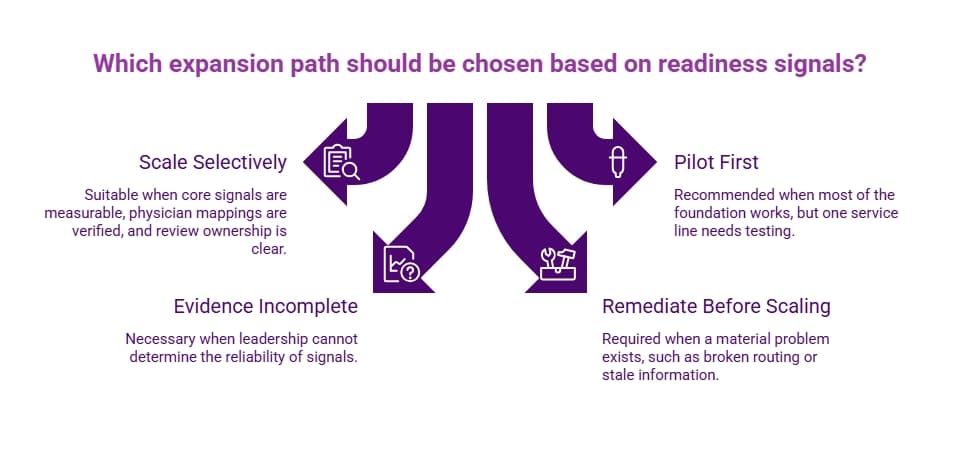
After completing the matrix, leadership should have enough evidence to choose one of four paths:
| Decision | When It Fits | Next Step |
|---|---|---|
| Scale selectively | Core signals are measurable, physician mappings are verified, and review ownership is clear. | Expand within the service lines where readiness is strongest. |
| Pilot first | Most of the foundation works, but one service line should test the operating model before broader expansion. | Use one priority service line to validate measurement, review, and maintenance before scaling further. |
| Evidence incomplete | Leadership cannot yet tell whether one or more signals are reliable. | Close the measurement or ownership gap before making a broad expansion decision. |
| Remediate before scaling | Evidence shows a material problem: broken routing, stale physician information, unclear event definitions, indexing blockers, or an unmanageable review backlog. | Fix the foundation before adding to it. |
These are management decision categories, not external standards. The right choice depends on where your practice's evidence is strongest and where the gaps create the most risk. Use the weakest important signal to identify what should be fixed first. "Remediate" does not mean the practice's SEO has failed. It means the foundation needs attention before expansion can produce reliable results.
The Right Expansion Question
The question that matters is not "How many pages can we publish?" It is "Which readiness signals can we already trust?" Review one priority service line through the matrix before approving site-wide expansion. The gaps that surface will tell you whether the next step is selective growth, a controlled pilot, or foundational repair.
If your practice wants an outside perspective on where measurement and content readiness stand today, BVM offers a free visibility analysis through its Medical Specialty SEO service. Get My Visibility Analysis
Frequently Asked Questions
Disclaimer: This article is for general educational and marketing-strategy purposes only and does not provide medical, legal, or privacy/compliance advice. Clinical, privacy, and regulatory decisions should be reviewed by qualified professionals and your organization's applicable policies.
Our Editorial Process: Our expert team uses AI tools to help organize and structure our initial drafts. Every piece is then extensively rewritten, fact-checked, and enriched with first-hand insights and experiences by expert humans on our Insights Team to ensure accuracy and clarity.
By: About the BVM Insights Team
The BVM Insights Team is our dedicated engine for synthesizing complex topics into clear, helpful guides. While our content is thoroughly reviewed for clarity and accuracy, it is for informational purposes and should not replace professional advice.