
 BVM Insights Team
The referral worked. A physician identified the right specialty practice. But the patient lands on the treatment page and finds a clinical overview, a stock photo, and a button that says "Schedule Now." They still do not know what the visit is for, what records to bring, whether their insurance applies, or whether this physician handles their specific concern.
A referral identifies a destination. It does not explain what happens next. For U.S. specialty practices, that explanation belongs on the treatment page, and it must build a clear appointment pathway: the connected sequence of information that moves a referred patient from "I was told to call this practice" to "I understand this visit, what to prepare, and how to schedule." The page must distinguish what it can answer from what requires consultation, and how to take the next step — without turning website content into individualized medical advice.
A Referral-Ready Page Answers Seven Questions
Before revising any treatment or procedure page, use these seven questions as an audit framework. Each one represents an information gap that can stall a referred patient between referral and appointment.
- What does this treatment or procedure address?
- Why might someone be referred for evaluation?
- What happens before a treatment decision is made?
- What should the patient prepare or bring?
- Who evaluates clinical fit for this treatment?
- What access, insurance, or authorization details need to be confirmed?
- What is the appropriate next step from this page?
These are not clinical protocol questions. They are page-content questions. Each one identifies a category of information that a referred patient may need before they feel confident enough to move forward. If the page does not address the category, the patient either calls the front desk, delays, or looks elsewhere.
The page cannot answer every case-specific question, but it can prevent the same avoidable uncertainty about scope, preparation, and routing from reaching the intake team on every call. More copy does not necessarily create more clarity; the goal is governed specificity with clear boundaries, not unsupported detail or total vagueness. A disclaimer at the bottom does not compensate for inaccurate clinical content above it.
Clarify the Treatment's Scope Without Deciding Candidacy Online
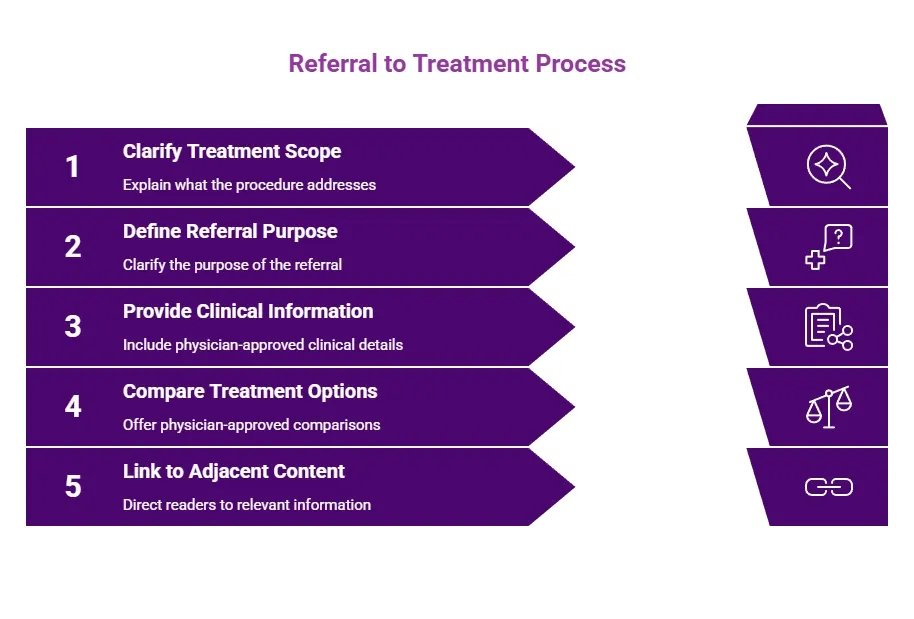
A treatment page should explain what the procedure addresses in terms a referred patient can understand. That means defining the clinical problem the treatment relates to, describing the general purpose of the procedure, and identifying the types of concerns that may lead a physician to refer someone for evaluation.
The critical boundary: a referral does not establish candidacy. A referral may initiate an evaluation, but it does not guarantee treatment or replace assessment by a qualified clinician. Consider a hypothetical referred patient who recognizes the procedure name on the page. They may not know whether the referral is for an initial evaluation, preliminary testing, or an active treatment decision. Without that distinction, they may arrive at the consultation expecting answers the visit was never designed to provide. The page should make the purpose of the referral explicit. For example, instead of writing "This procedure will cure your chronic joint pain," governed content might state: "This procedure is evaluated for patients with chronic joint pain who have not responded to conservative therapies like physical therapy or medication. Statements like "this procedure may be recommended for patients who..." belong only when a qualified physician has reviewed and approved the specific language.
Indications, contraindications, risks, alternatives, expected outcomes, and recovery expectations all require current clinical sources and physician approval before they appear on the page. Marketing cannot write these sections independently, even when the language sounds general. A phrase like "most patients experience improvement" is a clinical claim. A phrase like "this page provides an overview of the procedure and is not a substitute for clinical evaluation" is a boundary statement. The page needs both, and a physician should approve the first.
Procedure comparisons need similar boundaries. A brief comparison may help readers understand why different options are evaluated, but suitability, benefits, risks, outcomes, and alternatives require physician-approved content. If a comparison introduces a separate treatment decision, link to dedicated content instead of expanding the treatment page beyond its purpose.
When the treatment page sits within a broader content structure, link it to the relevant condition page or separate condition, treatment, and physician content paths so the reader can find adjacent information without the treatment page trying to cover everything.
Explain What Happens Between Referral and Consultation
A referred patient often understands that they need to see a specialist. They rarely understand the sequence of steps between the referral and the actual consultation. The treatment page should make that sequence visible, even when the exact steps vary by practice.
The categories most pages should address, verified with the practice's current workflow:
- Referral receipt or verification. How does the practice confirm the referral? Does the patient need to do anything, or does the referring physician's office handle it? State whether verification occurs and how the patient can confirm status.
- Records and testing preparation. Which medical records, imaging, or laboratory results should accompany the referral? Does any testing need to happen before the consultation? If the patient needs to transmit records, the page should direct them to the practice's approved records process rather than leaving them to guess the method.
- Scheduling and intake. Who initiates the appointment, the patient or the practice? What does the intake process involve? Where can the patient verify referral and scheduling status if they have not heard back?
- Consultation or clinical evaluation. What happens during the first visit? Is the purpose evaluation, testing, treatment planning, or a combination? Describe the purpose of the visit without promising a diagnosis, test, procedure, or treatment decision.
- Treatment decision. When and how does the actual treatment decision occur, if the evaluation supports it? Recommendations depend on clinical findings and may differ among patients.
Present this as a configurable sequence that the practice adapts, not as a universal workflow. Every item in this list requires verification with the practice's referral, intake, and clinical operations owners before it goes on the page. Requirements can change when payer contracts shift, when scheduling systems update, or when a new physician joins the team.
Do not guarantee timelines, state specific record requirements from memory, or imply that completing the referral means automatic progression to treatment.
"Patients can call if they have questions" is not a reason to leave the pathway unexplained. Calls remain appropriate for individual questions, but the page itself should clarify scope, preparation, routing, and the correct contact point so the intake team is not fielding the same avoidable inquiries on every call.
Separate Clinical Information from Administrative Access Information
Treatment pages frequently blend two categories of information that serve different purposes and require different reviewers. Without clear ownership, a page can combine outdated operational details with current clinical copy, and neither owner notices the problem in the other's domain.
| Information Type | Examples | Owner or Reviewer |
|---|---|---|
| Clinical | Purpose, evaluation, candidacy, risks, alternatives, outcomes, and recovery | Qualified physician or clinical reviewer |
| Referral and intake | Referral status, records, forms, testing preparation, and consultation sequence | Referral, intake, operations, and clinical teams |
| Insurance and billing | Participation, coverage, authorization, eligibility, costs, and payment requirements | Billing or authorization team using current official payer information |
| Scheduling and access | Locations, availability, appointment steps, and contact routes | Operations and scheduling owners |
One common example: a page states that the practice "accepts" a particular insurance plan. Participation and coverage are not the same thing. A practice may participate with a payer network without guaranteeing that a specific plan covers a specific procedure, that prior authorization will be granted, or that the patient's cost-sharing will be affordable. The page should explain what "accepts insurance" means in practice and direct the patient to verify plan-specific coverage, authorization requirements, and estimated costs with the practice's billing team and their own payer.
Unresolved administrative questions also need a verified route. Referral, records, insurance, and scheduling questions may each require different contacts. One primary page action can remain prominent while supporting instructions direct each question type to the responsible team. If the practice has a referral coordinator, insurance verification team, or specific intake line, that contact should be visible on the page rather than buried behind a generic form.
Connect the Treatment to the Right Physician, Location, and Next Step
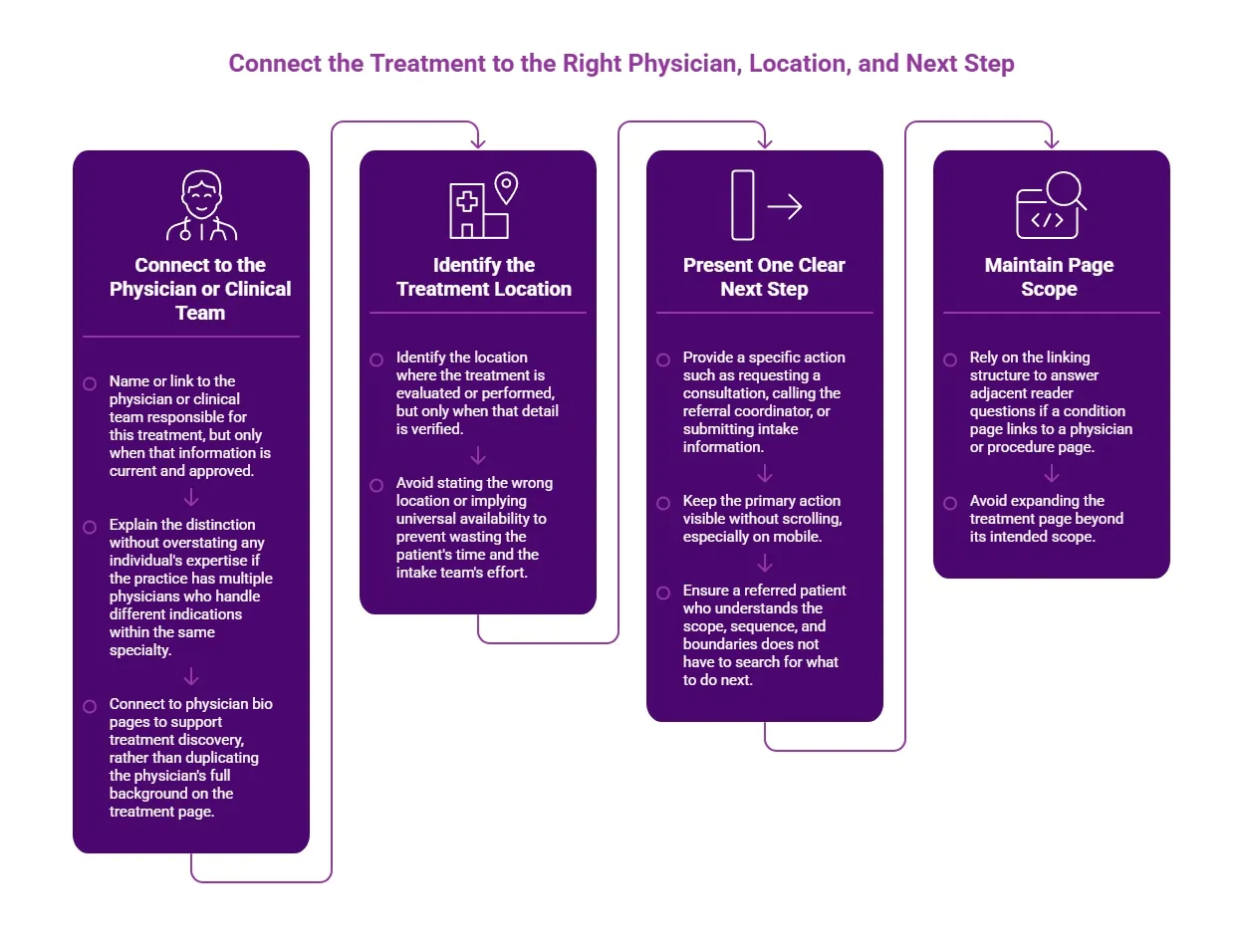
Name or link to the physician or clinical team responsible for this treatment, but only when that information is current and approved. If the practice has multiple physicians who handle different indications within the same specialty, explain the distinction without overstating any individual's expertise. The page should connect to physician bio pages to support treatment discovery, rather than duplicating the physician's full background on the treatment page.
Identify the location where the treatment is evaluated or performed, but only when that detail is verified. Practices with multiple offices may offer certain procedures at only one site, and the same treatment may be evaluated at one location and performed at another. Stating the wrong location — or implying universal availability — wastes the patient's time and the intake team's effort.
Present one clear next step. For most treatment pages, that means a specific action: request a consultation, call the referral coordinator, or submit intake information. Keep the primary action visible without scrolling, especially on mobile. A referred patient who has read through the page and understands the scope, sequence, and boundaries should not have to search for what to do next.
If a condition page links to a physician page, a procedure page, or both, rely on that linking structure to answer adjacent reader questions, rather than expanding the treatment page beyond its scope.
Use a Governed Referral-Readiness Checklist Before Publishing
The framework above becomes operational when every item on the treatment page has a designated owner, a verified source, and a review date. Use this checklist to audit one priority treatment page before publication or revision. Record each status as approved, needs review, missing, or not applicable.
| Page Question | Required Information | Owner / Reviewer | Status |
|---|---|---|---|
| Is the page's purpose clear? | Scope, educational role, and limits | Marketing and Physician | Approved / Needs review / Missing / N/A |
| What does this treatment address? | Physician-approved scope statement | Physician | Approved / Needs review / Missing / N/A |
| Why might someone be referred? | General referral context (non-diagnostic) | Physician + Marketing | Approved / Needs review / Missing / N/A |
| Is a referral required? | Current requirement and verification route | Referral Team and Operations | Approved / Needs review / Missing / N/A |
| What is the consultation sequence? | Current referral-to-evaluation workflow | Operations / Intake | Approved / Needs review / Missing / N/A |
| What should the patient prepare? | Records, imaging, testing, and intake requirements | Intake / Referral Coordinator | Approved / Needs review / Missing / N/A |
| Who evaluates clinical fit? | Current physician or team assignment | Physician / Practice Admin | Approved / Needs review / Missing / N/A |
| What are the candidacy boundaries? | Non-advisory language reviewed by physician | Physician | Approved / Needs review / Missing / N/A |
| Is the correct physician or program identified? | Current clinical responsibility | Clinical and Operations Leaders | Approved / Needs review / Missing / N/A |
| Is the location accurate? | Verified evaluation or treatment location | Operations | Approved / Needs review / Missing / N/A |
| How is insurance addressed? | Participation, authorization, and verification language | Billing / Payer Team | Approved / Needs review / Missing / N/A |
| What is the next step? | Verified action (consultation request, intake, call) | Operations / Marketing | Approved / Needs review / Missing / N/A |
| When was this content last reviewed? | Review date and responsible reviewer | All applicable owners | Approved / Needs review / Missing / N/A |
Route any item marked "needs review" or "missing" to the designated owner before the page goes live. Clinical items go to the responsible physician. Operational items go to intake, scheduling, billing, or the referral coordinator. Marketing owns page structure and linking, not the accuracy of clinical or administrative claims. Marketing approval alone is insufficient for clinical language.
Some teams avoid useful details because they believe more information creates compliance risk. The safer approach is governed specificity: publish verified information, define clinical boundaries, assign reviewers, and omit unsupported details. Precision and verified boundaries protect the practice far better than overwhelming the patient with unvetted medical details.
For a deeper look at assigning clinical review responsibility across specialty content, see how to build a clinical review workflow for specialty content.
Frequently Asked Questions
Disclaimer: This article provides general information about website content and patient communication. It does not provide medical advice or determine whether any treatment is appropriate for an individual. Clinical, referral, insurance, and operational details should be reviewed by qualified professionals and verified with the applicable practice and payer.
Our Editorial Process: Our expert team uses AI tools to help organize and structure our initial drafts. Every piece is then extensively rewritten, fact-checked, and enriched with first-hand insights and experiences by expert humans on our Insights Team to ensure accuracy and clarity.
By: About the BVM Insights Team
The BVM Insights Team is our dedicated engine for synthesizing complex topics into clear, helpful guides. While our content is thoroughly reviewed for clarity and accuracy, it is for informational purposes and should not replace professional advice.