
 BVM Insights Team
A board-certified surgeon's name sits beneath a condition page on your practice website. The page describes a procedure the surgeon performs weekly. Nothing tells the reader whether the surgeon wrote the clinical explanation, reviewed someone else's draft, or has any ongoing responsibility for keeping it accurate. The name is there. The accountability is not.
Most specialty practices have the clinical expertise to stand behind their content. What they lack is a visible system that shows who did what, why that person is qualified, and who owns the page after publication.
The responsibility matrix below separates four governance roles, translates them into six visible signals, and connects both to a maintenance workflow built on event-based triggers.
What a Meaningful Physician-Authorship Signal Should Tell the Reader
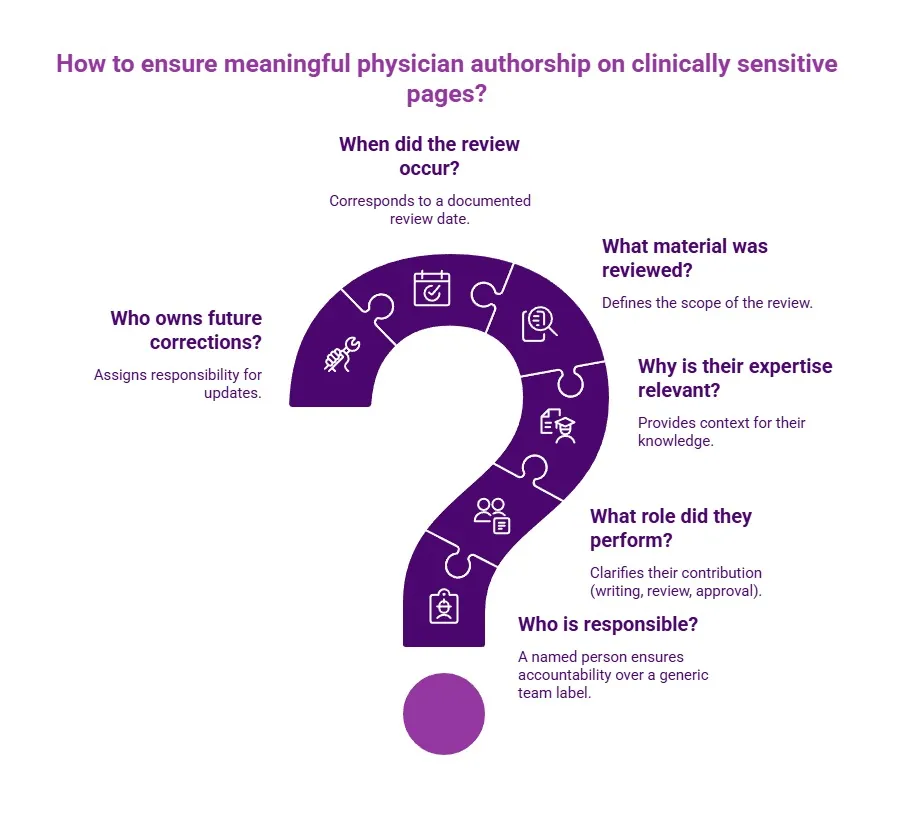
A useful authorship signal answers six accountability questions for every clinically sensitive page:
- Who is responsible? A named person, not a generic team label.
- What role did that person perform? Writing, clinical review, editorial approval, or another defined function.
- Why is their expertise relevant? Verified credential context tied to the page topic, not a full CV.
- What material was reviewed? The scope of the review: full page, clinical claims only, evidence references, or a defined section.
- When did the review occur? A date that corresponds to a documented review, not an automated timestamp.
- Who owns future corrections? A named person or role responsible for monitoring changes, routing corrections, and triggering re-review.
These six questions form the accountability baseline. A page that answers all of them gives readers a clear picture of clinical responsibility. A page that answers only one or two leaves the rest to assumption.
Treat these as recommended accountability questions, not universal legal requirements. The specific obligations that apply may depend on your specialty, organization, and jurisdiction.
Separate the Four Roles Before Assigning a Byline
A single byline can obscure the fact that several people contributed in different capacities. Separating those contributions into distinct roles makes each person's responsibility clear.
Physician Author
The physician author takes primary responsibility for the clinical substance attributed to them. This does not require drafting every sentence. It means the clinical assertions and medical explanations reflect that physician's professional judgment and are attributed with their knowledge and consent. An editor may still help organize, clarify, or produce the copy, and the label should not conceal that division of work.
Clinical Reviewer
The clinical reviewer evaluates defined clinical claims against current evidence within their area of verified expertise. The role should have a stated scope: which claims were evaluated and which fell outside the review.
When a page's clinical substance is narrow enough that a scoped review covers the risk, a clinical reviewer may be more appropriate than a physician author. Reserve the author role for pages where the physician takes primary accountability for the attributed clinical content.
Editorial Owner
The editorial owner manages clarity, structure, sourcing, and style. This person ensures that later edits do not alter approved clinical language without re-review. Any material clinical change should return to the designated clinical reviewer. Editorial approval is not clinical endorsement.
Content Owner
The content owner handles ongoing maintenance: monitoring update triggers, routing corrections, managing version control, and ensuring the page returns for re-review when circumstances change. This role often falls to a growth lead, marketing director, or agency partner.
When clinical, editorial, brand, legal, or compliance reviewers disagree on wording, the practice should follow a documented escalation path and hold unresolved language until the appropriate decision owner responds. A content owner who lacks that escalation path risks stalling publication or publishing disputed claims.
In smaller practices, one person may hold more than one role. A physician might serve as both author and clinical reviewer when no other qualified clinician covers the topic. A growth lead might serve as both editorial owner and content owner. The model works when each role is documented and labels reflect actual responsibilities.
For a deeper look at structuring the clinical review step, see how to build a clinical review workflow for specialty content.
| Role | Core Responsibility | Visible Label Example | Boundary |
|---|---|---|---|
| Physician author | Clinical substance attributed to the named physician | "Written by [Name], [Credential]" | Does not mean the physician personally drafted all non-clinical copy |
| Clinical reviewer | Evaluation of defined clinical claims or sections | "Clinical claims reviewed by [Name], [Credential]" | Review scope should be stated; does not imply full-page authorship |
| Editorial owner | Clarity, structure, sourcing, style, approved-wording preservation | "Editorial production by [Team or Role]" | Not a clinical endorsement |
| Content owner | Maintenance, corrections, re-review triggers, version control | Internal assignment (may or may not be displayed) | Operational accountability, not clinical authority |
For example, consider a dermatology practice publishing a condition page. One physician reviews clinical claims. A content strategist drafts and structures the page. A growth lead owns updates. Each contribution is distinct, and the visible labels reflect that.
This matrix is a recommended governance model, not a mandated legal structure.
Build a Page-Level Responsibility Record
Roles stay abstract until the practice documents them for each high-stakes page. A page-level responsibility record connects the governance roles above to a specific piece of content, making it possible to answer every accountability question without searching across teams.
Use one record for each high-stakes condition or treatment page. A shared spreadsheet or controlled document works when the practice does not have a formal content-management or version-history system. For instance, a joint-replacement procedure page might record the orthopedic surgeon as the named author, a physical therapist as the clinical reviewer, and a marketing director as the content owner.
| Field | Decision to Record | Public or Internal |
|---|---|---|
| Page or claim type | What the page covers and which material may require escalation | Internal |
| Named author | Who is responsible for attributed authorship | Public when applicable |
| Clinical reviewer | Who reviewed the defined clinical scope | Public when applicable |
| Credential context | Which verified credential explains topic relevance | Public and internal |
| Editorial owner | Who manages production and approved wording | Usually internal |
| Review scope | Which claims, evidence, or sections were evaluated | Public summary and internal detail |
| Last reviewed date | When the documented review was completed | Public and internal |
| Update trigger | Which events return the page for review | Internal |
| Correction owner | Who receives, records, and routes corrections | Internal |
This record should connect information that may otherwise be maintained by different teams, including physician profiles, credential files, service pages, and location pages. When one source changes, the content owner can identify every affected page instead of relying on separate teams to notice the inconsistency on their own.
Build Six Visible Signals from the Underlying Workflow
Roles become useful when they translate into visible, consistent page elements. Each signal below answers one of the six accountability questions.
Name and Role Label
Replace generic labels with role-specific ones. "Medically reviewed" does not tell the reader whether the named person wrote the page, checked clinical claims, or lent their name.
Compare two patterns:
- Weak: "Medically reviewed."
- Clearer: "Clinical claims reviewed by [verified physician name and relevant credential], Month D, YYYY. Editorial production by [team or role]."
The second version names the person, specifies the role, scopes the review, and separates clinical from editorial responsibility.
Relevant Credential Context
List only verified credentials that explain why this person is qualified for the specific topic. Do not infer expertise from a title, search result, directory listing, or marketing description. Link to the physician's full profile rather than compressing an entire career onto every page. For guidance on structuring profiles, see what physician bio pages need.
Review Scope
State whether the reviewer checked the entire page, clinical claims only, or a specific section. A scoped label prevents the reader from assuming the reviewer endorsed every word, including marketing language.
Review Date
Display a date that represents a real, documented review. If no recorded review occurred on that date, the date should not appear. Refreshing a timestamp without a corresponding review creates a false signal. If a service line changes after that review, the existing date should not create the impression that the revised information has already been evaluated.
Evidence Basis
Identify the evidence standard the page relies on, such as peer-reviewed research, clinical guidelines, or professional-association guidance. Record the source category or evidence standard actually used. This does not require inline citations for every sentence. It means the reader can understand the general foundation of the clinical content without the practice manufacturing citations or implying that the reviewer evaluated evidence outside the documented scope.
Maintenance Owner
Make it clear, at least internally, who is responsible for corrections and re-review when triggered events occur. Some practices display this role publicly; others keep it operational. Either way, the assignment should be documented.
| Signal | Question It Answers | Internal Owner | Misuse to Avoid |
|---|---|---|---|
| Name and role label | Who is responsible, and what did they do? | Physician author or clinical reviewer | Using "medically reviewed" without naming the reviewer or defining the review |
| Relevant credential context | Why is this person qualified for this topic? | Physician, verified by credentialing authority | Listing every credential regardless of topic relevance |
| Review scope | What material was actually reviewed? | Clinical reviewer or editorial owner | Implying the reviewer endorsed the full page, including marketing copy |
| Review date | When was this page last reviewed? | Content owner (maintains the record) | Displaying a date without performing a documented review |
| Evidence basis | What evidence supports the clinical content? | Physician author or clinical reviewer | Fabricating citations or implying peer-reviewed rigor without a defined standard |
| Maintenance owner | Who handles corrections and re-review? | Content owner | Assigning no one, leaving outdated content without a correction path |
Match Review Intensity to Content Risk and Change Triggers
Not every page carries the same clinical weight. Pages containing clinical, credential, treatment, or eligibility claims warrant closer review than operational content. Risk-based review intensity means matching review depth and frequency to the potential consequences of an error.
This approach can also reduce unnecessary physician workload. Editors can consolidate questions, isolate changed claims, and send only the relevant material to the appropriate reviewer instead of requesting repeated approval of entire pages.
A calendar-based schedule can create false confidence. A practice that redesigns a service line in March while affected pages are not scheduled for review until December displays a passing review date for nine months after the underlying content changed. A more reliable approach combines a baseline cadence with event-based triggers.
Events that should trigger a re-review:
- A listed physician leaves the practice or stops treating the relevant condition
- A reviewer remains at the practice but no longer treats the represented topic
- A service line is added, discontinued, or materially changed
- A physician's credentials or board certifications change
- New clinical evidence or professional-association guidance affects the page topic
- Approved clinical language is altered during a design, SEO, or conversion edit
- A factual error or correction request is received
- An organizational policy affecting disclosures changes
When later SEO or conversion edits touch a page, verify that approved clinical wording remains intact. If language changed, route the page back to the clinical reviewer before republishing.
After a trigger fires, the content owner should log the issue, identify every affected page, route the relevant material to the designated reviewer, record the decision, preserve the new version, and update the public review date only after the defined review is complete. This post-trigger sequence is what makes the visible review date defensible.
Record the reviewer, date, scope, and version for each review. For related guidance on connecting clinical claims to verifiable evidence, see how to support specialist claims with verifiable evidence.
Keep Multi-Physician Content Consistent Without Flattening Expertise
Multiple physicians may contribute across overlapping service lines, but their training and clinical experience are not interchangeable.
Start with one approved shared record for stable practice-wide information: office locations, accepted insurance plans, and intake procedures. These facts should not vary across pages.
Assign topic ownership based on verified expertise. One physician should not automatically review every specialty topic. Different service lines may require different reviewers, and a single complex page may require more than one physician when its claims cross distinct areas of expertise. In a hypothetical surgical group, one shared terminology standard covers general practice information while different reviewers handle distinct procedures. One surgeon reviews joint-replacement pages; another reviews sports-medicine pages. A complex comparison page covering both areas receives two scoped reviews, with each reviewer's scope recorded separately. The shared standard keeps facts consistent; separate assignments preserve clinical distinctions.
When physicians disagree on clinical language, designate a resolution path before the disagreement stalls publication.
Structured data cannot repair weak authorship governance. It may reflect accurate, visible author or reviewer information, but it should not replace the underlying responsibility record or create an attribution that the page does not support.
Re-review pages when physician roles change. If a surgeon who authored a procedure page leaves, flag that page for reassignment rather than leaving the departed physician's name attached. For guidance on these transitions, see how to keep multi-physician content accurate when service lines change.
Audit One High-Stakes Page Before Redesigning the Whole System
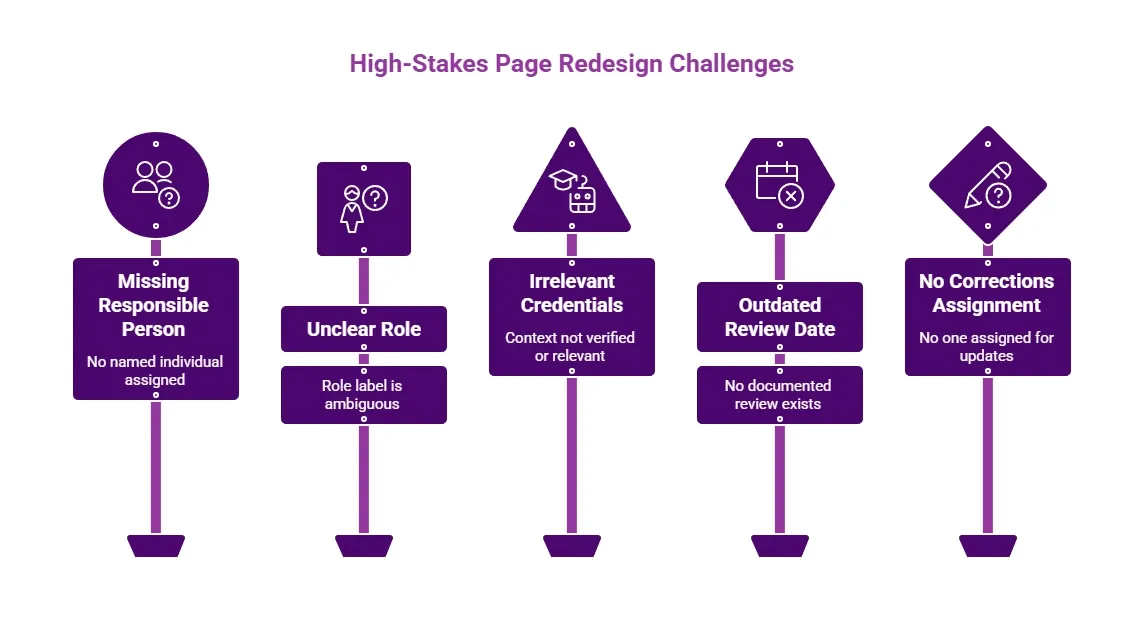
Apply the responsibility matrix to one high-stakes condition or treatment page and check whether the visible signals match the underlying workflow.
- Is a responsible person named, with a specific role label?
- Is the person's exact role clear: author, clinical reviewer, editorial owner, or content owner?
- Is the credential context verified and relevant to the page topic?
- Does the displayed review date represent a documented review?
- Is someone assigned to corrections and event-based updates?
If any answer is "no" or "unclear," that gap is the first thing to fix. Complete the page-level responsibility record before changing the visible label.
Practices connecting this governance work to a broader medical specialty SEO strategy can use the responsibility matrix as a starting point.
Frequently Asked Questions
Disclaimer: This article is for general educational and healthcare-marketing purposes only. It does not provide medical, legal, regulatory, or compliance advice. Physician credentials, clinical-review responsibilities, public disclosures, and content-governance requirements should be verified for the applicable organization, specialty, and jurisdiction before implementation.
Our Editorial Process: Our expert team uses AI tools to help organize and structure our initial drafts. Every piece is then extensively rewritten, fact-checked, and enriched with first-hand insights and experiences by expert humans on our Insights Team to ensure accuracy and clarity.
By: About the BVM Insights Team
The BVM Insights Team is our dedicated engine for synthesizing complex topics into clear, helpful guides. While our content is thoroughly reviewed for clarity and accuracy, it is for informational purposes and should not replace professional advice.