
 BVM Insights Team
Executive Summary
A practice can be clinically ready and still be hard to find at launch. This 48-hour audit confirms access, names an owner and reviewer for every launch-critical search asset, checks five readiness layers, and ends with one owner-and-dependency board. The payoff is a launch where the right patients can evaluate your surgeons with confidence.
From a Fixed Opening Date to a Controlled Launch
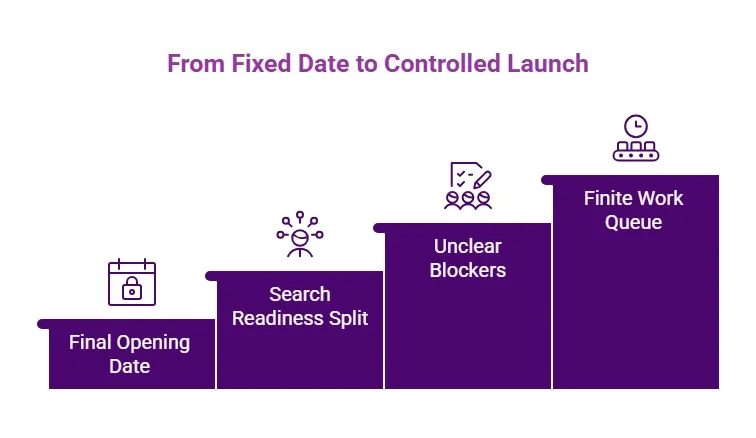
The date on the glass is final.
Inside, the shared drive still holds an empty folder labeled “Gallery: Approved,” and an email titled “Search Console access?” has reached its fourth reply. Whose job is this, exactly?
You have spent months on build-out, staffing, and clinical setup. Search readiness, meanwhile, is split across four people (surgeon-owner, administrator, COO, and marketing lead), and nobody can say what is blocking it.
The First 48-Hour Blueprint will not finish your SEO in two days. It shows what is ready, what is blocked, who owns each gap, and what can safely wait, so your team leaves with a finite work queue.
What the First 48 Hours Should Accomplish
Plastic surgery SEO launch sequencing is a phased approach for preparing the search, trust, and conversion assets a new, relocating, or rebranding Texas practice needs around market entry.
Think of it as building the runway before the practice takes off. The clinical practice may be ready, but patients can still form their shortlist before procedure pages, surgeon proof, galleries, and regional signals become discoverable.
The desired outcome is to open with the highest-priority patient-discovery pathways already connected, while reserving lower-priority expansion for later. The sequence should therefore be driven by dependencies and existing authority. A generic launch-now-and-optimize-later approach can fail when the practice has no established visibility to carry it through the early comparison period.
The 48 hours describe the audit window, not the time search engines need to rank a page, which varies by market and existing authority. The first useful action is not publishing more pages. It is finding the missing access, proof, owner, or approval that would keep priority patient pathways from being trustworthy at launch.
The audit produces four working records:
- an access register
- an owner-and-reviewer matrix
- a five-layer readiness assessment
- a dependency board
Together they answer three questions: what must work before opening, what prevents it from working, and who has authority to resolve the problem.
One sequence runs throughout: verify, assign, prove, review, and unblock. It keeps publication decisions tied to evidence and accountability rather than to the urgency of the opening calendar.
Hour 0-4: Audit Access Before You Audit Tactics
Every later task depends on someone being able to log in. List each system the practice actually uses and record its status as accessible, access pending, ownership unclear, or not applicable.
| System | Verification Requirement | Suggested Owner |
|---|---|---|
| Website, CMS, and domain/DNS | Editing rights and technical ownership | Website lead |
| Search Console and analytics | Property access and reporting visibility | Marketing lead |
| Google Business Profile | Profile ownership and accurate identity | Practice administrator |
| Consultation forms and call tracking | Forms and calls reach the intended team | Marketing lead |
These roles are suggestions, not assumptions about your staffing.
Watch for a former web vendor holding the only admin login. An inaccessible website account can keep an approved procedure page from ever going live, so resolve access before commissioning more content. If URL structures must change during a rebrand, strictly map and implement 301 redirects to pass the earned authority from the old procedure pages to the new ones.
While the Business Profile is open, check accuracy first. Google’s guidelines for representing your business require a profile to reflect the business accurately and to represent its actual, real-world location. That means a consistent name, a precise address, and fitting categories. Profile eligibility, and how a profile is treated during a relocation, depend on the practice’s actual circumstances.
Hour 4-8: Assign Owners and Review Gates
Marketing can coordinate content, but clinical accuracy requires professional oversight. Each launch-critical asset therefore needs two names: one person supplies the evidence, and another approves publication.
| Asset | Evidence Owner | Reviewer |
|---|---|---|
| Procedure page facts | Clinical content owner | Qualified surgeon |
| Surgeon credential claims | Practice administrator | Surgeon |
| Gallery images and testimonials | Authorized asset custodian | Clinical and privacy reviewers |
| Location and business details | Practice administrator | Practice leadership |
| Analytics and measurement setup | Marketing lead | Business decision-maker |
Treat these pairings as a starting point. Your practice defines who may approve each item, a process outlined in how clinical review workflows keep specialty SEO content accurate and publishable.
An asset counts as ready only when it clears four gates:
- Its evidence source is named.
- Its reviewer has approved it, and that approval is recorded.
- Its credential or clinical claims match practice records.
- Its proof is cleared for public use, with permissions documented.
A page awaiting surgeon approval is not publication-ready, even when its writing and design are finished. An asset with no owner is a blocker.
Hour 8-24: Audit the Five Launch-Readiness Layers
The core test is whether a patient can move from procedure discovery to surgeon evaluation, credible proof, regional relevance, and a consultation without hitting a critical gap.
BVM’s Plastic Surgery SEO framework assesses readiness across five layers because patients compare surgeons on several signals at once. For the wider governance view, see how to evaluate whether a specialty practice website is ready for condition-to-physician SEO.
Procedure. A patient researching a priority procedure should be able to understand it, see who performs it, view approved proof, and find the consultation step. Anything awaiting photography or surgeon review is a dependency.
Surgeon. Profiles should connect verified credentials, such as board certification, to the surgeon’s procedure focus. They should also connect to any documented aesthetic philosophy and to the procedures the surgeon actually performs. Bios lacking those links leave the patient’s question open, as examined in when specialist bios fail to answer treatment-intent questions. The reverse fails too: a procedure page with no identifiable surgeon leaves patients unable to judge clinical fit.
Proof. Inventory only what the practice can substantiate. Where proof is missing, write “missing.” Adjectives do not fill that gap.
Local and regional. The website, the Business Profile, and the real practice should describe the same business. Cosmetic patients often travel for the right surgeon, so regional relevance can matter beyond the map listing.
Measurement. Decide how leadership will separate four signals:
- discovery
- engagement with procedure and surgeon pages
- consultation actions
- consultation fit
Hour 24-32: Separate Launch Blockers From Post-Launch Expansion
Not every unfinished asset threatens opening. Sort each open item into one of three states:
- A launch blocker prevents a priority pathway from being trustworthy, accessible, reviewable, or measurable.
- An item that can follow matters, but the launch foundation works without it.
- Expansion covers additional procedures and authority work for later.
Under launch pressure, teams often fill gaps with generic copy because publishing feels like progress. It rarely is. A page without surgeon mapping or approved proof adds volume, not trust. An unapproved description on a priority procedure page, for instance, deserves attention before any new educational article.
This discipline pays off in avoided waste. It reduces the risk of funding work that cannot be implemented, of publishing unsupported placeholder content, and of discovering approval bottlenecks after opening. It also keeps attention on usable patient pathways rather than traffic alone. No universal financial return or ranking timeline follows from completing the audit.
Hour 40-48: Turn the Audit Into an Owner-and-Dependency Board
The final hours consolidate everything into one controlled work queue. Each row moves through the same five actions: verify, assign, prove, review, and unblock. The sample rows are illustrative.
| Audit Item | Layer | Status | Evidence Source | Owner | Reviewer | Blocking Dependency | Criticality | Next Action |
|---|---|---|---|---|---|---|---|---|
| Priority procedure page | Procedure | Waiting on evidence | Surgeon-approved notes | Marketing lead | Clinical reviewer | Gallery photography | Launch blocker | Schedule photo session |
| Surgeon biography | Surgeon | Waiting on evidence | Practice credential records | Practice administrator | Surgeon | Unverified credentials | Launch blocker | Verify credentials |
| Patient gallery | Proof | Waiting on evidence | Signed image permissions | Asset custodian | Privacy reviewer | Missing authorization | Launch blocker | Confirm image permissions |
| Consultation form | Measurement | Technical dependency | Form configuration | Marketing lead | Business decision-maker | Untested routing | Launch blocker | Test submission and routing |
Status describes where an item stands, while criticality describes how much it matters. Tracking both keeps an unfinished enhancement from being mistaken for a critical defect. Each row takes one of seven statuses:
- Ready: evidence and required approvals are complete.
- Waiting on access: necessary system permissions are unavailable.
- Waiting on evidence: supporting information or authorization is missing.
- Waiting on review: evidence exists, but approval is outstanding.
- Technical dependency: implementation requires technical action.
- Can follow: important, but not essential to the initial pathway.
- Expansion: adds coverage beyond initial priorities.
Picture an administrator looking at a page that has been marked blocked for nine days. The board shows the dependency is photography, not surgeon review, and names who books the shoot. One call clears it.
When the surgeon-owner, administrator, COO, and marketing lead review the board, a few questions settle most debates:
- Which items are truly required before launch?
- Which blockers need surgeon or technical input?
- Which claims still lack approved proof?
- What existing authority must be preserved?
- How will consultation quality be measured after opening?
Before anything goes live, confirm three things: no critical task lacks an owner, no clinical claim lacks verification, and no asset is marked ready without its required approval.
What to Monitor After the Audit
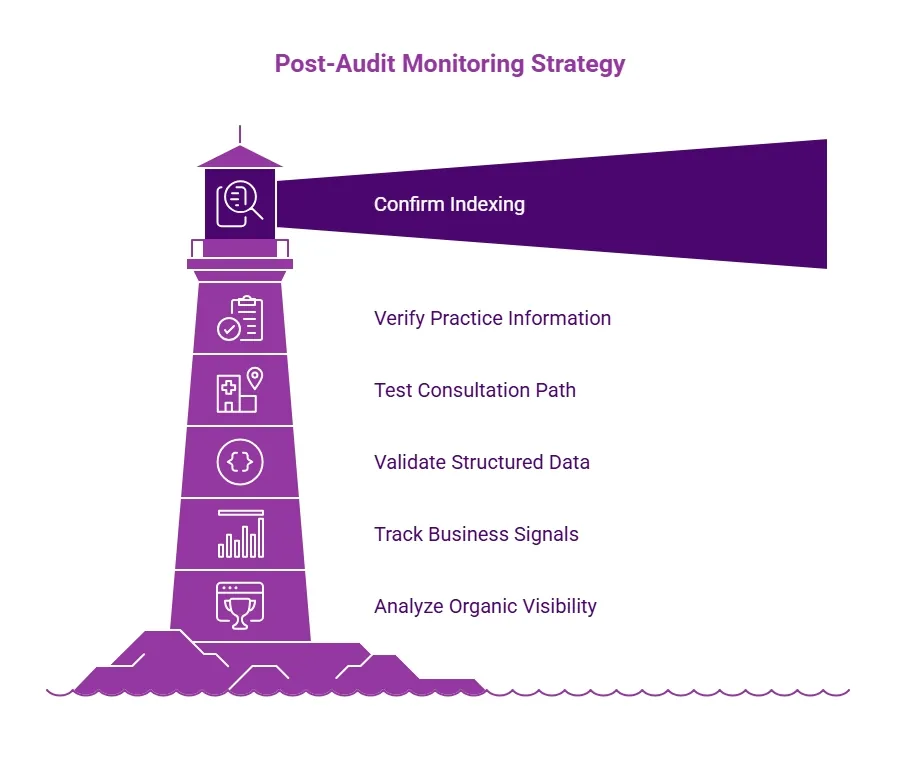
Once priority pages are live, confirm they can be indexed. Search Console’s URL Inspection tool shows Google’s indexed version of a page and can test whether a URL might be indexable. An indexed URL is still not assured a place in search results.
Beyond indexing, keep checking that practice information stays accurate and that the consultation path works end to end.
Where structured data applies, it should accurately reflect what the page visibly shows, following Google Search Central’s introduction to structured data. Markup cannot substitute for missing clinical evidence.
For business signals, track conversion rate and lead quality. More poor-fit, price-driven inquiries are not progress, even when traffic climbs.
In an aesthetics-adjacent market, BVM’s Avere Beauty case study documents three results:
- 287% traffic growth
- 12 number-one rankings
- a primary local term moving from position 62 to position 1
The case illustrates what stronger organic visibility can do. It does not predict a plastic surgery launch timeline.
Opening Day, Ready to Be Evaluated
The date on the glass has not moved, but the gallery folder now has an owner, a reviewer, and a status.
That is the real work of a plastic surgery SEO launch plan. It builds a controlled queue that makes surgeons, procedures, and the consultation path credible when patient research begins. The runway is built. Sequencing the validated dependencies comes next.
For deeper context on how procedure, surgeon, proof, regional relevance, and consultation intent fit together, review BVM’s Plastic Surgery SEO framework.
Verified access. Named owners. Approved proof.
Disclaimer: This content is for informational purposes. Clinical content, patient imagery, privacy obligations, and location-specific business decisions require appropriate professional review. Search performance and consultation outcomes vary by practice.
Our Editorial Process: Our expert team uses AI tools to help organize and structure our initial drafts. Every piece is then extensively rewritten, fact-checked, and enriched with first-hand insights and experiences by expert humans on our Insights Team to ensure accuracy and clarity.
By: The BVM Insights Team
The BVM Insights Team is our dedicated engine for synthesizing complex topics into clear, helpful guides. While our content is thoroughly reviewed for clarity and accuracy, it is for informational purposes and should not replace professional advice.