
 BVM Insights Team
A referred patient opens a specialist's profile page. The degrees are listed, the board certification is visible, and the fellowship is named. The page looks credible. Yet the visitor still cannot tell how this physician's expertise connects to the condition they were referred for, which treatments fall within that clinical focus, or what to do next. The profile established qualification. It did not help the visitor understand whether that qualification relates to their specific situation.
That gap is the problem most practice leaders sense but struggle to define. Treatment intent — the information need behind a search involving a condition, treatment, specialist, or next step — asks questions the biography was never built to answer. The page is accurate, but it was constructed to prove qualification rather than to support a practical decision. Adding more credentials, keywords, or biography length will not create the missing relationships. What follows is a focused audit framework for identifying where that disconnect lives and who should own the fix.
Why Credentials Do Not Automatically Answer Treatment-Intent Questions
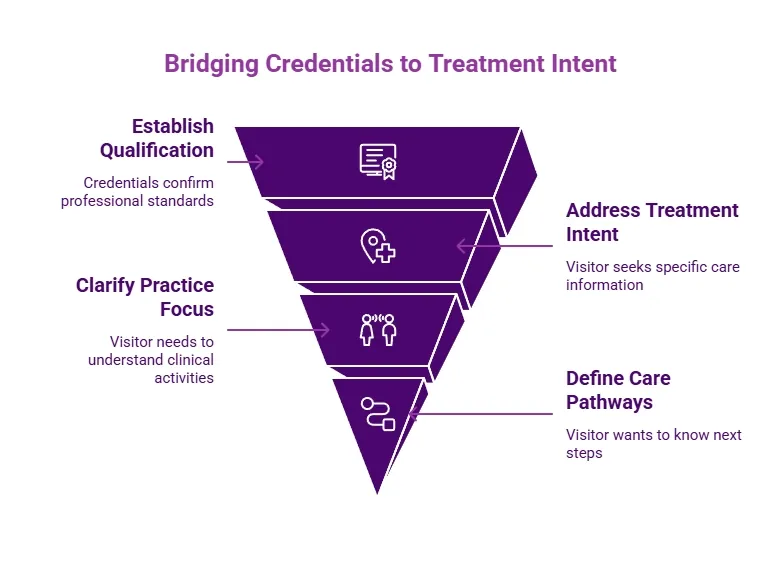
Credentials answer a foundational question: is this person qualified? Board certification, fellowship training, and hospital affiliations confirm that a physician has met established professional standards. That confirmation matters, and nothing here minimizes it.
Treatment intent, however, asks a different set of questions. A visitor arriving with a specific condition or referral wants to understand how this physician's verified expertise relates to their need, which procedures or care roles are involved, and how to move toward an evaluation. A longer biography does not clarify those relationships. It reinforces the same answer the visitor already accepted before clicking.
Consider the difference in practical terms:
| Credential Signal | What a Verified Record May Establish | Question Still Unanswered |
|---|---|---|
| Education and training | Documented educational and training history | What is the physician's current clinical focus? |
| Board certification | The status and scope stated by the relevant certifying body | How does this physician participate in care for a particular condition? |
| Fellowship at a recognized institution | Specialized training verified through institutional records | Which conditions or procedures did that fellowship emphasize in current practice? |
| Institutional affiliation | A current relationship confirmed by the institution and practice | Where is the physician available, and what access steps apply? |
Each credential is valuable. None of them, on its own, tells a treatment-intent visitor what the physician actually does in practice or what the next step should be. This distinction does not minimize qualifications. It prevents the practice from treating a credential as proof of treatment fit — a gap that matters most for referral-driven specialty practices, surgical groups, and diagnostic clinics that need both verified qualifications and clear boundaries around what those qualifications mean on the website.
The Six Questions a Treatment-Intent Visitor Needs the Page System to Answer
A specialist bio does not need to answer every question alone. The broader page system — condition pages, treatment pages, location pages, and appointment pathways — shares that responsibility. The bio's role is to connect the physician to that system clearly enough that a visitor can continue with confidence.
Six questions define that connection:
1. What is this physician's verified clinical focus?
Not a generic specialty label, but an approved description of what the physician concentrates on in current practice. Clinical focus should distinguish meaningful roles without using unsupported superiority language. For a hypothetical multi-physician orthopedic group, one surgeon's focus might center on joint preservation while another's centers on total joint replacement. Identical credentials can support meaningfully different clinical roles, and using the same clinical-focus paragraph for every physician in the group would flatten those differences. For example, instead of a generic label like 'Dr. Smith specializes in orthopedics,' a focused summary reads: 'Dr. Smith is an orthopedic surgeon specializing in joint preservation and arthroscopic repair of the knee and shoulder.
2. Which conditions or patient needs relate to that focus?
A visitor searching for a specific condition needs to see that the physician's work connects to it. Include only connections supported by current practice records and physician review. The bio should reference relevant conditions without implying that every listed condition falls within the physician's exclusive expertise.
3. Which treatments, procedures, or care roles are associated?
A physician might evaluate a condition, perform certain procedures, provide follow-up care, or participate in a broader team. A surgeon who performs a procedure and a nonsurgical specialist who manages the same condition occupy different roles in the care pathway. The bio should make that distinction visible and describe the verified role without implying involvement in every related service.
4. What belongs on the bio versus a condition or treatment page?
The bio summarizes the physician's role and links outward. Detailed condition education, procedure explanations, candidacy considerations, and outcome context belong on pages designed for that depth.
5. Where is the physician available, and are access steps explained?
Location, referral requirements, insurance verification, accepting status, and scheduling logistics shape whether a visitor can act on the information. When access details are missing or outdated, even a well-written bio stalls the visitor at the point of decision.
6. What is the appropriate next step?
The bio should route the visitor toward the verified appointment, referral, or evaluation process — not leave them guessing. That next step might be scheduling a consultation, calling to confirm referral requirements, or reviewing a related condition page for more context before proceeding. The page should not promise eligibility, recommend a treatment, or decide physician fit through copy alone.
Decide What the Bio Should Explain and What It Should Link To
Thin profiles force visitors to reconstruct relevance from disconnected pages. Overloaded profiles duplicate clinical explanations, complicate review, and risk accumulating unsupported scope language. The more useful approach is defining which information the bio owns and which information it points to — and extending that same discipline to every page in the system.
| Page | Explain Here | Link Elsewhere For |
|---|---|---|
| Physician bio | Identity, verified credentials, clinical focus, care role, locations, and next step | Detailed condition, treatment, access, and form content |
| Condition page | Condition education and the practice's approved care context | Treatments, relevant physicians, locations, and evaluation routes |
| Treatment page | Treatment process and supported candidacy limitations | Related conditions, participating physicians, locations, and access |
| Location or access page | Availability, logistics, referral, insurance, accepting status, and scheduling details | Clinical education and physician-specific context |
| Appointment pathway | The verified action and information needed to proceed | Explanations needed before a request is submitted |
The pathway should also make its handoffs visible. A condition page introduces relevant care options. A treatment page explains a supported service. A physician bio clarifies an approved role. A location page confirms access. The appointment route states the next action. This sequence organizes information without presenting navigation as evidence of clinical suitability.
Consider a hypothetical practice where a surgeon's bio currently contains three paragraphs of condition-specific education about rotator cuff injuries. That detail serves the visitor better on a dedicated condition page, where it can be maintained independently and linked from every relevant physician profile. The bio retains a verified summary of the surgeon's clinical focus and role, then links to the condition page for depth. This separation also means that when the condition content is updated, the revision does not require editing every physician profile that references it.
When a physician's clinical focus spans several service lines, resist the urge to duplicate complete explanations on the bio. A concise, verified summary with links to the relevant condition, treatment, and physician content paths keeps the page manageable while preserving meaningful clinical distinctions across a multi-physician group. For deeper guidance on structuring these page relationships, see what physician bio pages need to support treatment discovery.
Add Ownership and Clinical Review Before Adding More Copy
A bio that no one clearly owns tends to degrade quietly. Credentials change, affiliations shift, clinical focus evolves, and locations adjust. Without a defined review process, the page stays frozen at its launch-day version while the physician's practice moves forward.
Content ownership assigns responsibility for maintaining records, drafting, approving high-risk language, publishing, and logging review status. The source of truth is the controlled record for approved physician information — the single document that resolves conflicting terminology when details are scattered across CVs, hospital pages, directories, onboarding records, and service-line documents. The record owner resolves those conflicts before drafting begins, and CMS access never authorizes marketing to infer clinical scope.
Five roles typically need to be assigned:
| Role | Responsibility | Trigger |
|---|---|---|
| Record owner | Maintains the source-of-truth document for each physician's verified information | A record changes or conflicts arise |
| Content drafter | Writes or updates the page copy based on approved source records | New content or material edits |
| Physician or clinical reviewer | Confirms that clinical-focus descriptions, condition references, treatment associations, and scope language are accurate and approved | New or changed clinical claims |
| Brand/editorial reviewer | Ensures consistency, tone, clarity, and compliance with practice communication standards | Public-facing wording changes |
| Publisher | Confirms that reviewed, approved content is published, that approved wording is preserved, and that author, reviewers, date, and status are logged | Final approval or a link change |
Physician review is not optional for clinical statements. Marketing teams may control the CMS, but the accuracy of scope language, condition associations, and treatment descriptions depends on qualified clinical confirmation. A content drafter should never infer expertise from a CV, a directory listing, or a competitor's page. Once a physician approves specific clinical language, that approved wording should be preserved during future edits rather than paraphrased by someone without clinical authority.
A common objection is that physicians lack time to review every change. A practical response is risk-tiered review: route new scope claims and material clinical changes for physician sign-off, while allowing brand and editorial reviewers to handle grammar, formatting, and layout changes independently without altering approved meaning. Preserve approved wording for recurring high-risk statements such as scope descriptions and treatment associations.
Updates should combine a scheduled review cycle with event-driven triggers. Changes to credentials, board certifications, affiliations, clinical focus, treatments offered, service lines, locations, accepting status, referral requirements, insurance participation, or approved messaging should each prompt a review. A scheduled cycle supplements those triggers rather than substituting for them. A visible review date is meaningful only when an actual review occurred — posting a date without a substantive review creates a false signal.
For a more detailed framework on structuring these workflows, see how to build a clinical review workflow for condition-to-physician content.
Run the Specialist Bio Treatment-Intent Audit
The framework above becomes actionable when applied to a real profile. Select one high-priority specialist page and evaluate it against these eight checks. Mark "Needs Verification" when the necessary source, owner, or approval is unclear. Do not fill the gap through inference.
Specialist Bio Treatment-Intent Audit
| Audit Check | Yes | No | Needs Verification |
|---|---|---|---|
| Is physician identity and credential information current and verified against an approved source record? | |||
| Is the clinical focus explained in approved, reader-accessible language (not just a specialty label)? | |||
| Are relevant conditions and treatments connected to the physician without implying universal fit? | |||
| Is the physician's role in the care pathway clear (surgical, nonsurgical, diagnostic, consultative, or other)? | |||
| Do internal links connect the bio to condition, treatment, or service-line pages that provide appropriate depth? | |||
| Are location, referral requirements, accepting status, insurance, and appointment pathways visible or clearly linked? | |||
| Are content owner, author, clinical reviewer, editorial reviewer, publisher, review date, and status documented internally? | |||
| Are scheduled reviews and change-triggered update rules defined so the page does not remain static after credential, affiliation, or scope changes? |
Mark each check honestly. A "No" identifies a content gap that needs drafting and review. A "Needs Verification" flags information that may exist internally but has not been confirmed by the physician or an approved source record. The verification gap requires the physician or record owner to confirm accuracy before anything is published. Assign each gap to the role with the authority to resolve it: the record owner for factual records and terminology, the clinical reviewer for scope language, the author for comprehension improvements after underlying information is approved, and the publisher for final version checks, working links, and documented review trail.
Any clinical gap found during this audit should go to the appropriate physician or practice owner rather than being resolved through inference. If the page simply needs more keywords, the audit will show no evidence, ownership, or routing gap. If it lacks verified relationships, adding phrases will not correct the underlying problem — resolve the information and governance issue first.
Do not convert this checklist into a score. It is not a validated measure of physician quality, clinical suitability, search performance, or appointment outcomes. Its purpose is to reveal incomplete relationships and identify the person responsible for the next action.
Connecting Verified Expertise to the Care-Information Pathway
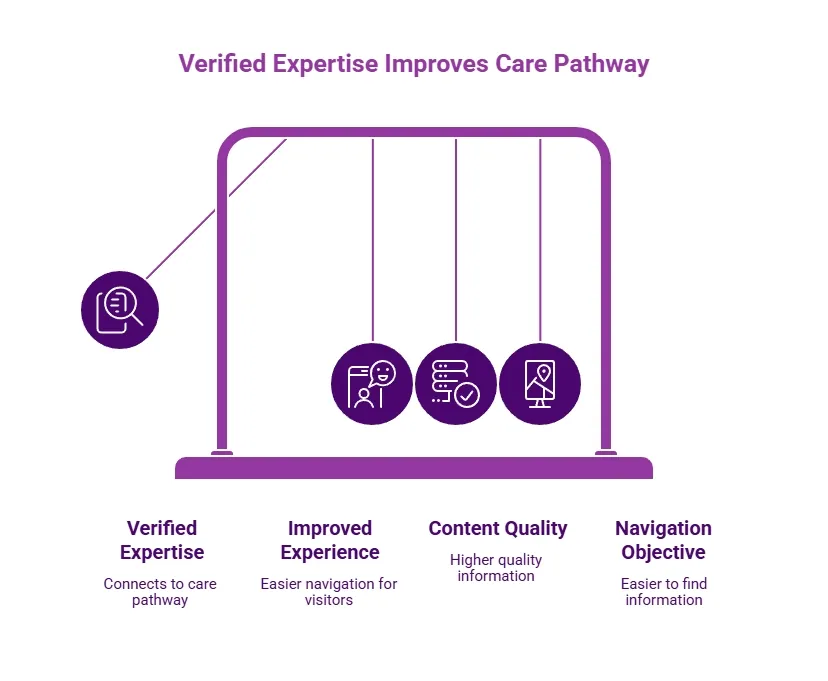
A useful physician bio does not simply collect more credentials or stretch the biography into a longer narrative. It connects verified expertise to the larger system of condition pages, treatment pages, location details, and appointment pathways that a treatment-intent visitor needs to navigate. That connection is a content-quality and navigation objective. It may improve the visitor's experience, but it does not guarantee rankings, referrals, or appointment volume.
The audit above gives your team a starting point. Apply it to one specialist page, assign each gap or verification need to the right stakeholder, and use the results to decide whether your physician-content system needs a broader evaluation.
Frequently Asked Questions
Disclaimer: This article provides general educational information about healthcare website content and does not provide medical, legal, or regulatory advice. Physician credentials, affiliations, scope statements, and clinical content should be verified and reviewed by qualified professionals before publication.
Our Editorial Process: Our expert team uses AI tools to help organize and structure our initial drafts. Every piece is then extensively rewritten, fact-checked, and enriched with first-hand insights and experiences by expert humans on our Insights Team to ensure accuracy and clarity.
By: About the BVM Insights Team
The BVM Insights Team is our dedicated engine for synthesizing complex topics into clear, helpful guides. While our content is thoroughly reviewed for clarity and accuracy, it is for informational purposes and should not replace professional advice.