
 Dustin Ogle
A specialty practice can have hundreds of medically accurate pages and still leave one fundamental question unanswered: which specialist is relevant to a given patient need, and why? The issue is rarely that the library is too small. More often, the pages exist but their roles overlap, their relationships to specific physicians remain vague, and the path from a condition to the right specialist is something readers piece together on their own.
Marketing leaders may feel caught between two risks here. Slowing production can feel like lost momentum, while continuing without clear ownership can create more overlap. A better next step is diagnostic. Audit the content already in place, identify where relationships are unclear, and decide whether to clarify, connect, consolidate, or create. The six-part Specialist Relevance Audit below provides a repeatable method, along with a framework for choosing among those four responses.
A Bigger Medical Content Library Can Still Leave the Care Path Unclear
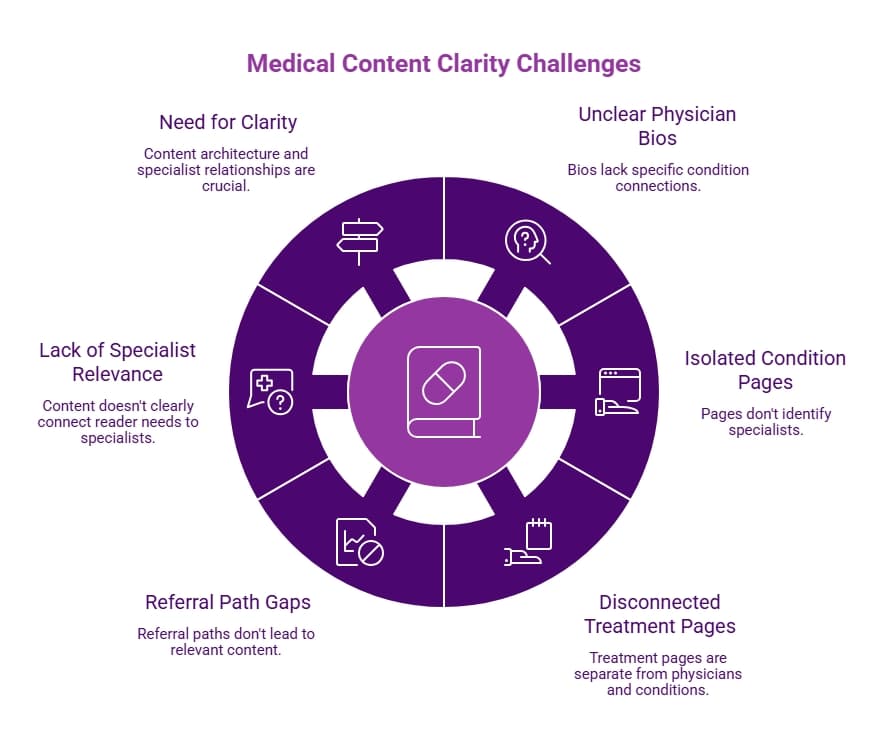
Page count and content completeness answer different questions. A practice can cover dozens of conditions and still fail to show how those topics connect to actual specialist expertise. The gap appears in predictable places: physician bios that list broad affiliations without connecting to specific conditions, condition pages that never identify which specialist evaluates the problem, treatment pages isolated from both the performing physician and the conditions they address, and referral paths disconnected from the content that should lead there.
Consider a hypothetical specialty group that publishes regularly. A reader finds two condition articles covering similar territory, neither naming a specialist. The physician bios mention the service line but do not connect to condition pages. The treatment page links to a general scheduling form. Every page is accurate, but the relationships among them are unclear. For example, a condition page for 'chronic knee pain' might end with a generic 'Contact Us' button, while the practice’s actual knee specialist is buried in an unrelated staff directory, and the 'arthroscopic knee surgery' page links to neither.
More pages do not solve this. Page-role clarity, verified specialist relationships, and explicit connections do. Before proceeding, three terms anchor this strategy. Specialist relevance is how clearly a site communicates a verified relationship among a reader need, the practice's content, relevant specialist information, and the next information or access step. A page role is the single primary question or decision a page owns. Content architecture is the system that organizes those roles and connections. Publication frequency is easy to count, but leadership still needs a defensible reason for the next content investment. Existing pages should first show whether the problem is missing information or unclear structure.
Run a Six-Part Specialist Relevance Audit Before Publishing Another Page
Apply this audit to any service line or content cluster. Start with a high-priority area — the service line generating the most questions or the most internal confusion about page ownership — and evaluate five to ten key pages before expanding to the full inventory.
The audit uses three statuses:
- Clear: Role and relationship are current and understandable.
- Unclear: Role, evidence, ownership, or next step is ambiguous.
- Needs clinical review: Qualified medical judgment is required before publication.
Name one audit owner to coordinate reviewers, document decisions, and trigger updates when physician roles or access details change.
1. Give Every Page One Primary Job
Each page should answer one principal reader question. A condition page explains the problem and who might need evaluation. A treatment page explains what the intervention involves. A physician page explains who the specialist is and what clinical focus they bring. When one page tries to serve as condition explainer, treatment overview, physician introduction, and scheduling prompt simultaneously, its primary job becomes impossible to identify. If you cannot state the page's most important reader question in one sentence, the role needs revision.
2. Verify the Condition-to-Specialist Relationship
Ask whether each condition page identifies a relevant specialist and whether that relationship reflects actual practice evidence. Marketing teams should not assign a physician to a condition page based on assumptions about clinical scope. The connection should come from an approved internal source: credentialing records, clinical leadership confirmation, or documented service-line responsibility.
Physician relevance may vary by procedure, patient population, location, or care role. Editorial page ownership does not create exclusive clinical ownership. As a hypothetical example, imagine three physician bios at a specialty group all mention the same service line. The marketing team wants to designate one as the primary specialist for a particular condition page. Without an approved source clarifying each physician's actual clinical role, the team risks publishing a relationship it cannot substantiate. Flag any condition-to-physician assignment that lacks practice evidence for clinical review before publication.
Review relationships across the content set as well. Individual statements can be accurate while separate pages still describe the same physician role inconsistently.
3. Connect Treatments Without Turning Content Into Medical Advice
Treatment pages can support the information path by explaining what a procedure involves, what conditions it may address, and which specialist performs it. The boundary is that marketing content should not imply patient candidacy, recommend a treatment for a specific symptom, or suggest one intervention over another. Those determinations require clinical judgment. Connect treatments to the broader architecture based on verified practice relationships, and route anything that crosses into clinical recommendation to a qualified reviewer.
A valid clinical referral pathway may also include steps that differ from a simple digital conversion path. Do not reduce that process to "book now" merely to simplify the website journey.
4. Make Physician Expertise Evidentiary, Not Promotional
A specialist-relevance claim is only as strong as the evidence behind it. Physician pages should connect expertise to approved credentials, board certifications, documented clinical focus, fellowship training, or service-line responsibilities. Stating that a physician "specializes in" a condition carries an implicit clinical claim, so the content should reflect what the practice can substantiate. Record where that evidence lives, who owns it, and what triggers review. For a deeper workflow, see supporting specialist-relevance claims with verifiable practice evidence.
5. Check Whether the Reader Can Follow the Full Information Path
A reader who arrives on a condition page should be able to move logically to a relevant treatment overview, a relevant physician page, and an appropriate next step without starting a new search. Does the condition page link to the treatment it discusses? Does the treatment page identify the performing physician? Does the physician page connect back to conditions and treatments within their verified scope? Look for isolated pages, inconsistent terminology, stale access details, and contradictory destinations. Keep physician roles, service names, treatment terms, and access details consistent across pages.
Internal links cannot make an unsupported clinical relationship valid. Verify the connection first. Even if a team expects a search system to infer context, do not make inference the governance model. For a detailed approach, see how to map symptom, condition, treatment, and specialist pages without search overlap.
6. Identify Overlap Before Adding Another URL
Before creating a new page, check whether an existing one already serves the same reader need. Overlap is common when multiple service lines address related conditions, when different authors create similar content independently, or when legacy pages remain live alongside newer versions. Overlap can be legitimate when pages answer different questions or support distinct physician contexts or access needs. If two pages answer the same core question, resolve the duplication rather than add a third.
Sunk cost can complicate consolidation. An older page may have traffic, backlinks, history, or internal stakeholders. Do not delete, redirect, merge, or canonicalize solely because editorial roles overlap — technical consequences require separate SEO review. For context on why distinct page roles matter, see separate condition, treatment, and physician content paths.
Specialist Relevance Audit Summary
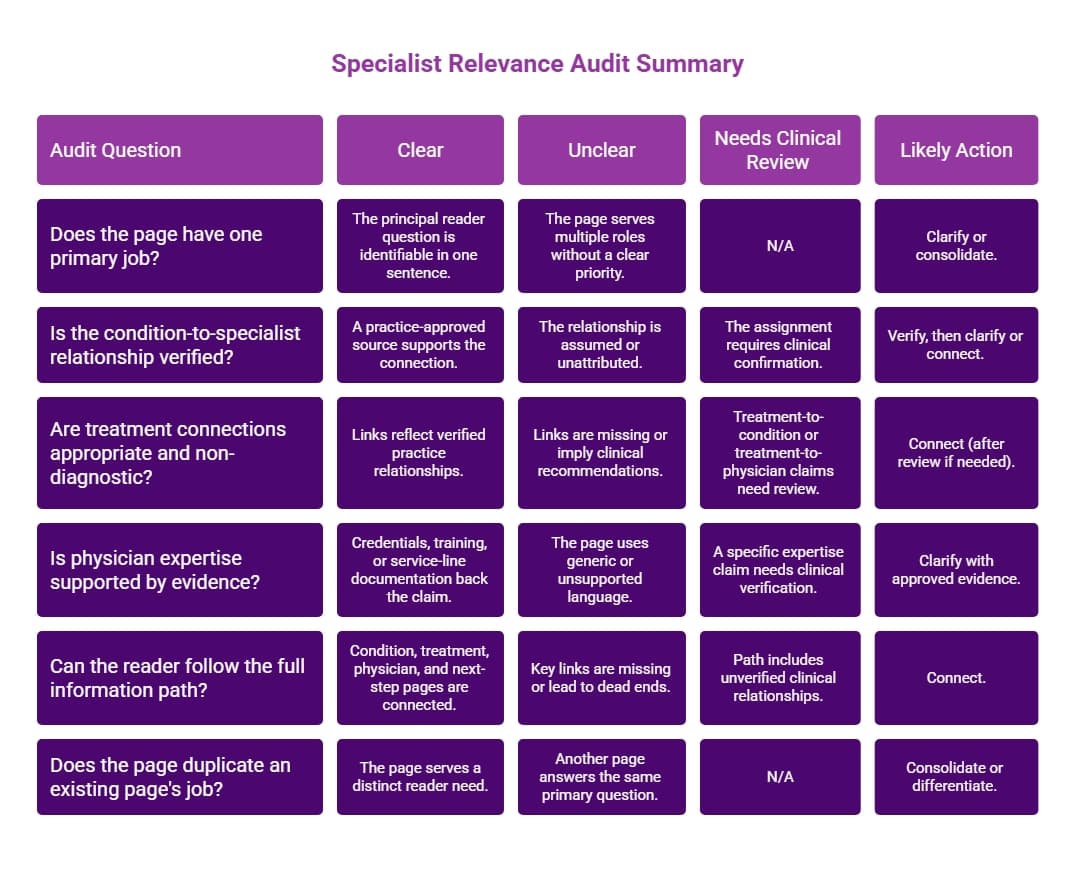
| Audit Question | Clear | Unclear | Needs Clinical Review | Likely Action |
|---|---|---|---|---|
| Does the page have one primary job? | The principal reader question is identifiable in one sentence. | The page serves multiple roles without a clear priority. | N/A | Clarify or consolidate. |
| Is the condition-to-specialist relationship verified? | A practice-approved source supports the connection. | The relationship is assumed or unattributed. | The assignment requires clinical confirmation. | Verify, then clarify or connect. |
| Are treatment connections appropriate and non-diagnostic? | Links reflect verified practice relationships. | Links are missing or imply clinical recommendations. | Treatment-to-condition or treatment-to-physician claims need review. | Connect (after review if needed). |
| Is physician expertise supported by evidence? | Credentials, training, or service-line documentation back the claim. | The page uses generic or unsupported language. | A specific expertise claim needs clinical verification. | Clarify with approved evidence. |
| Can the reader follow the full information path? | Condition, treatment, physician, and next-step pages are connected. | Key links are missing or lead to dead ends. | Path includes unverified clinical relationships. | Connect. |
| Does the page duplicate an existing page's job? | The page serves a distinct reader need. | Another page answers the same primary question. | N/A | Consolidate or differentiate. |
Choose the Fix: Clarify, Connect, Consolidate, or Create
Each audit finding maps to one of four actions. Use the smallest intervention that resolves the actual problem. Match what you observed to the appropriate response, the mistake to avoid, and the team that owns the resolution.
| Signal Observed | Appropriate Action | What Not to Do | Review Owner |
|---|---|---|---|
| The right page exists, but its role or specialist relationship is unclear. | Clarify. Sharpen the page's primary role and verify clinical claims before republishing. | Do not leave an unverified specialist relationship in place while improving surrounding copy. | Marketing leads rewrite; clinical reviewer verifies specialist or treatment claims. |
| Relevant pages exist, but readers cannot move logically among them. | Connect. Add internal links, physician attributions, or next-step paths that complete the architecture. | Do not add links implying clinical relationships the practice has not confirmed. | Marketing leads link placement; clinical reviewer confirms underlying relationships. |
| Multiple pages duplicate the same reader need. | Consolidate. Merge or retire the redundant page after a technical assessment of traffic, backlinks, and redirect consequences. | Do not merge or remove URLs without a technical SEO review. | Technical/SEO reviewer assesses risk; marketing coordinates the merge. |
| A distinct reader need has no appropriate page, and the clinical or service relationship is verified. | Create. Build a new page with a clear primary job and verified relationships from the start. | Do not create the page if an existing one could serve the role after clarification, connection, or consolidation. | Marketing leads development; clinical reviewer verifies the relationship before publication. |
Clarify when the information exists but its role, terminology, evidence, or next step is difficult to understand. Connect when the right pages exist but operate as separate islands. Consolidate when several pages materially duplicate the same information job — though not every overlapping page should be consolidated. Create only when a distinct reader need has no appropriate owner page and the practice can verify the relationship being represented. "Every condition deserves a page" is not a sufficient reason. Neither is "the health system has one."
Do not treat ranking movement, AI mentions, traffic, or appointments as built-in proof that this audit worked. This framework is designed to improve content governance and decision clarity. Search and business performance require a separate, site-specific measurement plan with appropriate baselines and evidence.
Compete With Large Health Systems by Making Your Specialty Easier to Understand
A large health system may cover dozens of specialties and locations. Matching that volume page for page is neither realistic nor necessary for most independent practices.
The opportunity is different: make the relationships among your conditions, treatments, specialists, and next steps explicit rather than implied. Where a larger institution spreads attention across a wide scope, a specialty practice can concentrate on explaining its own verified expertise with greater precision.
| Content Model | What It Emphasizes | Strategic Risk |
|---|---|---|
| Institutional breadth | Wide topic coverage across many specialties, service lines, and locations. | Breadth may dilute the clarity of individual specialist relationships. |
| Specialist clarity | Explicit, verified relationships within a narrower clinical scope. | Narrower coverage may leave some adjacent topics unaddressed. |
These are different models, not a winner and a loser. Neither inherently performs better. The question is whether a reader can understand which specialist is relevant, what that expertise is based on, and what to do next.
Competitive pressure can still push a smaller practice toward imitation, and that often produces a page count goal instead of a clarity goal. A more defensible approach is to identify the smallest set of pages needed to explain the practice accurately, then make the relationships among those pages explicit. The practice does not need to claim its specialists are better than a hospital's physicians. It needs current evidence for its own expertise and a content architecture that presents that evidence consistently.
One adjacent question worth acknowledging: whether clearer structure also improves visibility in AI-generated search results. That requires current, platform-specific evidence before any reliable claim can be made. This audit is designed around human-facing information clarity, which remains valuable regardless of how any particular search or AI system interprets the structure.
For a broader look at how medical specialty SEO connects content architecture to search strategy, that resource covers the wider evaluation context this article stays upstream of.
What to Do Next
Select one high-priority service line. Pull five to ten key pages in that cluster: condition pages, physician pages, treatment pages, and scheduling or referral entry points. Run the six-part audit. Score each page. Record unclear roles, stale evidence, unsupported relationships, disconnected paths, review dependencies, and overlapping ownership. Then assign each issue one action and one accountable owner.
The goal is not to freeze publishing. It is to make the next publishing decision defensible to marketing, physicians, web teams, and leadership. Do not add a page until you can state the information job the new page will perform that the current architecture does not.
If you want a structured evaluation of how your specialty content performs in search, Get My Specialty Search Audit.
Frequently Asked Questions
Disclaimer: This article is for general informational purposes only and does not constitute medical advice, diagnosis, or treatment. Readers should consult a licensed healthcare professional for guidance specific to their health, symptoms, medications, or treatment options.
Our Editorial Process: Our expert team uses AI tools to help organize and structure our initial drafts. Every piece is then extensively rewritten, fact-checked, and enriched with first-hand insights and experiences by expert humans on our Insights Team to ensure accuracy and clarity.
By: About the BVM Insights Team
The BVM Insights Team is our dedicated engine for synthesizing complex topics into clear, helpful guides. While our content is thoroughly reviewed for clarity and accuracy, it is for informational purposes and should not replace professional advice.