
 BVM Insights Team
A referring physician hands a patient a name, a specialty, maybe a phone number. That recommendation carries weight. Yet when referral coordinators and practice administrators compare incoming referrals against completed appointment requests, the numbers do not always align. The gap between "recommended" and "scheduled" can feel invisible because the friction may not live in one system or under one team's responsibility.
The useful question is not, "Why did this patient leave?" It is, "Where does the available evidence show a possible break in the pathway?" The stages between recommendation and appointment request form a referral validation journey: the sequence of information checks a prospective patient may complete before acting. A momentum gap—a place where forward movement toward the appointment weakens—can develop at any point in that sequence. The following diagnostic framework locates those gaps and assigns the next investigation step using your practice's existing evidence, avoiding assumptions about patient motive or treating appointment volume as proof of clinical fit.
A Physician Referral Can Lead Into a Separate Validation Journey
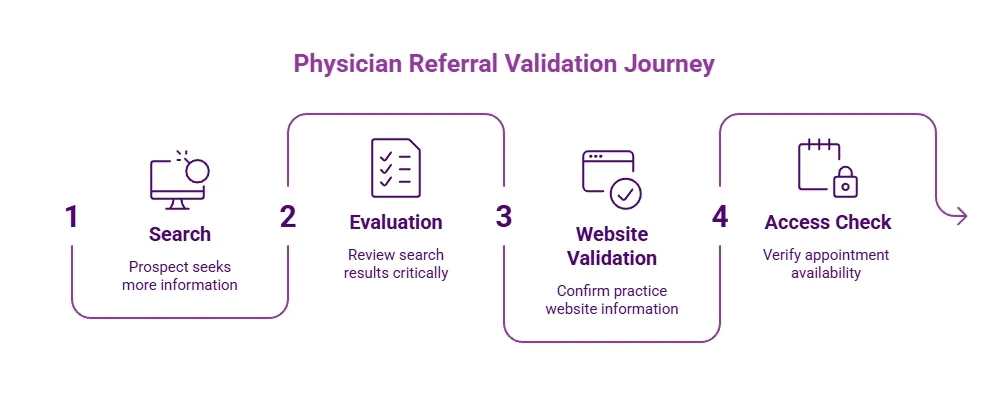
A recommendation creates initial interest, but it does not resolve every question a prospective patient may need answered before requesting an appointment. For this framework, treat the validation journey as a sequence: recommendation, search, search-result evaluation, website validation, access check, and appointment pathway. Each stage is a point where additional information may be needed. If that information is difficult to find or unclear, the next step may feel less certain.
This sequence is a diagnostic model, not a universal path. Individual situations vary by specialty, condition complexity, and urgency. Some people may contact the practice immediately, while others may follow instructions supplied by the referring office. The model gives referral coordinators and practice administrators a structured way to investigate where friction could exist rather than guessing at a single explanation.
The model still matters when referrals appear strong or the practice ranks for its name. Branded visibility confirms one checkpoint, not whether physician pages explain fit, access information agrees, or the next action works on mobile. Complexity can grow when one condition connects to several specialists, locations, or care pathways. Practices can review when one condition needs more than one physician pathway on a specialty practice website without suggesting that website content determines clinical fit.
When a referred prospect encounters a page that supports condition and treatment search discovery, the journey may continue smoothly. When the result or access information raises an unanswered question, that stage becomes worth investigating.
Map the Questions That Must Be Resolved at Each Stage
Each stage corresponds to a question a prospective patient may try to resolve. Treating these as investigation prompts, not confirmed patient priorities, helps your team audit the pathway without attributing motive. Physician credentials, clinical focus, locations, insurance information, referral requirements, and appointment instructions must come from current practice-approved records. Clinical descriptions and physician-fit statements also require appropriate review.
- Can the practice and referred physician be found? A branded search should return the correct practice and physician. If the physician's name produces an outdated listing or no result, friction begins at the first stage.
- Does the search result appear relevant to the recommended need? The title and description should connect the physician to the condition discussed. Ranking for the practice name alone does not resolve this stage; the result needs to connect to the concern behind the referral.
- Does the physician page establish current, reviewable fit? Credentials, specialty focus, and conditions managed help confirm that the recommendation aligns with the prospective patient's need. In a hypothetical example, a referred prospect finds the page, but it lists only a title and office address without the relevant condition or specialty area. The page is visible, but the fit question remains unanswered. Physician-fit claims require practice verification and clinical review. For example, a complete physician-fit statement might read: 'Dr. Smith specializes in conservative, non-surgical management of complex spinal deformities in adults
- Do condition and treatment pages connect to the appropriate physician? When a condition requires more than one physician pathway, the relationship between the condition page and the right physician should be explicit.
- Are location, insurance, referral requirements, and scheduling details current? Access information that differs across pages or omits referral instructions introduces uncertainty at the moment closest to action.
- Is the appointment pathway usable on mobile? If the appointment form is difficult to complete on a smaller screen, the friction may resemble weak demand when it is actually a usability problem. A mobile form issue and genuinely low interest produce similar analytics signals. Test the pathway on mobile before concluding that interest is the issue.
Referral-to-Search Momentum Diagnostic Matrix
| Journey Stage | Question to Resolve | Observable Signal | Evidence to Review | Likely Owner | Safe Interpretation | Next Step |
|---|---|---|---|---|---|---|
| Search | Can the physician and practice be found? | Physician name returns irrelevant or missing results | Search console data, branded queries | Marketing / web team | Visibility may need attention, not proof of lost patients | Audit branded and physician-name queries |
| Search-result evaluation | Does the result look relevant? | Title or description omits specialty or condition context | SERP review, page metadata | Marketing / web team | Result may not reinforce the recommendation | Review titles and descriptions for referred specialties |
| Physician-page validation | Does the page confirm fit? | Page lacks specialty detail or condition context | Physician page audit, clinical review | Marketing, physician, clinical reviewer | Incomplete information may leave questions open | Compare page content against current scope |
| Condition/treatment connection | Is the physician linked to the condition? | Condition pages do not reference the physician | Content mapping, internal link audit | Marketing, clinical reviewer | Missing connections may reduce clarity | Map physician-to-condition relationships |
| Access check | Are logistics clear? | Insurance, location, or referral instructions differ across pages | Access audit, front-desk verification | Operations, scheduling, web team | Inconsistent details may create uncertainty | Verify access info against current operations |
| Appointment pathway | Can the next step be completed? | Form errors, broken links, or mobile usability problems | Form testing, analytics, call tracking | Web team, scheduling, IT | A broken pathway may look like weak interest | Test the appointment path on desktop and mobile |
Behavioral signals identify where to investigate. They do not prove why an individual did not schedule.
Separate Visibility, Confidence, Access, and Referral-Process Gaps
Not every suspected breakdown has the same cause, and not every cause lives in the same team. Four diagnostic categories help prevent the default assumption that "the website must be the problem." Several digital and operational stages can produce similar signals, and each points to a different owner.
| Gap Type | Definition | Observable Signals | Evidence to Review | Likely Owner |
|---|---|---|---|---|
| Search-visibility | The correct practice or physician is difficult to locate | Low impressions for physician-name queries, outdated directory listings | Search console data (such as Google Search Console), directory accuracy | Marketing / web team |
| Page-confidence | Available pages do not resolve fit, credentials, or next-step questions | Physician pages without specialty detail, condition pages that do not reference the physician | Page content audit, clinical review, internal link audit | Marketing, physician leadership, clinical reviewer |
| Access | Location, insurance, referral requirements, or scheduling instructions are unclear or inconsistent | Conflicting information across pages, absent referral instructions | Access audit, front-desk verification, scheduling records | Operations, scheduling, web team |
| Referral-process | The referring and receiving workflows do not transfer information or ownership reliably | Referrals received without contact information, delayed follow-up, patients told to "call the office" without detail | Referral logs, intake records, call tracking | Referral coordinator, intake team, referring office liaison |
These categories are working hypotheses, not mutually exclusive diagnoses. One route may contain a visibility problem and an access conflict, while another may reach the correct physician page but fail during intake. Record each signal under the category that determines the next investigation, then revise the classification when stronger evidence appears.
A visibility gap does not confirm a patient searched and left. A page-confidence gap, particularly when physician expertise is not mapped clearly to treatment content, means available information may not support the recommendation, not that a patient decided against the practice. A page-confidence review should follow the same discipline as every other category: if a physician page contains verified credentials but lacks a clear location or appointment route, correct those specific gaps rather than treating additional copy as the default remedy.
An access gap may be as specific as a hypothetical practice whose physician page lists three locations while the form defaults to one. Consider a case in which one page lists a referral requirement while another does not. Operations can resolve the discrepancy against current policy, but the conflicting pages do not reveal whether a visitor noticed it. A referral-process gap prevents the website from absorbing blame for operational handoffs. Each category identifies where to investigate, not what caused the outcome.
A broken mobile form often mimics weak demand in your analytics, just as weak demand can mimic a technical failure. Strong branded visibility can also coexist with an incomplete referral status or a scheduling delay. These patterns require evidence from more than one function.
Run a Cross-Functional Referral-Validation Audit
A single team reviewing one system is unlikely to locate friction that spans visibility, content, access, and operations. A cross-functional audit surfaces competing explanations and prevents premature conclusions.
Referral, website, analytics, call, and scheduling data may sit in separate systems. A practice may be unable to identify one referred visitor across the full journey, and referring offices may provide inconsistent instructions or incomplete contact details. Several reviewers may also be required before physician or clinical content changes. Referral coordinators, administrators, marketing staff, website owners, intake and scheduling teams, physician leadership, and clinical or compliance reviewers should test competing explanations rather than favoring the explanation closest to their own function. Agree on those responsibilities before corrective work begins.
- Choose one referral source, specialty, physician, or service line. Start narrow. A practice-wide audit dilutes focus.
- Document the intended referral-to-appointment path. Write down what should happen after the recommendation: who contacts whom, what transfers, and where the prospective patient is expected to go.
- Recreate the research journey on desktop and mobile. Search for the physician name, practice name, and relevant condition. For instance, branded visibility might be strong while the physician profile omits the specific condition being researched. Meanwhile, the referral log shows the referring office sent the referral without a preferred contact method. The confidence stage and the referral-process stage both need attention, and the evidence comes from different systems.
- Compare visible information with current practice-approved facts. Are credentials current? Is insurance accurate? Does the online referral process match the actual intake workflow?
- Review analytics, call records, form behavior, referral statuses, and scheduling outcomes. Look for patterns, but do not infer individual motives from aggregate data. Analytics show what happened, not why.
- Record evidence gaps and competing explanations. A broken form, delayed appointment, incomplete referral, unclear page, weak demand, and tracking gap may produce similar summaries. Each team may favor the explanation closest to its own function. When the data supports more than one, document both.
- Assign an owner and review date. Each suspected gap needs a named person responsible for the next step, including every required clinical or compliance reviewer.
- Change one high-confidence issue at a time. Monitor the signal closest to that correction instead of treating a broad redesign as proof of improvement.
Any step involving patient data, call recordings, or tracking configuration should follow the practice's privacy and compliance requirements. Any new analytics implementation or combination of identifiable patient information requires qualified review. This article does not provide privacy, legal, or implementation guidance.
Prioritize the Gap With the Strongest Evidence
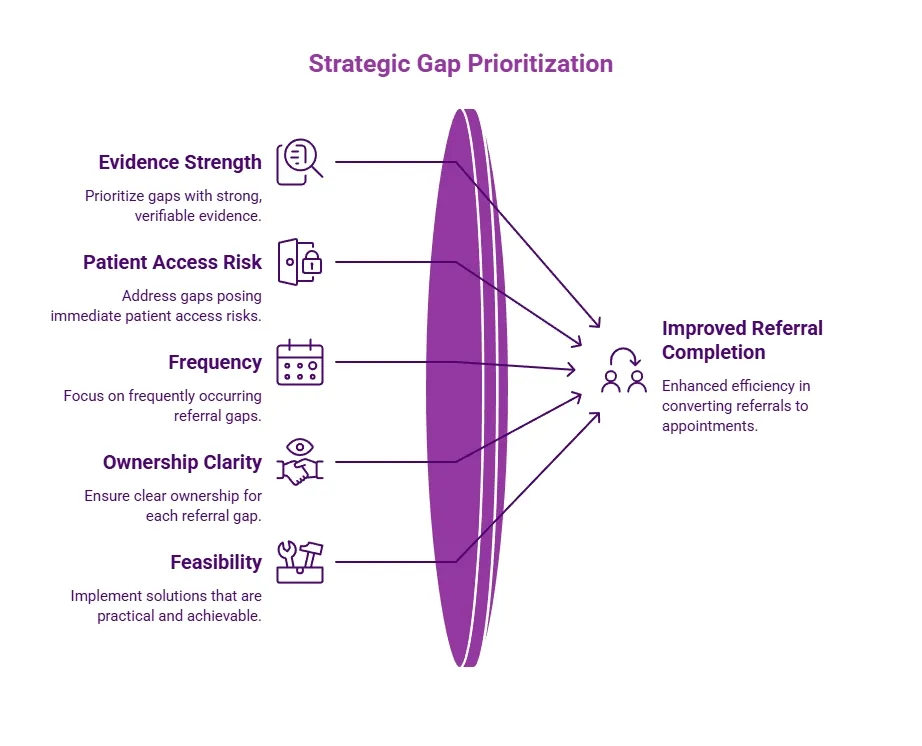
Multiple suspected gaps will compete for attention. Prioritize by evidence strength, patient-access risk, frequency, ownership clarity, and feasibility. Small teams should correct urgent, verifiable facts first, then reserve limited review capacity for the uncertainties closest to an appointment action.
An urgent factual correction—outdated insurance information, a broken form, an incorrect phone number—differs from a lower-confidence content experiment such as rewriting a physician bio to add condition context. The correction has clear evidence, a defined owner, and an immediate access concern. The experiment requires clinical review and a measurable signal before its effect can be evaluated. A thin physician page does not automatically need more words. It needs accurate information that resolves a verified gap. Fix verified gaps before adding content volume indiscriminately.
Lower-confidence patterns need a test or data task, not a confident conclusion. If users reach a page but no downstream event appears, verify the measurement before rewriting the content. If referral activity remains stable while scheduling completion changes, compare access and intake evidence before attributing the pattern to search. When attribution is unclear, the response is a test or data-collection task, not a confident conclusion.
A benchmark from another specialty, market, or measurement definition cannot reliably indicate whether your referral completion is normal. Track a consistently defined internal baseline instead. Increasing appointment volume is not inherently the goal. Appropriate clinical fit, accurate access information, and qualified review matter more than volume. Misrepresenting scope or credentials creates a different kind of risk.
For broader context on connecting search visibility to patient access, appointment-first healthcare SEO may complement this diagnostic approach. The same discipline applies: work backward from the intended action and distinguish a verified defect from a hypothesis.
Turn "Lost Momentum" Into a Testable Question
The goal is not to blame a page, a team, or a patient, or to declare that every unresolved referral is a website or scheduling failure. It is to locate the first uncertain point, identify evidence that could confirm or challenge it, and place the next review with the right owner.
Map one referral pathway from recommendation to appointment request, record the evidence at each stage, and assign an owner to the first unresolved gap. That single pathway will reveal more about where momentum weakens than a broad assumption about what patients want or what the website should do.
Frequently Asked Questions
Disclaimer: This article is for general informational purposes only and does not constitute medical advice, diagnosis, or treatment. Readers should consult a licensed healthcare professional for guidance specific to their health, symptoms, medications, or treatment options.
Our Editorial Process: Our expert team uses AI tools to help organize and structure our initial drafts. Every piece is then extensively rewritten, fact-checked, and enriched with first-hand insights and experiences by expert humans on our Insights Team to ensure accuracy and clarity.
By: About the BVM Insights Team
The BVM Insights Team is our dedicated engine for synthesizing complex topics into clear, helpful guides. While our content is thoroughly reviewed for clarity and accuracy, it is for informational purposes and should not replace professional advice.