 Dustin Ogle
A specialty practice can have polished physician bios, organized service pages, and location coverage across every office — and still lose a significant share of treatment-intent searches. The problem is rarely a missing keyword. More often, it is a missing connection.
When a patient searches for 'rotator cuff repair specialist' or 'GI doctor for Crohn's disease,' a credentials summary alone is rarely enough. They are looking for a page that connects a specific condition or treatment to a specific physician, program, and appointment path. When that connection is absent from the site architecture, the search may surface a generic result, return a lower-priority page, or fail to reach the most relevant specialist at all. This article explains where those connections typically break, which page type should own each kind of search, and what a practical first audit looks like before any large content rebuild begins.
Treatment-Intent Searches Often Don't Start With a Physician's Name
Many patients who have not yet chosen a specialist begin their search with what they already know: a diagnosis, a symptom, a procedure they've been referred for, or a specialty they need in a reachable location. A patient preparing for a second opinion on a knee injury may search "orthopedic surgeon for ACL reconstruction." Someone recently diagnosed with a retinal condition may look for "ophthalmologist for macular degeneration" before they know which physician they want to see.
BVM's high-value healthcare SEO materials support this framing: higher-consideration healthcare users frequently search by diagnosis, treatment path, program type, provider credibility, and location access. The path toward a specialist appointment often begins long before the patient knows a specific doctor's name. Aligning a specialty practice SEO strategy to how patients actually enter the search journey is what distinguishes a site that converts from one that merely exists online.
A strong specialty practice architecture helps connect those searches by answering four questions clearly:
1. What condition, symptom, or procedure is being researched?
2. Which specialty or service line treats it?
3. Which physician or physician group has relevant expertise?
4. Where and how can the person take the next appropriate step?
Where Specialty Practice Architecture Breaks
When those answers live on disconnected pages, the website may appear complete while still failing to route searchers effectively.

Disconnected pages — not missing pages — are the most common cause of lost treatment-intent searches. Five structural failure patterns recur across specialty types, and a sixth undermines even well-constructed content.
An orthopedic group has a dedicated rotator cuff page explaining the anatomy and surgical options, but the page provides no link to the shoulder specialists who perform the procedure and no indication of which locations offer it. A dermatology practice has physician bios for each provider, but every bio lists "medical dermatology" as an area of expertise without naming specific treatable conditions. A patient searching for a "dermatologist for psoriasis" finds no condition-level signal on any physician page and cannot confirm fit.
A gastroenterology group maintains separate procedure pages for colonoscopy and upper endoscopy. Neither page names the physicians who perform those procedures or identifies which offices offer them. A cardiology practice has location pages for three offices, each listing an address and general hours, but none of those pages identifies available subspecialists or the diagnostic services offered on-site. Patients searching for a cardiologist for heart failure near a specific area cannot determine where to go.
Beyond these structural gaps, weak internal linking creates a sixth failure that affects even well-written content. Educational pages may explain a condition accurately and attract meaningful search traffic while never linking to the relevant physician, the procedure involved, or the appointment path. The visit ends without a conversion opportunity because the architecture stops at the article's edge. That is where an appointment-first healthcare SEO approach can support conversion confidence without turning content into a hard sell.
Why Physician Pages Underperform as Standalone SEO Assets
A traditional physician bio answers, "Who is this doctor?" A stronger physician page also answers, "When is this doctor relevant to the searcher's need?" That distinction defines whether a bio functions as a trust document or as an active part of the search architecture.
Physician bios serve a genuine trust function — patients want to know their provider's training and credentials. The problem is that most bios are built for the patient who has already selected the practice and is comparing providers, not for the patient whose search began with a condition. A typical bio leads with medical school, residency, fellowship, and board certifications. That information is meaningful for credentialing. It does not reach the patient searching "neurologist for essential tremor" or "urologist who treats interstitial cystitis."
For a physician page to function as part of a working search architecture, it generally needs:
- The conditions the physician treats
- The procedures performed
- Any subspecialty focus distinguishing this provider from others in the group
- The locations where the physician sees patients
- A clear path to a consultation or referral
A dermatology bio that says "medical dermatology" may be accurate but still too broad to guide condition-level searches. A cardiology profile may list impressive credentials but omit relevant diagnostic services or location availability. A specialist may have deep expertise, but if the page does not connect that expertise to search intent, discoverability remains limited.
Google's helpful, people-first content guidance emphasizes material that genuinely serves the user's informational need. Its SEO Starter Guide reinforces the same principle: pages should be written for people, organized to answer real questions, and structured so that relevant information is easy to find. A bio confirming academic history without clarifying whether this physician treats a patient's condition — at a reachable location, with a visible next step — leaves the most consequential questions unanswered. Adding structured relevance to physician pages also creates the connective tissue that allows condition pages and procedure pages to link purposefully to the right provider.
Clinical content should be reviewed by qualified clinicians or approved internal subject-matter reviewers before publication. That review should focus on medical accuracy, treatment descriptions, risk language, and whether the page makes claims the practice can support.
The Condition-to-Physician Mapping Model
Before auditing or rebuilding pages, it helps to define what each page type is responsible for. The goal is not to make every page longer. The goal is to decide what each page owns and what it should connect to.
| Patient Search Entity | Page Role | What It Should Connect To |
|---|---|---|
| Condition | Explains the problem and care pathway | Relevant treatments, physicians, locations |
| Procedure | Explains a treatment option | Conditions addressed, physicians who perform it, consultation path |
| Physician | Validates expertise and provider fit | Conditions treated, procedures, locations, appointment CTA |
| Service line | Organizes a specialty area | Conditions, procedures, providers within that specialty |
| Location | Clarifies geographic access | Available providers, services offered, appointment actions |
This model prevents page confusion. A condition page should not try to become a full physician directory. A physician bio should not become a complete medical encyclopedia. A service-line page should not bury every high-priority condition in one broad overview. A location page should not force readers to guess which specialists practice there.
The central architectural question for any practice is whether a patient searching for a specific condition can follow a clear path from that condition page to a relevant physician and a logical next step. When internal links are missing between these page types, patients — and search systems — must infer connections the site has not made explicit. Schema.org documents health and medical entity types including Physician, MedicalClinic, MedicalCondition, and MedicalProcedure, providing a structured vocabulary for those relationships. BVM's resource on medical schema for service pages covers how this applies to specialty content in practice.
Which Page Should Own the Search Intent
Once the mapping model is in place, the practical question is which page type should serve as the primary landing destination for a given query.
Condition pages are appropriate when the patient searches by diagnosis, symptom cluster, or "specialist for [condition]." These pages should explain the condition, describe care pathways, link to relevant physicians and procedures, and — because they contain clinical descriptions — require review by a qualified clinician or appropriate internal reviewer before publication.
Procedure pages fit searches driven by treatment comparison, when a patient is evaluating options or confirming a location for a referred intervention. The page should name the physicians who perform the procedure and provide a clear consultation path.
Physician pages become the right destination when provider fit is the primary concern: credentials, subspecialty focus, or second-opinion access. The page must confirm whether this provider treats the patient's specific condition at a location they can reach.
Service-line pages serve broad specialty searches that need to route patients to subtopics. An "Orthopedic Services" or "Neurology Programs" page introduces the specialty and directs visitors toward relevant conditions, procedures, and providers.
Location pages are the correct entry point when geographic access is the patient's primary concern. These pages should identify which providers are available at each site and which conditions can be evaluated there — not simply list an address. BVM's resource on location pages for multi-specialty clinics addresses how to structure this effectively across multiple offices.
How to Avoid Thin or Duplicative Content
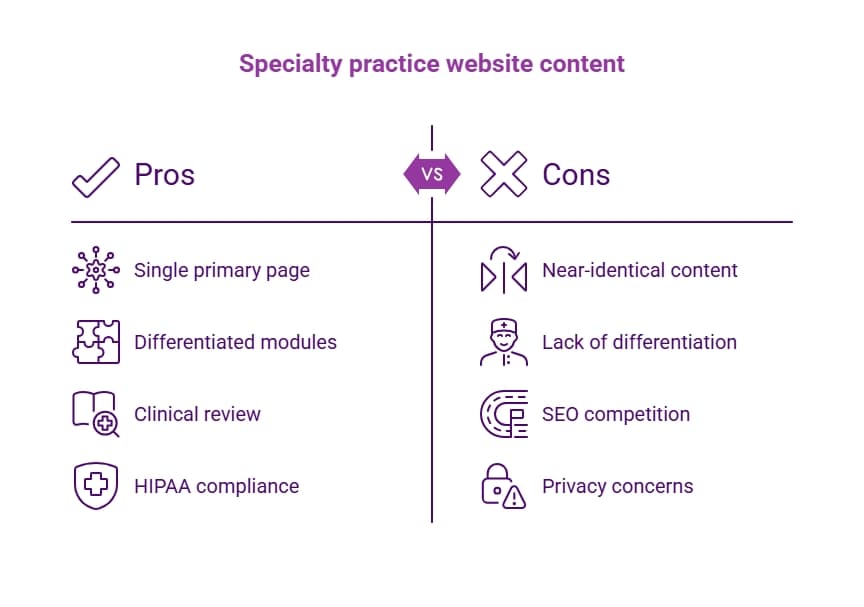
When several physicians treat the same condition, the instinct is to create a separate page for each physician-condition pairing. The result is frequently near-identical content that competes with itself without offering genuine patient value.
A more practical approach assigns one primary page to own the condition's search intent, then uses differentiated physician modules or sections to describe each provider's distinct role. If three orthopedic surgeons treat shoulder instability, a single well-developed condition page can explain the diagnosis and care pathway, then include distinct sections for each surgeon based on subspecialty focus, treatment approach, or location availability. Differentiation between those sections should reflect something real. If the meaningful difference is name and photo, a shared condition page with physician modules is the more honest and more useful architecture.
Every page addressing a condition, symptom, or treatment option should have a designated clinical reviewer responsible for accuracy before publication and for periodic review as guidelines evolve. This is not primarily an SEO concern — it is a patient-trust and accuracy requirement that the site architecture should plan for from the start.
Privacy, appointment tracking, call tracking, review responses, remarketing, analytics, and HIPAA-adjacent issues require appropriate compliance or legal review. HHS guidance on HIPAA marketing explains that the Privacy Rule addresses uses and disclosures of protected health information for marketing purposes and includes authorization requirements in certain situations. Website architecture alone does not make a practice HIPAA compliant, and any statements about privacy practices, tracking, or patient data should be reviewed by the appropriate compliance resource before publication.
A Short Audit for Practice Leaders
A complete content rebuild can take months. An architecture audit can often begin with a spreadsheet and a focused internal review.
- List priority conditions and procedures by referral volume, revenue mix, or physician subspecialty focus — these define where the architecture needs to function best.
- Identify the current page owner for each priority condition — which URL is the primary destination? Is there one clear page, or are several competing versions fragmenting search intent?
- Check condition-to-physician links — does each condition page link to relevant physicians, and do physician pages link back to priority conditions within their scope?
- Check location-to-provider alignment — do location pages clarify which physicians are available and which services can be accessed at each site?
- Confirm the appointment path — does a patient arriving on a condition or physician page have a visible next step toward scheduling? BVM's resource on appointment-first healthcare SEO covers how the patient conversion path integrates with site architecture.
- Flag thin, duplicate, or clinically unsupported pages — pages with minimal content, overlapping focus, or medical claims without a designated review owner.
- Confirm clinical review ownership — for every condition and procedure page, is there a named clinician or qualified internal reviewer responsible for medical accuracy?
- Confirm compliance review ownership — are privacy statements, tracking disclosures, remarketing practices, and call tracking configurations reviewed by the appropriate legal or compliance resource?
Why This Matters for AI Search and Structured Understanding
Search systems — including AI-assisted search — build their understanding of a page from the content and relationships the site makes visible. A page that clearly names a condition, links it to the physician who treats it, and identifies where a patient can act gives both human readers and search systems a coherent picture of what the practice offers.
Google's guidance on structured data describes it as a way to help Google understand page content — not a ranking guarantee, but a tool for communicating entity relationships. Schema.org's health and medical types document how physician, clinic, condition, and procedure relationships can be expressed in structured form.
Structured data works as a support layer, not a substitute for sound content architecture. A site with well-connected condition, physician, and location pages and appropriate schema markup gives search systems more to work with than one relying on markup alone. A confusing page does not become useful because markup was added. As AI-assisted queries become a more common entry point for patients researching care, practices with clear entity relationships across their content will be better positioned for that environment.
The Expertise Is Already There
The physicians, subspecialties, and treatment programs at a specialty practice are real. The credentials, clinical focus, and procedural expertise already exist — the website's job is to make them visible, organized, and clearly connected to the patient searches that matter most.
Condition pages, procedure pages, physician bios, service-line pages, location pages, and appointment paths should not operate as isolated assets. They should work as a connected system. When that system is clear, physician expertise becomes easier to discover, easier to understand, and easier to route toward the appropriate next step.
A focused audit of how pages relate to one another is often a more productive first step than publishing new content. Identifying the missing connections between conditions, physicians, locations, and appointment paths clarifies the architecture before larger investments begin.
Want to see where condition, treatment, and physician searches are getting disconnected on your site? BVM can map the specialty and condition searches shaping patient decisions in your market and show where your practice is getting missed. Get a Specialty Search Audit.
Frequently Asked Questions
Our Editorial Process: Our expert team uses AI tools to help organize and structure our initial drafts. Every piece is then extensively rewritten, fact-checked, and enriched with first-hand insights and experiences by expert humans on our Insights Team to ensure accuracy and clarity.
By: About the BVM Insights Team
The BVM Insights Team is our dedicated engine for synthesizing complex topics into clear, helpful guides. While our content is thoroughly reviewed for clarity and accuracy, it is for informational purposes and should not replace professional advice.