
 Dustin Ogle
A specialty-practice condition page may list several physicians without explaining why a visitor would review one profile, treatment page, program, or location instead of another. Assigning the page to one physician can be equally inaccurate when responsibility is shared.
The decision is not “one doctor or many doctors.” Multiple pathways are appropriate only when each route gives the user a distinct, verified reason to continue, such as a difference in expertise, care role, treatment responsibility, location access, referral process, or appointment ownership. When that distinction cannot be explained and maintained, one primary route or neutral intake is clearer. This article addresses website architecture and governance, not personal medical guidance.
When One Condition Actually Needs Multiple Physician Pathways
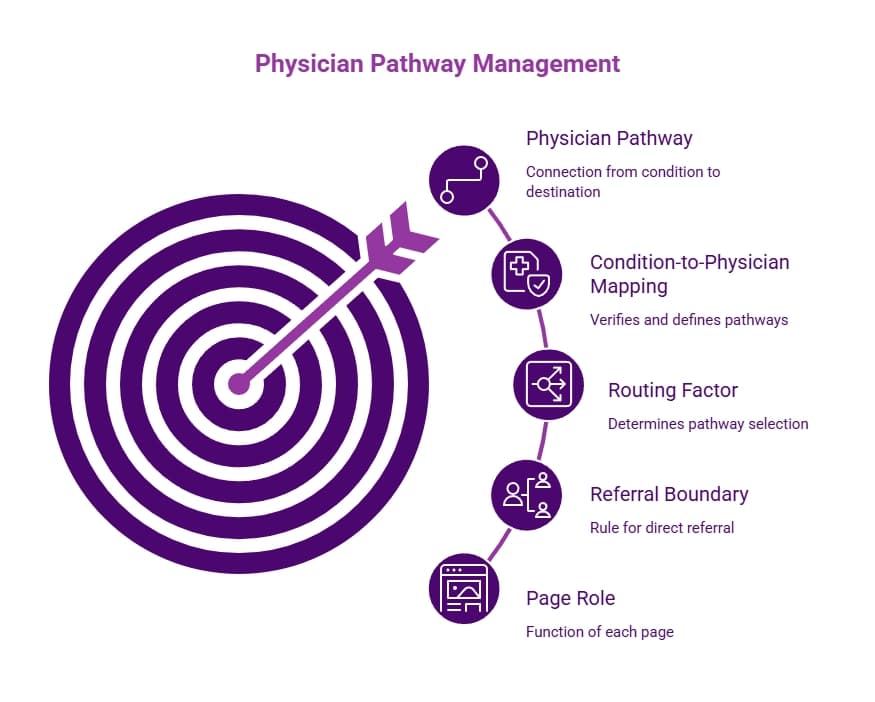
A physician pathway is a purposeful connection from a condition page to a physician, specialty, treatment, program, location, referral, or appointment destination. Condition-to-physician mapping verifies those connections, defines each destination’s purpose, and assigns maintenance responsibility.
Use multiple pathways when verified differences change the information or next step a visitor needs. A routing factor may be expertise, specialty ownership, care role, location availability, referral requirements, or appointment routing. A referral boundary is a practice-approved rule determining whether an inquiry can move directly to a destination or needs review.
Several physicians listing the same condition does not justify several routes. Neither do equal-exposure requests, plans for more pages, or a desire to add internal links. A path belongs on the page only when its purpose can be described without implying that the site knows which physician an individual needs.
This separation is easier to manage with distinct condition, treatment, and physician content paths. Each should have a defined page role: the evaluation or navigation job that page performs.
Use Five Tests Before Creating More Than One Path
1\. Is each relationship clinically verified?
A physician or designated clinical reviewer should confirm each condition-to-physician, treatment, and specialty relationship; a broad specialty title is insufficient.
Terms such as “treats,” “evaluates,” “performs,” “co-manages,” and “receives referrals for” are not interchangeable. Use them only when approved; otherwise, note more narrowly that a profile lists the condition among its clinical focus areas.
2\. Does each pathway answer a different decision question?
A separate route should answer a question another destination does not. Verified distinctions may involve subspecialty expertise, care role, treatment approach, patient population, referral responsibility, or program affiliation.
Hypothetical, illustrative example: Two physicians are connected to one condition, and their approved profiles describe different care roles. The page may present two neutral profile routes. If explaining the difference requires interpreting symptoms, history, or records, the website should not make that choice.
3\. Does the path lead somewhere meaningfully different?
Every route needs a destination with a clear role. A physician biography may support evaluation of credentials and approved focus areas; treatment, program, location, referral, and intake pages should provide different information.
Thin or duplicative pages create the appearance of choice without decision value. Effective condition-to-physician mapping therefore evaluates destination quality as well as the relationship.
4\. Can the practice honor the path operationally?
Confirm that scheduling, intake, referral, appointment-type, and location information matches current operations. Location warrants a separate route only when verified access differences change the useful next step.
Hypothetical, illustrative example: Several physicians may be relevant, but appointments begin through one program team. The page should use that neutral intake route rather than asking the visitor to select a physician.
5\. Is there enough proof and ownership to maintain it?
A pathway needs a substantive destination, verified details, a named reviewer, and a change process because clinical scope, schedules, locations, and referral rules can change.
A neutral intake path is a general contact, navigation, or intake destination used when the website cannot responsibly distinguish among physician routes. Do not describe a dedicated navigation service unless it actually exists.
Multi-Pathway Decision Matrix
| Decision factor | Question to ask | Evidence required | Possible routing result | Required reviewer |
|---|---|---|---|---|
| Clinical relevance | Is the relationship approved? | Current clinical documentation | Keep, revise, remove, or defer | Clinical lead |
| Meaningful distinction | Does the route answer a different question? | Approved expertise or role distinction | One path, supporting links, or differentiated paths | Clinical and editorial leads |
| Destination value | Does the page provide useful information? | Substantive destination page | Link, strengthen, or do not link | Marketing or SEO lead |
| Operational accuracy | Can intake and scheduling honor it? | Current access and scheduling rules | Direct, location, or neutral route | Administration |
| Governance | Who maintains it? | Named owner and review trigger | Publish, defer, or use no physician-specific route | Cross-functional owner |
Routing is not diagnosis: A website can explain verified physician, treatment, program, and location relationships. It should not determine which provider an individual needs.
Choose the Routing Pattern That Matches the Evidence
One primary pathway
Use one primary route when a physician, specialty, program, or intake team owns the public next step, including when internal physician differences do not change what the visitor needs to do.
The destination may be a profile, specialty overview, treatment hub, program page, referral destination, or appointment route. Simplicity works only when that destination can handle the relevant inquiries.
One primary pathway with supporting links
Use this pattern when one destination controls the next step while physician profiles, treatment information, or location pages provide supporting context.
Supporting links should remain subordinate to the main action. A biography that merely lists the condition may not explain care role, treatment connection, location access, referral relationship, or the next step.
Several differentiated pathways
Use several routes when each can be labeled by a verified factor, such as physician role, program affiliation, treatment responsibility, referral process, or location availability. Labels must not declare medical suitability.
This pattern requires stronger destinations and governance than a flat physician list. The choice about when to link a condition page to a physician or procedure page should follow the information each destination contributes.
Neutral intake or navigation
Use neutral intake when public information cannot responsibly distinguish among physicians. Selection may depend on records, referral review, prior care, appointment type, or other details the website should not interpret.
Neutral intake is not a less optimized fallback. It may be the most accurate route when provider selection requires information unavailable online. When no verified navigation service exists, use a general contact destination without overstating its capabilities.
CMS limitations can also affect implementation. If the platform cannot support conditional routing cleanly, a simpler primary or neutral route may be safer to maintain than a complex template that reviewers cannot reliably update.
Present Options Without Turning the Page Into a Diagnostic Tool
Safe language describes the destination instead of prescribing a choice. Examples include “Meet physicians whose profiles list this condition among their clinical focus areas,” “Review related treatment and program information,” and “Contact the practice for help identifying the appropriate appointment path.”
Avoid statements such as “Choose this doctor if your symptoms are severe,” “This physician is right for patients who…,” or “You need a surgeon when….” Those formulations ask the website to interpret an individual medical situation.
The Agency for Healthcare Research and Quality emphasizes making health information and services easier to understand, navigate, and act on. As a general principle—not an endorsement of this framework—that favors clear roles, neutral labels, and a contact route when uncertainty remains.
Google Search Central’s link guidance recommends concise, relevant, descriptive anchors because they help people navigate and help Google understand linked pages. This platform guidance does not mean that adding more links or pathways will improve rankings.
Google also recommends helpful, reliable, people-first content and gives added weight to trust for health and safety topics. That supports accurate distinctions and restrained claims.
MedlinePlus, a service of the U.S. National Library of Medicine, states that online health information is not a substitute for professional medical care or advice. A condition page may explain options and navigation, but it cannot select the correct provider for an individual.
Assign Clinical and Operational Ownership Before Publishing
Marketing should not approve these relationships alone. Clinical leaders should review condition, physician, treatment, and program connections. Practice administration, intake, or scheduling should validate location, referral, appointment-type, and availability claims. Marketing or SEO should manage page roles, labels, links, and coordinated updates.
Use a practice-appropriate review cadence plus checks after physician, program, treatment, location, referral, scheduling, or destination-page changes. No universal interval should be presented as fact.
A pathway record should identify the source, approved wording, destination URL, clinical and operational owners, last review, and change trigger.
Structured data can support an accurate model after the relationships are verified. Schema.org’s health and medical types can represent relationships in web content, but they are not clinical markup, a controlled medical vocabulary, or proof of medical validity.
The finished article and any practice-specific matrix still require clinical, operational, and editorial review before publication. Legal or compliance review may also be appropriate when practice-specific medical claims are included.
When Not to Create Multiple Physician Pathways
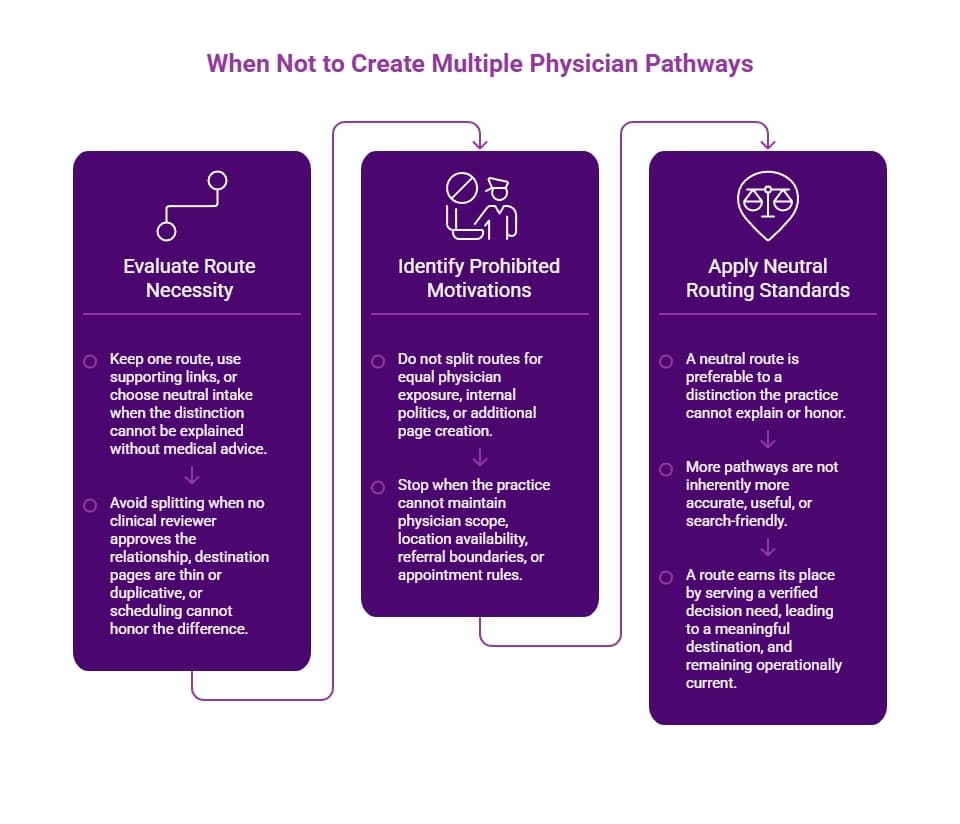
Keep one route, use supporting links, or choose neutral intake when the distinction cannot be explained without medical advice, no clinical reviewer approves the relationship, destination pages are thin or duplicative, or scheduling cannot honor the difference.
Do not split routes for equal physician exposure, internal politics, or additional page creation. Stop when the practice cannot maintain physician scope, location availability, referral boundaries, or appointment rules. A neutral route is preferable to a distinction the practice cannot explain or honor.
More pathways are not inherently more accurate, useful, or search-friendly. A route earns its place by serving a verified decision need, leading to a meaningful destination, and remaining operationally current.
Frequently Asked Questions
Disclaimer: This article is for general informational purposes only and does not constitute medical advice, diagnosis, or treatment. Readers should consult a licensed healthcare professional for guidance specific to their health, symptoms, medications, or treatment options.
Our Editorial Process: Our expert team uses AI tools to help organize and structure our initial drafts. Every piece is then extensively rewritten, fact-checked, and enriched with first-hand insights and experiences by expert humans on our Insights Team to ensure accuracy and clarity.
By: About the BVM Insights Team
The BVM Insights Team is our dedicated engine for synthesizing complex topics into clear, helpful guides. While our content is thoroughly reviewed for clarity and accuracy, it is for informational purposes and should not replace professional advice.