
 Dustin Ogle
A multi-physician specialty practice may have dozens or hundreds of legitimate relationships among conditions, treatments, physicians, locations, and appointment paths. Organizing those relationships into useful search content is repetitive, time-consuming work. AI can help with that organization. The problem starts when faster organization leads a team to treat inferred clinical relationships as approved facts.
The operating model that keeps this process defensible separates five layers of responsibility: machine-assisted organization, SEO and editorial judgment, clinically meaningful assertions, approval authority, and publish controls. AI is useful for the first layer. The remaining four require human ownership. The operating principle is straightforward: AI assists with pattern work; qualified humans approve clinical meaning.
This article provides a governance framework for that division, including which tasks AI can support, which decisions require clinical review, and what must exist before a practice scales.
Use AI for Pattern Work, Not Clinical Judgment
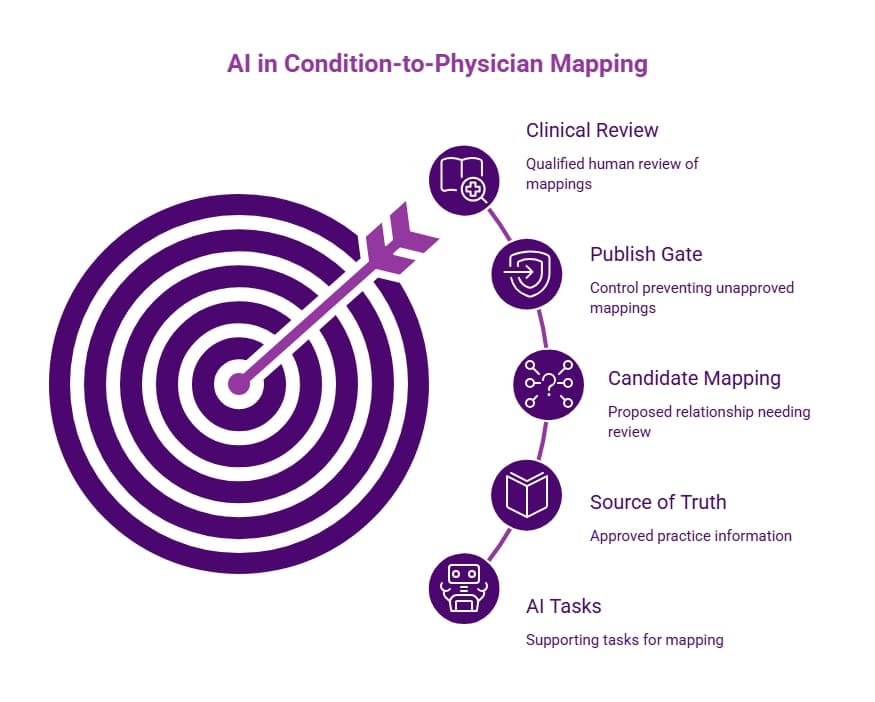
AI is most useful when it handles tasks that are repetitive, structured, and grounded in existing approved information. In a condition-to-physician mapping workflow, that means organizing what the practice already knows rather than generating new clinical conclusions.
A few terms make the boundary clearer. A source of truth is the approved practice information used to support a mapping. A candidate mapping is a proposed relationship that has not yet passed all required review. Clinical review is the qualified human review of medically meaningful claims or physician-condition relationships. A publish gate is the control that prevents a candidate relationship from going live until its required evidence and approvals are complete.
Appropriate AI-assisted tasks include normalizing condition and treatment terminology across physician bios, service pages, and location records. AI can sort existing condition lists, extract candidate relationships from approved practice materials, flag duplicate entries, identify gaps in physician-page coverage, detect inconsistencies between sources, and identify stale information. It can also generate a structured review queue that highlights which relationships need human attention.
The value of this work is narrowing what physicians and clinical reviewers must inspect, not removing their approval role. A practice with 200 candidate mappings does not need a physician to build the list from scratch. It needs a physician to review the 30 entries that are ambiguous, conflicting, or clinically meaningful.
The critical distinction is output type. AI should produce candidate mappings and review queues, not publication-ready clinical assertions. Every relationship it surfaces should carry a status (such as "candidate," "needs evidence," or "conflicting sources") rather than an implied seal of accuracy.
Condition Mapping Responsibility Matrix
| Mapping Activity | AI May Assist? | Marketing/SEO Owns? | Clinical Review Needed? | Required Source | Publish Condition |
|---|---|---|---|---|---|
| Normalize condition names | Yes | Yes | If meaning could change | Approved terminology | Meaning remains consistent |
| Find duplicate terminology | Yes | Yes | If consolidation affects clinical meaning | Approved source record | Conflicts resolved |
| Extract candidate relationships from approved materials | Yes | Workflow coordination | Yes, when clinically meaningful | Approved practice information | Required review completed |
| Flag missing physician-page connections | Yes | Yes | Before a new clinical relationship is published | Current approved sources | Evidence supports the connection |
| Score mapping completeness | Yes | Yes | Not for the score itself | Approved source inventory | Used as an operational QA signal only |
| Identify ambiguous relationships | Yes | Yes, as a queue | Yes | Traceable source records | Ambiguity resolved or withheld |
| Draft internal mapping notes | Yes | Yes | If notes contain clinical assertions | Source references | Internal until approved |
| Approve physician-condition relevance | Preparation only | No | Yes | Approved clinical information | Approval recorded |
| Approve clinical statements | Preparation only | No | Yes | Approved clinical information | Wording approved |
| Publish changes | Not autonomously | Content workflow | According to review rules | Approval record | Publish gate satisfied |
A leader should be able to take this matrix into a workflow meeting and assign ownership for each row.
Draw the Physician-Review Boundary Before You Automate
A condition-to-physician mapping may begin as an SEO task, but the output can carry clinical weight. Associating a physician with a condition on a public website implies that the physician treats that condition and is an appropriate point of contact for patients searching with that need. That implication exists whether or not the marketing team intended it.
The boundary worth defining is the line between taxonomy decisions and clinical assertions. Taxonomy decisions include how conditions are labeled, how pages are organized, and how search coverage is structured. Clinical assertions include statements about which physician treats a given condition, whether a physician is a suitable match for a clinical need, and whether a condition falls within a physician's current scope. Marketing and SEO teams can own the taxonomy. They should not independently approve clinical assertions beyond their competence.
A common assumption is that existing physician bios already contain everything the model needs, so no further review is required. In practice, bios may contain inconsistent terminology, ambiguous ownership, or outdated relationships. The process should test source quality before scaling, not assume it.
A related misconception is that better AI prompts or AI-readable page structure can eliminate the need for governance. Prompt quality can improve output structure, and structured data helps search systems and AI models read content more reliably. Neither confers clinical authority. Making content easier for machines to parse does not make an unreviewed clinical assertion valid.
Escalation triggers help keep the boundary operational. A mapping should be escalated to clinical review when it involves ambiguous physician fit, conflicting source records, new clinical language not present in approved materials, an unsupported expertise claim, or patient-facing wording that implies diagnosis or treatment suitability.
Red lines to enforce before scaling: Do not let AI infer physician expertise from generic bio language. Do not treat co-occurrence (a condition appearing near a physician's name) as publishable clinical relevance. Do not auto-publish AI output without a human approval step. Do not equate high search volume with clinical validity. Do not use AI for diagnosis or patient-specific suitability determinations. Do not treat ranking performance as proof that a mapping is clinically accurate.
This review requirement is framed here as a governance boundary, not a universal legal mandate. It protects clinical credibility, reduces the risk of publishing inaccurate associations, and gives physicians a structured role rather than an ad hoc veto. Practices should define the specific scope of their own review rules based on clinical significance, ambiguity, risk tolerance, and organizational requirements. For a deeper look at the review process itself, see how to build a clinical review workflow for condition-to-physician SEO, or explore how clinical review workflows keep specialty SEO content accurate and publishable.
Build a Three-Stage AI-Assisted Mapping Workflow
Turning the review boundary into an operating process requires three stages:
Source Record → AI Candidate Map → Review, Approve, Publish
Stage 1: Establish the approved source record. Before AI touches anything, the practice needs a single, current source of truth for physician-condition relationships. That record may draw from physician bios, service-line documentation, condition and treatment pages, location and access information, and any approved internal clinical documentation suitable for public use. Each source type should have a named content owner and a named review owner.
If the source record is inconsistent, incomplete, or outdated, AI will organize bad information faster. Cleaning the inputs is a prerequisite, not an optional improvement.
This workflow does not inherently require patient-level data. The framework can operate from approved practice information. Patient data and specific privacy obligations should not be introduced unless the actual workflow requires them and the applicable requirements have been separately reviewed.
Stage 2: Let AI create a candidate map. With a clean source record, AI can normalize condition labels, extract explicit associations from approved materials, flag likely gaps in coverage, and mark conflicting evidence. The output should assign a status to each relationship rather than force certainty. Statuses might include "candidate," "needs evidence," "conflicting sources," or "ready for review." Every entry should include a traceable reference to the source record it was derived from.
For example, if Condition A appears in materials associated with both Physician A and Physician B, AI should surface both candidate relationships and note the source basis for each. It should not select one physician as the correct match. A qualified reviewer confirms whether one, both, or neither should be published.
In another common situation, a physician's bio and a service page may imply different relationships for the same condition. AI should identify the conflict and flag both sources. It should not decide which source is clinically correct. That resolution belongs to a reviewer who can evaluate the underlying clinical relationship.
Stage 3: Review, approve, and publish. SEO and editorial review confirms structure, source traceability, and content quality. Clinical review confirms that medically meaningful claims and physician-fit associations are accurate. Both layers should complete before publication. Once approved, the mapping enters the live content system with an approval record and a change log.
Recommended statuses across the full lifecycle: candidate → needs evidence → clinical review → approved → published → stale/re-review.
This is where the efficiency gain should be measured. AI narrows and organizes what experts need to inspect rather than removing accountable review. If review appears to erase the speed benefit, evaluate how much repetitive preparation has been removed and whether reviewers are seeing a smaller, better-organized queue than they would have without AI assistance.
Practices formalizing this process can build a clinical review workflow for condition-to-physician SEO.
Add Quality Controls Before You Scale
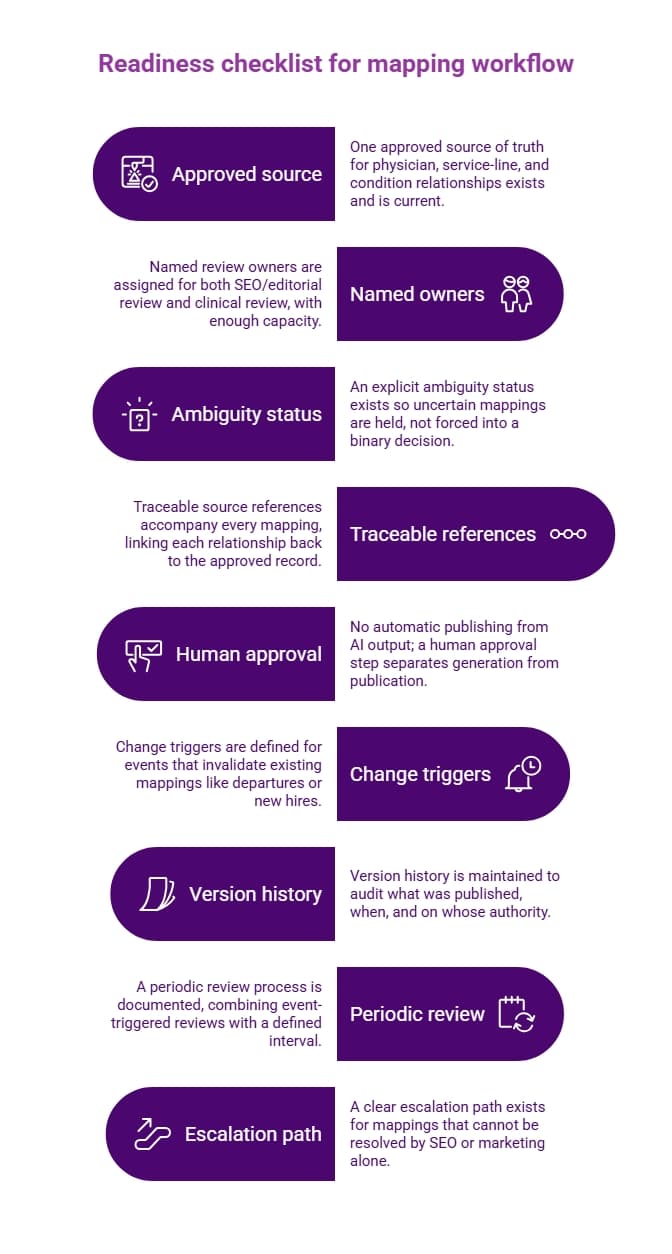
Scaling a mapping workflow before governance is in place means scaling risk. Most publishing systems encourage binary decisions: publish or do not publish. Real-world mappings need intermediate statuses (approved, ambiguous, needs evidence, stale, do-not-publish) so that uncertain relationships are held rather than forced through.
The following readiness checklist helps practice leadership decide whether the current process can handle more volume safely.
- One approved source of truth for physician, service-line, and condition relationships exists and is current.
- Named review owners are assigned for both SEO/editorial review and clinical review, and there is enough review capacity for the expected queue.
- An explicit ambiguity status exists so uncertain mappings are held, not forced into a binary decision.
- Traceable source references accompany every mapping, linking each candidate relationship back to the approved record it came from.
- No automatic publishing from AI output. A human approval step separates candidate generation from live publication.
- Change triggers are defined for events that invalidate existing mappings: physician departures, new hires, service-line additions or removals, location changes, and shifts in clinical focus.
- Version history is maintained so the practice can audit what was published, when, and on whose authority.
- A periodic review process is documented, combining event-triggered reviews with a periodic interval defined by the organization.
- A clear escalation path exists for mappings that cannot be resolved by SEO or marketing alone.
Consider what happens without change triggers: a physician's clinical focus shifts or a location closes, but old website mappings remain in place. A governed workflow marks affected relationships stale and queues them for re-review before any patient encounters outdated information. Without that trigger, stale mappings persist and scale alongside accurate ones.
If any of these controls is missing, the practice should close that gap before increasing mapping volume. For a broader assessment, evaluate whether your practice is ready for condition-to-physician SEO.
Governance tooling can support these controls, but tools alone do not make clinical mappings safe. The accountability structure matters more than the software.
Measure Mapping Quality Before You Measure Traffic
Search visibility and clinical accuracy are independent considerations. A high-volume search term does not make a physician-condition relationship legitimate, and a ranking improvement does not prove that the underlying mapping is correct. Measure governance quality first.
| Metric | What It Measures |
|---|---|
| Percentage of mappings with traceable source support | Whether each relationship ties back to an approved record |
| Percentage clinically reviewed (where review is required) | Whether the review boundary is holding |
| Number of unresolved ambiguous relationships | How much uncertainty remains in the live map |
| Stale mappings awaiting re-review | Whether change triggers are working |
| Correction or rework rate | How often published mappings need revision |
| Review turnaround time | Whether physician review capacity is keeping pace |
| Coverage of priority conditions after approval | Whether the governance process is producing useful output |
Once these governance metrics are sound, the practice can layer in SEO performance measures (visibility, engagement, qualified inquiry behavior) and evaluate them with confidence that the content behind the numbers is accurate.
A traffic increase built on unreviewed mappings is not progress. It is exposure.
The Scalable Model Is Controlled Task Allocation
The question is not whether AI is safe for condition-to-physician SEO. The better question is which tasks benefit from AI-assisted organization and which decisions require qualified human authority.
AI handles repeatable pattern work: normalizing terms, surfacing candidates, flagging conflicts, and building a structured review queue. Clinical authority remains with physicians and appropriately qualified reviewers who can confirm whether a mapping is accurate, current, and appropriate for publication. That means better source records, candidate mappings instead of assumed truths, explicit ambiguity states, traceable evidence, review capacity, publish controls, and change triggers. A practice that builds governance before it builds volume will scale with fewer corrections, fewer credibility risks, and a defensible record behind every published relationship.
BVM describes condition-to-physician demand mapping as part of its Medical Specialty SEO framework. If your practice is evaluating how to structure this kind of workflow with professional support, Get My Visibility Analysis.
Frequently Asked Questions
Disclaimer: This article is for general educational and marketing-strategy purposes only. It does not provide medical advice or determine which physician is appropriate for any individual patient. Clinical content, physician-condition relationships, and care-related statements should be reviewed by appropriately qualified clinical professionals before publication or use.
Our Editorial Process: Our expert team uses AI tools to help organize and structure our initial drafts. Every piece is then extensively rewritten, fact-checked, and enriched with first-hand insights and experiences by expert humans on our Insights Team to ensure accuracy and clarity.
By: About the BVM Insights Team
The BVM Insights Team is our dedicated engine for synthesizing complex topics into clear, helpful guides. While our content is thoroughly reviewed for clarity and accuracy, it is for informational purposes and should not replace professional advice.