
 BVM Insights Team
A patient receives a referral to your specialty practice. Your treatment page describes the procedure clearly. And yet, the phone rings with the same questions: Do I need authorization first? What records should I bring? What happens after I submit a request?
When a treatment or procedure page explains what a service is without clarifying how to begin, referred patients and referrers are left to guess, call, or wait. That gap between a referral and an appropriate appointment request is where page content either resolves uncertainty or creates it.
This framework helps you evaluate whether your pages cover the core operational areas that matter most: requirements, records, process, boundaries, and expectations—all underpinned by clear internal ownership.
What a Referral-Ready Treatment Page Must Accomplish
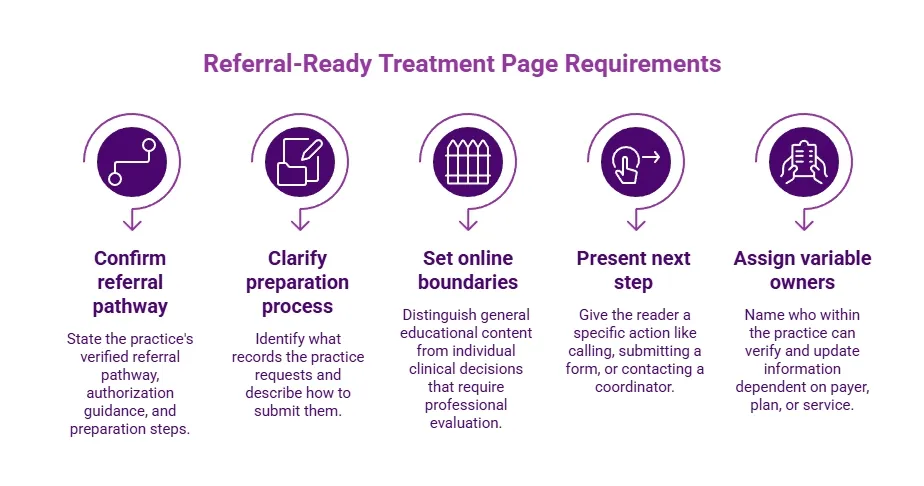
A referral-ready page (one that gives a referred patient or referrer enough verified information to prepare and act appropriately) does not need to answer every clinical question. It needs to answer the operational ones. Five requirements define that standard:
- Confirm what the page can safely explain. State the practice's verified referral pathway, authorization guidance, and preparation steps without presenting variable requirements as universal rules.
- Clarify preparation and process. Identify what records the practice requests and describe how to submit them.
- Set boundaries around what cannot be determined online. Distinguish general educational content from individual clinical decisions that require professional evaluation.
- Present one appropriate next step. Give the reader a specific action: calling a scheduling line, submitting an inquiry form, or contacting a referral coordinator.
- Tie every variable statement to an approved owner. If a requirement depends on the payer, plan, or service, name who within the practice can verify and update that information.
This is an evaluation framework, not a compliance standard. Every practice will populate these categories differently based on its services, payer mix, and policies.
Five Content Gaps That Create Referral Friction
When a treatment page leaves any of these five categories unclear, staff end up answering the same questions that the page should have resolved.
1. Referral and authorization requirements
Some specialty visits may require a referral from a primary care provider. Others may not. Some payers may require prior authorization for certain procedures, while others handle authorization differently depending on the plan, service, or network status.
The page should explain the practice's general referral pathway using language such as "a referral may be required depending on your plan" rather than "all patients must have a referral." Where requirements vary, state the variation and direct readers to confirm with the practice or their payer. Publish only the process your practice has verified through current documentation. If the requirement cannot be confirmed, do not guess and do not copy language from another practice. A concise caveat paired with a reliable confirmation route is more useful than an exhaustive but fragile list of payer rules.
2. Medical records and preparation
Referred patients often need to bring or submit records, prior imaging, test results, intake forms, or a current medication list. The specific documents depend on the practice, the service, and the clinical situation.
A referral-ready page identifies the general categories of information the practice typically requests and explains the approved submission process. Practices should publish only their own verified records checklist and confirm that any electronic submission method meets their privacy and security requirements. Do not invent upload methods, email addresses, deadlines, or secure-handling assurances that the practice has not confirmed. Timing guidance should appear only when the practice has verified that timeline. Omitting a detail is safer than publishing one that changes without a page update. Clear preparation guidance should reduce uncertainty without implying that submitting materials guarantees an appointment.
3. Consultation sequence and next steps
A referred patient may not understand what happens between submitting an inquiry and sitting in an exam room. Pages that describe a treatment without explaining the intake sequence leave that gap open.
At a non-clinical level, the page can clarify the practice's general process: request, record review, scheduling confirmation, initial consultation, or another verified sequence. The key distinction is between submitting an inquiry and being accepted as a patient. A request does not guarantee an appointment, and the page should not imply otherwise. Replace vague labels such as "Contact Us" or "Get Started" with action-specific language such as "Request an Appointment" or "Submit a Referral" so the reader understands what their action initiates. The goal is to set an accurate expectation and provide a next action, not to simplify the process beyond what the practice can support.
4. Candidacy boundaries
Treatment pages sometimes blur the line between general educational information and individual clinical suitability. A page may describe factors that clinicians commonly evaluate (such as symptom duration, prior treatment history, or diagnostic findings) as general orientation. That context can help a reader understand what a consultation may involve.
The page should not suggest that a reader can determine their own candidacy based on those factors. Individual suitability requires evaluation by a licensed professional. Detailed claims about contraindications, risks, alternatives, recovery, or medical necessity require current authoritative clinical support and licensed review. Where a reader's question moves from "What does this procedure address?" to "Is this right for me?", the page should route them to approved clinical content on the practice's site or to a qualified professional rather than attempting an answer.
5. Procedure comparisons and expectation setting
When a practice offers multiple approaches to a similar clinical concern, readers may want to understand how those options differ. A page can safely clarify general distinctions in purpose, approach, and evaluation pathway without declaring one option superior or appropriate for a specific reader.
Comparison language requires balanced, clinically reviewed wording. Framing such as "Procedure A and Procedure B address similar concerns through different approaches, and your specialist will recommend the most appropriate option after evaluation" keeps the comparison useful without overstepping. When adequate evidence or review is unavailable, explain the consultation process instead of inventing clinical detail. The page's role is to prepare readers for an informed discussion, not to make the decision on a clinician's behalf.
Use a Referral-Ready Page Gap Matrix
The five categories above become more actionable as a structured audit tool. Use this matrix as a framework to customize for your practice, not as verified requirements. Before publishing a populated version, confirm every operational fact with the appropriate owner and submit clinical language for professional review.
| Patient or Referrer Question | Page Answer Required | Type | Source of Truth | Owner / Reviewer | Review Trigger | Appropriate Next Step |
|---|---|---|---|---|---|---|
| Is a referral required? | Verified pathway and variation caveat | Administrative | Current practice and payer documentation | Referral coordinator or payer owner | Policy or contract change | Confirm with practice or payer |
| Does this visit require prior authorization? | Confirmed rule or confirmation route | Administrative | Applicable official documentation | Authorization owner or billing specialist | Payer or service change | Verify with payer before proceeding |
| What records should I bring or submit? | Practice-approved list for the service | Administrative | Current intake policy | Intake manager or records owner | Checklist or form change | Prepare confirmed materials |
| How should materials be submitted? | Approved submission method only | Administrative / Compliance | Current secure-handling process | Operations or compliance reviewer | Process or platform change | Follow approved instructions |
| Am I a candidate for this procedure? | Evaluation boundary; general orientation factors only | Clinical | Approved clinical guidance | Licensed physician or clinical lead | Clinical-policy or guideline update | Request professional evaluation |
| What happens after I submit a request? | Verified request-to-confirmation sequence | Administrative | Current scheduling workflow | Scheduling coordinator or practice administrator | Workflow or staffing change | Take the labeled page action |
Every fact you place in the matrix should trace back to a named source within your organization. For a deeper look at where treatment pages commonly leave intent-level questions unanswered, see this guide to treatment-intent content gaps.
Keep Administrative Guidance Separate From Medical Advice
The most important editorial boundary on a referral-ready page is the line between administrative facts and clinical facts.
| Administrative Content | Clinical Content | Prohibited Inference | |
|---|---|---|---|
| Describes | Access, process, preparation, scheduling | Treatments, risks, suitability, recovery | |
| Can be owned by | Administrative staff with appropriate oversight | Licensed clinician (authorship or review) | |
| Example | "Submit records at least five business days before your visit" | "This procedure may not be appropriate for patients with certain cardiac conditions" | |
| Review standard | Operational accuracy and current policy | Clinical accuracy, safety, and evidence | |
| Referral pathway | Practice requires a PCP referral for all HMO plans | Patient requires a referral due to severity of symptoms | One rule applies to every patient |
| Authorization | Approval is guaranteed | ||
| Records and submission | The process ensures compliance | ||
| Treatment education | The page recommends treatment | ||
| Candidacy | The reader qualifies based on page copy |
Some statements cross both categories. "Patients with a history of cardiac events should inform the practice before scheduling" contains an administrative instruction (inform the practice) attached to a clinical qualifier (cardiac events). That sentence needs both an administrative owner and a clinical reviewer.
When the boundary is unclear, a reliable default is explicit: "A consultation is required to determine individual suitability." That phrasing acknowledges the clinical question without attempting to answer it. Separating condition, treatment, and physician content paths can also help each page perform a defined decision-support role without collapsing education, access, and individualized guidance into one message.
Assign an Owner and Review Trigger to Every Variable Statement
Accurate information becomes inaccurate the moment a policy, workflow, or clinical guideline changes without a corresponding page update. Governance is what keeps a referral-ready page referral-ready over time. Three concepts make this manageable:
- A source of truth is the single verified document or policy that a page statement must match.
- A content owner is the named person responsible for confirming that a statement remains accurate.
- A review trigger is the event (a payer update, a physician change, a revised form) that signals when a statement needs to be rechecked.
For each category of variable content, assign a content owner responsible for verifying accuracy:
- Referral and authorization language: referral coordinator or billing specialist.
- Records and preparation instructions: intake manager, with compliance review for protected information.
- Scheduling and process descriptions: scheduling coordinator or practice administrator.
- Candidacy, treatment, and clinical language: licensed physician or clinical lead.
Identify the events that should trigger a review: a payer contract change, a new service line, a physician change, a revised intake form, or new clinical guidelines. Maintain one source of truth for each statement so updates flow from a verified document rather than memory. Consider tying these review triggers to a quarterly calendar review or a centralized ticketing system so updates aren't reliant on staff memory. The objective is to prevent several departments from maintaining conflicting versions of the same instruction.
The goal is not to prescribe a particular software system. It is to ensure every variable statement has someone accountable for its accuracy and a defined reason to recheck it. For practices building a more formal process, this guide to creating a clinical review workflow for specialty content offers a useful starting framework.
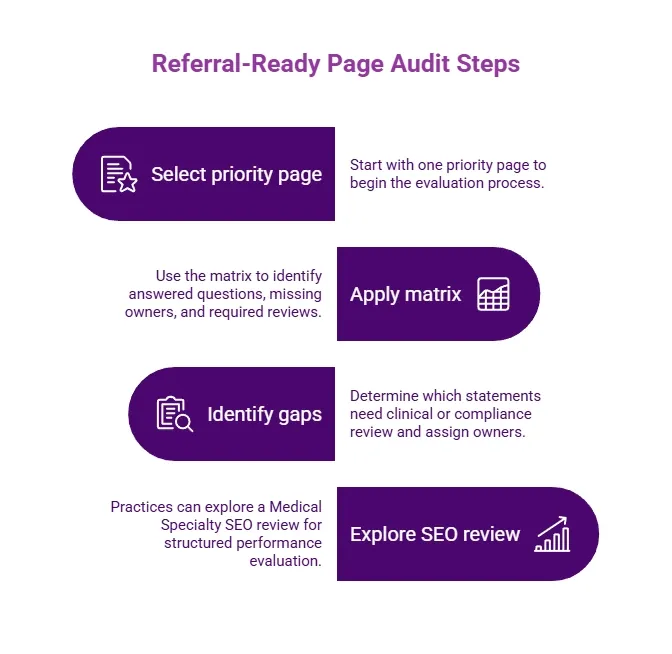
Audit One Page Before Adding More Content
A referral-ready treatment page is not measured by length. It is measured by whether verified answers, boundaries, owners, and next steps are clear.
Start with one priority page. Apply the matrix. Identify which questions are answered, which answers need an owner, and which statements require clinical or compliance review. That single audit will reveal more about page quality than adding another paragraph of service description. Practices that want a structured evaluation of how specialty pages perform in search can explore a Medical Specialty SEO review.
Frequently Asked Questions
Disclaimer: This article is for general informational purposes only and does not constitute medical advice, diagnosis, or treatment. Readers should consult a licensed healthcare professional for guidance specific to their health, symptoms, medications, or treatment options.
Our Editorial Process: Our expert team uses AI tools to help organize and structure our initial drafts. Every piece is then extensively rewritten, fact-checked, and enriched with first-hand insights and experiences by expert humans on our Insights Team to ensure accuracy and clarity.
By: About the BVM Insights Team
The BVM Insights Team is our dedicated engine for synthesizing complex topics into clear, helpful guides. While our content is thoroughly reviewed for clarity and accuracy, it is for informational purposes and should not replace professional advice.