
 BVM Insights Team
A patient receives a referral for a procedure they have heard of but never experienced. They visit the practice website expecting to learn what the consultation involves, what records to bring, and how suitability will be assessed. Instead, they find marketing copy and a "Request Appointment" button. The referral did not answer those questions, and neither does the page.
That gap is where a procedure-comparison page earns its value. When built correctly, the page performs referral validation: helping a reader understand why the page may be relevant, what general factors distinguish the procedures, and what happens next. It should compare verified general factors and explain preparation and access steps while distinguishing stable educational content from practice-specific requirements that must be confirmed individually. Below is a comparison matrix, a governance workflow for keeping claims accurate and owned, and an audit checklist you can apply to one existing page today.
The Page Is a Referral-Validation Tool, Not a Treatment Selector
Before choosing what the page should contain, define what it should do. A procedure-comparison page serves three functions: clarify general differences, prepare the reader for consultation, and route them to the correct physician or appointment path.
A common assumption is that referred patients already know what to do. A referral confirms that specialist evaluation is appropriate, but it does not necessarily answer preparation, physician-fit, or process questions. The page addresses that remaining uncertainty without determining candidacy, ranking procedures, or recommending treatment.
| Page May Do | Clinician Must Do | Page Must Never Imply |
|---|---|---|
| Present general, verified differences between procedures | Assess individual candidacy based on patient history, imaging, and examination | That a reader can determine their own suitability from the comparison |
| List questions the reader should prepare for consultation | Recommend, modify, or rule out a specific treatment for a specific patient | That one procedure is inherently superior for a given condition |
| Explain the referral, records, and scheduling process | Evaluate risks, benefits, and alternatives in a patient-specific context | That insurance will cover a particular procedure or that authorization is guaranteed |
Practices that maintain separate condition, treatment, and physician content paths reinforce these boundaries by keeping each page focused on its designated job.
The page should answer process questions without converting them into conclusions. "What will the clinician evaluate?" preserves room for assessment. "Which procedure should I choose?" asks the page to perform a clinical function it cannot responsibly fulfill.
Use a Comparison Matrix Built Around Questions, Not Winners
The primary asset is a matrix organized by what readers need to know, not by which option "wins." Each row addresses a comparison dimension: a category of information (such as general purpose, candidacy considerations, or insurance process) that helps the reader prepare without implying a recommendation.
Safe Comparison Dimensions
- General purpose of each procedure. Describe what each procedure addresses in broad terms, verified by a physician reviewer.
- Questions addressed during consultation. List what the clinician will evaluate, so the reader knows what to expect rather than conclude.
- Records, referral, and test requirements. A referral here means a formal recommendation from one physician to another, often required before a specialist appointment. State what the practice's current process requires, verified by the operational owner.
- General candidacy considerations. Describe factors a clinician may evaluate. When procedures address overlapping conditions, explain that overlap exists and suitability will be assessed during consultation, not that procedures are interchangeable. Do not provide scoring or "you may be a candidate if" language.
- Benefits, limitations, risks, and alternatives. Present these as categories the clinician will discuss, not as a ranked comparison.
- Recovery and follow-up. Present approved general recovery and follow-up categories verified by a procedure-specific source and physician. Recovery and follow-up needs can vary, so the page should describe categories the clinician will discuss rather than fixed timelines or guaranteed expectations.
- Insurance and authorization process. Prior authorization is a requirement from an insurer that the provider obtain approval before performing a procedure; requirements vary by plan, procedure, and jurisdiction. Explain steps a patient should take to confirm coverage.
- Physician, location, and appointment path. Link the reader to the appropriate next step.
Boundaries That Keep the Comparison Clinically Responsible
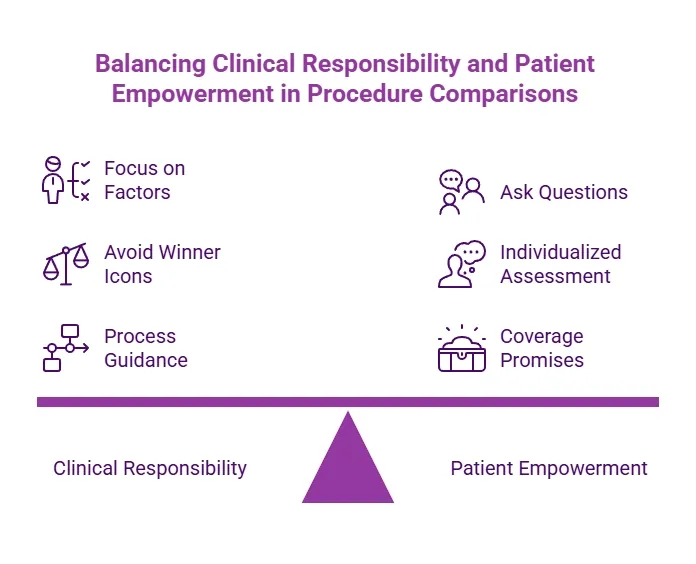
Shared characteristics do not make procedures equivalent, and overlap does not establish candidacy. Use "factors a clinician may evaluate" instead of "who qualifies." Avoid winner icons, "best for" labels, pros-and-cons scores, and quizzes that return results such as "you qualify." A candidacy quiz can look like an individualized assessment even when it uses general information, which is precisely why it does not belong on a comparison page.
Use "questions to discuss" instead of "which option is right." Consider a hypothetical page that labels Procedure A as "best for minimal downtime" and Procedure B as "best for long-term results." Those labels compress nuance into a recommendation. A safer structure presents the same information as a question: "Ask your physician how recovery timelines and long-term expectations compare for your situation."
Use process wording for insurance and authorization rather than coverage promises. Replace "Insurance usually covers this procedure" with process guidance: coverage and authorization requirements can depend on the plan, procedure, and individual circumstances, so readers should confirm the current process with their insurer and the practice.
Note: For any content addressing candidacy or insurance, explain the process and direct readers to confirm requirements individually. Do not determine eligibility or promise coverage. Place this boundary beside candidacy and insurance content, not only in the final disclaimer.
Referral-Ready Procedure Comparison Matrix
Use this structure to draft or audit one comparison page. Replace "Procedure A / Procedure B" with actual procedures only after a qualified physician has reviewed the clinical content (e.g., such as comparing LASIK and PRK, or knee replacement and arthroscopy).
| Reader Question | Page May Provide | Required Reviewer | Safe Wording Direction | Wording to Avoid | Next Step |
|---|---|---|---|---|---|
| What does each procedure address? | General clinical purpose | Physician reviewer | "Procedure A is generally used to address [condition category]" | "Procedure A is the best treatment for [condition]" | "Discuss which approach fits your situation with your physician" |
| Who may be considered? | General factors a clinician evaluates | Physician reviewer | "Your physician will evaluate factors such as [category list]" | "You are a candidate if..." or self-assessment scoring | "These factors will be assessed during your consultation" |
| Benefits, risks, alternatives? | Categories the consultation will cover | Physician reviewer | "Your clinician will discuss potential benefits, risks, and alternatives based on your individual assessment" | Ranked comparison, numeric risk rates, or "risk-free" language | "Ask your physician how these factors apply to you" |
| What does recovery or follow-up involve? | Approved general recovery and follow-up categories | Procedure-specific source and physician | "Recovery and follow-up needs can vary" | Fixed timelines or guaranteed expectations | "Request current clinical guidance from your physician" |
| Records or referrals needed? | Practice-verified preparation steps | Operational owner | "The practice may request [general category of records]" | Exact universal requirements | "Contact the office to confirm what to bring" |
| Insurance or authorization? | Process steps to follow | Revenue-cycle owner | "Contact your insurer to confirm coverage and any prior-authorization requirements" | "Insurance covers this procedure" | "Your practice coordinator can help you understand the process" |
| Where to go for consultation? | Physician, location, scheduling path | Practice-approved pathway | "Request a consultation through [approved path]" | Invented locations or scheduling guarantees | Link to physician page or appointment request |
Connect the Comparison to the Actual Referral and Consultation Path
Consider a hypothetical page that presents a thorough comparison table but offers no physician link, no scheduling path, and no explanation of the consultation. The reader is better informed but still stuck.
Connect general education to the consultation pathway through six elements: confirm the page's general scope, identify the relevant physician or physician-selection path, describe categories of records or tests the practice may request, direct readers to verify referral or authorization requirements with their insurer and practice, describe the consultation as the point of individual assessment, and provide a clear appointment or inquiry path.
Create a routing inventory before drafting. For every procedure named on the page, identify the approved physician destination, location information, inquiry path, and source for administrative requirements. Mark any missing destination as a content dependency rather than filling the gap with an inferred URL, generic form, or unsupported instruction. Patient-facing content and operational information may live in different systems, and if those sources are not reconciled, the comparison can present current clinical copy beside outdated referral, scheduling, or insurance instructions.
Understanding when a condition page should link to a physician page, a procedure page, or both helps ensure routing decisions serve the reader's actual position in the referral process.
Content ownership matters. The scope statement is a content-team responsibility reviewed by a physician. Records, referral, and insurance language belongs to operational and revenue-cycle owners. Mixing these lines is how pages accumulate outdated claims.
Build Clinical Review Into the Page Before Drafting Begins
A common concern is that adding clinical detail inherently creates risk. The problem, however, is not the information itself; it is ungoverned detail published without sourcing, review, or an accountable owner (the person responsible for a statement's accuracy, source, and update status). Useful detail is not automatically risky. Unsupported, outdated, oversimplified, or ungoverned detail creates the problem. Clinically reviewed explanations can remain specific while preserving the distinction between general education and patient-specific judgment.
A related concern is that physician review will slow every update, which happens when every claim requires the same review path. Route effort by claim risk instead.
- Inventory every clinical and administrative claim on the page.
- Assign each claim a content, clinical, or operational owner.
- Record the approved source and exact approved wording.
- Apply a risk tier: high-risk (candidacy, clinical comparisons, insurance coverage) requires physician review; moderate-risk (preparation, process descriptions) requires operational review; low-risk (scheduling, page-scope statements) requires content-team review.
- Route high-risk and moderate-risk statements to the assigned reviewer before publication.
- Publish only approved language.
- Re-review after any procedure, physician, location, referral-policy, or payer change rather than relying solely on a fixed calendar interval.
The claim record should preserve the exact approved wording, source date, reviewer, decision status, and reason for any re-review. This creates a usable handoff when a different writer, physician, or administrator later updates the page, and it separates an approved reusable statement from a new claim that requires fresh review.
When several physicians describe the same procedure differently, record the approved source, assign one accountable claim owner, and preserve medically meaningful differences rather than allowing contradictory copy to accumulate across drafts.
| Claim Example | Source | Owner | Status | Update Trigger |
|---|---|---|---|---|
| "Procedure A is generally used to address [category]" | Physician-approved specialty guidance | Physician reviewer | Draft / Review / Approved | Procedure scope or guidelines change |
| "A referral from your primary care physician may be required" | Current practice referral protocol | Operations manager | Draft / Review / Approved | Referral policy or payer contract changes |
| "Contact your insurer to confirm prior-authorization requirements" | Revenue-cycle team confirmation | Revenue-cycle owner | Draft / Review / Approved | Payer policy or authorization process changes |
A deeper treatment of this process is covered in the guide on how to build a clinical review workflow.
A disclaimer cannot substitute for this governance. If underlying claims are inaccurate or outdated, a disclaimer does not correct the reader's understanding, and a conversion call to action should follow education, not replace it.
Audit for the Signs That the Page Is Creating More Friction
Before building a new page, audit an existing one. These ten questions identify the most common problems:
- Does the page imply one procedure is generally superior?
- Could a reader mistake the copy or a quiz for a candidacy determination?
- Are benefits, limitations, risks, and alternatives supported by current, physician-reviewed sources?
- Are referral, records, and payer statements current and verified by the operational owner?
- Is the consultation sequence visible?
- Does every clinical and administrative claim have an identified owner?
- Is the physician or appointment path clear and functional?
- Are caveats placed beside the content they qualify?
- Does the call to action follow education rather than replace it?
- Is there a defined update trigger for each claim category?
Start with the highest-risk finding and work through the matrix one row at a time. Repeat the audit after a relevant service, physician, location, referral, scheduling, or payer change. The update trigger should identify which claims and routes must be checked rather than forcing an unsupported fixed review interval on every page.
Help the Page Prepare the Conversation, Not Make the Decision
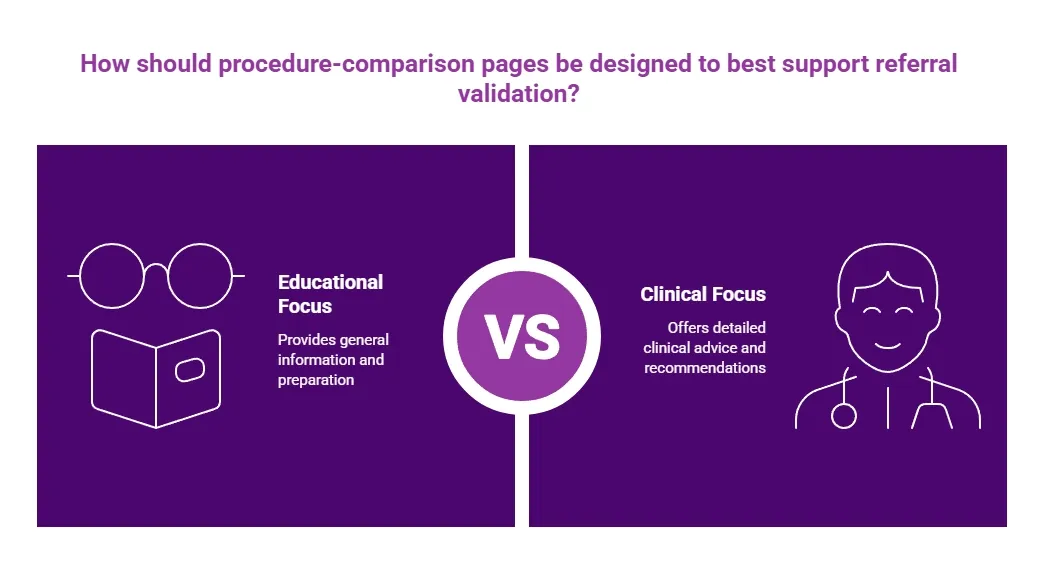
A procedure-comparison page does its job when a reader leaves understanding what general factors distinguish the options, what to prepare, and where to go for individualized assessment. It does not need to answer every clinical question. It needs to make the consultation more productive.
Audit one current page using the matrix above. Identify claims that lack an owner, administrative details that have not been verified recently, and wording that crosses from education into implied recommendation.
For a broader evaluation of how procedure pages connect with your medical-specialty SEO strategy, or if your specialty practice needs support evaluating how procedure content, search visibility, and clinical review work together, get a specialty search audit.
Frequently Asked Questions
Disclaimer: This article is for educational and content-strategy purposes only. It does not provide medical advice, diagnosis, or treatment recommendations. Procedure eligibility, risks, benefits, alternatives, referral requirements, and insurance or authorization decisions should be addressed by qualified clinicians and relevant organizations using current, patient-specific information.
Our Editorial Process: Our expert team uses AI tools to help organize and structure our initial drafts. Every piece is then extensively rewritten, fact-checked, and enriched with first-hand insights and experiences by expert humans on our Insights Team to ensure accuracy and clarity.
By: About the BVM Insights Team
The BVM Insights Team is our dedicated engine for synthesizing complex topics into clear, helpful guides. While our content is thoroughly reviewed for clarity and accuracy, it is for informational purposes and should not replace professional advice.