
 Dustin Ogle
A large health system may have hundreds of condition pages, dozens of service lines, and a domain that spans primary care through tertiary subspecialties. Copying that breadth is rarely a productive content plan for a practice with a fraction of the publishing capacity, particularly when physician review time, clinical governance, and editorial maintenance are already stretched.
The more useful question is whether your own pages make specialist relevance easier to understand and verify. That kind of clarity — what we will call specialist depth — is where a narrower organization can do its most differentiated work.
Don't Compete With a Health System on Breadth Alone
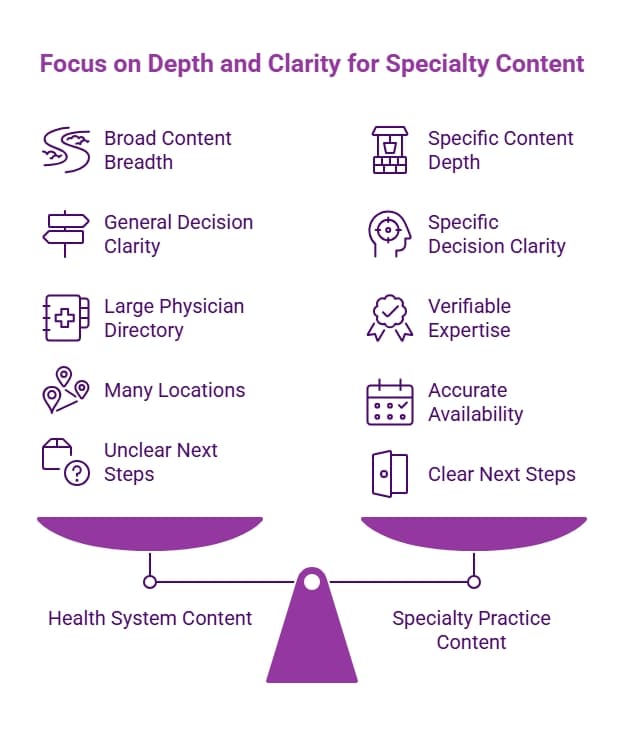
Page count and institutional scope are observable differences between your site and a health system's, but they are not a strategy to imitate. A broad institutional site may cover hundreds of conditions while organizing content around departments, campuses, and rotating provider directories. That structure serves a different organizational purpose than your practice's narrower clinical focus.
Instead of measuring how many pages you lack, ask where your narrower scope can produce more specific answers. The distinction matters:
| Content Breadth | Decision Clarity |
|---|---|
| Number of condition pages published | Whether each page names the relevant physician or team |
| Range of service lines covered | Whether the reader can verify expertise and credentials |
| Large physician directory | Whether physician expertise is verifiable, not just listed |
| Many locations | Whether physician and service availability is accurate at each site |
| Total indexed pages | Whether the next step (referral, appointment, consultation) is accurate and clear |
Your competitive audit should ask, "What can a reader understand and verify here?" rather than, "How many pages do they have?"
This reframing is not a promise that specialist depth produces higher rankings. It is a practical way to allocate limited content resources toward pages that do more useful work per visit.
Audit Six Dimensions Where a Specialty Practice Can Be More Specific
Each of the following dimensions represents a kind of clarity that a focused practice can often articulate more precisely than a broader institutional site. Use them as audit criteria, not as ranking factors.
A few terms are worth defining once. Specialist depth means the amount of useful, verified specificity a page provides about the practice's actual scope and expertise. Pathway clarity means how easily a reader can follow the connection from a problem or referral to the correct physician, service page, and next step. Entity consistency means whether physician names, titles, service-line associations, and location details agree across every page that references them. A content gap, in this context, is a missing, unclear, unsupported, or inconsistent piece of information that the practice can realistically improve.
1. Service-Line and Specialist Specificity
Examine whether your page clearly states its service or problem focus, identifies the relevant physician or clinical team, distinguishes its role from adjacent pages on your own site, and avoids duplicating content that belongs elsewhere. A page without a distinct job tends to overlap with neighboring pages and dilute the specificity a smaller site can otherwise offer.
Ask whether the reader can tell what the page covers, why it exists separately from other pages, and where to find the next layer of verified information.
For example, a hypothetical orthopedic group might have a generic "Shoulder Care" page while a competing health system's page is broader but equally unspecific. The practice could audit whether its own page identifies verified physician focus areas, links to relevant treatment pages, and explains the appointment path. Specialist depth is not about having the page; it is about whether that page answers questions the broader page does not.
2. Physician Expertise and Verifiable Proof
Evaluate whether expertise is demonstrated through verifiable credentials, clinical focus areas, published affiliations, authorship, review responsibility, and professional roles rather than through unsupported adjectives. A common objection is that search engines should already recognize the physicians' expertise. In reality, offline reputation does not appear on the page by itself. The website still needs accurate, visible, verifiable information that a reader (or a search system) can confirm. or instance, rather than stating a surgeon is 'highly skilled in joint replacement,' list their specific fellowship training, annual procedure volume, and roles in relevant orthopedic associations.
Ask who is accountable for each expertise statement, what evidence supports it, and whether the current wording still matches approved information. Proof that drifts out of date undermines the credibility it was meant to establish.
For more on connecting authorship and clinical credibility to published content, see physician authorship signals.
3. Referral and Access Pathway Clarity
Assess whether each page explains the next operational step accurately — without attempting to diagnose, determine candidacy, or recommend treatment. Consider a hypothetical scenario: a referred patient lands on a physician biography but cannot determine which service page explains the condition they were referred for. The page describes the physician's background but leaves the reader uncertain about what the practice actually treats, what referral documentation is needed, or how to schedule. That gap between information and action is a pathway clarity failure that a focused practice can fix more quickly than a large system can across hundreds of provider profiles.
Verify stated referral requirements, records, locations, intake steps, and appointment paths before publishing them. Do not flatten physician or location differences into a generic promise that obscures real operational variation across offices.
A related resource on how referred patients validate a specialist explores this dimension further.
4. Entity Consistency and Contextual Connections
Check whether condition, treatment, physician, location, and appointment information agree across your pages and connect through useful internal links. A hypothetical practice might update a service-line structure without revising every physician biography that references the old one. The result is two pages describing the same physician differently, making it harder for readers and search systems to understand the relationship.
This is a consistency and architecture concern, not a schema implementation project. For guidance on structuring these connections, see mapping patient conditions to the right physician pages.
5. Local or Regional Relevance Where It Is Real
A focused practice may be able to state more precisely which physicians practice at which locations, what services are available at each site, and what referral logistics apply to a specific office. This specificity is a real differentiator, but only when the facts are verified. Generic city-name repetition is not local relevance. Accurate, verifiable location detail is.
For multi-location practices, audit whether each page accurately represents which physician, service, and appointment path applies at each location. Specificity is useful only when it is true, useful, reviewable, and maintainable.
6. Content Ownership, Review, and Maintenance Signals
Evaluate whether your content identifies who authored or reviewed it, whether physician and service associations are current, and whether someone is accountable for keeping the page accurate. A smaller practice can assign clear page ownership more easily than a large system managing thousands of pages, provided the editorial process supports it.
Where appropriate, record authorship or reviewer information and a documented review date. Marketing teams often want faster publishing cycles, while clinical review takes time. A page that cannot be reviewed or maintained reliably will either become stale or remain stuck in draft indefinitely.
This dimension protects the other five. A useful content improvement needs an owner after launch, not only an editor before publication.
Quick-reference checklist (one question per dimension):
| Dimension | Key Audit Question |
|---|---|
| Service-line specificity | Can the reader tell which problem this page addresses and which physician is relevant? |
| Physician expertise and proof | Is expertise shown through verifiable evidence rather than adjectives? |
| Referral and access pathway | Does the page explain what the reader should do next, accurately? |
| Entity consistency | Do physician names, titles, and service associations agree across all pages? |
| Local or regional relevance | Are location, availability, and access details verified and current? |
| Content ownership and review | Is there a named author or reviewer, and is the page maintained? |
Run a Side-by-Side Specialist Clarity Gap Audit
The six dimensions become more useful when you compare your pages directly against competing health-system pages that answer the same search need.
Workflow:
- Choose one commercially or clinically important service line.
- Select one practice URL and two or three current competing health-system URLs answering the same need.
- Record the date of the audit. Competitor pages change, and stale observations can lead to misguided priorities.
- Score only observable content characteristics using simple labels: clear, partial, missing, or cannot verify.
- Mark "unknown" rather than assuming missing clinical facts.
- Identify the one or two gaps your practice can substantively improve.
- Assign an owner and reviewer before creating or rewriting a page.
| Dimension | Competitor Page Observation | Practice Page Observation | Clarity / Proof Gap | Priority Action |
|---|---|---|---|---|
| Service-line specificity | ||||
| Condition/treatment-to-physician connection | ||||
| Physician expertise and proof | ||||
| Referral/access pathway | ||||
| Entity and internal-link consistency | ||||
| Local/service-area relevance |
Treat content ownership and maintenance as a governance check across every row rather than a standalone row of its own. And do not interpret a missing detail on a competitor's page as proof that the organization lacks the underlying capability. You are auditing published information, not clinical competence.
Avoid assigning numerical "SEO scores" that imply false precision. Describe what you observe, date-stamp the observation, and recheck the competitor page before acting on stale findings.
Turn the Audit Into a Focused Content Roadmap
An audit that identifies fifteen gaps but leads to no published improvements is another unused spreadsheet. Imagine a hypothetical scenario: the audit reveals a competing health system has more pages across five service lines, but your practice has verified physician proof, documented referral pathways, and a willing clinical reviewer for one high-priority service line. That single service line is where to start, not the five where you lack proof or review capacity.
Prioritize each gap against these criteria:
- The service line is materially important to the practice.
- A real reader or search need exists.
- Physician or service fit can be verified.
- Proof assets (credentials, affiliations, clinical focus documentation) exist.
- A qualified reviewer is available.
- The referral, appointment, or access pathway can be stated accurately.
- The page serves a role distinct from other pages on the site.
- The content can be maintained over time.
Keyword volume alone does not satisfy those tests. Neither does "we already list all our services" or "we already rank for our brand." Those statements say little about physician fit, proof, pathways, or the nonbranded service questions that drive specialist search needs.
One principle should govern the entire process: more specificity is not automatically better. Specificity must be true, useful, reviewable, and maintainable. Do not publish a new page simply because a competitor has one. Publish or improve a page when your practice can answer a meaningful search need with verified, differentiated clarity.
For practices that want broader execution support, SEO for medical specialties covers the wider strategic context.
Common Mistakes to Avoid
"Their domain is bigger, so we cannot compete." Audit observable page clarity instead of predicting ranking parity. Domain size is not destiny; content specificity is a different axis entirely.
"We need as many pages as they have." More pages can create overlap, maintenance burden, and review bottlenecks that erode the quality of your existing content.
"Our physicians are experts, so search systems should know that." Expertise still needs visible, verifiable support on the page. Offline reputation does not self-publish.
"We are more specialized." Replace comparative adjectives with specific scope and proof. If your specialization cannot be verified on the page, the claim does no work for the reader.
"AI search requires special markup." Verify current first-party guidance before making platform-specific implementation claims. Content that is clearly structured, factually consistent, and connected through useful internal links supports visibility across multiple search formats without chasing speculative technical requirements.
"Let's compare outcomes or doctor quality." Keep search-content comparisons separate from clinical quality. Do not equate search rankings with clinical quality. Do not compare clinical outcomes or physician quality unless the comparison is clinically valid, source-supported, and professionally reviewed.
Start With One Service Line and One Verified Gap
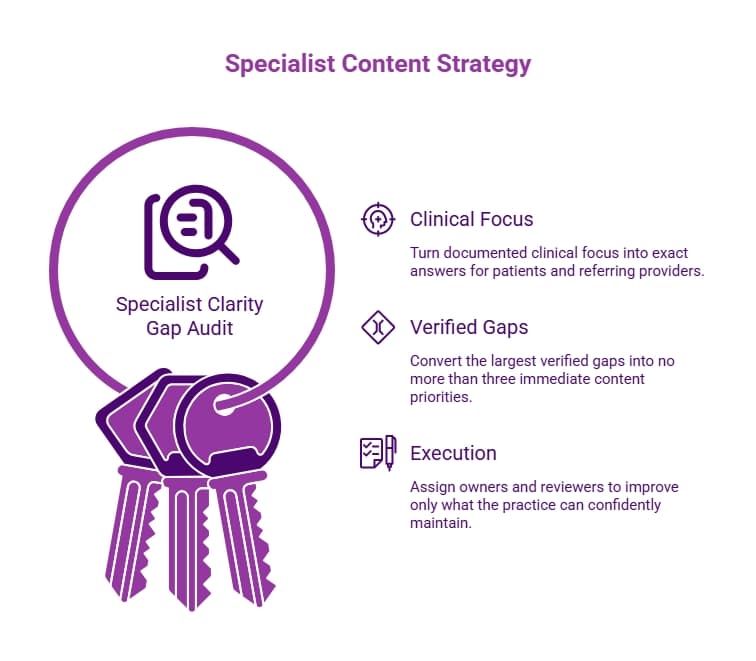
The durable alternative to imitating institutional breadth is execution. Turn your documented clinical focus into the exact answers patients and referring providers look for when closing the gap between research and scheduling.
Apply the six-dimension Specialist Clarity Gap Audit to one priority service line before planning your next page. Convert the largest verified gaps into no more than three immediate content priorities, assign owners and reviewers, and improve only what the practice can confidently maintain. Start with the gap where your proof is strongest, your reviewer is available, and the reader need is real.
If your practice needs a structured competitive analysis to guide that process, get a specialty search audit.
Frequently Asked Questions
Disclaimer: This article is provided for educational and marketing-strategy purposes only and is not medical advice. Any clinical, physician, treatment, referral, or patient-access information used in published content should be verified by the appropriate qualified healthcare professional before publication.
Our Editorial Process: Our expert team uses AI tools to help organize and structure our initial drafts. Every piece is then extensively rewritten, fact-checked, and enriched with first-hand insights and experiences by expert humans on our Insights Team to ensure accuracy and clarity.
By: About the BVM Insights Team
The BVM Insights Team is our dedicated engine for synthesizing complex topics into clear, helpful guides. While our content is thoroughly reviewed for clarity and accuracy, it is for informational purposes and should not replace professional advice.