
 BVM Insights Team
Practice launch search readiness means preparing verified surgeon information, priority procedure pages, credible proof, regional discovery signals, and working consultation pathways before a plastic surgery practice opens. Patients can start building their shortlist before opening day. A practice they can’t find or verify online may never make it onto that list.
The opening date is set.
Plastic still covers the arms of the consultation chairs. A new front-desk phone sits beside a stack of blank intake forms, and its line has not rung yet.
You have spent months on the lease, the build-out, hiring, and credentialing. Search keeps sliding to the bottom of the list. The website can wait until we’re open. That instinct makes sense when everything else feels more urgent. It also assumes prospective patients will wait.
The fix is smaller than most leadership teams expect. You don’t need every page finished before opening. You need a short, approved set of assets that lets a prospective patient find your surgeon, check credentials, understand a procedure, and request a consultation. Once that set is confirmed, the practice can open with its most important discovery paths already working.
Plastic surgery SEO launch sequencing is a phased approach for preparing the search, trust, and conversion assets a new, relocating, or rebranding practice needs around market entry. Think of it as building the runway before the practice takes off. The clinical practice may be ready, but patients can still form their shortlist before procedure pages, surgeon proof, galleries, and regional signals become discoverable. The goal is to open with the highest-priority patient-discovery pathways already connected and to leave lower-priority expansion for later. Dependencies and existing authority should drive the sequence. A generic launch-now-and-optimize-later approach can fail when the practice has no established visibility to carry it through the early research period.
Patient Shortlisting Begins Before a New Plastic Surgery Practice Opens
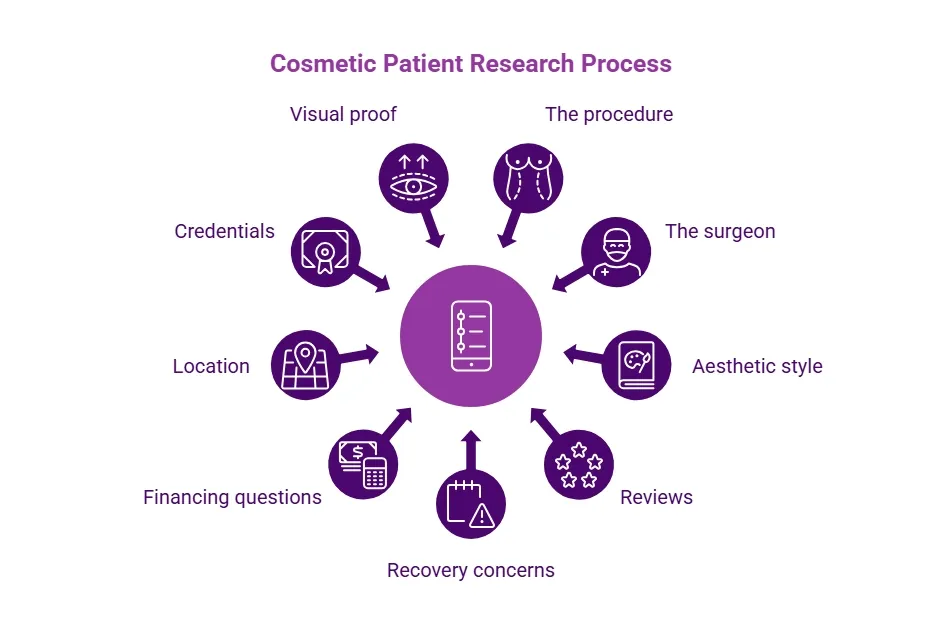
Leadership measures readiness inside the building. Patients measure it on a phone screen. Operational readiness determines whether the practice can deliver its services. Search readiness determines whether prospective patients can discover and evaluate those services online. Neither one guarantees new patients on its own.
BVM’s Plastic Surgery SEO framework treats cosmetic patient research as a process with many inputs. Before booking a consultation, patients weigh the procedure, the surgeon, aesthetic style, reviews, recovery concerns, financing questions, location, credentials, and visual proof. How long that research takes, and in what order, varies from one patient to the next. There is no reliable universal timeline, so planning around one would be guesswork.
Geography also matters more than many new practices assume. The same framework notes that cosmetic patients may travel for the right surgeon. A patient two hours away can be building a shortlist that your practice belongs on.
A common mistake is treating a top result for the surgeon’s name as proof of launch visibility. Name searches serve people who already know the surgeon. They do little for someone researching a procedure who has never heard of the practice.
Missing Launch Search Assets Can Weaken Early Surgeon Consideration
Each missing asset creates a point where a patient’s evaluation stalls:
- A procedure page with two generic paragraphs doesn’t help a patient judge fit.
- A surgeon bio that omits board certification raises a question and leaves it unanswered.
- An unfinished gallery removes the visual evidence many cosmetic patients rely on.
- A consultation form that routes to an unmonitored inbox ends the journey entirely. Even a working form can leave patients hesitating if it doesn’t explain what happens after they submit it.
None of these gaps proves the practice ranks poorly. Their effect can’t be counted as a fixed number of lost patients. Still, each unresolved question adds friction, and a patient who does arrive may not be able to finish evaluating the surgeon.
Consider an illustrative scenario. A practice administrator is eight days from opening. Gallery consent forms are still waiting for signatures, so the team publishes procedure pages with placeholder copy “to fix later.” Patients researching those procedures find nothing that shows the surgeon’s work. Early inquiries come almost entirely through referrals, and the team can’t tell whether search is underperforming or simply unfinished.
Sometimes the problem isn’t the website at all. It’s the approval queue: surgeon review, consent paperwork, and operational setup all competing for the same two weeks. Publishing more generic content won’t clear that queue. A smaller set of accurate, connected pages often serves patients better than a large site full of incomplete answers.
Practice Launch Search Readiness Prepares Credible Patient Evaluation Paths
Search readiness means a patient can do three things:
- Find the practice when researching a priority procedure in the region.
- Evaluate who the surgeon is, what they focus on, and what their results look like.
- Act by locating the practice and requesting a consultation through a path that works.
The connections between those steps matter as much as the pages themselves. A procedure page should lead to the surgeon who performs it. The surgeon’s page should lead to relevant proof, and the proof should lead to a clear consultation step. BVM calls this route a procedure-to-consult pathway. It’s a core part of launch sequencing because it keeps patients from restarting their research somewhere else.
Take a patient researching rhinoplasty. On one site, they should be able to understand the procedure at an educational level, identify the surgeon who performs it, review that surgeon’s qualifications, and find the consultation step. This reflects Google’s guidance on helpful, reliable, people-first content, which emphasizes useful information, demonstrated expertise, and satisfying the reader’s purpose.
A connected pathway is both a usability goal and a sound search foundation. Clear relationships between surgeons, procedures, credentials, and galleries also give AI-driven search tools cleaner material to summarize, and BVM structures content with that in mind. How each AI system weighs these signals isn’t fully public. Treat this as a sound preparation principle, not a guaranteed outcome.
The right measure follows from the same logic. Track whether consultation requests come from well-matched patients, not just whether traffic rises.
Surgeon Credentials and Clinical Proof Help Patients Evaluate Practice Fit
Credentials should be easy to confirm, not just easy to read. Patients can verify American Board of Plastic Surgery certification directly with the board. Your surgeon bio should state verified training, board certification, professional background, and clinical focus in terms that match what the patient will find there. Every specific claim needs factual confirmation before it goes live.
The board also points patients to state medical boards to check license standing. Accurate, consistent credential details across every page reduce friction at this step. Clear physician authorship signals on procedure content add another layer by showing who wrote or reviewed the clinical information.
Proof requires permission before placement. Under HHS guidance, HIPAA’s Privacy Rule gives patients control over marketing uses of their health information. That generally means written authorization before identifiable before-and-after photos appear on a website, and state law can add further requirements. Once permission is in place, each image should be accurately described and shouldn’t suggest outcomes a patient can expect.
Every public claim has to hold up, including reviews. The FTC’s advertising FAQs for small businesses call for truthful, substantiated representations and endorsements. Its updated Endorsement Guides address how businesses procure, edit, and feature reviews, including reviews a practice reposts in its own marketing.
A brand-new practice may have few approved photographs and no local reviews yet. That gap doesn’t justify filling the space with unsupported proof. Lead with verifiable credentials, clear explanations, and honest limits instead. Credibility begins with what can be demonstrated.
A consistent clinical review workflow helps keep procedure pages descriptive without implying individual candidacy or promising results. These are general principles, not legal advice, so confirm the specifics with qualified healthcare counsel.
A Launch-Readiness Sequence Prioritizes Essential Search and Proof Assets
Order assets by dependency, not by calendar. Each step relies on the one before it. However, a reliable baseline is to initiate the credentialing and core page framework (Steps 1-3) at least 60 days prior to opening, allowing adequate time for legal and clinical review before testing local discovery (Steps 4-5) at the 30-day mark.
- Business facts: Confirm the practice name, address, phone number, and hours so every listing matches.
- Clinical facts: Get the surgeon’s written approval of credentials, procedure list, and procedure focus.
- Core pages: Build procedure pages for the services the practice most wants to be known for, each connected to the right surgeon.
- Proof permissions: Collect gallery authorizations and review permissions before designing pages around them.
- Local discovery and contact: Prepare local listings and test the consultation request from submission to staff response.
- Measurement: Decide how the team will judge consultation quality before data arrives.
For step five, Google’s guidelines for representing a business tie a Business Profile to a real-world location with permanent signage. Google also offers guidance for businesses preparing to open. Eligibility, timing, and publication requirements still need to be checked against those rules for your practice before opening day.
What Has to Be Live Before Opening, and What Can Wait?
No single pre-opening deadline applies to every practice. The answer depends on the authority the practice already has.
A relocating surgeon with an established reputation, existing content, and reviews may reasonably improve some assets after opening. The team should first verify what remains accurate, then carefully migrate and reconnect the existing equity. A brand-new practice has no prior visibility to rely on, so the first four steps belong on its pre-opening list.
One objection deserves a direct answer: SEO takes too long to matter before launch. BVM is explicit that search work requires a build period, and no one can promise when results appear. That build period is the reason to start early. Waiting until opening only moves the starting line later.
An Executive Patient-Shortlist Matrix Identifies Gaps Before Opening
Leadership needs one page that turns this strategy into decisions. The proposed matrix below maps each patient question to four things: the minimum asset that answers it, the owner who confirms it, the review it must pass, and whether its absence blocks launch. That last column is a planning suggestion, so adjust it to your practice’s circumstances.
| Patient shortlisting question | Minimum credible asset | Owner to confirm | Review gate | Blocks launch if missing? |
|---|---|---|---|---|
| Who is the surgeon and what are their qualifications? | Approved surgeon biography and credential details | Surgeon/practice lead | Clinical and factual approval | Yes |
| Is the procedure relevant to what I am evaluating? | Approved procedure explanation connected to the appropriate surgeon | Clinical reviewer | Clinical accuracy and candidacy boundary | Yes, for priority procedures |
| What can I reasonably assess from results? | Permission-cleared gallery or compliant educational explanation | Clinical/consent owner | Consent, image rights and suitability | Not if a compliant alternative is live |
| Where is the practice and how do I contact it? | Verified location and contact/consultation path | Operations lead | Operational facts and working pathway | Yes |
| Can I trust the information? | Clear authorship/review, verified credentials and appropriately attributed proof | Clinical/editorial owner | Evidence and permissions | Yes |
Print it and mark each row approved, in review, or missing. A row marked missing that also blocks launch belongs on the same agenda as equipment delivery and staff training.
A few firm rules make the blocking column easier to apply:
- Never publish an unverified credential.
- Fix a broken consultation path before directing any patient toward it.
- Let additional educational content wait when the core pathway already works.
Across industries, BVM’s clients consistently say they value clear explanations, named owners, and realistic expectations. The matrix brings that same clarity inside the practice. It gives the surgeon-owner, clinical reviewers, operations team, and marketing lead a shared view of readiness without turning every unfinished task into a launch blocker.
Practice Leaders Can Assess Launch Readiness Before Committing to Expansion
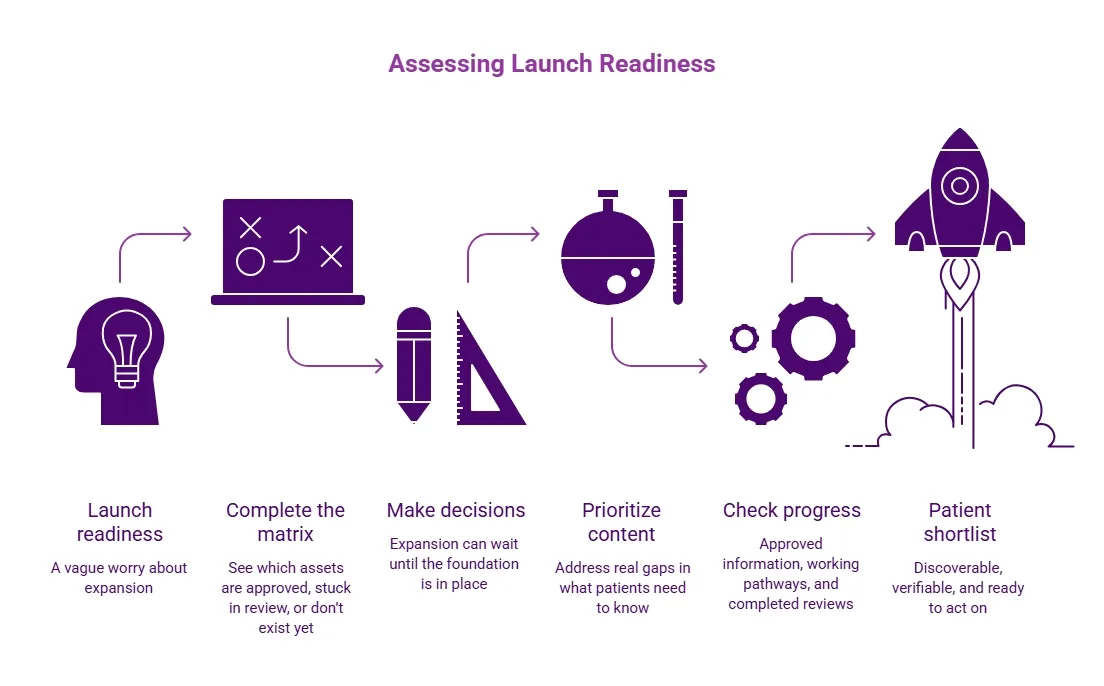
Return to that quiet front-desk phone. A silent line isn’t a search failure on its own. The real question is whether patients researching your procedures today can find, evaluate, and reach your surgeon.
With the matrix complete, the answer becomes visible. Leadership can see which assets are approved, which are stuck in review, and which don’t exist yet. A vague worry turns into a handful of decisions, and expansion can wait until the foundation is in place. If the pathway works, further content can be prioritized by real gaps in what patients need to know. If it breaks, the first investment belongs in the missing connection, not in more pages.
In the first weeks, progress shows up as approved information, working pathways, and completed reviews. As reliable data arrives, relevant inquiries and consultation quality reveal more than aggregate traffic ever will.
This approach suits teams willing to invest in approved pages, documented proof, and clinical review. It isn’t designed for anyone expecting instant rankings. If the gaps are larger than your team can close alone, BVM’s Plastic Surgery SEO work centers on this kind of launch planning, covering procedure-focused visibility, surgeon positioning, and patient evaluation pathways.
Discoverable, verifiable, and ready to act on: that’s how a practice earns a place on the patient’s shortlist.
Disclaimer: This article discusses marketing and practice-launch planning. Clinical information and use of patient images require appropriate professional review and permissions.
Our Editorial Process: Our expert team uses AI tools to help organize and structure our initial drafts. Every piece is then extensively rewritten, fact-checked, and enriched with first-hand insights and experiences by expert humans on our Insights Team to ensure accuracy and clarity.
By BVM Insights Team
The BVM Insights Team develops practical guidance on SEO, entity clarity and content planning for businesses and specialty practices.