
 Dustin Ogle
A query can belong to one page without belonging to only one specialty.
That distinction gives a multi-specialty practice a workable answer when several physicians or service lines have a defensible relationship to the same condition-led search. Assign one page to own the reader’s primary information need, acknowledge other clinically reviewed pathways, connect the supporting pages, and require approval before publication. Do not turn page ownership into a diagnosis or a personalized recommendation.
MedlinePlus explains that different conditions can cause similar symptoms and that identifying the likely cause requires a healthcare provider’s evaluation. A website can therefore organize information and access paths, but it cannot determine which clinical explanation applies to an individual.
The operating model is simple: separate editorial ownership from clinical relevance, navigation, and care access. Then document each decision in a routing matrix that marketing, clinical, and operational stakeholders can review.
Why Ambiguous Searches Are an Architecture Problem—Not a Medical Answer
Search-intent routing means deciding which page should answer a query and which related pages should support it. It is an editorial and information-architecture task. Clinical relevance means that a qualified reviewer has confirmed that a specialty, physician, treatment, or service may legitimately relate to the topic.
Those decisions intersect, but they are not interchangeable.
| Search-intent routing | Medical triage |
|---|---|
| Organizes pages and links | Evaluates an individual’s condition |
| Clarifies available information | Determines urgency or clinical next steps |
| Can be designed by marketing with review | Requires qualified clinical judgment |
| Uses neutral pathways | May involve diagnosis and treatment decisions |
Query wording indicates an information need, not a confirmed diagnosis. The editorial owner should be the page with the clearest purpose for that need. Clinically relevant alternatives can remain visible through reviewed language and links.
This avoids the false simplification that one query must equal one specialty and one landing page. It also prevents the opposite mistake: listing every service line merely to avoid making a decision.
Separate Four Decisions That Teams Often Collapse Into One
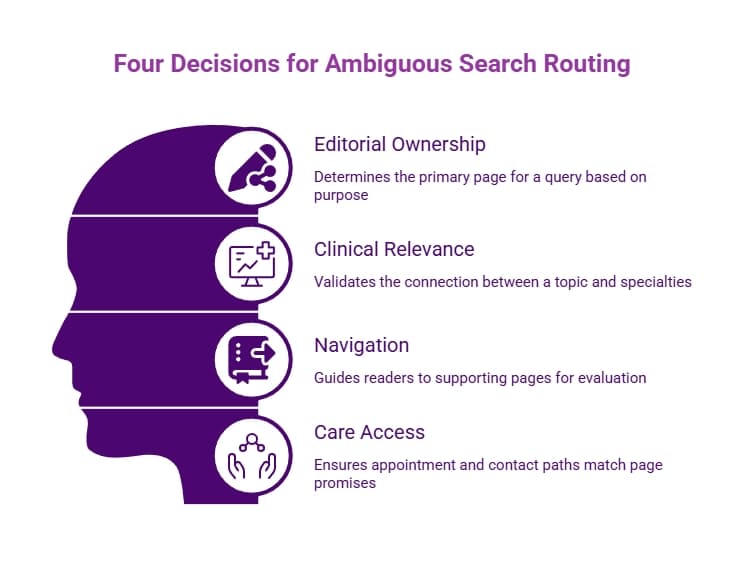
A routing dispute becomes manageable when the practice separates four questions.
Editorial ownership: Which page best answers the primary query? Page purpose should control this decision—not organizational seniority, revenue priority, or which service line requested the content.
Clinical relevance: Which specialties, physicians, or services may legitimately relate to the topic? A marketing team can identify a possible relationship, but an appropriately qualified clinical reviewer must validate it. A broad specialty title or an outdated physician bio is not sufficient proof.
Navigation: Which supporting pages help the reader evaluate the available information? Depending on the page’s purpose, those destinations may include physician profiles, treatment pages, specialty pages, or access information. Practices that need a broader page-role model can use separate condition, treatment, and physician content paths.
Care access: Which approved appointment or contact path matches the page’s promise? Operations must verify the destination. A generic department label may not reflect the physician, service, location, referral requirement, or scheduling route described on the page.
These four decisions may have different owners. Marketing defines the reader job and proposed structure. Clinical stakeholders validate medical meaning. Operations confirms access. Compliance or legal review may be appropriate when wording creates additional risk.
Build an Ambiguity Routing Matrix Before Drafting the Page
The matrix converts an informal ownership argument into a reviewable content decision. Complete it before drafting headings, physician links, treatment references, or appointment calls to action.
This is a content-governance tool, not a clinical triage tool.
| Matrix field | Decision to record |
|---|---|
| Search theme or query cluster | The wording and closely related information need |
| Reader’s primary information need | The question the owner page must answer |
| Primary editorial page owner | The page with the clearest distinct purpose |
| Other relevant specialties or service lines | Only material relationships that receive clinical approval |
| Neutral overlap language | Wording that preserves uncertainty without ranking specialties |
| Supporting physician pages | Profiles with current, verified evidence of relevance |
| Supporting treatment or service pages | Pages that explain available services without implying suitability |
| Location or appointment path | A destination confirmed by operations |
| Claims or implications to exclude | Diagnosis, personalized routing, urgency, unsupported fit, or guarantees |
| Clinical reviewer | The person authorized to validate medical meaning |
| Content owner | The person accountable for the published page |
| Approval or review date | When the decision was last confirmed |
| Review trigger | Changes to physicians, services, treatments, locations, referrals, or scheduling |
The primary information need is the controlling field. A page should not own a query merely because its title contains the closest keyword. It should own the query because its purpose gives the reader the clearest answer.
The neutral overlap language must remain useful. “Several clinical factors may affect which specialty is relevant” preserves uncertainty; vague statements such as “many things are possible” do not explain the available pathways. The excluded implications field then records what the page must not suggest.
Supporting links need evidence. Missing physician-profile detail, incomplete service documentation, or an unverified scheduling route should be recorded as a content gap rather than filled by inference. Once the relationships are approved, a separate condition-to-physician mapping process can connect the owner page to substantiated profiles.
Hypothetical example: The query cluster is “\[shared symptom\] specialist.” The primary reader need is to understand what types of evaluation may be relevant. A neutral condition-information page owns the query and links to two unnamed, clinically reviewed specialty paths. The copy states, “Several clinical factors may affect which specialty is relevant.” It does not tell an individual reader which specialty to choose.
Do not publish if the page contains: a diagnosis, a personalized specialty recommendation, an urgency threshold, unsupported physician-fit language, or a guarantee.
Use Internal Links to Expose Alternatives Without Creating a Diagnosis Flowchart
Internal links should explain relationships among pages. They should not operate as a symptom checker or imply that clicking a link confirms a diagnosis.
Link to a physician profile when the reader needs to evaluate verified expertise or fit. Link to a treatment page when the reader needs to understand an offered service. Link to another specialty page when the overlap is material and clinically reviewed. Link to a location or appointment page only when the destination supports the service described.
Do not add every possible specialty. Each link should have a clear reason, supported destination, and neutral anchor. Safe patterns include “Explore physician expertise related to this topic” and “Review related treatment information.” Avoid anchors such as “Book the doctor you need,” “This is the correct specialist,” or “Choose this treatment.”
The detailed choice between physician and treatment destinations is addressed in when a condition page should link to a physician or procedure page.
Separate pages may be appropriate when they perform different jobs. In a hypothetical structure, Page A explains the condition and evaluation context, while Page B explains a treatment offered by one service line. The pages can link to each other because their purposes differ; neither should imply that the treatment applies to every reader associated with the condition.
Google’s own link guidance recommends descriptive, concise, relevant anchor text. Its people-first content guidance also emphasizes useful, trustworthy content with a clear purpose. These are platform-owned recommendations, not proof that a particular structure will improve rankings, AI visibility, traffic, or appointments.
Define Who Can Approve What Before Publication
Governance should specify decision rights rather than asking one stakeholder to approve everything.
The marketing or content owner is responsible for page purpose, search need, terminology, structure, and the proposed link set. The clinical reviewer validates medical accuracy, specialty overlap, physician relevance, excluded implications, and the risk of misleading interpretation. Operations confirms locations, referrals, scheduling destinations, and appointment paths. Compliance or legal review may be needed for higher-risk claims, while the web owner implements and maintains the approved structure.
Recommended handoff:
Marketing proposal → clinical review → access validation → compliance review when needed → publication → scheduled re-review
The AMA Code of Medical Ethics states that physician communications must not be false, misleading, deceptive, or misleading through omission of necessary information. For ambiguous content, an omitted limitation can materially change the meaning of a specialty-relevance claim.
A governance breakdown often occurs gradually. Marketing revises the condition page, a service line updates a physician profile, and scheduling changes the appointment destination. The site then presents three inconsistent routes. One maintained matrix, named owners, and recorded review triggers create a single place to resolve the conflict.
Clinical review should occur before publication, not after a finished article has already shaped the site. Give reviewers the matrix, proposed claims, links, exclusions, and access destinations so they can assess a finite set of decisions.
Audit One Ambiguous Topic Before Scaling the Framework
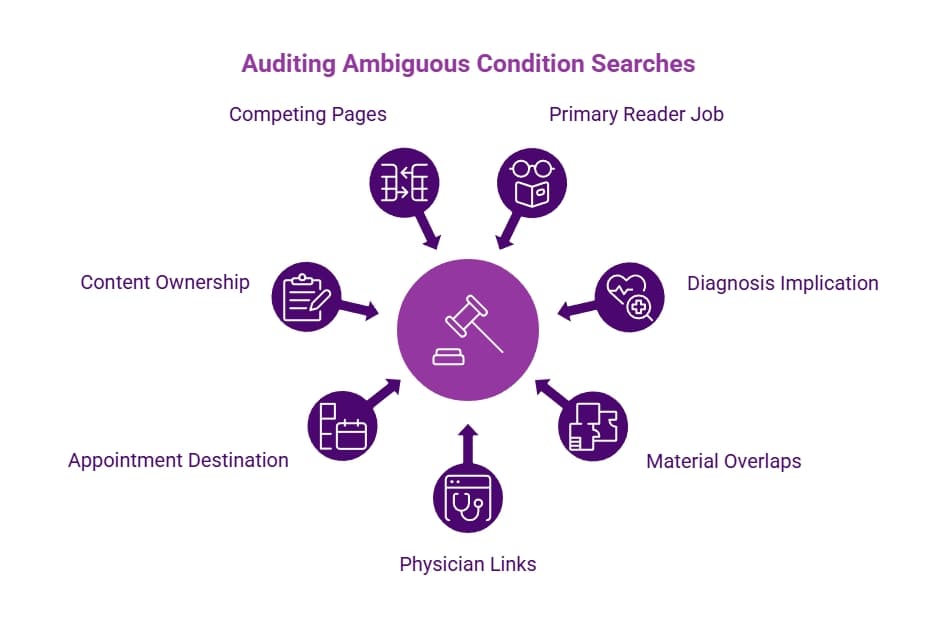
Pilot the process on one high-priority query cluster. Review the current owner page and ask:
- Does one page clearly own the primary reader job?
- Does any wording imply diagnosis or personal recommendation?
- Are material overlaps acknowledged and clinically reviewed?
- Do physician and treatment links have current support?
- Does the appointment destination match the page’s promise?
- Are the content owner, reviewer, approval date, and review trigger recorded?
- Could another team publish a competing page for the same purpose?
The result should be one documented ownership decision, a limited set of supported pathways, explicit exclusions, and a review record.
Audit one ambiguous query using the routing matrix before publishing another condition page.
Frequently Asked Questions
Disclaimer: This article is for general informational purposes only and does not constitute medical advice, diagnosis, or treatment. Readers should consult a licensed healthcare professional for guidance specific to their health, symptoms, medications, or treatment options.
Our Editorial Process: Our expert team uses AI tools to help organize and structure our initial drafts. Every piece is then extensively rewritten, fact-checked, and enriched with first-hand insights and experiences by expert humans on our Insights Team to ensure accuracy and clarity.
By: About the BVM Insights Team
The BVM Insights Team is our dedicated engine for synthesizing complex topics into clear, helpful guides. While our content is thoroughly reviewed for clarity and accuracy, it is for informational purposes and should not replace professional advice.