
 Dustin Ogle
A treatment page that answers "Am I a candidate?" needs to explain how candidacy is evaluated and reserve the individual conclusion for clinical evaluation. That middle ground is more precise than it sounds: describe the decision process, identify the kinds of information that may matter, and make the appropriate next step clear, without converting any of it into a verdict about the person reading.
The question carries unusual weight because it sits at the point in the condition-to-treatment journey where education turns into treatment consideration. The visitor is no longer asking what a procedure is. They are asking whether it could apply to them. A page that answers with generic boilerplate leaves the visitor where they started: interested, uncertain, and without a reason to take the next step. A page that answers with a definitive yes-or-no framework creates a different problem. It can read as though the website has made a clinical judgment about someone it has not evaluated.
Marketing and clinical teams can hold that middle ground with a shared structure: a three-zone boundary for classifying copy, rewriting patterns, a review workflow, and a pre-publish audit.
A Candidacy Page Should Explain the Decision, Not Make It
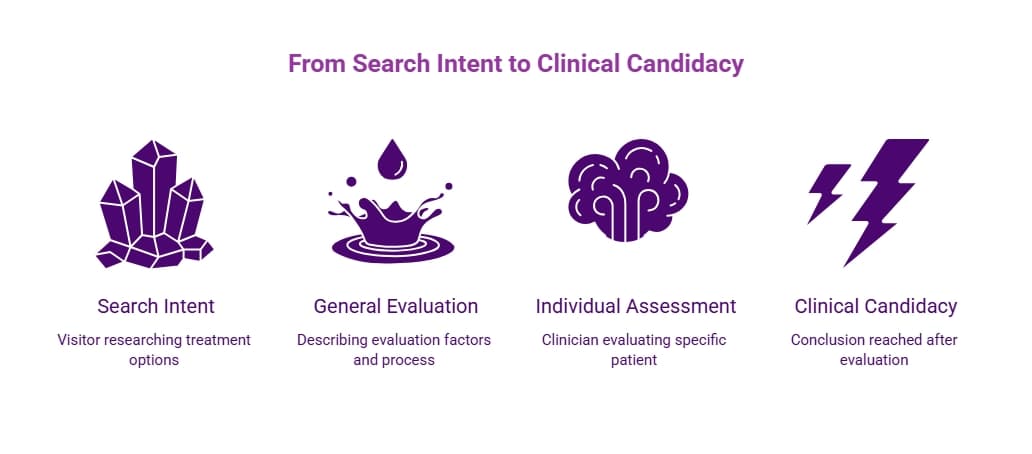
Marketing teams often treat "candidate" as an intent category, meaning a visitor researching whether a treatment might fit. Clinicians use the same word for a conclusion reached after evaluation. Practice leadership wants pages that attract treatment-relevant demand, and legal or compliance stakeholders, where involved, want that demand generated without added risk. Content overreaches when it turns the search-intent category into the clinical conclusion, and patient eligibility content is where that collision happens most visibly.
Three definitions settle the conflict. Treatment candidacy is an individualized clinical determination: a conclusion a clinician reaches after evaluating a specific patient. General evaluation factors are the categories of information that can be considered during that assessment. General education explains those factors and the evaluation process without applying them to the person reading.
That distinction between eligibility and education is also how you explain patient fit without giving medical advice: describe what fit depends on, not whether the reader has it.
"A clinician may consider factors such as..." describes an evaluation process.
"Whether treatment is appropriate depends on an individual evaluation." places the conclusion where it belongs.
"You are a good candidate if..." issues a verdict the page has no basis to issue.
A referral to specialist evaluation should mark the boundary of the page, not serve as the whole answer. "Talk to your doctor" tells the visitor where the decision happens but nothing about what it involves. Earlier-stage pages face a similar tension, which is why the approach to symptom-to-specialist content without overstating clinical relevance follows the same logic.
Use a Three-Zone Candidacy Content Boundary
Before drafting, sort every proposed candidacy statement into one of three zones. The zone determines who owns the claim, what evidence it needs, and whether it belongs on a public page. This is an editorial method for structuring copy, not a medical, legal, or regulatory standard.
| Content zone | What belongs here | Example pattern |
|---|---|---|
| Explain | General evaluation process and non-personalized context | "A clinician may consider..." |
| Verify and qualify | Treatment-specific factors requiring sourced clinical review | "For this procedure, factors may include..." only after verification and review |
| Reserve for evaluation | Individual diagnosis, eligibility, recommendation, urgency | "You qualify..." (do not publish as a generalized conclusion) |
Zone 1: Explain
This zone carries most of the page's usefulness: general information about what an evaluation seeks to clarify, the types of information a patient may be asked to share, and what the next step involves. A description of what the treatment is intended to address belongs here only after it has been clinically verified.
Marketing can draft Zone 1 copy because it describes a process rather than asserting clinical facts. It still goes through review, since process descriptions can drift into implied criteria.
Zone 2: Verify and Qualify
Treatment-specific selection factors, contraindications, clinical terminology, and statements about outcomes, risk, or effectiveness sit here. Each requires verified clinical information from authoritative, current sources and approval from the physician or clinical reviewer who owns the claim. Factors that may rule a patient out need the same scrutiny, because a "who should not" list can read like a personal verdict as easily as an inclusion list.
Qualified language matters in this zone, but it cannot stand in for evidence. Adding "may" to an unsupported criterion produces a hedged unsupported criterion, and appending "results vary" to an overconfident outcome statement leaves the overconfidence intact. Use qualifiers where clinically appropriate, and remove claims the evidence does not support.
Consider a hypothetical failure. A procedure page lists three conditions under "You're a candidate if," borrowed from a competitor's site. Each item is a Zone 2 claim dressed up as a Zone 3 verdict, and competitor pages are not acceptable evidence for medical content.
Zone 3: Reserve for Individual Evaluation
Diagnosis, eligibility, treatment recommendations, individual prognosis, urgency conclusions, and any promise about outcomes belong only to clinical evaluation. No amount of qualification moves them into generalized website copy. If a draft sentence tells the reader what they have, whether they qualify, or what will happen to them, rewrite it or remove it. For example, instead of writing 'You are a candidate for surgery if your BMI is under 35,' move it to Zone 1: 'During evaluation, a surgeon will review your complete health history, including factors like BMI, to determine if this procedure is a safe option.' The pre-publish audit below condenses all three zones into five questions.
Make the Page Useful Without Turning It Into a Self-Screening Checklist
Cautious copy becomes empty when teams strip out specificity without replacing it. The replacement is structure: explain the categories of information a clinician evaluates instead of publishing pass/fail thresholds.
Universal thresholds rarely hold up anyway. Selection factors can vary by procedure, patient context, clinician judgment, evolving evidence, and practice standards, so a partial list published as a checklist can mislead readers in either direction. A partial list can also look complete once formatted as a checklist, even when other information could affect the assessment. Keep factors that may be relevant to evaluation separate from verified criteria that determine candidacy—and present the former as inputs to evaluation rather than gates the reader can score independently. Even when criteria are authoritative, treatment-specific, current, and clinically reviewed, they must remain educational context rather than functioning as a public-facing screening tool.
These hypothetical patterns illustrate sentence structure only, not treatment-specific clinical guidance.
| Riskier wording | Better editorial pattern |
|---|---|
| "You are a candidate if you meet A, B, and C." | "Evaluation commonly considers several factors. Which factors matter, and how they affect treatment options, depends on the individual clinical assessment." |
| "If none of these apply, the treatment is right for you." | "These considerations may be relevant to evaluation, but they do not determine candidacy on their own." |
| "Ask your doctor if this treatment is right for you." | "During an evaluation, a specialist may review your history and current situation to determine whether this treatment is an appropriate option to discuss." |
| "If you have this symptom, you need this procedure." | "A symptom alone does not determine whether a treatment is appropriate. A clinician can evaluate what may be contributing and which options may be relevant." |
Specialist evaluation content earns its value in what comes next. Describe what the consultation typically covers, what information the patient may be asked to bring, and how the specialist will discuss options once the evaluation is complete. Then give readers questions to carry into the appointment:
- Which factors will you weigh in my case?
- What alternatives should we discuss?
- What information would help you evaluate my situation?
- What questions can only be resolved through an individual clinical assessment?
Every treatment-specific statement in these sections still needs evidence and review. Structure makes the page useful; verification keeps it accurate.
Build Physician Review Into the Content Workflow
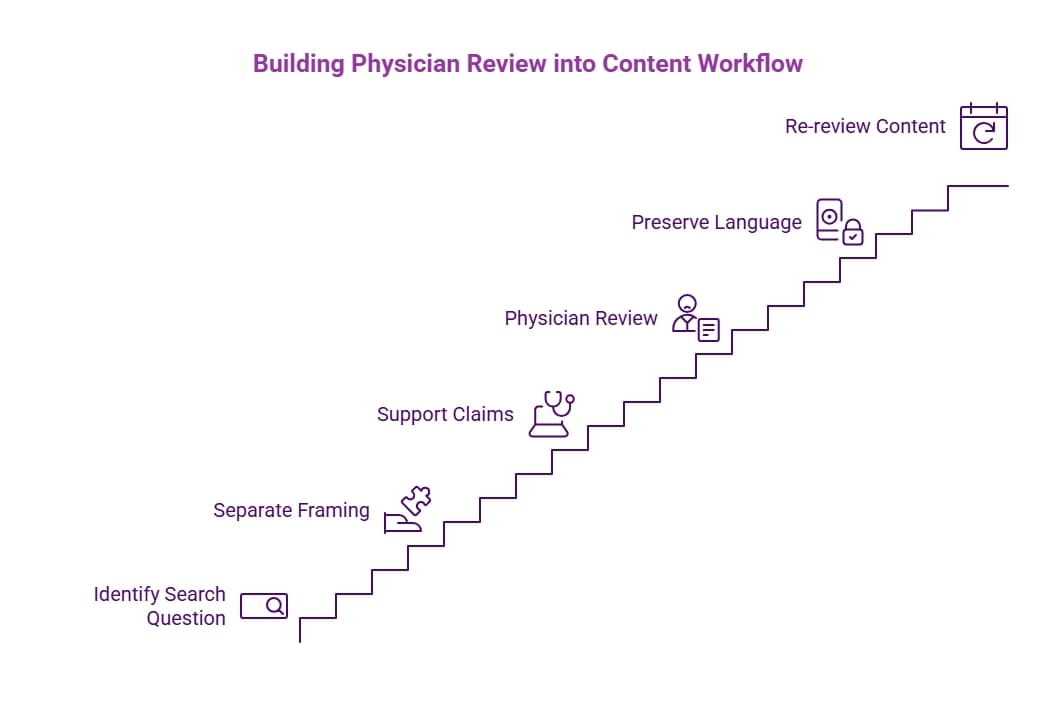
When a page's framework is already overconfident, review after drafting turns into line-by-line rebuilding. Applying the three zones before anyone writes treatment-specific claims moves review earlier, where it shapes the page instead of repairing it. It also joins search intent and clinical review into one process instead of two.
A workable sequence:
- Marketing identifies the search question the page must answer.
- The writer separates general editorial framing from clinical claims and tags each Zone 2 statement.
- Each clinical claim receives support from authoritative clinical references. Competitor practice pages, anonymous health blogs, AI-generated summaries, affiliate content, and unsourced marketing copy are not acceptable evidence for treatment-specific medical statements.
- The appropriate physician or clinical reviewer approves the claim and its qualifiers, adds qualification, or removes it.
- Approved language is preserved through later editing.
- The content is re-reviewed when treatment information materially changes.
Step 5 is where many pages lose accuracy. Edits for tone, length, or conversion can strip out a qualifier the reviewer considered clinically important. Treat reviewed qualifiers as controlled language: changing one requires the reviewer's sign-off, even when the edit looks cosmetic.
Here is a hypothetical handoff. Marketing proposes a treatment-specific selection statement for a procedure page. The reviewer approves the exact wording with its source, approves it with added qualification, or cuts it. The decision is recorded so the next editor knows the sentence is locked. Review should not merely confirm that a draft "sounds medical enough."
For implementation detail, see how clinical review workflows for specialty SEO content keep pages accurate and publishable.
Audit the Page Before Publishing
A pre-publish audit should catch two opposite failures. The first is over-definitive copy that appears to diagnose the reader, decide eligibility, or strengthen a clinical claim beyond its evidence. The second is vague copy that avoids those errors but leaves the reader unable to understand what evaluation is meant to clarify.
Run every candidacy section through the same five questions before it goes live. The checklist works for new drafts and for existing pages that may already imply more certainty than intended.
- Does any sentence diagnose the reader or decide their treatment eligibility, rather than describe a general factor?
- Is every treatment-specific clinical statement verifiable against an authoritative, current source?
- Has the appropriate clinician reviewed the final wording, including every qualifier?
- Does the page explain why individual evaluation still matters?
- Is the next step useful without implying what the clinical outcome will be?
Question 3 matters beyond the page itself. When a search result or AI-generated answer excerpts a single passage, a sentence that carries its own qualifier is harder to misrepresent than one relying on a caveat elsewhere on the page. Keep SEO mechanics and AI-search legibility secondary to this clinical boundary: clear content structure can make claim ownership easier to parse, but search considerations should not be used as a reason to add unsupported clinical specificity.
Also check relationships among treatments, conditions, and specialists. If the page says a particular clinician, specialty, or service is relevant, that relationship should rest on verifiable practice evidence rather than marketing assumption. A separate process for supporting specialist-relevance claims with verifiable evidence can help govern those connections.
A claim that fails any question has three possible fixes:
- Verify it and send it through review.
- Soften it into defensible general education that fits Zone 1.
- Remove it.
Start with one high-intent treatment page rather than the whole site. Classify its candidacy statements, correct both vague and over-definitive copy, confirm clinical ownership, and document what should trigger re-review. A single audit shows where your current copy clusters across the three zones and exposes wording habits that likely repeat across service lines. Once the process works on that page, expand it.
Give Readers a Defensible Next Step
The strongest candidacy content does not answer yes or no for the individual reader. It helps them understand what matters, why evaluation is necessary, and what the appropriate next step is. Built this way, responsible medical content and treatment-intent healthcare SEO stop competing: the structure that keeps a page clinically defensible also keeps it worth finding.
Treat the three-zone boundary as a drafting rule rather than a cleanup step, and review has less to correct. If you are weighing how candidacy content fits into broader medical specialty SEO, the same discipline helps keep treatment-intent content useful without making the clinical decision in the copy.
Frequently Asked Questions
Disclaimer: This article addresses healthcare content strategy, not individual medical advice. Treatment candidacy and clinical recommendations should be determined by an appropriately qualified healthcare professional after evaluating the individual patient.
Our Editorial Process: Our expert team uses AI tools to help organize and structure our initial drafts. Every piece is then extensively rewritten, fact-checked, and enriched with first-hand insights and experiences by expert humans on our Insights Team to ensure accuracy and clarity.
By: About the BVM Insights Team
The BVM Insights Team is our dedicated engine for synthesizing complex topics into clear, helpful guides. While our content is thoroughly reviewed for clarity and accuracy, it is for informational purposes and should not replace professional advice.