
 Dustin Ogle
A practice can publish detailed, physician-reviewed procedure pages and still lose the reader several steps earlier, when the person is trying to understand what their concern might warrant, what kind of evaluation comes next, and who performs it.
The instinct is often to publish more symptom articles. Volume will not close the gap if pages lack clear roles and the transitions between them are missing or unsafe. The higher-value problem is how content handoffs are designed: which page owns each stage of the question and what defensible next step follows. You can run a page-level audit on those handoffs without turning your content into diagnosis or procedure triage.
Procedure-First Content Starts Too Late In The Decision Path
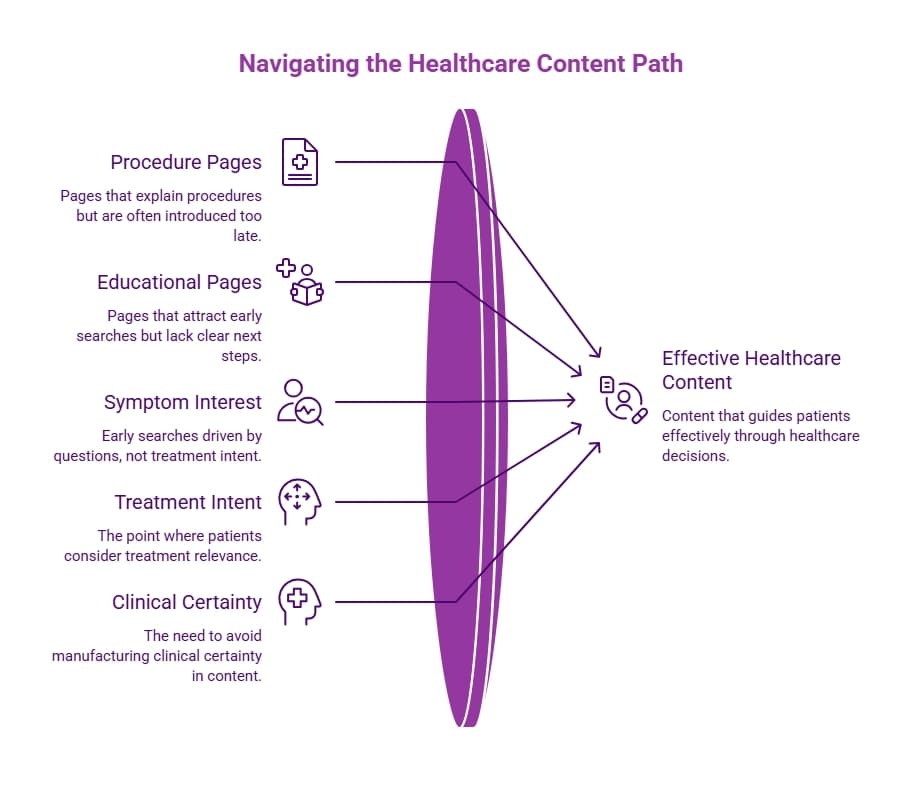
Procedure pages answer an important question, and they carry real commercial weight. The solution is not to bury them beneath layers of educational content. It is to recognize that they serve a later stage of the treatment-intent journey. Someone still working out whether their concern warrants a specialist evaluation has not reached procedure consideration yet. When someone objects that "our procedure pages already explain everything," the issue is timing, not quality.
Broad educational pages create a different problem. They attract early searches but often end without identifying an appropriate next information step. Consider a hypothetical specialty site. A general education article explains a common concern clearly. At the bottom, it links to a procedure page and a consultation button. The reader needed to know what an evaluation involves. Instead, they face a treatment description and a booking form. That page is a healthcare content dead end in two directions: it offers no defensible next step, and the step it does offer skips evaluation entirely.
Early symptom interest describes a question, not treatment intent. In this context, treatment intent means the point at which a reader is beginning to evaluate whether a treatment or procedure may be relevant to their situation — not that they have determined a treatment is appropriate. The clinical content architecture has to respect the distance between those two positions.
The practical question, then, is not whether the practice needs more symptom content. It is whether the reader can move from the question they have now to the next legitimate question without the site manufacturing clinical certainty.
Separate The Jobs Of Symptom, Condition, Treatment, Physician, And Access Content
Most practices already have these page types, often with overlapping service, condition, physician, location, and blog pages that blur responsibilities. Before creating anything new, clarify distinct page ownership. Combining symptom education, condition detail, treatment options, physician profiles, and FAQs onto one page makes every role harder to govern and every content handoff harder to audit.
Symptom And Problem Content: Clarify Uncertainty, Not Diagnosis
This page helps a reader understand what a concern can be relevant to and which kinds of evaluation may be involved. It should acknowledge diagnostic uncertainty, because several explanations are often possible. A qualified healthcare professional determines which one applies.
Condition Content: Explain A Verified Clinical Concept
A condition page explains a defined clinical concept and how it is generally assessed. Links to treatments or physicians belong only where a clinically supportable relationship exists and has been reviewed.
Treatment And Procedure Content: Support Evaluation And Comparison
This page describes what the procedure involves and what questions clinicians weigh when considering it. The goal is evaluation rather than assumed candidacy: help the reader prepare for a clinical conversation, not settle suitability on their own.
Physician And Access Content: Show Who Evaluates And What Happens Next
Here the reader learns who performs evaluations, what relevant expertise and credentials they hold, and where the practice provides access. It covers verified referral requirements, records, and appointment steps. Not every early-stage reader should be pushed immediately toward a booking form. Some need another trustworthy evaluation step before scheduling.
| Page type | Reader question | Page job | Appropriate next step | Risk to avoid |
|---|---|---|---|---|
| Symptom/problem | What might this concern relate to? | Clarify uncertainty and possible evaluation areas | Condition or evaluation information | Implying a diagnosis |
| Condition | What is this, and how is it assessed? | Explain a verified clinical concept | Evaluation process or treatment overview, where clinically supported | Unreviewed condition-to-treatment links |
| Treatment/procedure | What does this involve, and how is suitability decided? | Support evaluation and comparison | Physician or evaluation page | Self-assessed candidacy |
| Physician | Who evaluates this, and what expertise do they hold? | Establish relevant credentials and physician fit | Access and appointment information | Unsupported "right specialist" claims |
| Access | How do I get evaluated? | Explain location, referral, records, and scheduling | Contact or booking path | Outdated availability or access details |
Distinct page jobs do not mean creating a new URL for every search question. Start by asking whether an existing page can legitimately own the question. The opposite mistake is equally common: forcing symptoms, conditions, treatments, physician information, and FAQs into one page, where several intents compete for ownership and the reader loses track of which question the page is actually supposed to answer.
Keeping these types distinct also prevents them from competing with each other in search. That problem is covered in detail in this guide to mapping symptom, condition, treatment, and specialist pages.
Use A Five-Question Audit To Find Broken Handoffs
Existing specialty websites rarely have perfectly clean taxonomies. Functional overlap across the site map is entirely normal at this stage. Before commissioning more content, assign ownership among the pages you already have.
Pick one procedure or service line. Trace the path a reader could take from an early question to an evaluation step, and ask five questions at every page along the way.
The Five-Question Symptom-to-Evaluation Path Audit
- What does the searcher know at this page? Define the exact question the page is equipped to answer.
- What uncertainty still remains? Identify the next legitimate question after the reader finishes the page.
- Which page owns the next legitimate question? Determine whether an existing symptom, condition, treatment, physician, specialty, or access page should answer it before creating a new URL.
- What clinical relationship must be verified before linking or describing that next step? If the transition connects symptoms, conditions, treatments, procedures, specialties, or physician expertise, confirm that the relationship is clinically supportable.
- Does the pathway end with a clear evaluation or action option without implying diagnosis or candidacy? The next step may be more information, an evaluation explanation, a physician profile, or access guidance. It does not always need to be an appointment CTA.
Apply it to a generic pathway: a persistent concern → condition and evaluation information → relevant specialist evaluation → treatment discussion. For example, someone searching about 'chronic heel pain' (Symptom) needs to understand potential causes like plantar fasciitis (Condition). From there, they need to know what an orthopedic foot evaluation looks like (Evaluation), rather than being routed directly to a 'plantar fascia release surgery' booking page (Procedure). The audit does not test whether a page is well written. It tests whether each intent transition makes sense for someone who knows only what the previous page told them.
Three problems tend to surface.
A missing page: Question 3 has no answer. The reader's next legitimate question has no page that owns it. Most often, the gap is an explanation of what an evaluation involves, sitting between education and treatment.
A wrong link destination: The page exists, but the link skips a stage, usually jumping straight to a procedure. Question 4 catches this: if the link implies a clinical relationship nobody has verified, it needs a different destination or clinical review.
The right page with an unclear next step: The handoff reaches the correct page, but that page ends without a defensible action. For some readers, the right ending is an appointment path. For others still early in the patient search journey, it may be a page explaining what to expect at an evaluation.
Before creating a new URL for every gap, check whether the missing answer belongs inside an existing page's role. A short section on an evaluation page may resolve a handoff better than a standalone article that competes with it.
Do Not Turn Content Architecture Into Clinical Triage
Search intent describes a question, not a diagnosis. A link between two pages is an editorial relationship that readers may still interpret as a clinical one.
Ambiguity is where this matters most. Imagine a hypothetical concern that could be relevant to several conditions across different specialties, where the possible next steps range from monitoring to a procedure. Routing that page to a single treatment makes the site look decisive while quietly making a clinical judgment that belongs to a qualified healthcare professional. A risky architecture forces the reader into one procedure path because that is the practice's highest-value service. Instead, a sound architecture maps out the appropriate evaluation context and preserves the possibility of multiple clinical directions, making it clear that a clinician determines which applies depending on the patient and clinical findings. It can point to general evaluation information or to several relevant specialty overviews without forcing one destination.
Treatment relevance and candidacy belong to qualified healthcare professionals. Content can explain the evaluation process. It should not simulate the determination itself.
| Safer transition language | Riskier transition language |
|---|---|
| "A specialist evaluation can help determine whether this treatment is relevant." | "If you have this symptom, this procedure is the right treatment." |
| "This concern may warrant evaluation." | "This symptom means you need treatment." |
| "Suitability depends on the patient and clinical findings." | "You are a candidate if you experience any of the following." |
| "A qualified healthcare professional determines which approach fits." | "This procedure will fix the problem." |
| "This page explains questions that may come up during evaluation." | "Use these signs to decide whether you are a candidate." |
| "Several evaluation paths may be possible depending on clinical findings." | "This symptom should lead directly to this procedure." |
Any claim linking specific symptoms, conditions, procedures, or physician expertise should reach a clinical reviewer before publication.
Build The Review Workflow Around The Handoff, Not Just The Page
Clinical review bandwidth is limited. Reviewing the handoffs between pages is more efficient than rereading entire pages, because the relationships between content types carry most of the clinical risk. The solution is not to ask physicians to rewrite dozens of marketing pages. Concentrate their attention on the relationships and claims carrying the greatest clinical risk, while marketing owns page structure and operations owns access facts.
Start by assigning role-level ownership across the three teams involved:
| Item | Marketing | Clinical | Operations |
|---|---|---|---|
| Search intent and page role | Owns | Informed | Informed |
| Symptom, condition, treatment, or expertise relationship | Documents | Validates | Informed |
| Referral, records, scheduling, and access information | Informed | Informed | Validates |
| Review record and publishing status | Maintains | Approves clinical wording | Confirms operational facts |
That role-level ownership then feeds into a claim-level review record. For each important handoff, split ownership by the type of fact involved and record evidence alongside each decision:
| Claim or relationship | Owner | Evidence basis | Approved wording | Review date |
|---|---|---|---|---|
| Search intent and page role | Marketing | Intent research | N/A | [Date] |
| Symptom-to-condition link | Marketing proposes, Clinical approves | Authoritative clinical source | Reviewed language | [Date] |
| Treatment candidacy language | Clinical | Clinical guideline or professional judgment | Reviewed language | [Date] |
| Physician expertise description | Marketing drafts, Clinical approves | Credentials and scope verification | Reviewed language | [Date] |
| Referral, records, and appointment steps | Operations approves | Current scheduling and access details | Confirmed details | [Date] |
Re-review should be triggered by changes, not by a fixed calendar. Consider a hypothetical case: marketing refreshes a treatment page and keeps its link to a physician profile. Meanwhile, that physician has stopped offering the service, and the change was logged only in the scheduling system. The page reads correctly, but readers are now routed toward the wrong evaluation path. Each individual page may look reasonable in isolation, while the complete journey has become inaccurate.
Any change to physicians, service lines, or access processes should flag every page whose handoffs depend on that detail. A structured clinical review workflow makes those flags routine instead of accidental.
Start With One High-Value Journey, Not The Whole Website
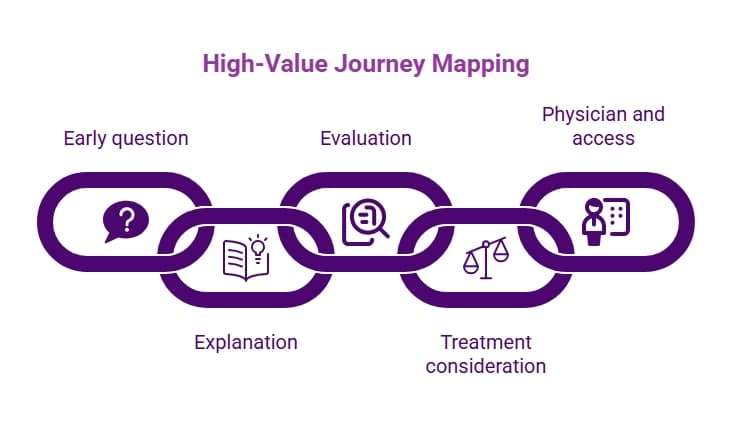
A sitewide rebuild is rarely the right first move, and physicians will not review dozens of new pages at once. Choose one procedure or service line that matters to the practice and map its path:
early question → explanation → evaluation → treatment consideration → physician and access next step
Run the five-question audit on every page in that path. Fix the handoff causing the most friction first. The page-level audit rules and review ownership you settle on for this journey become the template for the next one. Progress shows up when every stage has a page that owns it and a next step clinicians would stand behind.
Questions about local SEO or provider-selection search are adjacent but outside this framework. Those deserve separate attention once the journey architecture is sound.
Measure Success By Pathway Clarity, Not Invented Benchmarks
A repaired path does not require a universal traffic, ranking, appointment, or conversion target to prove its value. Success means being able to answer five operational questions clearly: Does each important reader question have an owner? Does the next step make sense for someone who knows only what the previous page told them? Are clinical relationships verified? Are access details current? Can the reader reach evaluation or treatment consideration without the content implying diagnosis or candidacy?
Those are the signals that the architecture itself is becoming more coherent. Performance measurement can follow separately without pretending this framework guarantees a particular search or business outcome.
Connect The Questions That Come Before The Procedure
Procedure content becomes more useful when it connects to the questions that legitimately precede procedure consideration. That connection must clarify evaluation rather than manufacture candidacy. Before adding more content, audit one journey. Identify the missing question, ambiguous handoff, unsupported relationship, content dead end, or unclear next action that creates the most friction.
If your practice wants an outside review of where condition, physician, and evaluation paths are breaking down, explore BVM's medical specialty SEO approach or get a Specialty Search Audit.
Frequently Asked Questions
Disclaimer: This article is intended for general educational and healthcare-marketing purposes and is not medical advice. It should not be used to diagnose a condition, determine treatment or procedure suitability, or replace guidance from a qualified healthcare professional. Clinical content should be reviewed by an appropriately qualified healthcare professional before publication.
Our Editorial Process: Our expert team uses AI tools to help organize and structure our initial drafts. Every piece is then extensively rewritten, fact-checked, and enriched with first-hand insights and experiences by expert humans on our Insights Team to ensure accuracy and clarity.
By: About the BVM Insights Team
The BVM Insights Team is our dedicated engine for synthesizing complex topics into clear, helpful guides. While our content is thoroughly reviewed for clarity and accuracy, it is for informational purposes and should not replace professional advice.